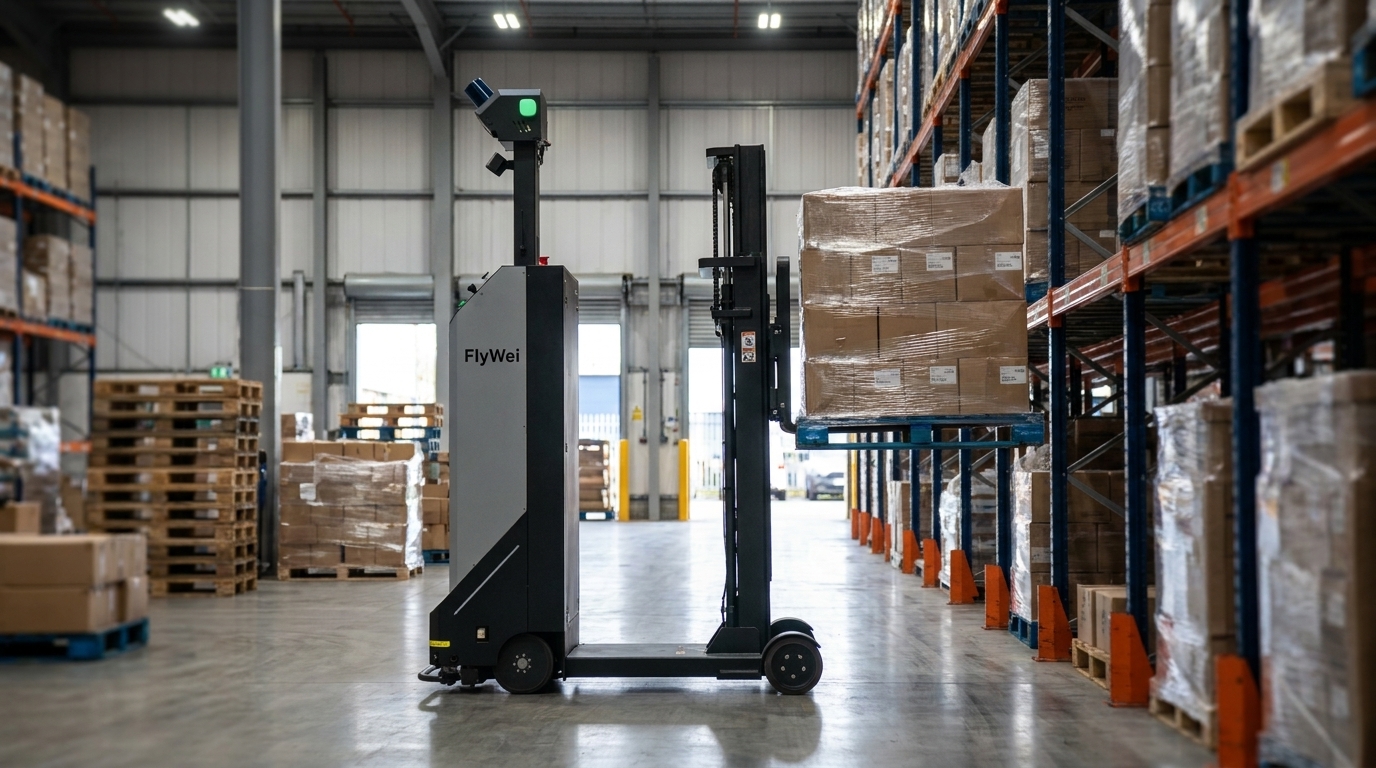
AGV controllers are the safety-rated compute and motion units that turn a conventional industrial truck into a guided vehicle under fleet control. That is why a brownfield site can automate internal transport without replacing racking, trucks or the warehouse system it already runs on. The Health and Safety Executive records roughly 5,000 workplace transport accidents in Great Britain each year, around 50 of them fatal: a figure that has barely shifted across a decade of forklift training spend. For a plant director running co-packing and value-added services inside a third-party logistics site, that number arrives beside a harder commercial one. Contracts are short-cycle, the building is leased, and the truck fleet was specified by somebody else. Capital that tears out racking or scraps a serviceable fleet cannot be defended against a tenancy you may not renew. The question on the Q3 risk register is not whether to automate internal transport, but whether anything can be automated without touching the assets you do not own.
Why co-packing halls stay manual longer than they should
Value-added services are where 3PL margin is won, and where the flow is least stable. A co-packing hall reconfigures with every promotion: benches move, display pallets change footprint, and the route between the pick face and the wrap station is redrawn several times a year. Fixed automation punishes that. Conveyor and shuttle schemes assume a layout that will still exist when the payback lands: precisely the assumption a contract logistics operator cannot make.
The second constraint is asset ownership. In most contract sites the trucks arrive on a lease negotiated centrally, the racking belongs to the landlord or the client, and the warehouse system is the client's. A plant director proposing to replace any of those is proposing to renegotiate three commercial relationships to solve one operational problem. The business case dies in the room.
Third, the labour position has hardened. Counterbalance and reach licences take time to earn and longer to retain where every distribution park within reach of Daventry, DIRFT, Magna Park and SEGRO East Midlands Gateway competes for the same drivers. So internal transport, goods-in to the co-pack benches to the despatch lanes, absorbs licensed operators on work requiring no judgement at all. Those moves repeat identically, all shift, at walking pace.
Finally there is the evidence burden. Every automated movement must be defensible under the Provision and Use of Work Equipment Regulations 1998 at contract handover. Operators who have never assembled that pack assume it is a barrier; it is a workstream, and a predictable one.
Lever 1: Automate the two moves that repeat, not the truck fleet
Start operationally, not technically. Walk the hall for one shift and list every transport move by frequency, distance and whether a human decision is involved. Two flows dominate almost every co-packing operation: replenishment of raw stock from the reserve aisles to the bench, and removal of finished, wrapped pallets from the bench to the despatch lane. Both are fixed origin to fixed destination, both run all shift, and neither requires the operator to judge anything.
Those two flows are the automation scope. Everything else (awkward recoveries, damaged pallets, trailer loading) stays manual, and should. Scoping tightly matters because it sets vehicle count, and vehicle count decides whether the case clears the hurdle rate. It also keeps the change small enough for the bench teams to absorb in a shift briefing. Measure the baseline first: moves per hour, queue time at the bench, and licensed-operator hours consumed by transport.
Lever 2: Put one fleet layer above whatever hardware you end up with
The technical lever is orchestration. A retrofitted pallet truck, a purpose-built stacker bought two years ago and a tugger added next year will not share a manufacturer, and need not. What they must share is one layer holding the map, arbitrating traffic at aisle intersections, allocating work and managing charging: the job of a fleet manager such as FlyWei M4, sitting above the vehicles and below the client's warehouse system.
The interface between that layer and the vehicles is where open standards earn their keep. VDA 5050 defines how a fleet manager issues orders and receives vehicle state over a documented message format, letting one control layer command vehicles of different origin without a bespoke integration for each. Upstream, the fleet layer takes work from the client's existing warehouse system and writes completions back, so that system remains the record of stock. Nothing is replaced. Ask any supplier how long the fleet manager keeps running if that link drops mid-shift.
Lever 3: Build the PUWER and ISO 3691-4 pack while you commission, not after
This is the lever operators most often leave until the client audit. Automated industrial trucks in Great Britain sit under PUWER for suitability, inspection and safe use, and under ISO 3691-4 for the design and safety requirements specific to driverless industrial trucks. The HSE's guidance on work equipment is explicit that the duty follows use, not purchase, so the 3PL operating the vehicle carries it, whoever owns the asset.
In practice the pack is short and specific: a risk assessment for each automated route, the pedestrian segregation and floor marking supporting it, the protective-field configuration per vehicle and speed, the emergency-stop and recovery procedure, competence records for whoever releases vehicles back into service, and the inspection regime. Build it during commissioning, while the engineers who set the protective fields are still on site to sign what they configured. Assembled afterwards from memory, it reads like reconstruction to an auditor.
Lever 4: Match the funding term to the contract term, not the asset life
An autonomous truck outlives a typical contract logistics tenure, and that mismatch is what kills capex approval. The commercial lever is to stop funding it like a building fixture. Leasing over three, five or seven years lets the cost sit in operating expenditure against the contract it serves, and lets the fleet leave with you when the site does: worth modelling against outright purchase on the FlyWei leasing terms before any capital request is drafted.
Redeployability is the argument that wins boards over. A retrofitted truck carrying its own guidance is a mobile asset: it is remapped for the next building in days, because the map, the routes and the traffic rules live in software rather than in the floor. Present both options side by side and let the committee see what each is worth at contract end.
| Decision factor | Retrofit with AGV controllers | Buy purpose-built autonomous trucks | Stay manual |
|---|---|---|---|
| Uses the fleet you already operate | Yes: guidance is added to existing trucks | No: new vehicles alongside the current fleet | Yes |
| Capital exposure at approval | Lowest of the three | Highest: full vehicle cost per unit | None upfront; recurring labour cost |
| Redeployable at contract end | Yes: vehicle and map move with you | Yes, if the next site suits the vehicle class | Not applicable |
| Disruption to the live operation | Truck out of service during conversion | Minimal: commissioned in parallel | None |
| Safety evidence route | PUWER plus ISO 3691-4 for the converted vehicle | PUWER plus supplier conformity documents | PUWER plus operator competence records |
| Licensed-operator hours released | Substantial on the automated flows only | Substantial on the automated flows only | None |
An AGV controller is the safety-rated compute and motion layer that turns a standard industrial truck into a guided vehicle, which is why a brownfield site can automate internal transport without replacing racking, trucks or the warehouse system it already runs on.
What FlyWei does in a 3PL co-packing operation
FlyWei is an independent UK systems integrator of autonomous forklifts and AMRs. Vendor-neutrality matters most in exactly this situation: FlyWei is not obliged to recommend any one manufacturer's vehicle, so the answer to a co-packing hall can honestly be a retrofit rather than a purchase.
FlyWei supplies and integrates the AGV controllers that convert conventional trucks into guided vehicles, including safety controllers for mobile robots rated for the duty, plus the navigation LiDAR, protective scanners and charging infrastructure the conversion needs. Where a purpose-built machine suits the flow better, FlyWei integrates autonomous forklifts instead, and lifting robots where the load is a cart rather than a pallet.
Above the hardware, FlyWei deploys M4 to hold the map, traffic rules and work allocation, and fleet dispatch software to dispatch tasks against the client's existing warehouse system so it remains the source of truth for stock. FlyWei's engineers are UK-based, which makes the commissioning-time evidence pack practical rather than aspirational, and the same team handles ongoing servicing once the fleet is live. Sector configurations sit across FlyWei's solutions range, with the technology explained in the guide to what an autonomous forklift is.
Frequently asked questions
What is an AGV controller?
An AGV controller is the safety-rated computing and motion-control unit that lets an industrial truck navigate and operate without a driver. It takes over steering, traction, lifting and obstacle detection, runs localisation, and communicates with the fleet manager issuing the work.
Can existing forklifts be converted, or must we buy new ones?
Many can. It depends on the truck's age, electrical architecture and whether its control system can be interfaced safely; a survey establishes which units are viable. Where a truck is near end of life, a purpose-built vehicle is cheaper over the contract term.
Do we have to replace our warehouse management system?
Normally not. An orchestration layer sits above the existing system and takes work from it, so that system stays the source of truth for stock. Replacement is only worth considering where it cannot expose work through an interface or scheduled export.
What safety regulations apply to automated trucks in a UK warehouse?
PUWER 1998 governs suitability, inspection and safe use, and the duty follows whoever uses the equipment, not whoever owns it. ISO 3691-4 sets design and safety requirements for driverless industrial trucks. Alongside both sit pedestrian segregation, floor marking and emergency-stop procedures.
Can vehicles from different manufacturers run in one building?
Yes, where they support a common interface. VDA 5050 lets one fleet manager issue orders to vehicles of different origin using a single message format. Mixed fleets still need traffic rules set centrally, but not an integration per manufacturer.
Does automation still make sense on a short contract?
It can, provided the assets are redeployable and funded over a term matching the contract rather than the asset life. A retrofitted truck carrying its own guidance is remapped for a different building; fixed automation is not.
Who is responsible for safety if the truck is leased?
Under PUWER the duty sits with the employer using the work equipment, so the 3PL operating the vehicle carries it whoever owns the asset. The lease should specify inspection responsibilities, and the operator should hold its own competence records.
If licensed-operator hours disappearing into repetitive internal transport is on your Q3 risk register, test a retrofit against one flow rather than the whole hall.
Get a 48-hour feasibility read on your highest-volume flow: send us the two moves that repeat most in your hall and we will say whether conversion, a purpose-built vehicle or staying manual is the right answer. Hardware options are set out on the FlyWei AGV controllers page.
UK-based engineers. No obligation, no site visit required for the initial read, and a reply within one business day.