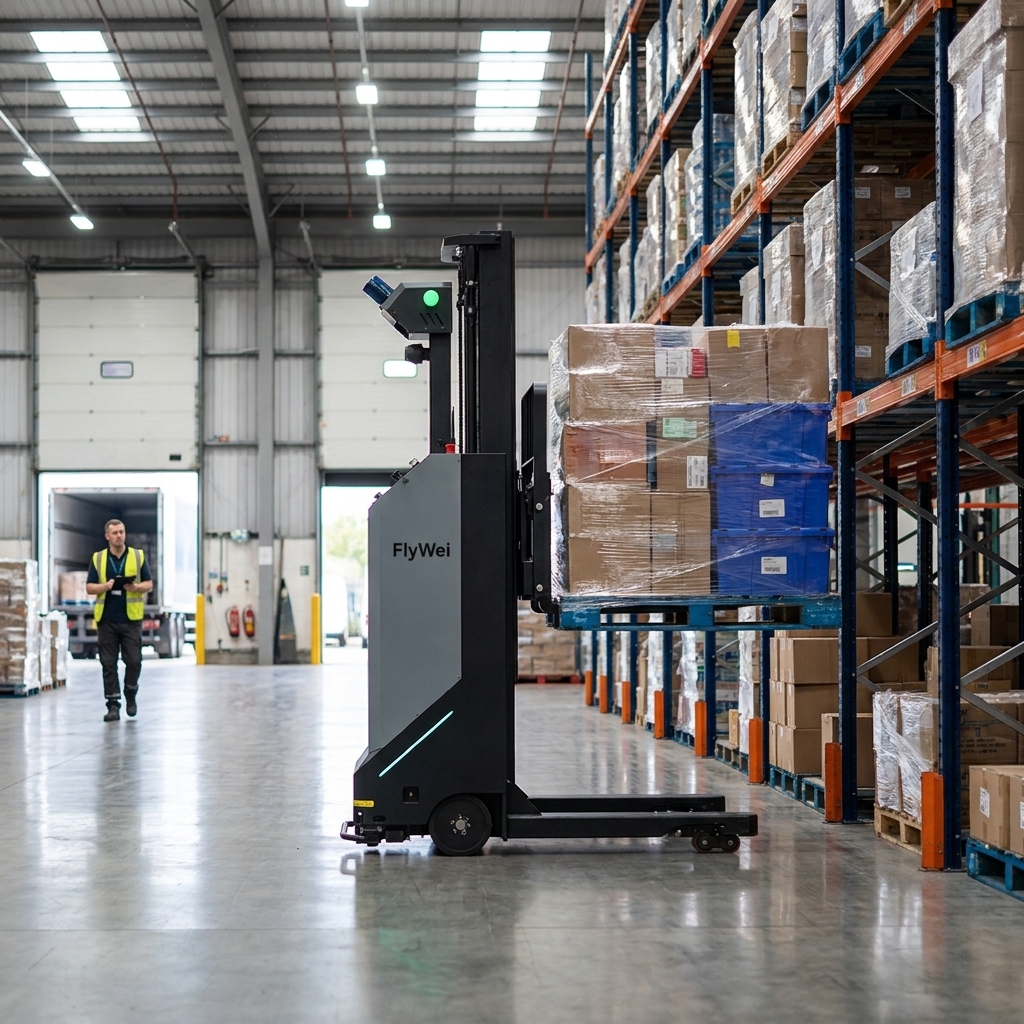
AGV controllers are the safety-rated on-board computers that drive an autonomous forklift's motion, navigation, obstacle response and emergency stopping: the SIL-2 or Performance Level d electronics that turn a chassis into a compliant industrial vehicle. The referenced design standard for driverless trucks in Great Britain is ISO 3691-4:2023, published by the International Organization for Standardization, and the enforcement instrument is PUWER 1998. For a UK engineering procurement head evaluating an autonomous forklift or AMR fleet in 2026, the controller choice locks in the seven-to-ten-year lifecycle: spares availability, cyber patches, VDA 5050 v2.0.0 orchestration compatibility, and the ability to add units next year without a rip-and-replace across sites at Magna Park, DIRFT or Burton-on-Trent. Capex committees see one number on the RFP, the sticker price, but the controller-inside quietly decides fleet total cost of ownership over a seven-year lease contract.
Why the controller is the procurement decision
Every autonomous forklift, autonomous pallet stacker or latent-jacking AMR you shortlist looks alike from the outside. Two 2-tonne autonomous counterbalance trucks from different vendors can sit side by side with matching mast heights, matching lithium-iron packs and matching top LiDAR pucks. What separates them is the ruggedised box under the sealed electronics enclosure: the AGV controller. It runs the SLAM stack, arbitrates between the safety scanner and motion drives, receives orders from your fleet manager, and carries the certificate that lets an HSE workplace-transport inspector tick "compliant" on the PUWER audit.
UK procurement teams have historically treated the controller as an implementation detail bundled with the vehicle. That worked while fleets were single-vendor and stayed under twenty units. It stops working the moment your Capex plan runs to fifty vehicles, three sites, two vehicle formats, and a seven-year depreciation schedule. At that scale the controller is the strategic asset. It decides whether you can bring a second-source supplier in year three when your incumbent misses a delivery, whether a firmware release breaks the interlock to your existing WMS, and whether the fleet you buy this quarter can accept an ISO 3691-4 revision in 2028 without swapping every unit. Logistics UK members repeatedly flag brownfield retrofit costs as the sting in the tail of automation: most of that sting is a proprietary controller that only talks to one vendor's software.
The three levers that fix vendor lock-in on a 10-year fleet
Lever 1, Operational: separate the vehicle line item from the controller line item
The single highest-impact change a UK procurement team can make in 2026 is to write the RFP so the AGV controller family, its functional-safety certificate revision, and its spare-part availability window are three separate scored line items, not a bullet buried on page eleven of the vehicle datasheet. This lets shortlisted suppliers price a general-purpose differential-drive controller (fine for a sub-tonne AMR shuttling totes through a Magna Park mezz) against a functional-safety forklift controller (mandatory for a 2-tonne counterbalance running mixed pedestrian aisles at Burton-on-Trent). It also forces the supplier to declare whether the controller inside the vehicle is the same silicon they sell as a spare in year six. Where it isn't, walk away. Insist on the phrase "same silicon, same firmware branch, seven-year forward-support commitment" in section 4 of the RFP.
Lever 2, Technical: specify VDA 5050 v2.0.0 on the controller, not just on the fleet manager
VDA 5050 is the German-published open interface for driverless industrial vehicles that lets a single fleet manager (like FlyWei's M4) issue orders to vehicles from any compliant vendor. Almost every AMR datasheet now claims "VDA 5050 compatible". Read the small print: many implementations sit only in the vendor's cloud gateway, not on the AGV controller itself. When the cloud goes down or you switch orchestration platforms, the vehicles lose their orders. A controller that speaks VDA 5050 v2.0.0 natively, over MQTT on the vehicle's own edge, survives a full orchestration swap. Ask each shortlisted supplier for the specific VDA 5050 revision the controller supports, whether the compliance is self-declared or third-party assessed, and which order types (pick, drop, charge, pause) are wired to the on-board finite-state machine.
Lever 3, Regulatory: make functional-safety class an unmoveable acceptance criterion
BS ISO 3691-4:2023, published by BSI, is the standard the HSE will hold you to for a driverless industrial truck operating in a Great Britain warehouse. It requires the vehicle's safety-related control system to meet at least Performance Level d (PL-d) or Safety Integrity Level 2 (SIL-2) against IEC 61508. This is a controller property, not a vehicle property. For any forklift-class vehicle (counterbalance, reach, VNA, autonomous pallet stacker over 1 tonne), specify a functional-safety controller such as the SRC-2000-FS or SRC-3000FS-Forklift class as a hard, non-negotiable acceptance criterion. For lifting AMRs and latent-jacking AMRs under 300 kg, a general-purpose SRC-2000-IS-class controller with a certified nanoScan3 laser scanner is normally proportionate. The UK Approved Code of Practice L117 for workplace transport is your reference document.
| Controller tier | Typical vehicles | Safety class | Order source | Payback horizon |
|---|---|---|---|---|
| General-purpose AMR (SRC-2000-IS class) | 150 to 300 kg latent-jacking, tote-shuttling AMR | SIL-1 with external scanner | VDA 5050 native | 24 to 36 months |
| Functional-safety AMR (SRC-3000FS class) | 400 to 1000 kg jacking / rotary lifting AMR | SIL-2 / PL-d built in | VDA 5050 native | 30 to 42 months |
| Functional-safety forklift (SRC-2000-FS class) | 1.4 to 2.0 t stacker, reach truck | SIL-2 / PL-d, ISO 3691-4 assessed | VDA 5050 native + M4 | 36 to 48 months |
| Heavy forklift (SRC-3000FS-Forklift class) | 2.0 to 3.0 t counterbalance forklift | SIL-2 / PL-d, ISO 3691-4 assessed | VDA 5050 native + M4 | 42 to 54 months |
Under PUWER 1998 and BS ISO 3691-4, every autonomous industrial truck operating in a UK warehouse must be driven by a functional-safety controller assessed to at least SIL-2 or Performance Level d: the on-board computer, not the chassis, is what defines the vehicle's legal safety class.
What FlyWei does here
FlyWei supplies a full controller portfolio matched to every vehicle class we build, so a UK engineering procurement head can specify hardware and firmware branch on the same purchase order as the truck. The SRC-2000-IS is the general-purpose differential-drive controller inside our lifting AMRs; the SRC-2000-FS is the SIL-2 functional-safety autonomous-forklift controller inside our stacker and reach-truck platforms; and the SRC-3000FS-Forklift is the SIL-2 controller specified for our 2-tonne and 3-tonne counterbalance autonomous forklifts. Every unit ships with a native VDA 5050 v2.0.0 stack on the edge, a seven-year forward-support commitment on the silicon, and a documented ISO 3691-4 assessment file for HSE evidence. Under our 3, 5 and 7-year fleet leasing the controller-refresh risk moves off your balance sheet: firmware updates, VDA 5050 revision alignment, and end-of-life controller swaps are our obligation, not yours. The same controllers are orchestrated by the M4 fleet manager and dispatched by fleet dispatch software.
Frequently asked questions
What is an AGV controller?
An AGV controller is the ruggedised on-board industrial computer that drives an autonomous vehicle's motion, navigation and safety response. It runs the SLAM stack, arbitrates between LiDAR scanners and motor drives, receives orders over VDA 5050, and carries the functional-safety certificate that permits autonomous operation under PUWER 1998 and BS ISO 3691-4 in a UK warehouse.
What safety class does an AGV controller need for a UK warehouse?
For any autonomous forklift, autonomous pallet stacker or lifting AMR above roughly 1 tonne, BS ISO 3691-4 expects PL-d or SIL-2 to IEC 61508. Below that mass class, a general-purpose controller paired with a certified safety laser scanner is normally proportionate. Your PUWER risk assessment is the arbiter; the HSE prosecutes the operator.
Is VDA 5050 a hardware or software standard?
VDA 5050 v2.0.0 is a software MQTT-based order and telemetry interface. It can be implemented on the AGV controller itself (native, robust) or in a vendor cloud gateway (fragile). For a ten-year fleet, insist compliance sits on the on-board controller, not in the cloud.
Can I mix AGV controllers from different vendors on one site?
Yes, provided every vehicle exposes VDA 5050 v2.0.0 on its on-board controller and a single brand-agnostic fleet manager, such as FlyWei M4, dispatches all vehicles and manages traffic zones centrally.
How long does an AGV controller last before it needs replacing?
Functional-safety AGV controllers are designed for seven-to-ten-year field life matching the chassis. Specify a written forward-support commitment on the silicon of at least seven years from delivery to cover CPU end-of-life, cyber patches, and ISO 3691-4 revisions.
Do AGV controllers need cyber-security certification?
Best practice for UK operators in 2026 is to require IEC 62443-family compliance, a coordinated vulnerability disclosure process, and security patch coverage matching the seven-to-ten-year vehicle warranty.
What is the difference between a general-purpose AGV controller and a forklift-specific one?
A general-purpose AGV controller drives differential-steer mobile robots up to roughly 1.5 m/s at SIL-1 with an external safety loop. A forklift-specific SIL-2 controller such as the SRC-3000FS-Forklift adds fork-height and load-mass sensing, mast-tilt interlocks, and dual-channel drive interfaces required by BS ISO 3691-4 for autonomous lifting.
Which UK regulations govern AGV controllers?
PUWER 1998, LOLER 1998, the Health and Safety at Work Act 1974, and ACOP L117 for workplace transport; the referenced design standard is BS ISO 3691-4:2023.
If your seven-year Capex plan is being asked to defend a controller-inside line item to the board this quarter, avoid the vendor-lock-in trap by specifying the controller family, functional-safety certificate revision, and VDA 5050 revision on the same page as the vehicle.
Request a controller-spec review and lifecycle-cost estimate for your fleet: a FlyWei engineer will map your target vehicle mix to the correct SRC-2000-FS, SRC-3000FS-Forklift or SRC-2000-IS class, and cost the ten-year support envelope against your Capex plan. Prefer to defer the balance-sheet exposure? See our 3, 5 and 7-year fleet leasing terms, where controller-refresh risk sits with FlyWei.
UK-based engineers · no obligation · reply within one business day.