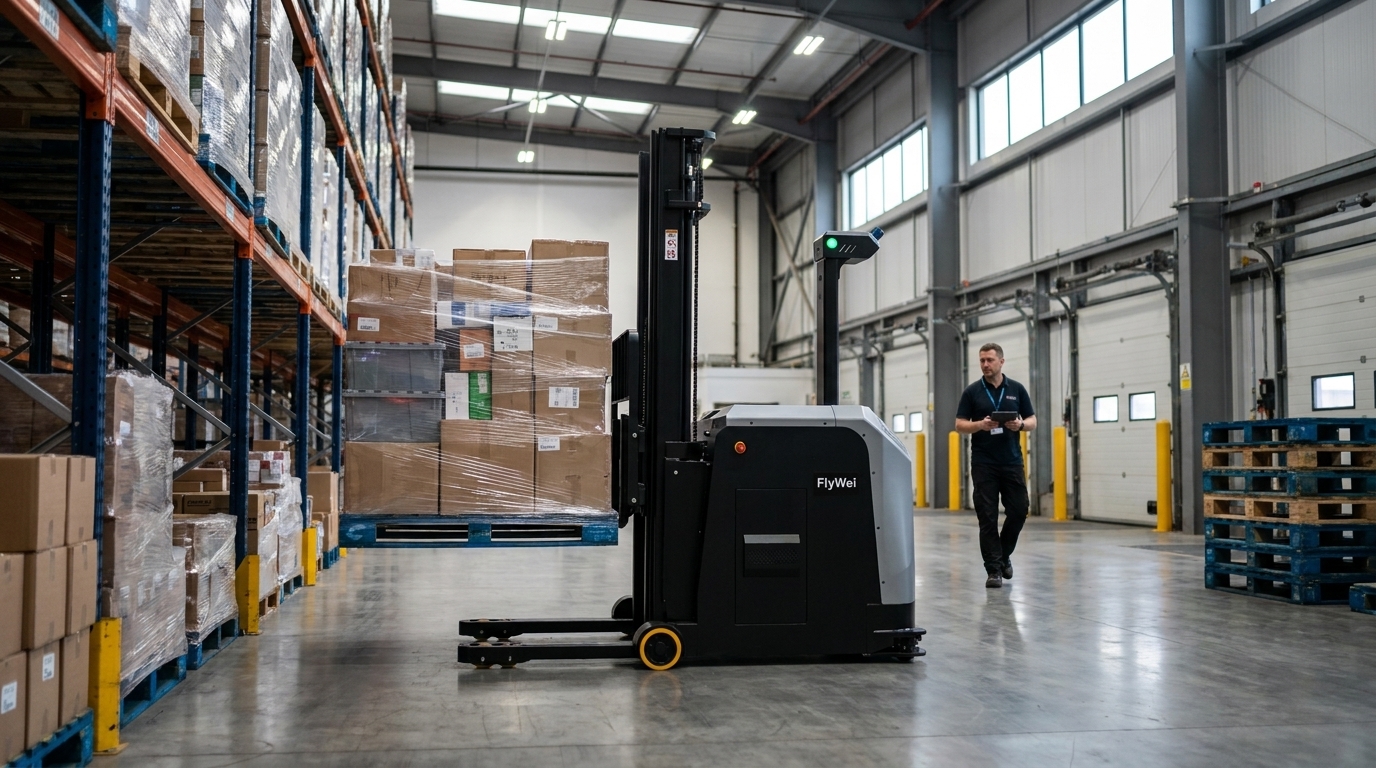
AGV forklift trucks are driverless counterbalanced, reach, stacker and pallet trucks that lift and move loaded pallets under software control, using onboard sensors and a map of the building instead of a seated operator. The duty they carry is not abstract: struck by moving vehicle accounted for 24 of the 126 work-related worker deaths recorded in Great Britain in 2025/26, according to provisional RIDDOR statistics published by the Health and Safety Executive. For a third-party logistics capex committee, though, the blocker is rarely the technology. It is that a fleet has a seven-to-ten-year working life while the contract it serves runs three or five years, with a break clause at year two. Finance sees an asset stranded by a client loss. Operations sees the only credible fix for shift-to-shift variance. Nobody in the room can produce a defensible cost per pallet move, so the paper goes back for rework and another quarter disappears.
Why the 3PL capex case stalls
Contract logistics runs on borrowed certainty. A mandate at Magna Park or DIRFT is won on a service level and a rate card, both priced against labour that scales up in week one of a peak and is released in January. Automation inverts that: it asks a committee to commit a fixed sum against a variable revenue line, in a sector where the asset outlives the agreement justifying it.
Three structural factors make this worse in the UK. The first is labour volatility. Agency availability around Daventry, Burton-on-Trent and the SEGRO East Midlands Gateway corridor swings sharply between quarters, so the operational case for autonomy is strongest exactly when the finance case is least predictable. Industry bodies including Logistics UK have tracked warehousing recruitment and retention pressure for years, and operators feel it as unplanned overtime.
The second is building tenure. Leasehold sheds carry landlord constraints and racking set by a previous occupier, so any proposal implying civils work — floor grinding, charger power runs, pedestrian barriers — collides with a dilapidations clause.
The third is evidence. Pallet handling is regulated work equipment under the Provision and Use of Work Equipment Regulations 1998, and HSE guidance on workplace transport expects vehicle and pedestrian separation to be designed in, not bolted on. A committee that cannot see the safety file cannot sign. So the case keeps failing at the same three questions: what if we lose the client, what about the building, and who carries the safety duty.
Struck by moving vehicle accounted for 24 of the 126 work-related worker deaths recorded in Great Britain in 2025/26, which makes separating vehicles from people a board-level duty rather than a site-level preference.
Lever one: scope the fleet to the flow, not the site
The move that unlocks the funding conversation is to stop specifying a site and start specifying a flow. Walk the three moves that recur in every contract you have run: dock to bulk, bulk to pick face, pick face to despatch lane. Count them per shift, measure the distance, and note how many are run by a seated operator carrying nothing on the return leg. That empty-return proportion is usually the largest recoverable loss in a 3PL building, whether the pallets hold chilled ready meals or packaging.
Specify the fleet against those counted moves: a narrow-aisle autonomous reach truck for high-bay putaway, a pallet-truck class machine for long dock runs, a stacker for mid-height replenishment. Because the flow repeats across mandates the fleet is portable — when a contract ends, the machines move to the next building and the business case travels with them. That reframing turns a stranded-asset argument into a redeployment argument, and it is the difference between asking "what if we lose the client" and "which site goes second".
Lever two: make orchestration vendor-neutral from day one
The technical decision that determines ten-year cost is not which robot you buy first. It is whether the layer above the robots will accept the second and third makes you buy later. A fleet manager that speaks VDA 5050 — the open interface for communication between mobile robot fleets and a central controller — lets one control room command mixed hardware without a bespoke integration for each supplier.
In practice that means three things in the specification. The orchestration layer takes work from the enterprise WMS or the operator's existing ERP over a documented interface, rather than becoming a second system of record. Traffic rules, charging strategy and task priority are set centrally, so a mixed fleet does not deadlock in a shared aisle. And completions are written back as stock movements, so inventory updates as pallets move. FlyWei builds this with the M4 fleet manager and dispatches work through RDS robot dispatch. Insist the interface specification is contractual: a closed fleet manager is how a three-year saving becomes a ten-year lock-in.
Lever three: put the compliance file in the tender pack
Procurement has more leverage here than it usually uses. Under PUWER the duty to provide suitable, properly maintained work equipment and competent operation sits with the employer, and the HSE's PUWER guidance applies to mobile work equipment explicitly. Autonomy does not transfer that duty to a supplier; it changes what evidence discharges it.
Ask for four documents before award, not after. First, a declaration of conformity referencing ISO 3691-4, the safety standard for driverless industrial trucks, with the safety-related control system performance level stated. Second, a traffic-management plan showing designed separation of robot routes and pedestrian walkways, with interaction points named. Third, a floor survey against a recognised flatness specification such as the Concrete Society's TR34 classification. Fourth, the maintenance and inspection regime, mapped to your thorough-examination calendar. Standards bodies including BSI publish the UK adoptions. Make all four a condition of payment.
Lever four: structure the funding against contract tenure
Once the flow is portable and the evidence exists, the funding question becomes tractable. For most contract logistics operators outright purchase is the wrong instrument: it prices a seven-to-ten-year asset into a three-to-five-year revenue commitment. A fixed-term lease bundling robots, software, maintenance and UK support into one monthly charge matches cost to the contract period, and converts the question from capital exposure to cost per move.
Build the model that way. Divide the all-in monthly charge by the moves completed that month, then compare it with the fully loaded cost of the shifts it displaces — agency premium, unplanned overtime and damage included. Run it again at 70 per cent of forecast volume, the scenario the board is really asking about. FlyWei autonomous forklift leasing runs over three, five and seven-year terms for this reason: term selection becomes a risk decision, not a financing afterthought.
| Structure | Capital exposure | Fit to a 3-5 year mandate | Where it fails |
|---|---|---|---|
| Outright purchase | Full, at order | Poor — asset life exceeds the term | Client loss strands the asset mid-life |
| 3-year lease | None; highest monthly rate | Strong — short mandate, fast refresh | Highest cost per move if volumes hold |
| 5-year lease | None; balanced monthly rate | Strong — renewed mandate, usual review cycle | Needs a redeployment clause |
| 7-year lease | None; lowest monthly rate | Moderate — multi-client shared-user building | Over-commits on a single-client contract |
| Software purchase alone | Partial | Weak on its own | A second system of record, no pallets moved |
What FlyWei does here
FlyWei is an independent, vendor-neutral UK systems integrator of autonomous forklifts and AMRs. That matters in contract logistics, because the right machine for a 10-metre narrow aisle at one mandate is the wrong machine for a dock-heavy shared-user site at the next, and FlyWei integrates equipment across multiple manufacturers rather than defending one catalogue.
The engagement runs in that order. FlyWei surveys the building and counts the actual moves per shift, including empty returns, so the fleet is sized against measured work rather than a template. It then specifies the mix from its range of AGV forklift trucks and autonomous pallet stackers — reach, counterbalanced, stacker and pallet-truck classes — alongside lifting robots where carts and totes move rather than pallets. M4 takes work from the existing WMS or ERP and dispatches it over VDA 5050, so a second make can join later without a new integration, and RDS handles live dispatch and exception escalation.
FlyWei then builds the compliance file — ISO 3691-4 conformity, traffic-management plan, floor survey, inspection regime — and prices the fleet as a monthly charge over three, five or seven years, so the committee reads it as cost per move. Deployment is staged: one flow proven against a measured baseline before the second. Sector configurations are set out across FlyWei's industry solutions, and shift-to-shift variance in our guide to automated forklift fleets and 3PL peak variance.
Frequently asked questions
What are AGV forklift trucks?
AGV forklift trucks are driverless industrial trucks — counterbalanced, reach, stacker or pallet-truck classes — that lift, transport and stack loaded pallets with no operator on board. They navigate using onboard sensors and a stored map of the building, taking work from a fleet manager connected to the warehouse system. UK capacities typically run 300 kg to 3,000 kg.
How do we justify AGV forklift trucks on a three-year contract?
Specify the fleet against a flow that recurs in every mandate rather than one building, and fund it over a term matching the contract. A three or five-year lease prices the asset into the period the revenue covers, and a redeployment clause moves the machines to the next site if a client is lost. The committee then assesses cost per move.
Do we have to replace our WMS to run AGV forklift trucks?
Usually not. An orchestration layer sits above the warehouse system and takes work from it, so that system stays the source of truth for stock and orders. Replacement is only worth considering where it cannot expose work through an interface or a scheduled export.
Who carries the safety duty when trucks are driverless?
The employer does. Under the Provision and Use of Work Equipment Regulations 1998 the duty to provide suitable, maintained work equipment and competent operation stays with the site operator. Autonomy changes the evidence that discharges the duty rather than transferring it, so conformity declarations, the traffic-management plan and the inspection regime should be contractual deliverables.
Can robots from different manufacturers share one building?
Yes, where they support a common interface. VDA 5050 lets one fleet manager issue orders to vehicles from different suppliers in the same message format. Mixed fleets still need central traffic rules and a capability check per vehicle, but a separate integration per manufacturer is no longer required.
Does our floor need work before deployment?
It needs surveying. Navigation accuracy and load stability at height both degrade on a floor that was adequate for a manned truck, so a flatness survey against a classification such as TR34 should precede any order. Remedial grinding is often needed only at specific aisle entries.
If stranded-asset risk on an automation case sits on your Q4 risk register, the way through it is a counted baseline, not another round of estimates.
Request a fleet-sizing and ROI estimate for your DC and we will size the fleet against your measured moves per shift, then price it as cost per move over three, five or seven years. If funding structure is the open question, start with FlyWei autonomous forklift leasing.
UK-based engineers, no obligation, reply within one business day.