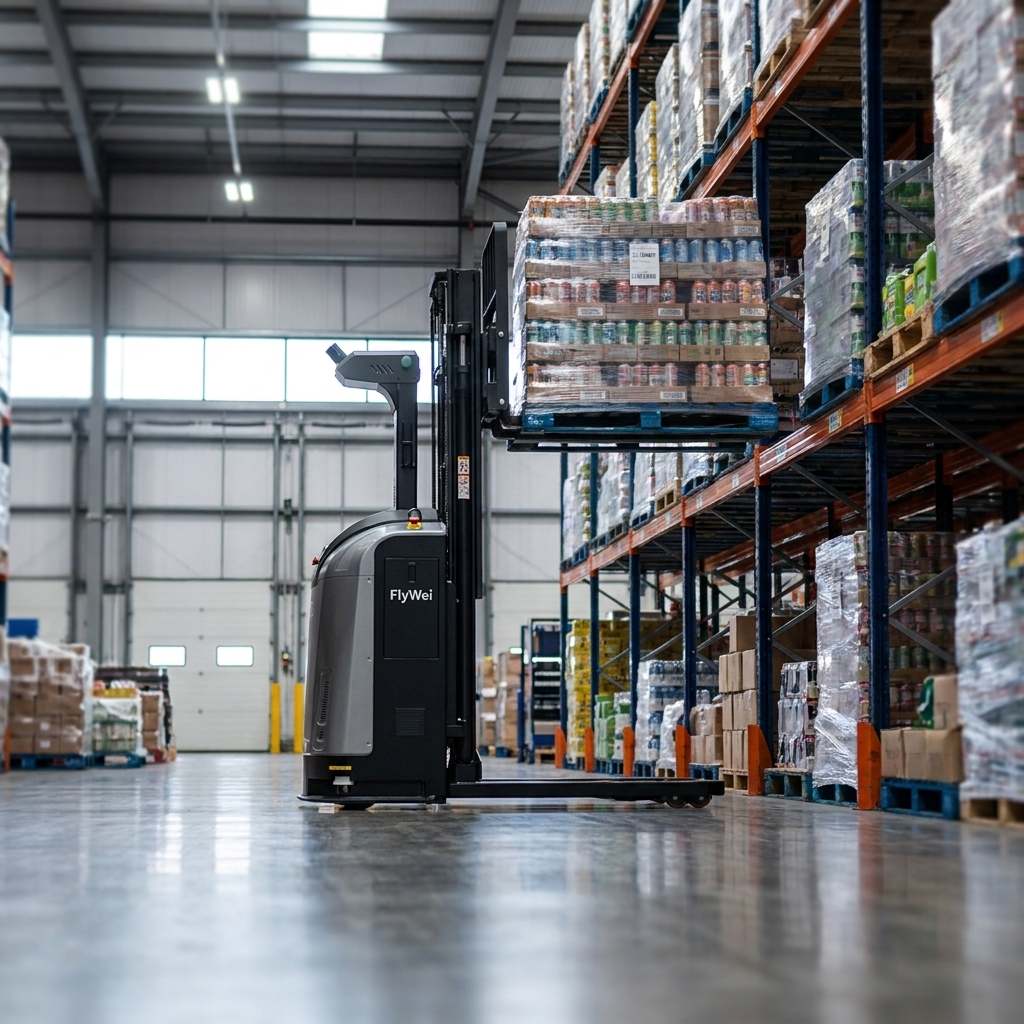
An automated forklift AGV is a driverless lift truck that navigates a warehouse under software control, lifting and moving palletised loads without an operator on board. The safety case is no longer theoretical: HSE's provisional RIDDOR figures record 24 of the 126 workers killed in work-related accidents in Great Britain in 2025/26 as struck by a moving vehicle (HSE work-related fatal injuries) — the second-largest single cause after falls from height. For a warehouse manager running more than 100,000 sq ft of drinks storage, that figure lands in the middle of the hardest quarter of the year. Q4 pallet volume climbs week on week, kegs and glass arrive on trailers that will not wait, and the agency forklift drivers who covered last year's peak are competing for shifts across every depot in the Midlands. You are being asked to move more beer, in less time, with a thinner and less-inducted driver pool.
Why peak cover breaks in a drinks warehouse
Drinks logistics punishes manual handling harder than most sectors. A pallet of canned lager or glass sits close to the top of the truck's rated capacity, leaving little margin for a mis-set fork or a hurried lift. Kegs travel in cages and on dollies that do not stack like standard pallets. And the Q4 curve is not gentle: volume climbs steeply from late October and does not relent until the new year.
The labour market is the binding constraint. Counterbalance and reach-truck licences take time to obtain, and the operators who hold them are in demand across every shed at Magna Park, DIRFT and SEGRO East Midlands Gateway at exactly the moment you need them. What arrives through an agency in week 44 is rarely the experienced operator you briefed for in week 30. They need a site induction, a familiarisation on your racking and your floor, and a supervisor's attention you do not have spare.
That is where damage and near-misses cluster. HSE's workplace transport guidance is blunt about the conditions that cause incidents: pedestrians and vehicles sharing space, time pressure, and unfamiliar operators. A drinks DC in December has all three. The cost shows up as broken glass, pallets rejected at the dock, racking strikes needing an engineer's sign-off, and at worst a RIDDOR report.
Throwing hours at the problem does not fix the structure. The moves consuming the most driver time are the dullest: the same trunk route, dozens of times a shift. Those should not depend on whether an agency turns up.
HSE's provisional RIDDOR figures record 24 of the 126 workers killed in work-related accidents in Great Britain in 2025/26 as struck by a moving vehicle.
Lever 1 — Automate the trunk moves, redeploy your licensed operators
The operational lever is a segmentation exercise, and it is yours to run before any supplier walks the floor. Spend a shift counting moves by route rather than by truck. In most drinks DCs above 100,000 sq ft, a small number of fixed routes — dock to bulk, line end to bulk, bulk to pick face, keg yard to despatch — account for a disproportionate share of truck hours. They are long, repetitive, uninterrupted and almost entirely free of judgement.
Those routes are what an automated forklift AGV fleet does well. A driverless forklift holds the same cycle time at 03:00 as at 11:00, needs no December induction, and does not accelerate because despatch is shouting. Put the automation on the trunk and your licensed operators move to work that genuinely needs a human: damaged pallet recovery, trailer loading to a weight plan, decanting mixed kegs, and the awkward exceptions that fill the rest of their day.
Measure the lever on moves per shift per route and touches per pallet, not on headcount.
Lever 2 — One orchestration layer above a mixed fleet
The technical lever is where most brownfield automation projects quietly fail. Different moves want different machines: a counterbalanced truck for 2-tonne bulk work at the dock, an autonomous pallet stacker for mid-height racking, a narrow-aisle reach truck for high-bay, a latent-jacking AMR for keg cages. Buy those as separate systems and you have bought separate traffic rules, charging strategies and screens for your shift team to watch.
The answer is a single fleet management layer owning traffic, task allocation and charging across every machine on site. FlyWei M4 takes work from the warehouse system the site already runs, converts each task into routes and vehicle assignments, and writes completions back so your existing system stays the record of stock. Because it speaks the VDA 5050 open standard, it can command vehicles from more than one manufacturer without a bespoke interface for each — which matters when you add capacity in two years and the best machine for the new flow is not the one you bought first. FlyWei RDS handles dispatch priority, so a late trailer can pre-empt a replenishment run without a supervisor rekeying anything.
Ask any supplier how long the fleet manager keeps running if the link to the warehouse system drops mid-shift. The answer tells you how it behaves on your worst night.
Lever 3 — Build the PUWER and ISO 3691-4 case a quarter early
The regulatory lever most often sets the go-live date. Driverless trucks are work equipment, so PUWER 1998 applies in full: suitable for purpose, safe by design, inspected, and operated by people with adequate information and training. The regulations themselves make no distinction for automation — a robot that strikes a pedestrian is a PUWER failure, not a software bug.
Three documents decide your timeline. First, the safety case for automated industrial trucks under BS EN ISO 3691-4, published in the UK by BSI, covering scanner coverage, protective stops, speed zones and pedestrian segregation. Second, a floor survey against TR34 — high-bay drinks racking is unforgiving of slab tolerance, and autonomous trucks lifting to 8 metres are more sensitive to it than a human who compensates without noticing. Third, revised safe systems of work for mixed manual and autonomous traffic, where HSE's ACOP L117 on rider-operated lift trucks still governs the manual half of your fleet.
None of this is difficult, but all of it takes longer than procurement expects. Agreeing pedestrian routes with your safety representatives is usually the long pole.
Lever 4 — Fund peak capacity as an operating line, not a capex bid
The commercial lever changes who approves the project. Agency cover is already an operating cost, absorbed into your peak budget without a capex paper. A fleet bought outright is not — it competes with every capital request and arrives, at best, after next peak. FlyWei leasing over 3, 5 and 7-year terms lets you set the comparison against the thing you are actually replacing: a monthly figure against the agency and overtime spend it displaces. That reframing matters where a warehouse manager has to persuade a finance committee, because it turns an unfamiliar capital argument into a familiar cost-per-move one. Logistics UK resources help sense-check sector labour costs first.
| Option | Lead time to productive | Night and weekend cover | After peak | Cost behaviour |
|---|---|---|---|---|
| Additional agency drivers | 2–6 weeks, plus induction | Scarce, priced at a premium | Capacity leaves in January | Operating cost, rises with demand |
| Overtime on existing crew | Immediate | Limited by fatigue management | Retention risk into Q1 | Operating cost, steepest per hour |
| Short-term truck hire plus drivers | 3–8 weeks | Depends on driver supply | Trucks and capacity both leave | Operating cost, two suppliers |
| Automated forklift AGV fleet, leased | One quarter, including safety case | Same cycle time every shift | Capacity stays, absorbs next peak | Fixed monthly, independent of demand |
What FlyWei does in a drinks DC
FlyWei is an independent, vendor-neutral UK systems integrator of autonomous forklifts and AMRs. We are not an OEM or a reseller, so the specification for your site is settled by your flows rather than one manufacturer's catalogue — and in drinks, where bulk pallet work, high-bay replenishment and keg handling pull in three directions, that independence is the point.
A typical engagement starts with a flow study on your floor: moves counted by route, slab checked against TR34, pedestrian interfaces mapped. From that we specify the fleet — FlyWei counterbalanced autonomous forklifts for 2-tonne dock and line-end work, FlyWei autonomous reach trucks for high-bay replenishment, latent-jacking AMRs for keg cages — and size it against your actual Q4 curve rather than an average week.
FlyWei M4 then runs the fleet as one system, taking work from the warehouse system you already use and writing completions back to it. FlyWei RDS sets dispatch priority so despatch deadlines beat replenishment when a trailer is late. We build the BS EN ISO 3691-4 safety case with your safety representatives, commission on live volume rather than in a cleared aisle, and our UK-based engineers support the fleet afterwards. Our sector solutions, the autonomous forklift versus AGV guide and our earlier piece on automated forklift AGV deployment for drinks operations directors cover related ground.
Automated forklift AGV: common questions from drinks warehouse managers
What is an automated forklift AGV?
An automated forklift AGV is a driverless lift truck that moves palletised loads under software control, using on-board sensing to navigate and stop for obstacles. Automated forklift, driverless forklift and AGV forklift all describe this class.
Can automated forklift AGVs work in a live drinks DC?
Yes — live, mixed-traffic operation is the normal brownfield case. It requires a safety case under BS EN ISO 3691-4 covering scanner coverage, speed zones and pedestrian segregation, plus revised safe systems of work.
How long does a deployment take before peak?
Plan a quarter. Commissioning the vehicles is rarely the constraint; the floor survey, the safety case and agreeing pedestrian routes take the time. A fleet covering Q4 should be specified by the end of Q2.
Will we have to replace our warehouse management system?
Usually not. The fleet management layer sits above your existing system and takes work from it, so that system stays the record of stock. Without a documented interface, a scheduled export and import is enough to begin.
Can they handle kegs and cages as well as pallets?
Not with the same machine. Keg cages and dollies suit a latent-jacking AMR that lifts from underneath; bulk pallet work suits a counterbalanced autonomous forklift. Hence a mixed fleet under one orchestration layer.
What happens to our existing forklift drivers?
They move to work automation does not do well: damaged pallet recovery, loading to a weight plan, decanting mixed loads and exception handling. Peak stops needing a different operating model.
How does this compare on cost with agency cover?
Compare it as a monthly figure against the agency and overtime spend it displaces, not as a capital item. Leasing over 3, 5 or 7-year terms puts both on the same operating line.
If peak cover in a drinks DC is on your Q4 risk register, the fastest way to find out whether automation helps is to have someone count the moves on your floor.
Book a free 30-minute site survey and we will walk your trunk routes, check your slab and tell you which moves are worth automating before next peak — or see the full range of FlyWei automated forklift AGV options.
UK-based engineers. No obligation. We reply within one business day.