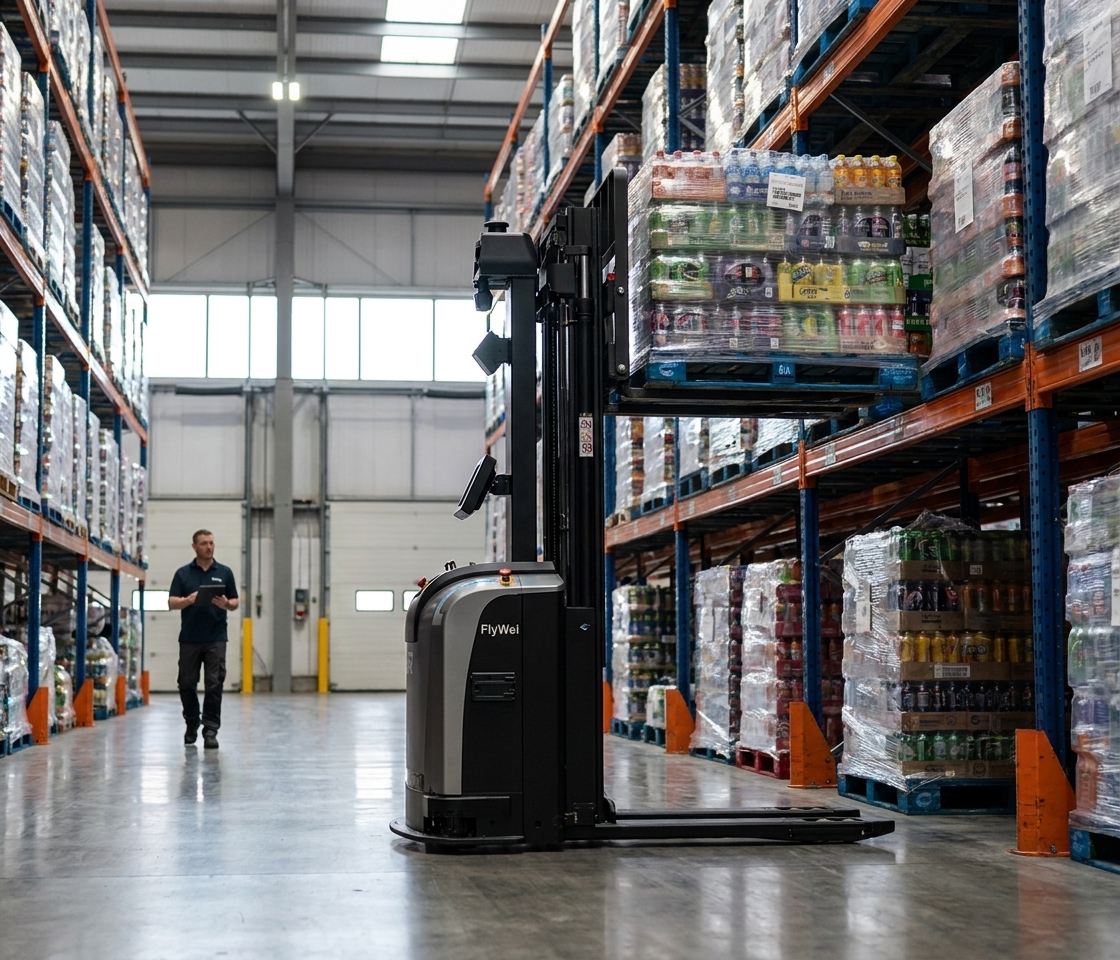
An automated forklift AGV is a driverless materials-handling truck that lifts, stacks and moves palletised loads under software control, with no operator on board and no fixed rails or floor wires. The safety case is now the commercial case: struck-by-moving-vehicle accidents caused 24 of the 126 worker deaths recorded across Great Britain in 2025/26, according to provisional RIDDOR figures published by the HSE, making vehicle movement one of the largest single fatal risks on any palletised site. For an Operations Director running a UK drinks depot, that number lands in one specific place: the congested strip between line-end, the chilled buffer and the outbound trunking bays. Kegs and shrink-wrapped cases arrive faster than the yard clears them, agency cover turns over between shifts, and every extra counterbalance truck you add to break the backlog puts another moving vehicle onto a floor that already has pedestrians on it.
Why line-end congestion happens in drinks logistics
Drinks sites carry a load profile that punishes manual handling harder than most. Volume is seasonal and spiky, the unit of movement switches between shrink-wrapped case pallets and keg cages within the same shift, and a large share of finished goods must clear a chilled or ambient buffer before it can be trunked. The bottleneck is structural, not behavioural.
Three UK-specific factors make it worse. First, floor condition: condensation around chilled buffers and residue from line washdown produce exactly the low-friction surfaces that HSE workplace transport guidance treats as a core control point for vehicle operations. Second, labour continuity: counterbalance and reach-truck work on a bottling or canning site is licence-controlled, so cover gaps cannot be filled by moving a picker across from another department. Third, site geometry — many UK drinks depots around Burton-on-Trent and the Midlands corridor have grown by extension rather than design, leaving narrow shared routes between production and despatch that were never laid out for today's volumes.
Underneath all three sits a measurement gap. Most sites know their despatch numbers precisely and their internal movement numbers barely at all. Nobody can say how many pallet moves happened yesterday, how far each travelled, or how much of the fleet's running hours went on repeat legs. Without that baseline, congestion gets treated as a staffing question every peak, and the same money is spent again the following year. Logistics UK reports sector-wide pressure on both capacity and cost in its annual industry reporting — the combination that makes an unmeasured internal flow expensive.
Lever one: separate the repeatable flow from the judgement flow
Split your internal moves into two categories. Repeatable legs run between fixed points on a predictable trigger — pallet complete at line-end, move to buffer lane; buffer lane full, move to outbound. Judgement legs need a human: damaged wrap, a mixed pallet rebuild, a trailer loaded to a customer's stacking rule, a keg cage that needs eyes on it.
On most drinks sites the repeatable category is the larger share of running hours and almost none of the difficulty. That is the work to automate first, because it is specifiable: same origin, same destination, same load geometry, same tolerance. Map it for two weeks before you specify anything. Count moves per hour by leg, note where peak-hour demand concentrates, record where trucks queue and for how long, and mark every point where a vehicle route crosses a walkway. That map is simultaneously your fleet-sizing input, your business case and your risk assessment baseline, and it is the single most useful document an Operations Director can produce before talking to any supplier.
Lever two: orchestrate the fleet rather than the individual trucks
A single driverless forklift running a fixed loop solves very little — it relocates the queue. The gain comes from a fleet-level layer deciding which vehicle takes which task, in what order, and how vehicles negotiate shared routes, chargers and blocked aisles. That is the job of a fleet manager such as the M4 fleet management platform, sitting above the vehicles and below your business systems.
Insist on an open interface on the robot side. VDA 5050 is the published standard for a central fleet control to command mobile robots, and it is what lets one orchestration layer run vehicles from more than one manufacturer without a bespoke integration for each. For a drinks operator that matters commercially, not just technically: it is what stops a pallet-truck decision in 2026 from dictating your reach-truck decision in 2029. Ask any supplier whether the fleet layer speaks that standard natively or through an adapter, how traffic between mixed vehicle types is arbitrated, and what happens when one vehicle faults mid-aisle.
Lever three: integration discipline — keep your existing systems as the record
The most common failure mode in warehouse automation is not a robot that cannot lift. It is a project that never gets trustworthy work out of the systems the site already runs. An automated forklift AGV does not connect to an ERP directly; the fleet layer takes work from your warehouse or business system over a documented interface and translates it into missions, then writes completions and load confirmations back so your existing system stays the source of truth for stock.
That framing is the whole of the risk reduction. You are not replacing your warehouse system, and you should be sceptical of anyone who says you must. Scope the interface explicitly: which fields carry the move request, what happens to work in progress if the link drops, how exceptions reach a human rather than posting silently, and whether a test environment exists. Where a system exposes no live interface, a scheduled export of open work and an import of confirmations is a legitimate starting point. FlyWei's RDS robot dispatch layer exists for exactly this seam, and getting it right separates a fleet that runs from a fleet that is babysat.
Lever four: build the compliance route before the pilot, not after
Driverless trucks are work equipment, so PUWER applies in full — suitability for the actual working conditions, inspection and maintenance regimes, and competence for the people who now supervise rather than drive. The duties sit in the Provision and Use of Work Equipment Regulations 1998 themselves, and lifting operations bring LOLER obligations alongside them. The product safety standard for driverless industrial trucks is ISO 3691-4, with BSI publishing the British adoption; your specification should name it and your supplier should evidence conformity rather than assert it.
Two site-level items get missed routinely. Floor flatness and joint condition govern how a laden autonomous truck behaves at height, and TR34 is the reference your engineering team will already know. And the pedestrian interface needs designing, not signposting: marked exclusion zones, defined handover points where a person takes a load from a robot, and a documented procedure for manual intervention in an automated aisle. Write all of it into the pilot scope so the compliance file is built as you go rather than reconstructed under audit.
| Lever | What it changes | Internal owner | Regulatory anchor | First KPI to move |
|---|---|---|---|---|
| Flow separation | Repeatable legs removed from manual fleet hours | Operations | HSE workplace transport route design | Manual truck hours on repeat legs |
| Fleet orchestration | Tasks, traffic and charging decided centrally, not per truck | Operations with engineering | VDA 5050 interface conformity | Pallet moves per hour at peak |
| Integration discipline | Existing system stays the stock record; moves post on completion | IT with operations | Interface scope and audit logging | Stock accuracy between counts |
| Compliance route | Pilot produces the inspection and competence file | SHEQ with engineering | PUWER, LOLER, ISO 3691-4, TR34 | Vehicle–pedestrian near misses |
Struck-by-moving-vehicle accidents caused 24 of the 126 worker deaths recorded across Great Britain in 2025/26, making vehicle movement one of the largest single fatal risks on a palletised drinks site.
What FlyWei does here
FlyWei is an independent UK systems integrator of autonomous forklifts and AMRs. FlyWei is vendor-neutral by design: it specifies and integrates the best machine for each leg of your flow across multiple manufacturers, rather than fitting one product range to every problem. On a drinks site that usually means a mixed specification, because line-end, buffer and outbound do not want the same truck.
In practice FlyWei surveys the site, maps the repeatable legs with you, and specifies from the range on its automated forklift AGV and driverless forklift page — pallet-truck class for dock-to-stock moves, counterbalanced class for 2-tonne case and keg-cage work, stacker and narrow-aisle reach-truck classes where buffer racking runs high. Where trolleys and cages dominate rather than pallets, FlyWei lifting robots and AMRs handle the cart work. M4 orchestrates the fleet, RDS carries the dispatch seam into your existing ERP and WMS, and FlyWei's UK engineers own commissioning and maintenance. Deployment typically runs eight to fourteen weeks from survey to go-live, and the fleet can be bought or taken on three, five or seven-year full-service lease terms covering robots, M4 and maintenance in one monthly figure — which keeps a programme out of a contested capex round. Sector context sits on the solutions pages.
Frequently asked questions
What is an automated forklift AGV?
An automated forklift AGV is a driverless forklift truck that transports, lifts and stacks loads on its own, using onboard sensors, a building map and fleet software in place of an operator. Modern units navigate by SLAM, needing no rails or floor magnets.
Do driverless forklifts cope with wet floors and shrink-wrapped pallets?
Yes, with the right specification. Traction and braking must suit the floor condition, load detection must handle film reflectivity, and routes must avoid the worst washdown areas — a survey question, not a product question.
Which UK regulations apply to an automated forklift AGV?
PUWER applies because it is work equipment, covering suitability, inspection, maintenance and competence. LOLER covers the lifting duty. ISO 3691-4 is the product safety standard for driverless industrial trucks, and TR34 governs floor flatness for laden high-level handling.
Do we need to replace our WMS to run an automated forklift AGV fleet?
Usually not. An orchestration layer sits above your warehouse system and takes work from it, so it remains the source of truth for stock. Replacement is only worth considering where it cannot expose work through an interface or an export.
How long does deployment take?
Eight to fourteen weeks from survey to go-live is typical for a first phase. Commissioning vehicles is rarely the long pole — mapping order and stock fields, agreeing exception handling and testing against live data usually are the constraint.
Can one fleet handle kegs as well as palletised cases?
A mixed fleet can, and on most drinks sites it should. Keg cages and case pallets differ in geometry and stability, so they suit different vehicle classes under one orchestrator.
Is leasing or buying better for a first phase?
A full-service lease turns robots, fleet manager and maintenance into one monthly operating cost over three, five or seven years, suiting a first phase where fleet size may flex. Purchase suits stable, long-life sites with capital available.
If line-end congestion and vehicle–pedestrian risk are still on your Q3 risk register as the quarter closes, the fastest way to size the problem is to walk the repeatable legs with someone who has done it before.
Book a free 30-minute site survey with FlyWei's UK engineering team, or see the vehicle classes on the automated forklift AGV range.
UK-based engineers, no obligation, reply within one business day.