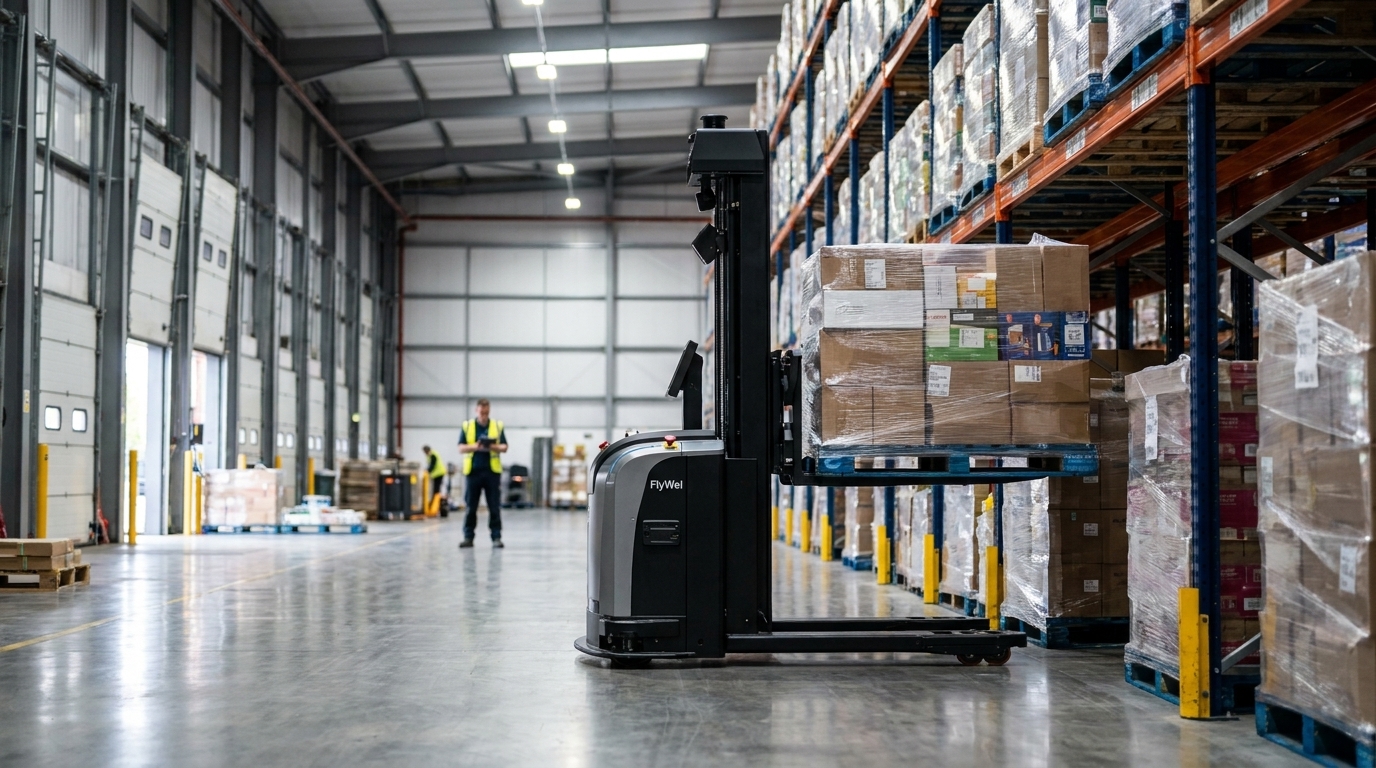
An automated forklift AGV is a driverless industrial truck that lifts, carries and stacks palletised loads under software control, navigating a live warehouse alongside people and manual trucks. Its safety baseline in Britain is Part 4 of the ISO 3691 series — ISO 3691-4, covering driverless industrial trucks and their systems — read alongside the duties every employer already holds under PUWER 1998. For an operations director running a UK retail distribution centre, the standards are not the hard part. The third shift is. Grocery and multi-channel DCs around Magna Park, DIRFT and SEGRO East Midlands Gateway are building Q3 volume ahead of a peak that will not move, and the pallet moves between goods-in, reserve and pick-face replenishment are still absorbed by agency drivers booked a week at a time. That absorption never appears as a line in the WMS, and it is the single most expensive thing in the building.
Why the replenishment shift is the one that breaks
Retail distribution is spiky in a way few other sectors are. A grocery or multi-channel DC absorbs promotional uplift, weather-driven demand and an online channel that peaks on different days from the stores sharing its roof. Almost none of that variability lands on picking, which is measured and resourced daily. It lands on replenishment — the moves that keep the pick-face fed and the reserve tidy — because replenishment is the only genuinely elastic part of the operation.
That elasticity is bought with people. UK retail DCs cover the gap with agency counterbalance and reach-truck operators booked shift by shift, and every booking carries induction, familiarisation and the training duty that the Provision and Use of Work Equipment Regulations 1998 place on the employer. A rota that changes weekly means a competence record that changes weekly.
Three British factors sharpen it. First, the sheds. Much of the estate around Daventry, Burton-on-Trent and the East Midlands corridor was built for pallet-in, pallet-out flow and now runs multi-channel; aisles and slabs laid to older TR34 tolerances were never specified for a truck that navigates to millimetres. Second, mixed traffic. HSE guidance on workplace transport treats separation of pedestrians and vehicles as the primary control, and a DC that has added a mezzanine, a returns cell and an online pick module since it opened rarely has clean segregation left. Third, visibility. The moves that hurt most are the ones nobody owns: yard-to-dock repositioning, damaged-pallet diversions, the reserve tidy before a stock count. They are absorbed rather than scheduled, so they never reach the board — which is why they are never funded, and why the shift keeps failing in the same place.
An automated forklift AGV is a driverless industrial truck that lifts, carries and stacks palletised loads under software control, navigating a live warehouse alongside people and manual trucks.
Lever one: run a lane census before you run a site survey
This lever costs nothing but a fortnight of discipline. Record every pallet move by origin, destination, hour and reason code — including those absorbed off-system. Most retail DCs find that four or five lanes carry well over half the movement, and that those lanes are long, straight and boringly repetitive. Those are the candidates. Rank them by moves per hour at the 90th percentile hour, not the average, because the average hour is not the one that fails. Then check the physical envelope for each: aisle width, lowest beam, floor joint condition, and the pallet types that actually appear rather than the ones in the spec. A lane census turns the business case from a shopping list into a throughput commitment you can hold a supplier to. Bring it to automated forklift AGV conversations first.
Lever two: put orchestration above the trucks, not inside them
The technical lever is the one that decides whether year three looks like year one. Intelligence belongs in a fleet layer that sits above the vehicles and takes work from the systems you already run, rather than in any single manufacturer''s on-board software. FlyWei''s M4 fleet manager commands mixed fleets over VDA 5050 — the open MQTT and JSON standard for fleet-to-vehicle communication — so a reach truck bought this year and a counterbalance truck bought in three years answer to the same traffic rules, charging strategy and reporting. Above it, FlyWei RDS takes task requests from your enterprise WMS or ERP and returns completions and load confirmations, leaving that system as the record of stock. Insist this seam is a documented interface with a test environment, not a bespoke connector.
Lever three: build the PUWER and ISO 3691-4 case with your own team
The regulatory lever is routinely left too late. Duties under PUWER do not pass to a supplier when the trucks arrive: the employer remains responsible for equipment that is suitable, maintained and used only by trained people, and that applies to a driverless forklift exactly as it does to a manned one. Work through it in the order an inspector would. Establish the risk assessment for mixed traffic in each automated lane, using Logistics UK and HSE workplace transport material for the segregation hierarchy. Define the safety-related functions the vehicle must deliver under ISO 3691-4, and get the supplier''s declaration and UKCA documentation before commissioning. Then write the local rules: who may enter an automated lane, how a truck is recovered when it faults, how a manual override is authorised and logged. A safety case built this way also makes the operational case, because it forces the exceptions into daylight.
Lever four: match the funding shape to the demand shape
The commercial lever is where good cases die in committee. Retail volume is seasonal and contract-linked, but an outright purchase forces a capital shape onto a demand curve that does not match it, and capex committees rightly resist a large single-year ask for a technology the board has not seen run. Terms of three, five and seven years through FlyWei leasing convert the ask into an operating line that can be set against the agency spend it replaces — the comparison the finance director will actually make. Two disciplines matter. Price integration, commissioning and support as visible line items rather than folding them into a truck rate. And size the committed fleet to base-load flow, with a documented route to add units for peak.
| Lever | What it changes on the floor | Where the cost sits | Evidence to demand before sign-off | Signal that payback is real |
|---|---|---|---|---|
| Lane census (operational) | Finds the lanes carrying most movement | Two weeks of supervisor time; no capital | Move log by lane, hour and reason code | Peak-hour moves hold for a full trading week |
| Orchestration (technical) | One traffic and charging regime across mixed vehicles | Integration work, priced apart from trucks | VDA 5050 shown on two vehicle classes; test environment | A second vehicle type joins without a new project |
| Safety case (regulatory) | Local rules for entry, recovery and override | Internal engineering and SHE time, front-loaded | ISO 3691-4 conformity and UKCA declaration pre-commissioning | Automated lanes pass an unannounced audit |
| Funding (commercial) | Fleet size flexes with contract and season | Monthly line over three, five or seven years | Integration and support quoted as separate items | Agency hours fall while service level holds |
What FlyWei does here
FlyWei is an independent, vendor-neutral UK systems integrator of autonomous forklifts and AMRs. It selects across multiple manufacturers to match the vehicle to your lanes rather than fitting your lanes to one catalogue — which matters in a brownfield retail DC where goods-in, reserve and pick-face rarely want the same truck.
In a retail distribution centre that usually means a pallet-truck autonomous forklift running long dock-to-reserve hauls, a reach-truck class vehicle handling narrow-aisle putaway into high-bay racking, and a stacker class unit feeding the pick-face. FlyWei designs the lane layout from your move data, supplies and commissions the vehicles, and integrates them through M4 so the mixed fleet runs under one set of traffic rules. RDS carries the task interface to your existing warehouse system, so stock stays where your team already looks for it.
FlyWei engineers also write the commissioning and safety documentation with your SHE and engineering leads — risk assessment, local rules, recovery procedure and the PUWER evidence pack — because the operator holds those duties and must be able to defend them. Fleets can be bought outright or taken on three, five or seven-year leasing terms. Where flow is trolley or cage-based rather than palletised, FlyWei lifting robots cover the same lanes with a different vehicle class. See also FlyWei sector solutions and our guide to retail DC replenishment lag.
Frequently asked questions
What is an automated forklift AGV?
An automated forklift AGV is a driverless industrial truck that lifts, carries and stacks palletised loads under software control. It navigates using on-board sensing and a site map, takes work from a fleet management layer rather than a driver, and runs alongside people under ISO 3691-4 and PUWER.
How many automated forklifts does a retail DC need?
Size the fleet from demonstrated moves per hour on each candidate lane at the 90th percentile hour, not from headcount replaced. A two-week lane census gives that figure. Commit to base-load flow and keep a documented route to add units for peak.
Will an automated forklift AGV work in an older UK warehouse?
Frequently yes, but the slab decides. Floor flatness, joint condition, aisle width and lowest beam height set the practical envelope before any vehicle is chosen. Survey the lanes you intend to automate rather than the whole building.
Do we have to replace our WMS to run driverless forklifts?
Usually not. An orchestration layer sits above the warehouse system, takes work from it over a documented interface and writes completions back, so that system stays the source of truth for stock. Replacement is only worth considering where the existing system cannot expose work through an interface or a scheduled export.
Who is legally responsible for safety once the trucks are running?
The employer. PUWER duties for suitable equipment, maintenance and trained users stay with the site operator and are not transferred by purchase or lease. A supplier provides conformity evidence and commissioning support, but the risk assessment, local rules and competence records belong to your team.
How long does an automated forklift AGV deployment take?
Commissioning vehicles is rarely the long pole. Mapping the site, agreeing exception handling and testing the interface against live data take the time. Projects move fastest where the warehouse system already exposes a documented interface and location master data is trusted.
Is leasing better than buying for a seasonal retail operation?
It depends how stable the flow is. Where volume is contract-linked or strongly seasonal, three, five and seven-year terms convert a capital ask into an operating line comparable with the agency spend it displaces. Where flow is stable, outright purchase can cost less across the asset life.
If agency-absorbed replenishment is on your Q3 risk register, the fastest way to know what an automated forklift AGV fleet would actually carry is to have someone walk your lanes.
Book a free 30-minute site survey with a FlyWei engineer, or see the vehicle classes and specifications on FlyWei autonomous forklifts.
UK-based engineers, no obligation, and we reply within one business day.