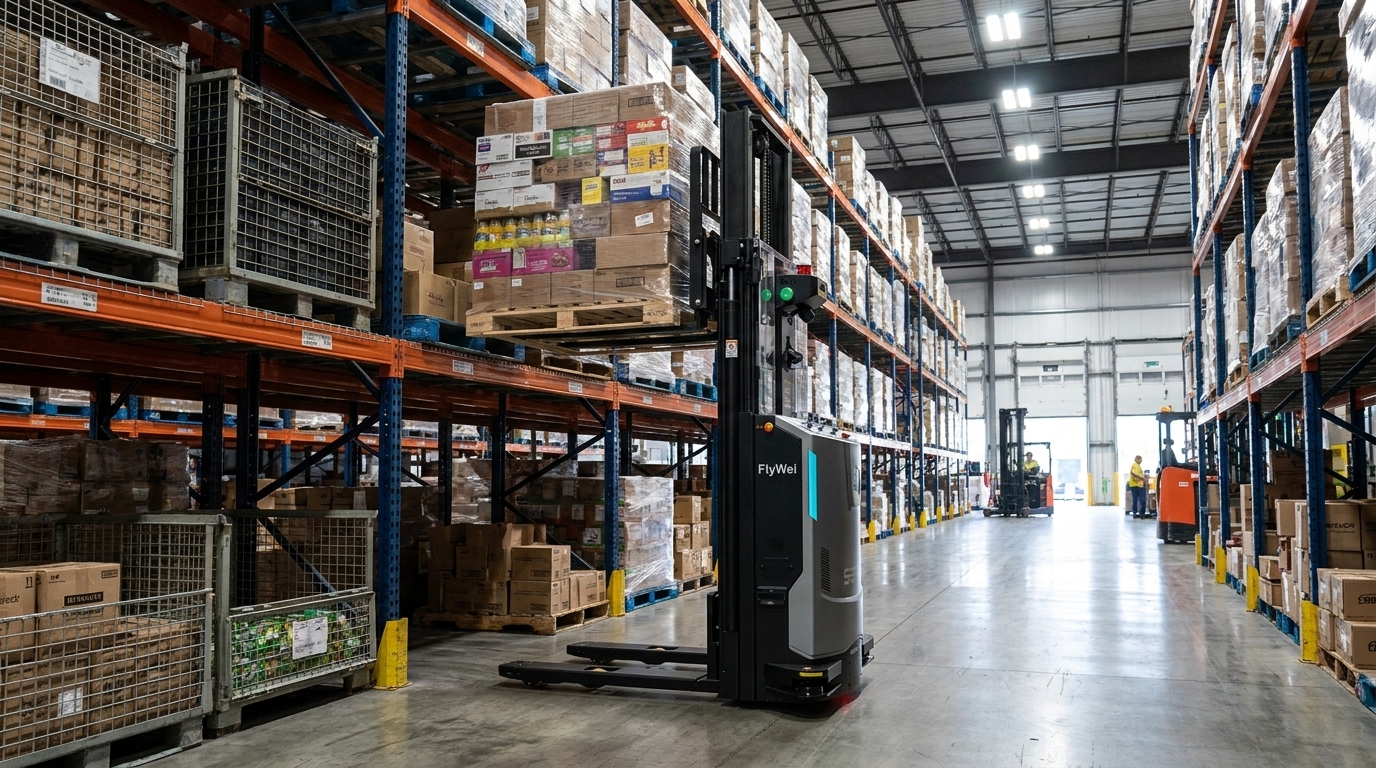
An autonomous pallet stacker is a driverless mast truck that lifts and places palletised stock into racking without an operator riding on board. The safety case is well established: HSE's workplace transport guidance has long put the toll at roughly 50 deaths and around 5,000 injuries every year across UK workplaces, with struck-by-vehicle among the leading causes. For a warehouse manager running more than 100,000 sq ft of grocery and multi-channel retail distribution, though, the pressure this quarter is rarely framed as safety. It is the 03:00 replenishment backlog: pick faces on the second and third beam levels running dry while the last counterbalance driver on shift works the goods-in yard. Every missed replenishment becomes a short-pick, a re-walk for the day-shift picker, and a service-level conversation with the retailer on Monday. Agency cover is expensive, inconsistent, and increasingly hard to book at short notice.
Why the mid-height pick face is where retail DC replenishment breaks
Grocery and multi-channel retail DCs are built around a ground-level pick face and bulk storage above it. That layout is efficient for picking and unforgiving for replenishment. Every case picked from beam level 0 has to be replaced by a pallet dropped from levels 1 to 3, and that movement is the single most repeated task in the building.
Three UK-specific pressures have made it harder. First, the driver and MHE operator pool has tightened across the golden triangle — Magna Park, DIRFT, Daventry and SEGRO East Midlands Gateway compete for the same counterbalance and reach-truck licences, and Logistics UK has tracked persistent recruitment difficulty across the sector. Second, retailer service-level agreements have moved to later cut-offs and tighter drop windows, compressing the replenishment window into the small hours. Third, range proliferation in multi-channel operations has multiplied SKU count without multiplying pick-face frontage, so each face turns over faster and demands more frequent top-ups.
The result is a queue. Replenishment tasks pile up behind goods-in and despatch, both of which have a hard external deadline that replenishment does not. Managers rationally deprioritise the internal task — until the pick face runs dry and the cost lands on the day shift as short-picks and re-walks. Meanwhile, the rushed manual replenishment that does happen at 03:00, by a tired operator working alone, is exactly the profile of movement that PUWER 1998 expects you to have risk-assessed and controlled. The labour problem and the safety problem are the same problem.
HSE's workplace transport guidance has long put the toll at roughly 50 deaths and around 5,000 injuries every year across UK workplaces, with struck-by-vehicle among the leading causes.
Lever 1 — Re-cut the replenishment wave so the robot owns the predictable legs
The operational lever comes before any hardware decision. Split your replenishment demand into two buckets: scheduled top-ups derived from forecast depletion, and reactive top-ups triggered by a picker hitting an empty face. The scheduled bucket is typically the larger share and is entirely predictable the night before — it is the bucket a driverless truck should own.
Practically, this means moving replenishment generation earlier in your wave planning so tasks are released as a batch at shift start rather than trickling in. Give the automated fleet a fixed aisle block and a fixed window, and keep manual trucks out of it during that window. Aisle segregation by time is far cheaper than aisle segregation by physical barrier, and it removes the mixed-traffic conflicts that slow a driverless truck to a crawl. Leave reactive top-ups with your manual operators, who handle exceptions far better than any robot will.
Lever 2 — Put one orchestration layer over mixed manual and driverless traffic
The technical lever is orchestration. A single autonomous pallet stacker running a fixed loop is a demonstration. A fleet that shares aisles, chargers and pick faces with manual trucks is an operation, and it needs a dispatcher that understands both populations.
This is the job of M4, FlyWei's fleet manager: it holds the live map, allocates aisle segments, sequences charging so no two trucks leave the floor at once, and enforces the time-boxed aisle rules from Lever 1. Task allocation itself — deciding which truck takes which replenishment, and re-allocating when one is blocked by a pallet left in the aisle — runs through RDS robot dispatch. Because FlyWei integrates equipment from multiple manufacturers, the orchestration layer speaks VDA 5050, the open interface standard for driverless transport vehicles, so a stacker, a lifting robot and a counterbalance truck from different builds can all be dispatched from one control plane. Integration to your existing ERP and WMS runs one way: the WMS keeps owning stock and task creation, and the fleet layer owns execution.
Lever 3 — Build the PUWER and ISO 3691-4 evidence pack before go-live, not after
The regulatory lever is the one most often left until the week before commissioning, and it is the one that delays go-live. A driverless mast truck is work equipment: PUWER applies in full, covering suitability, inspection, and the controls that stop it. Its lifting function brings LOLER duties for thorough examination. Its autonomy brings ISO 3691-4, the international standard for driverless industrial trucks, which sets out the personnel-detection, speed-and-braking and hazard-zone requirements a UKCA-marked truck must meet.
Assemble the pack in parallel with the technical work: the safety-function specification, the site-specific risk assessment covering mixed manual and driverless traffic, the operator and supervisor training records, the pre-use inspection regime, and the emergency-stop and recovery procedure your night-shift team will actually follow at 03:00. BSI holds the standards your safety case will reference. Doing this early also gives your insurer and your retailer's audit team a document set that exists before the first pallet moves.
Lever 4 — Fix the floor and the racking before you fix the labour
Driverless mast trucks are far less tolerant of a poor floor than a human operator, who compensates unconsciously for a dip or a worn joint. At mid-height beam levels, small deviations in floor flatness become large deviations at the fork tips. Commission a TR34 floor survey across the aisles you intend to automate, and treat joint condition and slab levelness as go/no-go criteria rather than snagging items.
Racking is the other precondition. Years of manual replenishment leave damaged uprights, bowed beams and out-of-tolerance beam levels, all of which a driverless truck will either refuse or aggravate. Run a rack inspection first, repair what fails, and record the corrected beam heights into the fleet map. This work is not automation spend — it is deferred maintenance you owe the building anyway — but it must happen before the trucks arrive, not after.
| Option | Covers scheduled top-ups | Handles exceptions | Racking-damage exposure | Regulatory route |
|---|---|---|---|---|
| Agency MHE operators | Yes, when bookable | Yes | Highest — least site familiarity | PUWER, operator licensing, induction per shift |
| Overtime on core team | Partly | Yes | Moderate — fatigue-related | PUWER, working-time management |
| Autonomous pallet stacker fleet | Yes, repeatably | No — escalates to a human | Lowest — consistent approach speeds | PUWER, LOLER, ISO 3691-4, UKCA |
| Do nothing, absorb short-picks | No | n/a | Moderate | None, but the SLA risk stays |
What FlyWei does here
FlyWei is an independent UK systems integrator of autonomous forklifts and AMRs. Because we are vendor-neutral rather than tied to a single manufacturer, we specify the truck class that fits your beam heights and aisle widths instead of the one we happen to stock — a FlyWei autonomous reach truck for narrow-aisle high-bay, a FlyWei stacker for the 1.5 to 2 tonne mid-height replenishment work most retail DCs actually need.
For a grocery or multi-channel DC the engagement usually starts with a single aisle block on the night shift. FlyWei surveys the floor and racking, maps the aisles, and sets the time-boxed segregation rules with your shift managers. We deploy the stacker fleet under M4 for fleet-level control and RDS for task dispatch, integrating to your existing WMS so replenishment tasks flow from the system your team already uses. Our UK-based engineers handle the PUWER and ISO 3691-4 documentation alongside the deployment, so the evidence pack lands with the trucks. Where capex timing is the constraint rather than the business case, FlyWei offers 3, 5 and 7-year leasing across the fleet. You can see how this maps to other formats across our retail and logistics solutions, and a comparable deployment pattern for contract logistics is covered in our 3PL replenishment guide.
Frequently asked questions
What is an autonomous pallet stacker?
An autonomous pallet stacker is a driverless mast truck that lifts palletised stock into racking without an on-board operator. It navigates using on-board LiDAR and a stored site map, and is typically rated between 1 and 2 tonnes for mid-height beam levels. It is also called a driverless forklift or automated forklift, though a stacker is the mast-truck class rather than a counterbalance machine.
Can an autonomous pallet stacker share aisles with manual forklifts?
Yes, and ISO 3691-4 sets out the personnel-detection and speed requirements that make it safe. In practice, throughput is far better if you segregate by time rather than run genuinely mixed traffic — give the automated fleet exclusive aisle windows on the night shift and hand the aisles back for day-shift picking.
How high can an autonomous pallet stacker reach?
Stacker-class trucks generally serve mid-height racking to around 6 metres. Above that, a reach-truck class machine is the right specification. FlyWei surveys your actual beam heights first, because a stacker working at the top of its range is slower and more sensitive to floor deviation.
What floor condition does a driverless stacker need?
A TR34 floor survey across the target aisles is the standard starting point. Slab levelness and joint condition matter more than surface finish, because small floor deviations are amplified at fork-tip height. Treat remedial floor work as a precondition of deployment.
Does PUWER apply to driverless forklifts?
Yes. A driverless truck is work equipment, so PUWER 1998 applies in full — suitability, inspection, maintenance and controls. The lifting function additionally brings LOLER thorough-examination duties, and the autonomy brings ISO 3691-4. Building this documentation before commissioning protects your go-live date.
How long does a first deployment take in a live retail DC?
The technical deployment is rarely the long pole. Floor and racking remediation, wave-planning changes and the safety evidence pack typically set the timeline. Starting with one aisle block on one shift keeps the first phase short and gives you real cycle-count data before you commit to a wider rollout.
Do we need to replace our WMS?
No. The WMS keeps owning stock accuracy and task creation. The fleet layer owns execution — which truck moves which pallet, in what order, and how charging is sequenced around it. FlyWei integrates to the ERP and WMS you already run rather than asking you to change systems.
If a 03:00 replenishment backlog is on your Q3 risk register, the fastest way to size the opportunity is to walk one aisle block with an engineer who has automated the same layout before.
Book a free 30-minute site survey and we will assess your floor, your racking and your night-shift wave plan against what an autonomous pallet stacker fleet can realistically absorb.
UK-based engineers. No obligation. We reply within one business day.