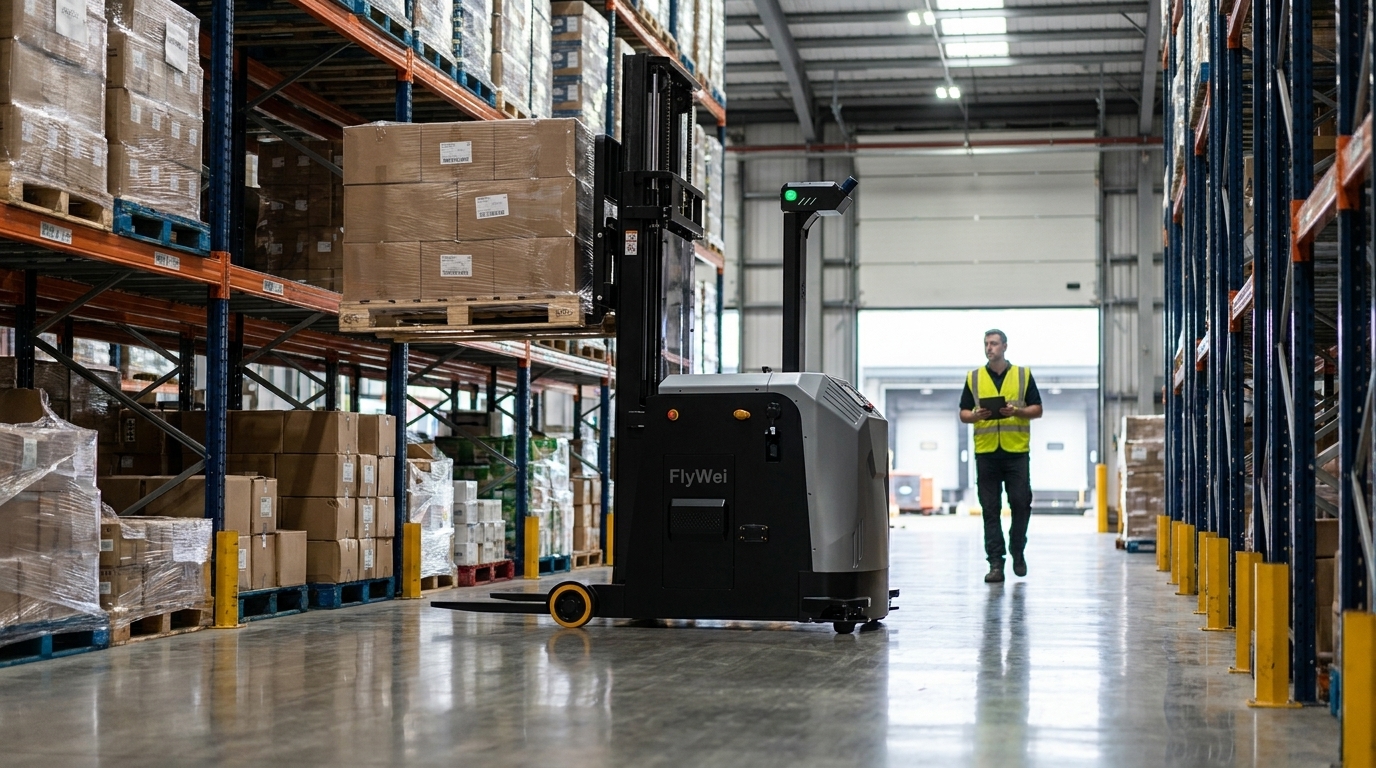
AGV forklift trucks are driverless counterbalance, reach and pallet trucks that navigate a warehouse under software control, taking pallet moves from a warehouse system and executing them without an operator on board. The safety case is stark: of the 126 workers killed in Great Britain in 2025/26, 24 were struck by a moving vehicle, the second-largest category after falls from height. For a warehouse manager running a 3PL contract site above 100,000 sq ft, that risk arrives bundled with a productivity problem. Agency cover churns, the night shift never quite matches days, and a client's SLA slips because three trucks sat idle waiting for a licensed driver. The appeal of AGV forklift trucks here is consistency rather than headcount: they hold the same putaway rate at 03:00 as at 11:00, because cycle time is set by software scheduling rather than shift-to-shift labour availability.
Why night-shift putaway rates collapse on contract logistics sites
Ask a warehouse manager on a multi-client site what their dock-to-stock time is and you get an average. Ask what it was between midnight and 06:00 last Saturday and the room goes quiet. That gap is where 3PL margin leaks.
Three UK-specific factors compound it. First, the counterbalance and reach truck operator pool is thin, and every operator must be trained, tested and authorised under the Approved Code of Practice for rider-operated lift trucks (L117). Agency cover is legal but slower: a driver who has worked your site twice does not know which aisle floods at goods-in, and hesitation is cycle time.
Second, contract logistics stacks mismatched demand curves on one floor. A grocery client's replenishment peak lands at the same hour as an e-commerce client's outbound cut-off, and both are contractually protected. Labour absorbs the shock — until it cannot, at which point the site runs overtime it did not price.
Third, most UK contract sites are brownfield. Buildings around Magna Park, DIRFT and the wider Daventry corridor were racked for a previous tenant's profile, so aisles are narrower than the current pallet mix wants. Manual trucks absorb that with operator skill, so when skill varies by shift, throughput varies too, and HSE workplace transport guidance on separating people from vehicles gets harder to honour as pressure rises. Across all UK employers, struck by moving object accounts for 10% of RIDDOR-reported non-fatal injuries — a rate that climbs when tired, unfamiliar drivers share aisles with pickers.
In UK 3PL contract logistics, AGV forklift trucks hold the same putaway rate at 03:00 as at 11:00, because cycle time is set by software scheduling rather than shift-to-shift labour availability.
Lever one: automate the trunk moves, not the whole building
The operational lever is scope discipline. Pallet movement splits into repeatable trunk moves — goods-in to bulk racking, bulk to pick face, pick face to marshalling — and everything else: damaged pallets, quality holds, reworked cases. The trunk moves dominate truck hours and involve no judgement.
Start by measuring one flow over a fortnight: count moves, distance and the hour they occur. Automate the flow with the highest volume and the flattest exception rate first, usually goods-in to bulk. Run AGV forklift trucks on that lane around the clock and leave your best manual operators on the awkward work where they add value. This avoids the classic failure mode: attempting full-site automation, hitting a long tail of exceptions, and concluding an automated forklift cannot work when the scope was simply wrong.
Practically, that means agreeing a written exception protocol before go-live — what the truck does when a pallet overhangs, a location is blocked or a barcode will not read — and who clears it. Sites that define this up front commission in weeks rather than months.
Lever two: one fleet layer over mixed truck classes
The technical lever is refusing to run one control system per machine type. A contract site needs counterbalance trucks at the yard interface, reach trucks in the high bay and pallet trucks on dock-to-stock runs. If each class brings its own traffic logic, three systems argue over the same aisle at 03:00.
The alternative is a single fleet management layer that speaks VDA 5050, the open standard for communication between mobile robot fleets and a central controller. One traffic model, one charging strategy, one set of priority rules. FlyWei's M4 fleet manager does this job: it holds the site map, arbitrates junctions between mixed truck classes and decides which machine takes which task. Above it, FlyWei RDS takes work from the warehouse system you already run and turns it into robot missions, writing completions back so your enterprise WMS stays the record of stock.
The integration question to settle early is not whether robots can talk to your systems — they can — but what happens when the link drops. A well-designed fleet layer finishes the task already issued, holds safely, then queues completions and replays them on reconnection without duplicating stock movements. Ask for that in writing.
Lever three: build the safety case before the trucks land
The regulatory lever is the one that delays projects when it is left late. Autonomous trucks are work equipment, so PUWER 1998 applies in full: suitable for purpose, properly maintained, protected against foreseeable risk. HSE guidance on PUWER is explicit that the duty sits with the operator of the equipment, not the supplier — so it is your safety case.
ISO 3691-4 is the relevant standard for driverless industrial trucks. It covers protective device performance, speed and stopping distance, and the behaviour required where automated and manual traffic mix. On a brownfield contract site that last point is the crux: you are not building a caged cell, you are running driverless forklift traffic through aisles containing pickers, agency staff and client auditors.
Do three things alongside procurement. Update the traffic-management plan to show automated routes, pedestrian routes and every crossing point. Agree who holds maintenance and thorough-examination duties, remembering LOLER obligations on lifting equipment. Brief shift leaders on stopping, recovering and restarting a truck — a night supervisor who cannot clear a stopped machine will switch the system off.
Lever four: prove it on the shift that hurts
The commercial lever is choosing the right pilot window. Most sites trial automation on days, when supervision is thickest and results flatter. Trial it on nights and weekends instead — that is where the variance lives and where the business case is decided.
| Measure | Manual trucks, day shift | Manual trucks, night shift | AGV forklift trucks, any shift |
|---|---|---|---|
| Cycle-time driver | Operator skill and familiarity | Agency familiarity, fatigue | Software scheduling and traffic rules |
| Throughput variance | Baseline | Widest — the contract-review gap | Narrow and repeatable |
| Supervision needed | Shift leader per zone | Thinnest cover, highest risk | One fleet controller per site |
| Pedestrian interaction | Managed by traffic plan | Hardest to enforce | Enforced by the fleet layer |
| Scaling for a peak | Overtime and agency | Overtime and agency | Extend running hours, add trucks |
| Cost shape | Variable labour | Premium variable labour | Fixed monthly on a lease term |
Set the measurement before the pilot: median and 90th-percentile dock-to-stock time, by shift, for the automated lane. Medians flatter automation less than averages do, and the 90th percentile is the number your client feels. If the spread between day and night narrows while the median holds, the case is made in language a contract review understands.
What FlyWei does on a 3PL contract site
FlyWei is an independent, vendor-neutral UK systems integrator of autonomous forklifts and AMRs. That matters on contract logistics sites, because a 3PL rarely gets to pick one machine class and stop. FlyWei integrates the best robot for each flow across multiple manufacturers, rather than fitting your building to one manufacturer's catalogue.
In practice, FlyWei surveys the building you actually have — aisle widths, floor condition, racking pitch, the pallet profiles each client sends — and specifies a mix from that: a narrow-aisle FlyWei autonomous reach truck for the high bay, FlyWei autonomous pallet trucks for dock-to-stock trunk moves, a counterbalanced machine at the yard interface if the trailer mix demands it. FlyWei then runs the whole mix under M4, so the site has one traffic model rather than three, and connects RDS to the warehouse system already in place so your client-facing stock records stay authoritative.
Because contract terms rarely match asset life, FlyWei supplies these fleets on 3, 5 and 7-year leasing terms as well as outright purchase — useful when a fleet needs to be sized to a contract that renews in four years. Commissioning, the PUWER safety case, training and ongoing service are handled by UK-based engineers. See how this plays out across other warehouse sectors or read our AGV forklift buyer's guide for 3PL procurement.
Frequently asked questions
What are AGV forklift trucks?
AGV forklift trucks are driverless versions of standard warehouse trucks — counterbalance, reach, stacker and pallet-truck classes — that navigate using onboard sensing and a site map, take pallet-move tasks from a warehouse system, and run without an operator on board. They handle standard pallets in existing racking rather than requiring purpose-built storage.
Do AGV forklift trucks work in a brownfield warehouse?
Yes, and that is the normal case in UK contract logistics. What matters is aisle width against the truck class, floor flatness, racking condition and how consistently locations are identified. A survey establishes which flows are automatable as-is and which need a change to racking or labelling first.
Can driverless forklifts and people share the same aisle?
Yes, where the safety case supports it. ISO 3691-4 sets the performance required of protective devices and the rules for mixed automated and manual traffic, and your site traffic-management plan must show automated routes, pedestrian routes and every crossing point. Most sites also retain pedestrian-exclusion zones at the highest-risk interfaces.
What happens to the existing forklift operators?
On most contract sites, automation absorbs the repeatable trunk moves and operators move to exception work, replenishment sequencing, quality holds and fleet supervision. Sites that plan this explicitly — naming who becomes the fleet controller before go-live — see far less resistance on the shop floor than those that do not.
How long does a first deployment take?
Commissioning the machines is rarely the long pole. Mapping the site, agreeing exception handling, reconciling the safety case and testing against live warehouse data are. Projects move fastest where the warehouse system already exposes work through a documented interface and a test environment is available.
Is leasing or buying better for a 3PL?
Leasing usually fits contract logistics better, because asset life outlasts contract terms. A 3, 5 or 7-year lease lets fleet size follow the contract book and converts a capital request into an operating line, which is easier to attach to a specific client P&L.
If night-shift and weekend putaway variance is on your Q3 risk register, the fastest way to size the opportunity is one flow on your own floor, not a generic business case.
Book a free 30-minute site survey and a FlyWei engineer will walk your highest-volume lane, check aisle widths and floor condition against the relevant truck classes, and tell you which moves are automatable as-is. For specification detail first, start with our autonomous forklifts and AGV forklift trucks range.
UK-based engineers. No obligation. We reply within one business day.