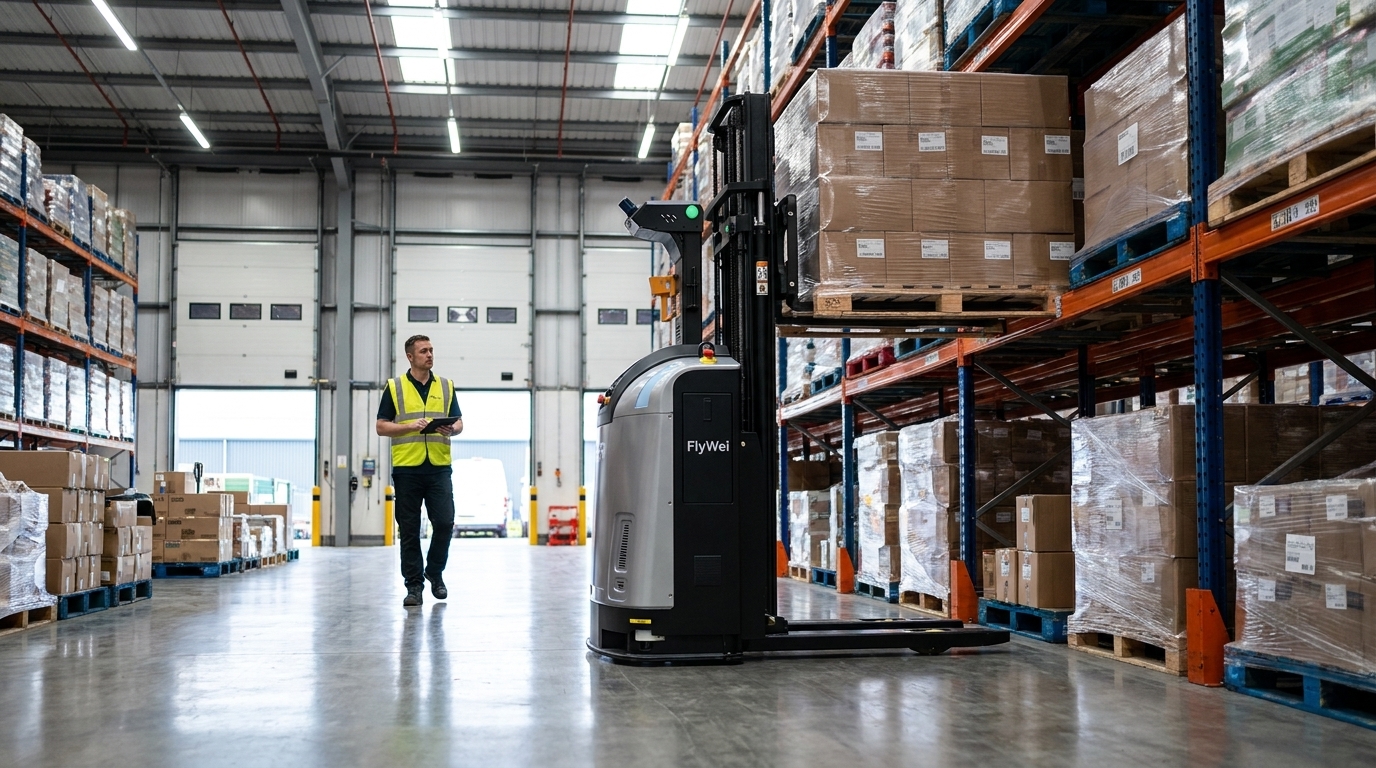
An automated forklift is a standard counterbalance, reach or pallet truck fitted with navigation and safety sensors so it moves pallets without a driver. The Health and Safety Executive reports that around 50 people are killed and about 5,000 injured every year in workplace transport incidents across Great Britain, with lift trucks a persistent cause. For a warehouse manager running a 100,000 sq ft shared-user site in the Midlands golden triangle, that statutory risk sits on top of a harder daily problem. Every new client contract adds pallet moves, yet the counterbalance fleet and the pool of licensed, site-inducted operators do not grow with it. Agency cover is thin and expensive, induction takes days, and refresher training pulls people off the floor. By mid-peak the binding constraint is rarely racking, dock doors or WMS logic — it is how many trained operators can legally drive a truck on any given shift.
Why the operator gap keeps biting contract logistics
Contract logistics runs on a margin that does not forgive idle assets. A shared-user site at Magna Park, DIRFT or SEGRO East Midlands Gateway carries several clients under one roof, each with its own service-level agreement, inbound profile and idea of what "peak" means. The MHE fleet was sized against a contract won on price, and the operator pool against a headcount plan written before the newest client went live.
Two UK-specific factors compound this. First, operator supply in the golden triangle is genuinely competitive; a site at Lutterworth or Daventry bids for the same labour pool as every neighbouring shed, and Logistics UK has documented sustained recruitment and retention pressure across the sector. Second, counterbalance and reach-truck operation is licensed, refresher-trained work — you cannot flex it the way you flex a picker.
Underneath both sits a mismatch between the work and the skill. A large share of truck hours on a shared-user site is long, unremarkable, repeatable transport: goods-in to bulk, bulk to pick face, empties to the baler, returns cage to rework. None of that needs judgement. All of it needs a licence. So your most experienced operators — the people genuinely better at damaged-pallet calls and tight-aisle recoveries — spend much of the shift driving in straight lines, exception work queues behind routine work, and the KPI that slips is not throughput but consistency. Clients notice consistency.
An automated forklift is a standard counterbalance, reach or pallet truck fitted with navigation and safety sensors so it moves pallets without a driver.
Lever one: automate the boring long-haul moves before anything clever
The operational lever is task selection, and most sites get it wrong by aiming too high. Map a week of truck movements from your WMS transaction log and sort them by distance travelled and decision content. You are looking for the long, low-decision, high-repetition band: goods-in to bulk, bulk to pick face, empties to baler, finished pallets to outbound. An automated forklift handles those well today — fixed route, consistent load presentation, low exception rate.
Deliberately leave the awkward work with people. Damaged or leaning pallets, blocked aisles, mixed-pattern trailer unloading and any judgement call on product condition should stay manual in year one. The goal is not a dark warehouse; it is returning licensed operators to the tasks that genuinely require a licence — which on most shared-user sites recovers skilled hours per shift without touching headcount, racking or the client's service agreement.
Lever two: put one fleet manager above a mixed truck fleet
The technical lever is orchestration. A single driverless truck is a novelty; a coordinated fleet is an operational change. That coordination lives above the vehicles, in a fleet management layer that takes work from your existing WMS, converts it into missions, arbitrates traffic at aisle ends, sets charging strategy and writes completions back so the WMS stays the record of stock.
Two design decisions matter more than any spec sheet. The first is the host-system interface: documented, testable against a non-production environment, and graceful in failure — a truck finishes the mission it holds then parks safely if the link drops, with completions queued and replayed rather than lost or double-posted. The second is the vehicle interface. Insisting on the open VDA 5050 standard for fleet-to-vehicle command and control lets one orchestration layer command trucks from more than one manufacturer — exactly what a 3PL needs when a new contract demands a truck class the incumbent fleet lacks. FlyWei's M4 fleet manager and RDS robot dispatch are built around that separation.
Lever three: build the PUWER and ISO 3691-4 evidence pack before go-live
The regulatory lever quietly determines whether your project lands on time. A driverless truck is still work equipment under the Provision and Use of Work Equipment Regulations 1998, so the PUWER duties you already discharge for manual trucks — suitability for the task, inspection, maintenance, and information and instruction for the people around it — apply unchanged. HSE guidance on PUWER is explicit that the duty sits with whoever controls the equipment, which on a shared-user site is you, not the client and not the supplier.
On top of that sits the standard specific to this class of machine. ISO 3691-4 covers driverless industrial trucks and their systems, and is the reference point for risk assessment, protective-device selection, speed and detection-zone configuration and operating-area definition; lifting components still fall under LOLER thorough-examination duties. Practically, that means a written traffic-management plan for mixed manual and automated operation, marked and briefed zones, a documented maintenance and rescue handover, and toolbox talks every shift — agency staff and client visitors included. Build that pack during commissioning and BSI-aligned assurance is straightforward; retrofit it afterwards and you do it under pressure.
Lever four: size the fleet to sustained shift demand, not to absolute peak
The commercial lever is fleet sizing, and over-sizing is the classic contract-logistics error. Peak in a shared-user shed is spiky, client-specific and often only weeks long, so sizing to the busiest hour of the busiest week leaves capital idle most of the year. Size to the sustained demand across a normal two-shift day and cover genuine peak with a documented manual overlay. Term-based funding changes the arithmetic: FlyWei offers three, five and seven-year leasing terms for warehouse robotics, letting a 3PL match the payment profile to the client contract that justified the fleet rather than to asset life.
| Lever | What it changes | Typical lead time | Evidence required | Where the return shows |
|---|---|---|---|---|
| Task selection (operational) | Routine long-haul moves shift off licensed operators | Weeks — a WMS data exercise first | Movement log by distance and decision content | Skilled operator hours returned to exception work |
| Fleet orchestration (technical) | One layer schedules a mixed truck fleet and writes back to the host system | Months, driven by host-system access | Interface spec, test environment, failure-mode plan | Utilisation, plus room to add truck classes later |
| PUWER and ISO 3691-4 pack (regulatory) | Compliance becomes a commissioning deliverable, not a scramble | Runs in parallel with commissioning | Risk assessment, traffic plan, examination regime | Go-live protected; client audits pass first time |
| Sustained-demand sizing (commercial) | Fleet matched to normal two-shift load, peak covered by overlay | Set at business-case stage | Shift-level demand profile and contract term | Capital not idle outside peak weeks |
What FlyWei does here
FlyWei is an independent, vendor-neutral UK systems integrator of autonomous forklifts and AMRs. That independence matters most in contract logistics, because a shared-user site rarely gets to standardise: one client needs 2-tonne counterbalance work at the docks, the next narrow-aisle reach-truck moves into 8-metre racking, the next wheeled cages. FlyWei specifies across multiple manufacturers and integrates the result as one fleet.
In practice, FlyWei starts with your movement data and a site walk, not a machine. From that we scope which lanes an automated forklift should take first — usually the dock-to-bulk and bulk-to-pick-face loops — and which stay manual. We specify the truck classes those lanes need, from pallet-truck and stacker variants through to counterbalance and narrow-aisle reach trucks, and integrate them under M4 so the fleet is scheduled as one pool against a documented host-system interface. RDS handles live dispatch and exception routing, so the floor team sees a queue rather than a black box. Where a contract calls for cage movement rather than pallets, the same layer runs FlyWei lifting robots and AMRs alongside the trucks. Sector configurations sit across our industry solutions, and our guide to autonomous pallet stackers on 3PL sites covers the narrow-aisle case.
Frequently asked questions
What is an automated forklift?
An automated forklift is a conventional counterbalance, reach, stacker or pallet truck fitted with navigation sensors, safety scanners and fleet software so it transports pallets without an operator on board. It follows missions issued by a fleet manager, and remains work equipment under UK regulation.
Is a driverless forklift different from an AGV forklift?
In everyday UK usage the terms overlap. An AGV forklift historically followed a fixed guide path such as wire or magnetic tape; a driverless or autonomous truck navigates using onboard sensing and can re-route around obstructions. Most trucks specified today are the latter.
Do we need to replace our WMS to run an automated forklift fleet?
Usually not. A fleet management layer sits above your existing warehouse system, takes work from it over a documented interface and writes completions back, so that system stays the record of stock. Replacement is only worth considering where it cannot expose work at all.
What regulations apply to driverless trucks in a UK warehouse?
PUWER 1998 duties apply to the trucks as work equipment, LOLER duties apply to lifting components, and ISO 3691-4 is the safety standard for driverless industrial trucks. HSE workplace transport guidance covers the traffic-management plan for mixed operation.
Can automated forklifts work alongside manual trucks and pedestrians?
Yes, and on a live 3PL site they must. It requires a written traffic-management plan, marked operating zones, correctly configured detection fields and briefing for every shift including agency staff. Undocumented mixed operation is where sites get into trouble.
How many automated forklifts does a 100,000 sq ft 3PL site need?
There is no default figure. It comes from a shift-level movement profile: the lanes you intend to automate, their distances, cycle time per move and sustained hourly demand across a normal two-shift day. Size to sustained demand, not to absolute peak.
What happens if the network or host system goes down mid-shift?
A well-designed integration degrades rather than stops. Trucks complete the mission already issued and then hold safely, while the fleet layer queues completions and replays them on reconnection. Ask how long the fleet manager runs detached and how duplicates are prevented.
Can we lease automated forklifts rather than buy them?
Yes. FlyWei offers three, five and seven-year terms, letting a contract logistics operator align the payment profile with the length of the client contract that justified the fleet rather than with the asset life of the trucks.
If capped pallet-move throughput and thin licensed-operator cover are on your Q3 risk register, the fastest way to size the opportunity is your own movement data, on your own floor.
Book a free 30-minute site survey with FlyWei, and see the truck classes on our automated forklift range.
UK-based engineers. No obligation. We reply within one business day.