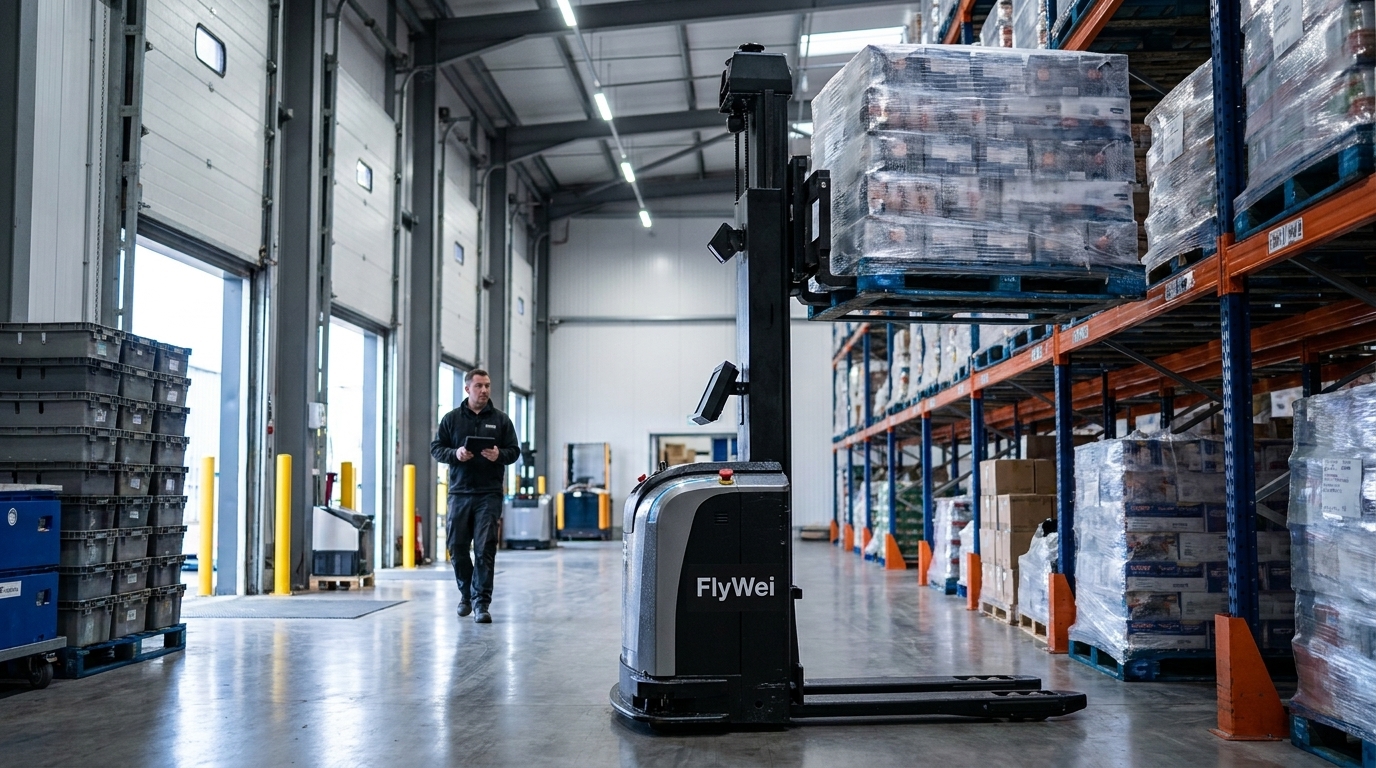
An autonomous forklift for cold storage is a driverless lift truck built to work continuously inside chilled and frozen rooms, using sealed electronics, condensation-resistant sensors and low-temperature battery chemistry to move pallets without a person in the cab. The stakes are physical: of the 126 workers killed in Great Britain in 2025/26, 24 were struck by a moving vehicle and 15 of those deaths were in transportation and storage, according to the Health and Safety Executive. For a plant director running a chilled production hall with an attached frozen store, the daily pain is quieter than that headline but relentless. Cold-exposure rotas mean a truck that could run a full shift only runs part of it. Batteries lose capacity in the freezer and spend longer on charge than on pallets. Cover for cold-store-ticketed drivers is scarce, and every unfilled shift pushes blast-freezer output into a queue that stalls the line behind it.
Why frozen-store throughput stalls
Three UK-specific factors compound in a cold chain site. The first is thermal, and it is unavoidable by design. HSE guidance sets a workplace benchmark of 16 °C, or 13 °C where much of the work involves rigorous physical effort — a threshold a frozen store can never meet, because the product requires the cold. The duty therefore shifts from warming the room to controlling exposure: shorter stints, mandated rewarming breaks, heavier personal protective equipment and more handovers. Every one of those controls converts directly into lost truck hours.
The second is regulatory drag on the product itself. The Quick-frozen Foodstuffs (England) Regulations 2007 set the conditions under which quick-frozen food may be placed on the market, including the storage temperature conditions in Schedule 2 and the record-keeping that proves them. A pallet parked in a chilled dock lobby while a driver rewarms is not just an idle pallet; it is a temperature record you may have to defend.
The third is labour depth. Cold-store work is a specialist ticket on top of a counterbalance or reach licence, and the pool of people willing to do it in the Midlands corridor — Magna Park, DIRFT, Daventry, Burton-on-Trent — is thin and fought over. Logistics UK has tracked driver and warehouse skills shortages across the sector for years through its annual reporting, and the cold chain sits at the sharp end of it. The result is a plant that has capital sitting in racking and blast capacity, throttled by a rota it cannot fill.
Lever one, operational: automate the two repetitive freezer legs first
Do not start by automating the whole frozen store. Start with the two legs that are high-frequency, low-variation and coldest: blast-freezer discharge into the store, and store to the marshalling lane. These are fixed origin-destination moves on a known cadence, which is exactly the work a driverless forklift does well and exactly the work that burns your scarcest operator-hours. Map a fortnight of moves by leg and by hour before you specify anything; most plants find that a minority of route types account for the majority of below-zero truck time. Automating those legs keeps your ticketed people in the aisles where judgement matters — damage assessment, stock queries, pick-face exceptions — rather than shuttling the same pallet down the same aisle forty times a night. It also converts a rota problem into a capacity problem, which is far easier to plan against.
Lever two, technical: specify for condensation, not just for cold
Cold is the obvious engineering problem. Condensation is the one that actually breaks deployments. Every time a truck crosses the dock threshold from an ambient lobby into the frozen band and back, moisture condenses and then freezes on optics, connectors and chassis. Specify accordingly: sealed drive and control enclosures, heated or purged sensor windows, low-temperature battery chemistry, and an opportunity-charging pattern that keeps the vehicle in its thermal band rather than cycling it in and out. Just as important, specify the threshold behaviour in software. Traffic rules at the door, dwell limits in the lobby and a defined rewarm-and-dry routine belong in the fleet layer, not in a driver''s habit. FlyWei handles this in M4, the fleet manager, which arbitrates traffic and charging across the whole fleet, while RDS robot dispatch takes the work from the systems the site already runs so the frozen store keeps one record of stock.
Lever three, regulatory: write the PUWER case before go-live
A driverless truck is work equipment, and the duties do not soften because nobody is sitting on it. The Provision and Use of Work Equipment Regulations 1998 devote Part III, regulations 25 to 30, specifically to mobile work equipment, and the HSE guidance on PUWER sets out the inspection, maintenance, training and competence expectations that sit alongside them. In a cold store, three points need explicit treatment. Segregation: define where people and robots share space, and where they do not, with the frozen aisles as the strictest zone. Inspection: cold and ice change wear patterns, so the inspection regime cannot be copied from an ambient site. Competence: your team no longer drives the truck, but somebody must be trained and authorised to intervene, recover and stop it safely at −25 °C in full protective gear. Build that evidence pack during commissioning, with the UKCA and CE documentation, and hand it to the board as a completed safety case.
Lever four, commercial: match the funding route to the asset life
Cold-store automation is rarely blocked on engineering; it is blocked on how it lands in the capital plan. A frozen store is a long-life asset and the flows inside it change slowly, which makes it well suited to a fixed-term agreement that turns a capital ask into an operating line. FlyWei offers 3, 5 and 7-year leasing terms covering the robots, fleet software, maintenance and UK support in one monthly rate. For a plant director, the practical value is that the business case stops being a single large number in front of a capex committee and becomes a per-shift cost you can set against the ticketed operator-hours and agency premium it displaces.
| Lever | What changes on the floor | Where the duty sits | Evidence to take to the board |
|---|---|---|---|
| Automate the two repetitive freezer legs | Blast-to-store and store-to-marshalling run to a fixed cadence, unaffected by rota gaps | Operations, with the plant director owning the flow map | Fortnight of moves by leg and hour, before and after |
| Specify for condensation and threshold crossings | Sealed enclosures, protected optics, thermal-band charging, door dwell rules in software | Engineering, with the integrator | Threshold-crossing fault rate and unplanned stops per 1,000 moves |
| Write the PUWER case before go-live | Segregation zones, cold-specific inspection regime, named authorised responders | SHEQ, under PUWER Part III (regs 25–30) | Completed safety case, inspection schedule, UKCA and CE pack |
| Match funding to asset life | Capital ask becomes a fixed monthly operating line | Finance, with procurement | Per-shift cost against ticketed operator-hours and agency premium displaced |
Of the 126 workers killed in Great Britain in 2025/26, 24 were struck by a moving vehicle and 15 of those deaths were in transportation and storage — which is why removing people from the busiest below-zero aisles is a safety decision before it is a productivity one.
What FlyWei does here
FlyWei is an independent, vendor-neutral UK systems integrator. We are not tied to one manufacturer, so for a chilled and frozen site we specify across the market and choose the machine that suits the actual flow, rather than fitting the flow to whatever one brand happens to build. In practice, a cold chain plant usually gets a mixed specification. A FlyWei autonomous forklift for cold storage — counterbalanced for blast-freezer discharge and yard-facing moves, reach-truck class for narrow-aisle high-bay put-away — handles the pallet work, while FlyWei lifting robots take cart and tote movement in the chilled packing hall where a full forklift is the wrong tool.
Above the machines, M4 runs the fleet and RDS takes work from the site''s existing systems, so stock stays where your team already looks for it. The sequence we run is deliberately slow at the front and fast at the back: a site survey in the live thermal conditions, a flow map, a fixed scope, then commissioning against that scope. FlyWei publishes an autonomous forklift guide covering the truck classes and navigation methods, and our industry solutions pages carry the deployment record by sector. Engineers are UK-based, and the safety evidence pack is delivered as part of the project, not chased afterwards.
Frequently asked questions
What is an autonomous forklift for cold storage?
It is a driverless lift truck specified to work continuously in chilled and frozen rooms, typically rated for operation down to −25 °C. It uses sealed electronics, condensation-resistant sensors and low-temperature battery chemistry, and takes its work from the site''s warehouse or production systems rather than from a driver.
Can a standard driverless forklift be used in a freezer?
Not reliably. Condensation on optics and connectors at the door threshold, battery capacity loss and seal failure make an ambient-specified machine unsuitable for continuous freezer duty. Cold-store operation is a specification decision made before purchase.
Does PUWER apply to an automated forklift?
Yes. A driverless truck is mobile work equipment, so Part III of the Provision and Use of Work Equipment Regulations 1998, regulations 25 to 30, applies alongside the HSE''s inspection, maintenance and competence expectations. Someone must still be authorised to intervene, recover and stop the vehicle.
Which cold-store flows should be automated first?
The high-frequency, low-variation legs: blast-freezer discharge into the store, and store to the marshalling lane. They are fixed origin-destination moves on a known cadence, they consume the most below-zero operator-hours, and they are easiest to prove in a first phase.
How do autonomous forklifts affect cold-store temperature compliance?
They shorten the time pallets spend outside the required band, because a robot does not need rewarming breaks or handovers. That makes the temperature conditions in the Quick-frozen Foodstuffs (England) Regulations 2007 easier to evidence, and every completed move is logged automatically for the record.
Do we have to replace our warehouse system to run robots in a cold store?
Usually not. A dispatch layer sits above your existing system, takes work from it and writes completions back, so that system remains the record of stock. Replacement is only worth considering where it cannot expose work through an interface or a scheduled export.
How is cold-store automation usually funded in the UK?
Either outright purchase or a fixed-term lease. Leasing over 3, 5 or 7 years covers robots, fleet software, maintenance and support in one monthly rate, converting a capital ask into a predictable operating line.
If frozen-store throughput and cold-store staffing are on your Q3 risk register, the fastest way to size the opportunity is to look at one flow rather than the whole site.
Get a 48-hour feasibility read on your highest-volume flow — we take your blast-to-store or store-to-marshalling leg, map it against the machine classes on our autonomous forklifts range, and come back with what is automatable and what is not.
UK-based engineers, no obligation, and we reply within one business day.