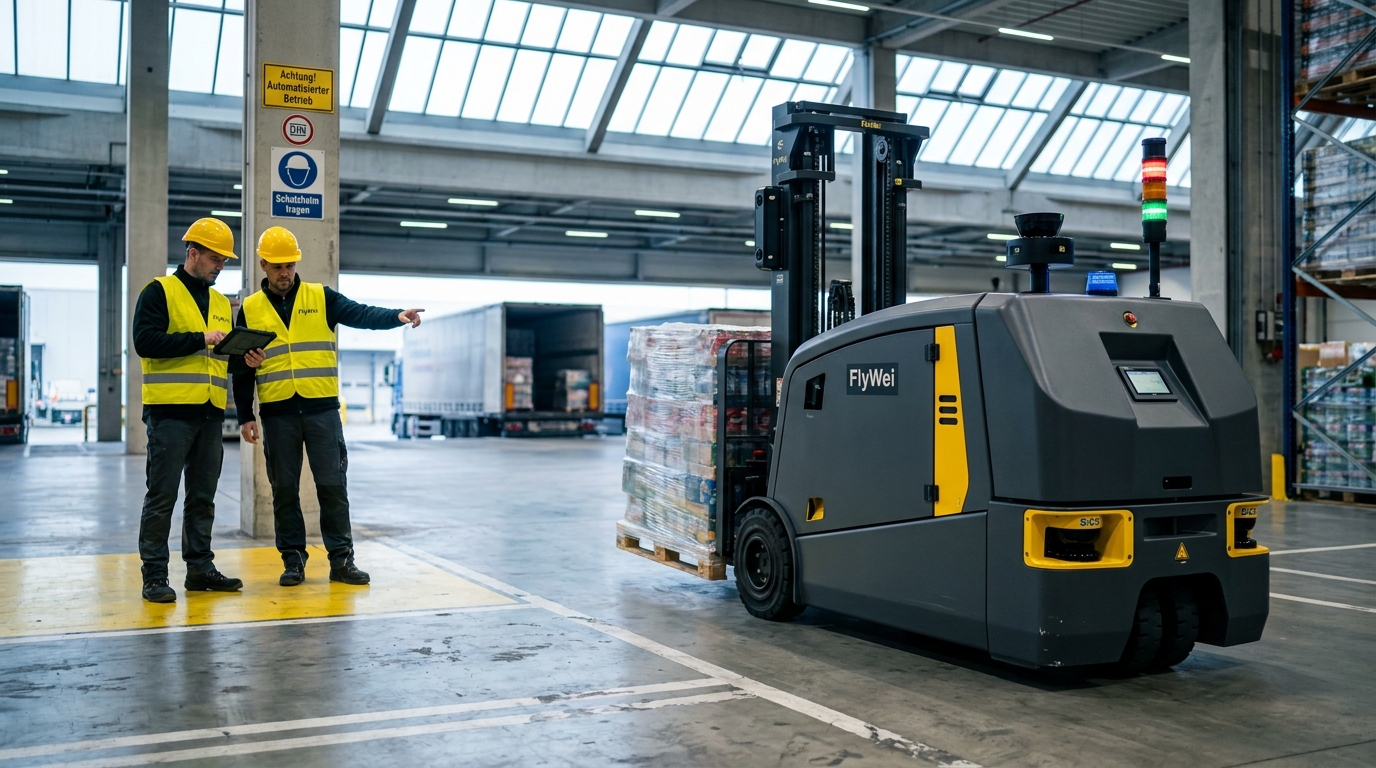
Autonomous forklifts in Germany and Austria are battery-electric industrial trucks that drive themselves (without a seated operator, steering wheel or overhead cab) using on-board LiDAR, 3D vision and a fleet controller to move pallets between racks, dispatch lanes and outbound docks. They are the floor-level alternative to fixed conveyor and high-bay shuttle automation in DACH distribution centres. Under EN ISO 3691-4:2023, the single harmonised standard now adopted across all 27 European Union member states for driverless industrial trucks, every new unit sold into Germany and Austria must meet one safety bar, removing the country-by-country certification drag that used to add six to nine months to deployment. For warehouse managers running large grocery, mixed-SKU and 3PL distribution centres across the Rhine corridor and Vienna basin, the operational pain runs sharper than headlines suggest: rising DGUV accident-prevention costs, persistent agency-operative wage inflation, and a fixed-automation rebuild that locks 18 to 24 months of capex into SKU and tenant assumptions that may not survive.
Why DACH distribution centres hit the autonomous-forklift inflection in 2026
DACH distribution centres did not wake up to autonomy in 2026: they ran out of alternatives. Three forces stacked at once. First, labour. Bundesagentur für Arbeit data put warehouse-operative gross hourly pay up double digits across 2025, and the temp-agency premium on top now routinely runs at 30 to 40 per cent. DGUV, the German statutory accident insurer, has tightened reporting on forklift-pedestrian collisions, and BAuA's 2025 transport-equipment fatalities report keeps workplace transport in the top three industrial-hazard categories for the Federal Republic. Second, capex risk. A fixed conveyor or shuttle rebuild for a 60,000-square-metre DC quietly assumes the SKU mix, tenant agreement and energy contract underpinning it will hold for seven years. Across DACH grocery and 3PL property, that assumption is breaking: SKU counts churn 20 per cent inside two years, and tenant break clauses are getting shorter, not longer. Third, regulation. Under EN ISO 3691-4:2023, a driverless industrial truck CE-marked once into the European Union is now accepted in Germany, Austria, the Netherlands and across the EU 27 without country-by-country re-certification; the single biggest cut to DACH deployment time in a decade. UK operators see the same regulatory direction under HSE workplace-transport guidance and PUWER 1998 in the British market. The combined result: floor-level autonomous forklifts win on regulatory certainty, on capex flexibility, and on labour exposure, at the same time.
The four levers that fix DC throughput without a rebuild
Lever 1, Operational: collapse the captive-driver shift pattern
A DACH retail distribution centre running two shifts plus a weekend backshift on conventional counterbalance trucks needs ten to fourteen ticketed-driver positions per twenty-bay outbound row. The real cost is not the wage line; it is the fragility: one absentee on the night shift collapses outbound throughput for the following morning, and the agency rate to cover a same-day FLT driver in München or Linz crossed sixty euros an hour through 2025. An autonomous-forklift pair handling the same outbound lane runs the night shift unattended and the day shift as one operator supervising five units from a tablet. The shift envelope flexes: 06:00 to 02:00 inside a single week, with no overtime negotiation, no break-cover and no agency invoice. For the warehouse manager this matters less for the headline saving and more for the planning floor it returns: peak-week ramp, mid-week SKU swap and outbound demand spikes stop being staffing problems and become fleet-utilisation problems.
Lever 2, Technical: VDA 5050 and a brand-agnostic M4 fleet layer
The protocol that matters here is VDA 5050: the German automotive sector's open interface for autonomous mobile robots, now the de facto European fleet-coordination standard. A distribution centre that locks itself to one vendor's proprietary fleet manager is making a seven-year bet on that vendor's roadmap; a centre that runs a VDA 5050-fluent fleet layer can mix forklifts, latent-jacking AMRs, scissor-lift heavy-lift AMRs and even manual MHE under one dispatch model. FlyWei's M4 fleet manager speaks VDA 5050 natively and pairs with FlyWei fleet dispatch software for traffic management across mixed aisles. The pragmatic test for any DACH buyer: ask the fleet manager to add a brand-different AMR to live traffic in a sandbox. If the answer involves a forklift OEM's quote for an integration project, the fleet layer is not actually open, regardless of the marketing badge.
Lever 3, Regulatory: EN ISO 3691-4:2023, CE marking and the TÜV pathway
The regulatory move that opens the DACH market is straightforward. EN ISO 3691-4:2023 harmonises driverless-industrial-truck safety requirements across the EU 27, the standard the United Kingdom has also aligned to via the British Standards Institution. For a German or Austrian buyer, the practical implication is that a forklift CE-marked under EN ISO 3691-4:2023 (with a notified body's certificate, the technical file in German on file at the importer of record, and a TÜV-acceptable risk assessment) does not need separate national approval to enter service. The pathway TÜV inspectors are auditing against in 2026 covers safety-rated LiDAR fields, redundant emergency stop, person-detection performance to ISO 13849-1 PL d minimum, and operational area marking to BSI-adopted EN signage. A buyer who confirms these four points in the supplier's technical file before signing capex closes the single biggest commissioning-delay risk on the project.
Lever 4, Commercial: 36-month TCO instead of a seven-year capex sink
The TCO comparison is unkind to fixed automation right now. A high-bay shuttle or tunnel-conveyor rebuild for a 60,000-square-metre DACH DC sits in the 18 to 32 million euro range, with civils, fire engineering, controls integration and a 12 to 24-month commissioning window. An autonomous-forklift fleet of equivalent throughput (typically eight to fourteen units across counterbalance, reach and stacker variants, plus the M4 layer) clears in the 2.6 to 4.2 million euro range with a six to twelve-week ramp. The capex profile flexes: add three units at peak season, redeploy four to a sister DC when a tenant moves out, sweat the original eight for another 24 months. Warehouse managers reporting to a CFO inside DACH grocery and 3PL property find the 36-month TCO story lands harder than the headline saving: it removes the seven-year lock-in that finance committees can no longer comfortably underwrite.
EN ISO 3691-4:2023 is the single harmonised safety standard for driverless industrial trucks across all 27 European Union member states, so an autonomous forklift CE-marked once now enters service in Germany and Austria without country-by-country re-certification.
| Dimension | Autonomous forklift fleet | Fixed conveyor or shuttle |
|---|---|---|
| Capex range | €2.6m to €4.2m | €18m to €32m |
| Commissioning | 6 to 12 weeks | 12 to 24 months |
| SKU-mix change cost | Software task re-map | Civils and controls rework |
| Redeployable to sister DC | Yes: drive on a truck | No: sell at scrap |
| EN ISO 3691-4 route | Vendor technical file | Notified body project |
What FlyWei does in Germany and Austria
FlyWei supplies and integrates autonomous forklift and lifting-robot fleets for DACH distribution centres, with the technical file held in German for TÜV acceptance and EN ISO 3691-4:2023 compliance audited up front. The product range covers the four DC tasks DACH warehouse managers ask about most: counterbalanced autonomous forklifts for two-tonne ambient pallet moves and outbound staging; reach-truck autonomous forklifts for narrow-aisle racking up to eight metres in mixed-SKU 3PL halls; stacker autonomous forklifts for mid-bay buffer; and heavy-lift AMRs for outbound one-tonne sub-assembly trolleys on Austrian manufacturing outbound. The M4 fleet manager coordinates the fleet over VDA 5050, paired with FlyWei fleet dispatch software for traffic and the operator's existing enterprise WMS for stock context. FlyWei delivers the integration directly (site survey, TÜV evidence pack, dock-marking, M4 commissioning, fleet handover) rather than handing the customer to a tier-one MHE channel partner. A DACH buyer talking to FlyWei is talking to the team that will run the deployment. Our autonomous forklift product page lists the units, and the solutions library covers prior DACH-adjacent work, including the France and southern Europe and European engineering DC briefings. Lifting robots sit alongside the forklift fleet where one-tonne sub-assemblies move between cells.
Frequently asked questions
Do autonomous forklifts need separate German approval if they are already CE-marked?
No. Since EN ISO 3691-4:2023 became the harmonised European safety standard for driverless industrial trucks, a unit CE-marked under it enters service in Germany, Austria and the wider EU 27 without country-by-country re-certification, provided the technical file in German is held by the importer of record. TÜV remains the inspection authority German operators trust for the in-service risk assessment.
What is the typical commissioning time for an autonomous-forklift fleet in a DACH DC?
For a fleet of six to fourteen units integrated with the operator's existing enterprise WMS, FlyWei targets six to twelve weeks from site survey to live throughput, depending on civils readiness and dock-marking complexity. The comparable fixed conveyor or shuttle rebuild typically takes twelve to twenty-four months.
How does VDA 5050 affect a DACH buyer's vendor choice?
VDA 5050 is the German automotive-led open interface for autonomous mobile robots that has become the de facto European fleet-coordination standard. A buyer who insists the fleet manager speaks VDA 5050 natively keeps the option to add brand-different AMRs and forklifts to the same dispatch model later, rather than locking the DC to one vendor's proprietary roadmap.
How do FlyWei autonomous forklifts handle DGUV pedestrian-safety reporting requirements?
Each unit logs every safety-zone intrusion, every emergency stop and every operator override into the M4 fleet manager, with timestamped events exportable for the operator's DGUV incident-reporting workflow. The audit trail is the same evidence base a TÜV in-service inspection asks for under EN ISO 3691-4 risk-assessment review.
Can a DACH DC mix FlyWei autonomous forklifts with manual MHE during a phased rollout?
Yes: phased adoption is the most common DACH pattern. M4 controls the autonomous units and the dispatch logic for them, while manual MHE keeps running on the operator's existing supervisor process. Operational areas are marked to BSI-adopted EN signage, and the autonomous fleet's safety-rated LiDAR fields keep pedestrians and manual trucks safely separated.
What evidence does a DACH CFO need to underwrite the capex?
A 36-month TCO model comparing the autonomous-forklift fleet to the cheapest fixed-automation rebuild for the same throughput, a redeployment scenario showing residual value if the SKU mix or tenant agreement changes, and a TÜV acceptance pathway document referencing the supplier's EN ISO 3691-4:2023 technical file. FlyWei provides all three to qualified buyers during pre-contract evaluation.
Ready to test the case in your own distribution centre? Talk to FlyWei for a DACH-region autonomous forklift assessment, with the TÜV evidence pack and 36-month TCO model worked against your own outbound profile.