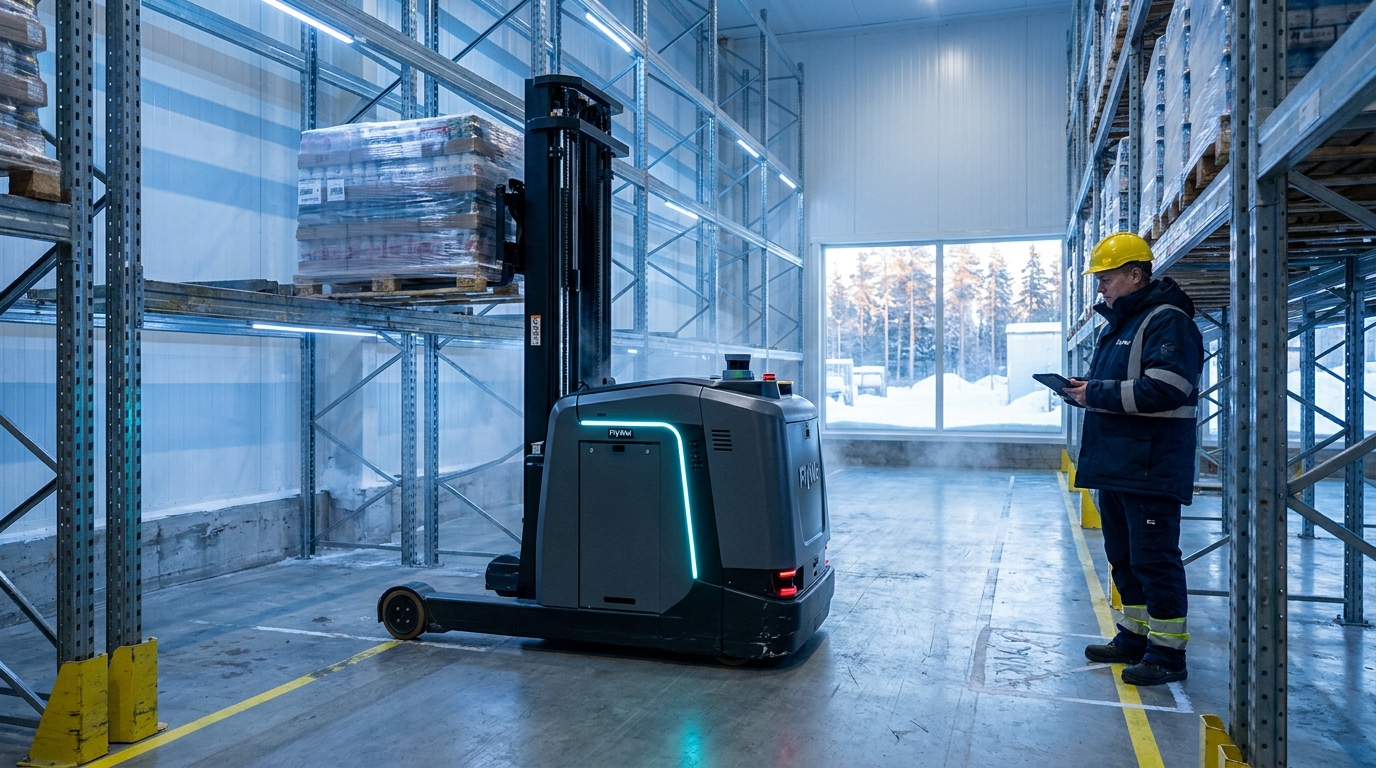
Autonomous forklifts for Nordic distribution centres are CE-certified, driverless industrial trucks (typically counterbalanced, reach or stacker variants) that move palletised goods through Swedish, Norwegian, Danish and Finnish warehouses without an onboard operator. According to Logistics UK, the wider European warehouse sector now carries a structural shortage of qualified forklift operators well into six figures, and Scandinavia is among the hardest-hit regions because of premium wage rates and a contracting working-age pool. For a Nordic retail-DC operations director, the squeeze is acute this quarter: night-shift overtime is unbudgeted, agency cover costs are climbing, and seasonal e-commerce peaks are landing on a labour base that simply will not stretch. The buying question is no longer whether to automate the pallet-handling layer; it is which CE-certified, open-standard autonomous-forklift platform integrates cleanly with an existing WMS without dragging the operation into a multi-year proprietary lock-in.
Why this is biting Nordic operators in 2026
Three forces are converging on the Nordic distribution-centre estate at the same time. The first is a labour market that has run out of slack. The Swedish, Norwegian, Danish and Finnish working-age cohorts are all contracting in absolute terms, and the materials-handling-equipment licence-holder population is contracting faster still. Operations directors who used to top up shifts with agency drivers from a wider European pool are now competing for the same labour with construction, last-mile delivery and the kerbside-recycling rollout.
The second force is wage. Across the Nordics, an hour of forklift-operator time, fully loaded, is materially more expensive than the EU mean, sometimes by 40 to 60 percent, once collective-agreement supplements, night-shift premiums, holiday accrual and statutory employer contributions are added. That cost asymmetry collapses the payback model for any automation that displaces operator hours; what looks marginal in a southern-European DC frequently looks compelling in Stockholm, Gothenburg, Oslo, Copenhagen or Helsinki.
The third force is regulatory. EN ISO 3691-4:2023, the harmonised standard for driverless industrial trucks, was implemented across the EU and EEA in the past 24 months, and is now the de facto buyer’s baseline. UK suppliers exporting to Scandinavia have had to bring their conformity files, risk assessments and post-market surveillance up to the standard; suppliers that have done so can sell with a single CE marking across the bloc, while suppliers that have not are bottlenecked in national approvals. Operators reading this should treat the conformity dossier as a procurement gating criterion, not an afterthought, exactly the way they treat workplace-transport safety in their own UK and Irish sites.
The four levers that fix it
1. Operational lever: redesign the floor for unmanned pallet flow
The single largest mistake a Nordic operations director makes when scoping autonomous forklifts is to drop the robots into an aisle layout that was drawn for manned trucks. The economics work when the floor flows for the robot, not the other way round. Practically, that means committing to four design moves before the first machine arrives: published one-way primary aisles wide enough for two-pallet clearance, dedicated charging bays sited near goods-in (so opportunity-charge windows align with inbound peaks), pedestrian segregation marked to BS EN 1838 illumination levels, and clearly chalked ‘exclusion zones’ around dock-edge approaches. With those four in place, throughput on the same square metres typically lifts by a third because the autonomous fleet runs at constant velocity instead of constantly yielding to human traffic.
2. Technical lever: VDA 5050 open standard plus a vendor-neutral fleet manager
The fleet-orchestration layer is where Nordic buyers most often get locked in. The defence is to insist on VDA 5050 v2.1 on every machine on the floor: the German VDA / VDMA open messaging standard that lets any compliant AGV or AMR exchange order, state and visualisation messages with any compliant fleet manager. With VDA 5050 in place, the operator owns the routing, not the OEM. The FlyWei M4 fleet manager sits at this layer, brokering task allocation across mixed-vendor estates and translating WMS-issued work orders into VDA-compliant mission packets, with the underlying fleet-intelligence approach documented separately. The same M4 instance can drive a counterbalanced forklift moving 2‑tonne paper rolls and a knee-height latent-jacking AMR shuttling sub-assembly trolleys, because both speak the same wire format. That is the difference between a fleet you can grow and a fleet you bought once.
3. Regulatory lever: treat EN ISO 3691-4:2023 conformity as a procurement gate
For a Nordic DC, the regulatory burden of an unmanned truck is materially higher than a manned one. The CE marking on the chassis covers electrical, mechanical and functional-safety design, but it does not relieve the operator of the duty of safe use. Under the local transpositions of the EU Machinery Regulation, and the parallel UK regime of PUWER 1998 and LOLER 1998 that many Nordic groups still use as an internal benchmark, the operator must commission, risk-assess and re-inspect the truck in its specific application. Insist on a supplier who hands you a complete conformity pack: the Declaration of Conformity, the technical file extract, the functional-safety analysis for the lift function, the laser-scanner field-test certificates, and a re-commissioning protocol you can put into your own permit-to-work system. If a supplier hesitates on any of these, the truck will become your liability the day it arrives.
4. Commercial lever: cold-storage and ambient compatibility under one platform
Nordic retail DCs are rarely single-temperature. A typical Stockholm or Copenhagen consolidation centre runs ambient, chilled and sometimes frozen zones inside the same envelope, with the trucks transiting between them across the day. The cheapest mistake is to buy two fleets, one for ambient and one for chilled, because the fleet manager can no longer load-balance across the estate. FlyWei autonomous forklifts in the counterbalanced and reach-truck classes are specified for sustained operation between +4°C and +30°C ambient, with battery chemistries chosen for cold-tolerant duty cycles; the fleet manager can route a single machine across temperature boundaries without re-tasking. That is how the second-shift payback model holds.
| Capability | FlyWei autonomous forklift estate | Vertical cube ASRS | Manual reach-truck baseline |
|---|---|---|---|
| Handles full EUR / industrial pallets | Yes, native | No: bin/tote only | Yes |
| Drops into existing racking | Yes | No: ground-up cube build | Yes |
| VDA 5050 v2.1 open orchestration | Yes | Proprietary | N/A |
| CE EN ISO 3691-4:2023 conformity | Yes | Different standard set | Operator-only |
| Operator-hour displacement at 2 shifts | High | Medium | Baseline |
| Typical payback window | 12 to 18 months | 3 to 5 years | N/A |
Autonomous forklifts for Nordic distribution centres are CE-certified, driverless industrial trucks that move palletised goods through Swedish, Norwegian, Danish and Finnish warehouses without an onboard operator; under EN ISO 3691-4:2023, with VDA 5050 v2.1 open orchestration, on the operator’s existing racking.
What FlyWei does in a Nordic deployment
FlyWei supplies and integrates autonomous-forklift fleets for Nordic retail DC operators end to end. The FlyWei autonomous-forklift platform covers the counterbalanced, reach and stacker variants needed for ambient and chilled zones, the heavy-lift and latent-jacking lifting-robot AMRs for sub-assembly and goods-to-person flows, and the M4 fleet manager that orchestrates the lot under VDA 5050 v2.1. The FlyWei fleet dispatch software takes the WMS work order and decomposes it into mission packets for whichever robot is best placed and best charged at the moment of dispatch: the same logic that runs in FlyWei solutions already in place at Magna Park, Daventry and the East Midlands corridor. For procurement teams comparing the cube-storage versus autonomous-forklift trade-off, the answer is rarely either-or; it is sequencing.
The conformity pack ships with every truck: EN ISO 3691-4:2023 Declaration of Conformity, functional-safety analysis, laser-scanner field-test certificates and a written re-commissioning protocol that drops straight into a Nordic operator’s permit-to-work system. For procurement teams running a parallel total cost of ownership model, the FlyWei commercial team will populate the SEK/NOK/DKK wage-rate columns and the local energy-tariff line items so the business case lands at the first capex committee, not the third.
Frequently asked questions
Do FlyWei autonomous forklifts need a separate national approval to operate in Sweden or Norway?
No. CE marking under EN ISO 3691-4:2023 is valid across the EU and EEA; Sweden, Denmark and Finland are EU members, and Norway is an EEA member with the same conformity recognition. The operator is still responsible for site-specific risk assessment and commissioning.
Can FlyWei autonomous forklifts work in a chilled or frozen zone?
The counterbalanced and reach-truck variants are specified for sustained operation between +4°C and +30°C ambient, covering the chilled-retail temperature band common in Nordic grocery DCs. Frozen-zone duty is a deployment-specific conversation; talk to the FlyWei team about your application.
Will the fleet plug into our existing WMS, or do we have to replace it?
Plug in. The FlyWei M4 fleet manager exposes a VDA 5050 v2.1 northbound interface and a standard REST adapter on the south side, so an existing enterprise WMS issues work orders in its native format and M4 translates. No WMS rip-and-replace is required.
What is the typical payback window for a Nordic DC?
Twelve to eighteen months at two-shift utilisation, driven by the SEK / NOK / DKK forklift-operator wage premium and the displacement of agency cover during peak. Single-shift sites typically see 18 to 24 months. The FlyWei team will model your specific shift pattern and energy tariff on request.
How do FlyWei autonomous forklifts compare with a vertical cube ASRS?
They solve different problems. A vertical cube ASRS handles bins and totes inside a purpose-built grid; FlyWei autonomous forklifts handle full EUR and industrial pallets inside your existing racking. Nordic retail DCs running palletised inbound from suppliers almost always need the pallet-layer automation first; the cube layer is an each-pick conversation, not a pallet conversation.
What safety standards apply on site once the trucks are commissioned?
EN ISO 3691-4:2023 governs the truck design and on-board safety functions. The operator is still bound by local workplace-transport rules (the EU Use of Work Equipment directive and its Nordic national transpositions, equivalent in scope to PUWER 1998 in the UK regime) covering risk assessment, inspection regimes and operator training for the supervisors who control the fleet.
Can the same fleet manager run mixed-vendor trucks?
Yes, provided every truck on the floor implements VDA 5050 v2.1. That is the entire point of the standard, and it is why FlyWei publishes the M4 conformity statement openly: you should not be forced to scrap a previous-generation truck because you bought a new fleet manager.
Talk to FlyWei. If you are scoping autonomous forklifts for a Swedish, Norwegian, Danish or Finnish distribution centre and want a CE-certified, VDA 5050 fleet on your existing racking with a 12-month payback line of sight, book a Nordic deployment consultation. We will walk the floor plan, model the shift economics in local currency and hand you the conformity pack before you commit.