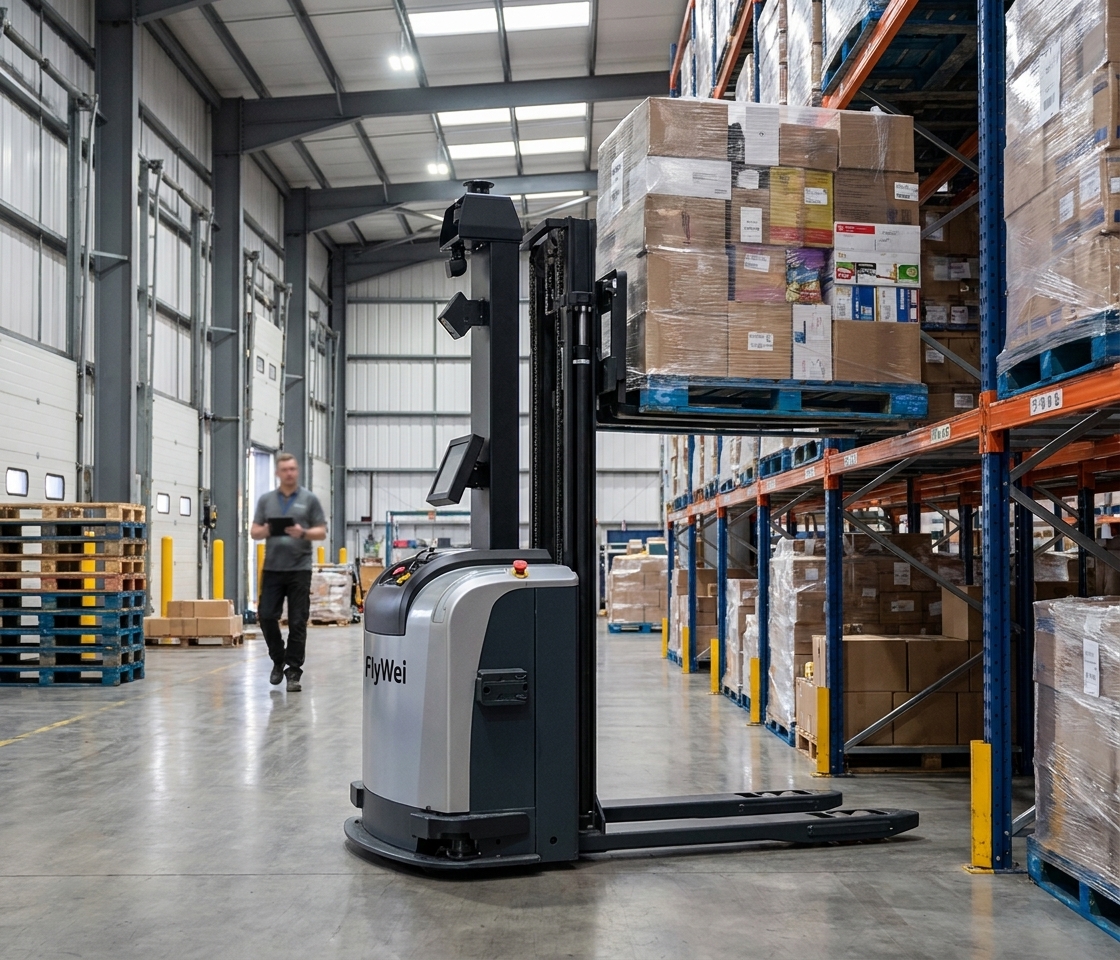
Autonomous forklifts are driverless industrial trucks that lift, stack and retrieve palletised loads under software control, navigating a live warehouse without a driver on board. In the UK they sit inside the same statutory regime as manned trucks: lifting equipment must be thoroughly examined at least every 12 months under the Lifting Operations and Lifting Equipment Regulations 1998 (LOLER), whether or not anyone sits in the seat. For a head of procurement in e-commerce fulfilment, that regime is the easy part. The hard part is the paper. Capex committees at Magna Park, DIRFT and SEGRO East Midlands Gateway are asked to approve six-figure automation on a business case built around a peak that lasts weeks, not quarters, with no per-move cost to set against the agency invoice, and no clear line for statutory inspection, floor works or software support across the asset's life.
Why the e-commerce capex paper keeps stalling
E-commerce fulfilment has a demand shape that capital committees are poorly built to assess. Volume through a large UK fulfilment centre is not flat; it swings between a quiet spring and a peak that can double pallet movements for a short, brutal window. Procurement is then asked to justify permanent capital against a temporary spike, using a payback model designed for a machine that runs at one rate all year.
The second problem is comparability. Agency labour arrives as a weekly invoice with a visible hourly rate. Automation arrives as a single figure with an implementation schedule attached. The two are not written in the same currency, so the committee cannot make the only comparison it actually wants to make — what does one pallet move cost, by each method, in December and in March.
Third, the regulatory cost is usually invisible. Driverless trucks are still work equipment. The Provision and Use of Work Equipment Regulations 1998 apply in full, and the Health and Safety Executive is explicit that duty holders must ensure equipment is suitable, maintained and inspected. Workplace transport remains one of the areas the HSE treats as a priority risk in warehousing, and its workplace transport guidance applies to automated and manual movement alike. None of that disappears because the seat is now a sealed enclosure — but it rarely appears in the quote.
Finally, the estate itself carries hidden cost. Narrow-aisle work at height depends on floor flatness, and a brownfield fulfilment centre with a decade of pallet traffic behind it may need remedial work before any truck runs to eight metres. That is a real number, and it belongs in the paper.
Autonomous forklifts are driverless industrial trucks that move palletised loads under software control, and in the UK they remain subject to the same statutory duties as manned trucks — including thorough examination of lifting equipment at least every 12 months under LOLER 1998.
Lever 1 — Price the flow, not the truck
Start from movements, not machines. For each flow — goods-in to bulk, bulk to pick face, pick face to despatch — record moves per shift, distance, lift height and the hours during which the flow must run. That gives a duty cycle. Divide the fully loaded annual cost of the automated option by the annual moves it absorbs, and you have pence per pallet move. Do the same arithmetic for the agency option, including induction, supervision, licence checks and the premium paid for peak cover. The committee can now compare two numbers written in the same units. This single reframing does more to get automation approved than any technical specification, because it moves the decision from "should we buy robots" to "which method of moving a pallet is cheaper at our volume". It also exposes flows that should stay manual, which is a credibility gain, not a loss.
Lever 2 — Make orchestration the asset, not the chassis
The truck is the visible cost; the software decides whether the investment scales. A fleet manager sits between your warehouse system and the vehicles, taking work over a documented interface, converting it into missions, arbitrating traffic and handling charging strategy. Insist that this layer speaks the VDA 5050 open standard natively, so that a second or third truck class added in two years does not require a fresh integration. Ask what happens when the link to the warehouse system drops: a well-designed fleet layer finishes the issued task, holds safely, queues completions and replays them on reconnection without duplicating stock movements. FlyWei's M4 fleet manager and RDS robot dispatch exist for exactly this seam. Specify the interface, the exception paths and the ownership of each side in the capex paper — integration is where warehouse automation projects overrun, and it is costed separately from the vehicles.
Lever 3 — Put the statutory line items in the paper
Regulatory compliance is a budget line, and writing it down early removes the objection that automation carries unknown risk. Three references cover most of it. PUWER 1998 governs suitability, maintenance and inspection of the trucks as work equipment. LOLER 1998 governs thorough examination of the lifting function at defined intervals. ISO 3691-4, published through the international standards system and adopted in the UK through BSI, sets the safety requirements for driverless industrial trucks and their systems, including protective device performance and the design of the operating zone. Add floor tolerance against the concrete industry's TR34 guidance where trucks work at height, and add the cost of a documented safety case. Four visible lines beat one contingency percentage, because a committee can challenge a line but can only reject a percentage.
Lever 4 — Match the funding structure to the demand curve
An e-commerce demand curve rarely justifies outright purchase on the first tranche. Structured terms let procurement convert a capital request into an operating line that tracks the contract it supports, which is usually the difference between approval and deferral. The table below is the comparison most capex committees actually want in the pack.
| Option | What the committee signs | Cash profile | Peak flexibility | Best fit |
|---|---|---|---|---|
| Outright capital purchase | One capital request, asset on balance sheet | Front-loaded, then maintenance only | Low — fleet sized for peak sits idle in trough | Stable year-round flows, long site tenure |
| Three-year lease | Operating line, short commitment | Level monthly, shortest total term | High — refresh or resize at term end | Contract logistics with a three-year customer term |
| Five-year lease | Operating line, mid commitment | Level monthly, lower than three-year | Medium | Owned or long-leased fulfilment centres |
| Seven-year lease | Operating line, longest commitment | Lowest monthly, longest exposure | Lower — resize windows are further apart | Mature, predictable flows with stable SKUs |
| Agency labour only | No capital request at all | Variable, rises sharply at peak | High, at the highest unit rate | Genuinely seasonal, low-volume overflow |
Whichever route the committee prefers, the arithmetic should be run on the same duty cycle from Lever 1. FlyWei publishes three, five and seven-year terms on the leasing page so that the comparison can be built before a site visit.
What FlyWei does here
FlyWei is an independent, vendor-neutral UK systems integrator. That matters to a procurement function more than it matters to anyone else in the building, because it means the truck class recommended for each flow is chosen on duty cycle and payback rather than on a catalogue. FlyWei designs and integrates autonomous forklifts across manufacturers — counterbalanced trucks for bulk and despatch, narrow-aisle reach trucks for high-bay pallet storage, pallet-truck classes for dock-to-stock runs — alongside lifting robots where cartons and totes rather than pallets are the unit of movement.
For an e-commerce fulfilment centre, a typical FlyWei engagement starts with a flow survey rather than a machine list: moves per shift, aisle widths, floor condition, charging positions and the interface your warehouse system can expose. The M4 fleet manager then orchestrates mixed classes in one traffic model, with RDS dispatching work from your existing system so it stays the record of stock. Commissioning is phased flow by flow, so the first tranche proves cost per move before the second tranche is signed. UK-based engineers hold the maintenance and thorough examination schedule, and the same numbers used to win approval become the numbers reported back to the committee.
Frequently asked questions
What is an autonomous forklift?
An autonomous forklift is a driverless industrial truck that lifts, transports and places palletised loads under software control. It navigates using on-board sensing rather than fixed wire guidance, receives tasks from a fleet management layer, and carries no seat, steering wheel or overhead-guard cab.
How much do autonomous forklifts cost in the UK?
Cost depends on truck class, lift height, duty cycle and integration scope rather than on a single list price. The useful figure for a capex committee is cost per pallet move across the year, which is why FlyWei quotes a fleet-sizing estimate against your measured flows and offers three, five and seven-year leasing terms.
Do autonomous forklifts need a LOLER thorough examination?
Yes. LOLER 1998 applies to the lifting function of the equipment regardless of whether an operator is on board, so the statutory thorough examination interval still applies and should appear as a visible line in the whole-life cost.
What standard covers driverless forklift safety?
ISO 3691-4 sets the safety requirements and verification for driverless industrial trucks and their systems, and it is adopted in the UK through BSI. PUWER 1998 sits alongside it as the duty on the operator to provide suitable, maintained and inspected work equipment.
Can an automated forklift work in a fulfilment centre that already has racking?
Usually yes. Brownfield deployment is the normal case in UK e-commerce. The constraints to check first are aisle width, floor flatness at height, charging positions and the pallet quality entering the site — not the racking itself.
Do we need to replace our warehouse system to run a driverless forklift fleet?
Normally not. An orchestration layer sits above the existing system and takes work from it, so that system remains the source of truth for stock and orders. Where no live interface exists, a scheduled export and import of confirmations is often enough to start.
How long does a first deployment take?
The vehicles are rarely the long pole. Mapping order and stock fields, agreeing exception handling and testing against live data set the timeline, so sites with a documented interface and a test environment move fastest. Phasing flow by flow keeps the first tranche small and measurable.
If the cost of covering peak with agency drivers is on your Q3 risk register, the next thing your committee needs is a number it can compare — not another brochure.
Request a fleet-sizing and ROI estimate for your DC, or review truck classes and duty cycles on the autonomous forklifts page first.
Related reading: automated forklift AGV deployment in UK e-commerce.
UK-based engineers. No obligation. We reply within one business day.