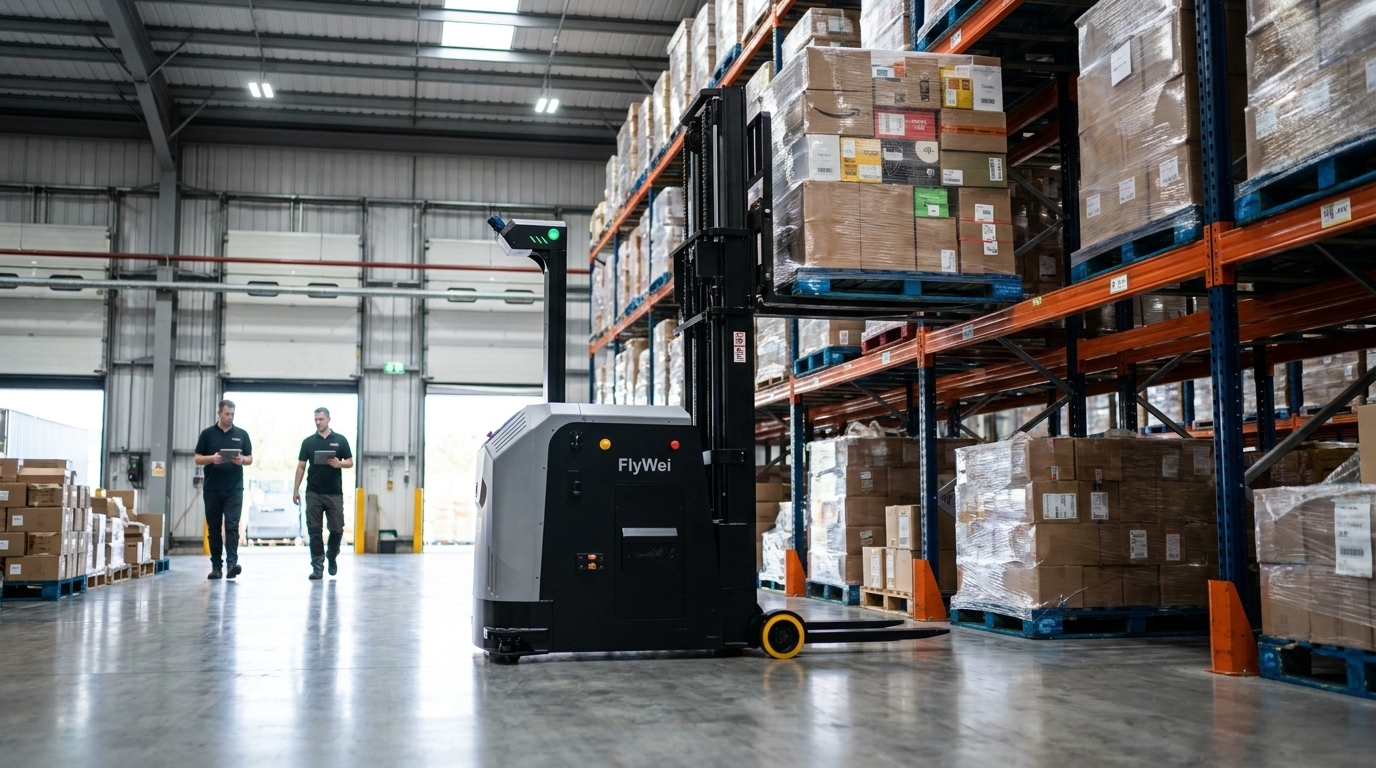
An automated forklift AGV is a driverless industrial truck that lifts, carries and stacks palletised loads under software control, without an onboard operator. The safety case is blunt: roughly 5,000 workplace transport accidents happen in Great Britain each year and about 50 are fatal, according to the Health and Safety Executive. For an operations director running a UK e-commerce fulfilment centre, that risk sits on top of a harder commercial problem. Goods-to-person and tote-based automation has taken the pick face, but the pallet layer around it — trailer unloading, dock-to-stock putaway, replenishment into the mezzanine, empty-pallet clearance — is still manual, still agency-staffed, and still the first thing to break when volumes ramp into the Black Friday build. Peak planning starts in Q3, agency rates climb, and the same pallet flow that looked comfortable in June becomes the constraint that caps every automated pick station downstream.
Why the pallet layer breaks before the pick face does
UK e-commerce fulfilment has automated from the pick face outwards. Tote-based storage, goods-to-person stations and conveyor-fed pack lines all target the touch a customer can feel, and they measure well: units per hour, pick accuracy, cost per order. The pallet layer underneath has been left alone because it is unglamorous and because it looks flexible — a counterbalance truck and a driver can, in principle, do anything. That flexibility is exactly the problem. Manual pallet flow absorbs variability by absorbing labour, so when volumes climb the site does not see a queue building in a control system; it sees another agency shift added to the rota. Logistics UK and the wider industry have documented the structural shortage of qualified operators across warehousing and transport, and the sites that feel it first are the seasonal ramps in the big Midlands parks — Magna Park, DIRFT, SEGRO East Midlands Gateway and the estates around Daventry.
The second reason is architectural. Goods-to-person automation is dense and fixed, and it wants a steady, predictable feed. Pallet moves are lumpy: a trailer arrives, a full load needs breaking down, and the replenishment queue to the mezzanine spikes. When that feed is manual, the automation downstream idles at exactly the moments it costs most. Operations directors then discover that the business case they signed for the pick face is being quietly clipped by a process nobody modelled. Add the safety exposure — pedestrians, pallet trucks and counterbalance trucks sharing a congested goods-in apron under Health and Safety Executive workplace transport guidance — and the pallet layer stops being a housekeeping issue and becomes a board-level constraint.
An automated forklift AGV is a driverless industrial truck that lifts, carries and stacks palletised loads under software control, without an onboard operator.
Lever 1: map the pallet layer flow by flow before buying a single truck
Start with a flow inventory, not a robot specification. List every repeatable pallet move on site: trailer to marshalling, marshalling to bulk store, bulk to pick-face replenishment, empty pallet and cardboard clearance, returns pallets back to bulk. For each one, record distance, load type, lift height, peak hourly rate and how many hours a day it genuinely runs. Two things fall out immediately. First, most sites find that three or four flows account for the majority of manual truck hours, and those flows are long, straight and repetitive — precisely the profile an automated forklift AGV handles best. Second, the flows that look hardest to automate are usually the ones nobody has standardised: pallets presented at inconsistent heights, wrapped poorly, or staged wherever there is space. Fixing presentation is cheap, happens before any robot arrives, and is the single strongest predictor of whether a deployment hits its rate. Sites that skip this step automate chaos and then blame the truck. The same discipline underpins any goods-to-person feed strategy.
Lever 2: orchestrate one mixed fleet from a single control layer
A fulfilment centre rarely needs one robot type. Pallet moves want counterbalance and reach-truck class machines; cart and tote shuttling wants low-profile latent-jacking units. The failure mode is buying them separately and ending up with two traffic systems that cannot see each other at the same aisle intersection. The answer is a fleet manager that owns the map, the traffic rules and the job queue for every machine on site. FlyWei's M4 fleet manager holds that single map and arbitrates deadlocks; RDS robot dispatch turns operational events — a trailer booked in, a pick face dropping below its minimum — into prioritised jobs rather than a fixed timetable. Insist on VDA 5050 as the interface between fleet manager and vehicle, because that is what keeps a second or third machine class addable later without a bespoke integration each time. Integration to your existing ERP and WMS should be event-driven, and read-only wherever the process allows it. One practical test at tender stage: ask how a supplier resolves two machines of different classes meeting head-on in a shared aisle. If the answer involves a human radioing the shift manager, you are buying two fleets, not one.
Lever 3: treat PUWER, ISO 3691-4 and the floor as design inputs
Compliance is not a gate at the end; it decides the layout. Under the Provision and Use of Work Equipment Regulations 1998 (PUWER), the duty holder must ensure equipment is suitable, properly maintained and used only by people who have been adequately instructed — which for a driverless fleet means documented safe systems of work for supervisors, defined recovery procedures and clear demarcation of shared areas. ISO 3691-4 covers driverless industrial trucks and their systems, and it is the reference your safety file should be written against: protective field sizing, speed-reduction zones and expected behaviour at blind corners. The third input is the slab. Mast-height accuracy depends on floor flatness, so a TR34 survey of the aisles you intend to automate belongs in the feasibility stage, not the snagging list. Get these three right and the deployment programme stops slipping to the left of peak.
Lever 4: phase the fleet against the peak curve, not the capex year
The most common planning error is sizing for the busiest hour of the busiest week and buying that entire fleet on day one. It inflates the capital ask, delays approval, and lands commissioning in the worst possible window. Phase it instead. Take the two highest-hour flows from Lever 1, deploy against those, and run them alongside the manual process for a defined proving period so the site never depends on unproven throughput during a ramp. Once the rate is evidenced, phase two is a copy of a working configuration rather than a new project. The commercial structure should follow the same logic: leasing over 3, 5 and 7-year terms lets an operator match payments to flows already proven, keeps phase one clear of a single capex committee cycle, and turns phase two into an amendment rather than a fresh business case. Operations gets trucks before peak; finance gets a predictable line.
| Pallet flow | Typical manual failure mode | AGV suitability | KPI for the board pack |
|---|---|---|---|
| Trailer to marshalling | Bunching at the dock when arrivals cluster | Medium — needs booked slots and a fixed drop pattern | Dock clearance time per trailer |
| Marshalling to bulk store | Long repetitive runs absorbed by agency hours | High — the classic first flow | Pallets moved per robot hour |
| Bulk to pick-face replenishment | Pick-face stockouts during a ramp | High — event-driven jobs suit dispatch software | Pick-face availability, per cent |
| Empty pallet and cardboard clearance | Deprioritised all shift, then blocks aisles | High — low value, high volume, always deferred | Aisle blockage incidents per shift |
| Returns and rework pallets to bulk | Irregular, poorly presented loads | Low to medium — standardise presentation first | Rework pallets aged beyond 24 hours |
What FlyWei does in an e-commerce fulfilment centre
FlyWei is an independent, vendor-neutral UK systems integrator of autonomous forklifts and AMRs. That independence matters in this exact scenario: the pallet layer and the cart layer of a fulfilment centre have different physics, and FlyWei selects the right machine class for each flow from across multiple manufacturers rather than bending the site to fit one catalogue. A typical engagement opens with the flow inventory described above, run by FlyWei engineers on your site across a shift or two, and closes with a phased deployment plan tied to your peak calendar.
On the equipment side, FlyWei supplies and integrates automated forklift AGV classes — counterbalance machines for dock and bulk work, reach trucks for narrow-aisle high-bay, and stacker and pallet-truck variants for lower, longer runs — alongside lifting robots and latent-jacking AMRs where carts and totes are the unit of movement. M4 runs the whole fleet as one traffic system; RDS connects it to the events your operation already generates. FlyWei writes the safety file against ISO 3691-4, prepares the PUWER-facing documentation with your engineering team, and supports the fleet from UK bases with UK-based engineers. Sector-specific configurations are set out across the FlyWei solutions range.
Frequently asked questions
What is an automated forklift AGV?
An automated forklift AGV is a driverless industrial truck that lifts, carries and stacks palletised loads under software control, taking jobs from a fleet manager rather than a driver.
How is an automated forklift AGV different from a driverless forklift or an AGV forklift truck?
They describe the same machine. Automated forklift AGV, driverless forklift and AGV forklift truck are used interchangeably in UK buying conversations; what differs is truck class and safety architecture. Our fleet guide compares the classes.
Can automated forklift AGVs be deployed in a live fulfilment centre without a shutdown?
Yes — that is the normal case. Brownfield deployments run flow by flow: one or two pallet flows commissioned alongside the manual process, proven at rate, then relied upon. Racking changes are rarely needed.
What safety rules apply to automated forklift AGVs in the UK?
PUWER 1998 covers suitability, maintenance and instruction. ISO 3691-4 is the standard for driverless industrial trucks, governing protective fields, speed zones and behaviour at blind corners. Health and Safety Executive workplace transport guidance covers the wider site.
Do we need a new warehouse floor?
Rarely a new slab, but you need to know what you have. Lift accuracy depends on floor flatness, so a TR34 survey of the aisles you intend to automate belongs in feasibility. Localised repair usually suffices.
How do automated forklift AGVs integrate with our warehouse software?
Through the fleet manager, not truck by truck. M4 holds the site map and traffic rules; RDS turns events from your existing ERP and WMS into prioritised jobs. VDA 5050 keeps the vehicle interface open.
What is a realistic first deployment scope before peak?
Two flows — typically marshalling to bulk store and bulk to pick-face replenishment, both long, repetitive and measurable. Scoped this way, phase one commissions with a proving period ahead of the Q4 ramp.
If pallet flow into and out of your pick face is on your Q3 risk register, the fastest way to size the opportunity is to have an engineer walk the flows with you.
Book a free 30-minute site survey with FlyWei, and we will map your highest-hour pallet moves against the automated forklift AGV classes that suit them.
UK-based engineers. No obligation. We reply within one business day.