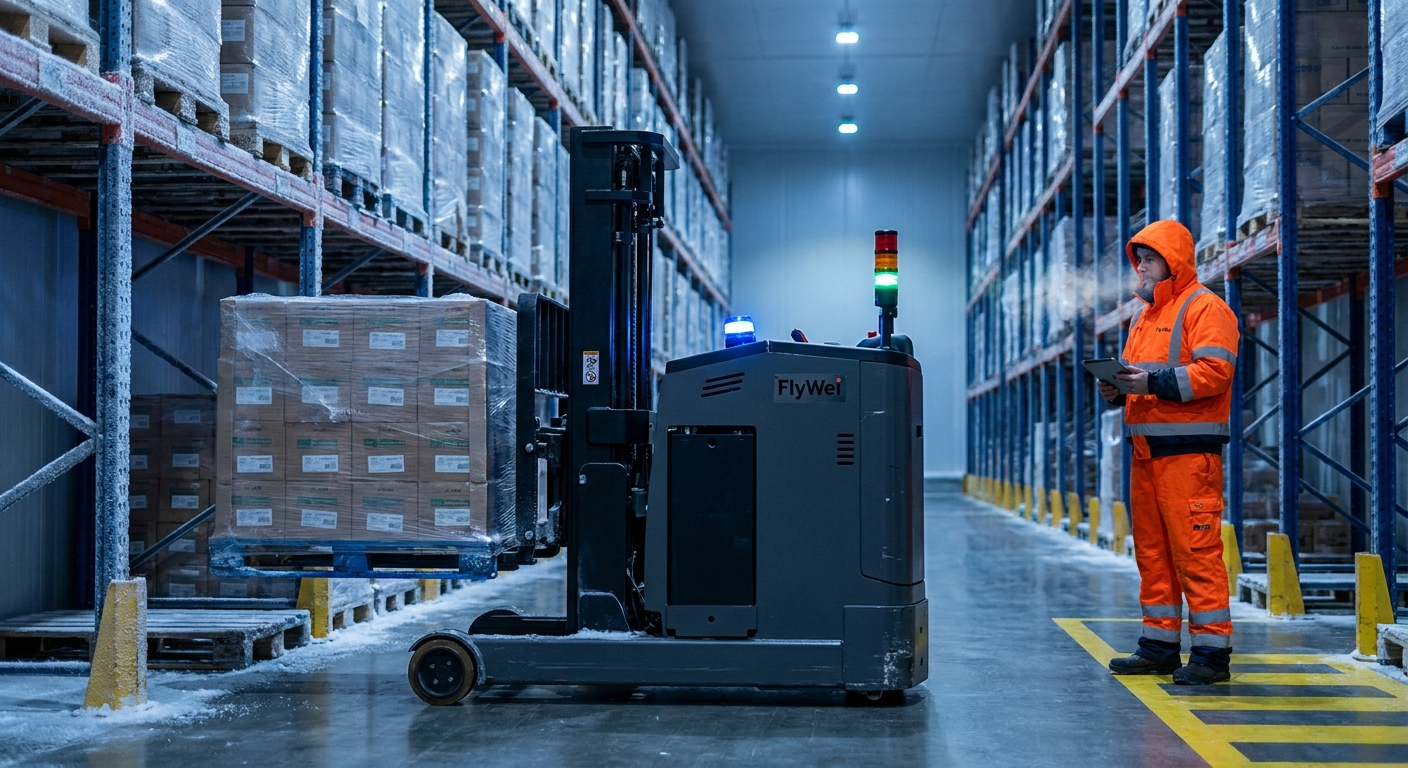
A cold storage autonomous forklift is a freezer-rated, driver-less truck designed to lift, stack and shuttle pallets inside chilled and frozen UK distribution centres without a human operator at the controls. Around a quarter of UK workplace-transport accidents involve lift trucks, according to HSE workplace transport guidance, and freezer floors amplify that exposure through condensation, glove fatigue and shortened concentration windows. For a UK cold-store warehouse manager running 24/5 across Magna Park, DIRFT or Burton-on-Trent this summer, three problems collide: a freezer-driver shift that takes weeks to fully train but turns over inside a year; a frozen-ready-meal demand spike that has compressed outbound trailer windows to little more than twenty minutes; and a peak that arrives six weeks earlier than the seasonal plan allowed for. A cold storage autonomous forklift sustains that throughput at -25°C without rest breaks, glove changes or seasonal re-training cycles.
Why this is hurting UK cold-store throughput right now
Why does freezer-driver churn keep widening? Three structural forces are pushing UK cold-chain warehouse managers into the gap.
First, the labour market for freezer-trained counterbalance and reach-truck operators has thinned. The cold-chain operator trains a driver to PUWER-compliant standard, fits them out with freezer PPE, exposes them to -25°C for forty-five-minute working windows, and watches a meaningful share leave for ambient warehouses where the gloves come off. Logistics UK tracks driver and warehouse-operative shortages in its annual workforce reports; the gap between vacancy and fill has been widest in temperature-controlled depots for several years running.
Second, peak demand has moved earlier in the year. Frozen-ready-meal and ice-cream-aisle replenishment used to spike in late July; consumer behaviour now starts the curve in early June. The result is that a warehouse manager built her labour plan around historical seasonality, and reality has overtaken the plan by six weeks. Outbound trailer windows that used to be thirty-five minutes are now roughly twenty-two, because the supermarket DC behind them is doing the same compression.
Third, the regulatory standard for driverless industrial trucks finally caught up. ISO 3691-4:2023 sets the safety requirements for driverless industrial trucks, including how they must detect a pedestrian, slow on a wet floor, and hand over control during a charge cycle. The UK then layers PUWER 1998 on top: every piece of work equipment must be suitable, inspected, and used by trained people, and autonomous trucks comply once the safety case has been written and approved by the in-house competent person.
Add it up: the labour is leaking, the peak has shifted, and the standards now permit a credible non-human alternative. UK cold-store warehouse managers who do nothing this summer are quietly betting that 2027 will be easier.
Lever 1: Lock the twenty-minute trailer window with a freezer-rated cold storage autonomous forklift
If the outbound dock controls a UK frozen DC's daily throughput, the answer is not to push more humans through the freezer; it is to put a sub-zero-rated autonomous counterbalanced forklift on the dock-to-trailer move. A freezer-rated truck runs continuously between the pick-face and the trailer at -25°C, with a sealed electronics enclosure replacing the cab and a top-mounted LiDAR puck reading the lane markings. Because the truck does not need rest breaks, does not stop for glove changes, and does not slow down at the end of a forty-five-minute exposure window, the twenty-minute trailer window is achievable on every load, not just on the first three of the shift. Specify a unit that has been declared compliant with ISO 3691-4 by the manufacturer's TÜV or BSI audit so the PUWER conformity step is short. Pilot it on one dock first; expand only once the cycle-time data proves repeatability.
Lever 2: Use M4 fleet management to balance trucks between blast freeze, racking and outbound docks
The technical lever that turns a small autonomous fleet into a throughput weapon is real-time orchestration. M4, FlyWei's fleet manager, speaks VDA 5050-aligned messaging to mixed-vendor robots and decides, every second, which truck should be moving which pallet. In a UK cold-store running blast-freeze, racking and outbound at the same time, M4 reads the inbound trailer schedule, the racking tier-down status and the outbound dock allocation, then re-prioritises moves so the constraint of the hour gets the trucks. Connect M4 to the operator's existing enterprise WMS over its REST and webhook interfaces, and the warehouse manager sees one dashboard rather than three vendor consoles. Add the FlyWei fleet dispatch software on top and the same operating model extends to mixed AMR types: counterbalanced for pallet moves, latent-jacking for cage moves, heavy-lift for bulk product. The freezer is now treated as one system, not three rooms with separate driver lists.
Lever 3: Build the PUWER safety case before the equipment lands
The regulatory lever is the one most warehouse managers under-budget. UK PUWER 1998 requires every piece of work equipment to be suitable for use, properly maintained and used only by trained people. For autonomous trucks the practical workstream is short but non-trivial: a written safety case covering hand-over, charge, fault and pedestrian-overlap scenarios; a competent-person sign-off naming who can stop the truck and who can release it; and a documented inspection regime aligned to the BSI-published ISO 3691-4 annex. The HSE PUWER pages make explicit that the duty does not shift to the vendor: it sits with the warehouse manager who controls how the equipment is used. Start the safety case at the order stage, not at go-live. Six weeks before the truck arrives, the dock layout, the exclusion-zone marking and the pedestrian routing should already be drawn.
Lever 4: Re-deploy your freezer driver into a supervisor and exception role
The mistake managers make when they introduce a cold storage autonomous forklift is to plan for redundancy rather than redeployment. The freezer-experienced FLT driver is the most valuable person to keep: they read the racking, they know which pallets are wrappable and which are not, and they spot a stretch-film failure six pallets earlier than a junior would. Pull them out of the cab, give them a tablet, and put them in the fleet-supervisor seat that M4 needs. Two supervisors covering a 100,000 sq ft freezer is a sustainable structure; two drivers plus six robots is throughput. Build the redeployment offer into the project gate at week zero: a pay-banding move from FLT operator to robotics technician, with a six-month training plan that includes a Logistics UK-accredited course module. Without this lever, the operational unions block the project; with it, they sign, and you keep the cold-store muscle memory inside the building. Add a written exception protocol so the supervisor knows when to intervene manually (a fallen pallet, a frosted reflector, a pedestrian breach) and the robot fleet stays auditable from day one.
| Dimension | Freezer driver | Cold storage autonomous forklift |
|---|---|---|
| Continuous time at -25°C | Forty-five-minute working windows with mandated breaks | Full shift, no rest cycle required |
| Training time to full PUWER competence | Several weeks of supervised exposure | Once the safety case is written, days for supervisors |
| Outbound trailer window achievable | Twenty-two minutes on the first three loads, then slips | Twenty-two minutes on every load |
| Annual headcount churn (UK cold-chain) | Sustained pressure across the sector | None; software updates only |
| Regulatory standing | PUWER plus manual operator competence | PUWER plus ISO 3691-4 safety case |
A cold storage autonomous forklift sustains pallet throughput at -25°C without the rest breaks, glove changes and seasonal re-training cycles that limit human freezer drivers in UK distribution centres.
What FlyWei does in a UK cold-store
FlyWei integrates cold-storage robotics for UK frozen and chilled distribution centres. The fleet you would deploy in a 100,000 sq ft Burton-on-Trent or East Midlands Gateway freezer is built around three machines: FlyWei autonomous counterbalanced forklifts for trailer load-and-unload at -25°C; FlyWei reach-truck autonomous forklifts for narrow-aisle racking up to eight metres; and FlyWei lifting robots for the lower bays where pallets must be re-tiered. M4 sits over all three and listens to the existing enterprise WMS over REST. Fleet dispatch software decides which machine takes the next move and where it goes to charge. The hand-off between the three systems is what the warehouse manager sees as throughput.
FlyWei delivers the safety case and PUWER documentation alongside the trucks. You receive a competent-person briefing pack, a pre-written exception protocol for fallen pallets and frost-fogged reflectors, and a redeployment template for the existing freezer drivers. The first dock goes live in eight weeks, the second in twelve, and from week sixteen you can scale to a full freezer floor. For broader context on cold-store automation strategy, see our earlier guides on cold-store pallet-stacker procurement and cold-chain warehouse automation across multi-site UK estates.
We support the deployment from our UK base. Site visits, maintenance, spares and software updates are handled in-country; the M4 dashboard is hosted in the UK. The result is a cold storage autonomous forklift fleet that runs on UK time, on UK rules, and under your name on the safety case.
Frequently asked questions
Will a cold storage autonomous forklift work down to -25°C without a heated cab?
Yes. There is no cab. The cab area is replaced with a sealed electronics enclosure that holds the compute, controller and LiDAR cluster at the truck's operating temperature. Lubricants, battery and seal sets are specified for the freezer range to -30°C in the current counterbalanced and reach-truck variants.
How does PUWER apply when the truck has no driver?
PUWER 1998 places the duty on the employer who controls how the equipment is used. The autonomous truck is work equipment; the warehouse manager's competent person signs the safety case, the inspection regime and the user training. HSE PUWER guidance makes this explicit, and the route is well established for ISO 3691-4-compliant machines.
How long is a typical UK cold-store pilot?
A first-dock pilot is usually eight weeks from purchase order to live moves. A full freezer-floor scale to a six-truck fleet takes three to four months, mostly driven by training and exception-protocol writing rather than by the trucks themselves.
Can M4 manage a mixed-vendor fleet?
Yes. M4 supports VDA 5050-aligned messaging, and fleet dispatch software handles the dispatch logic across vendor types. A FlyWei fleet can be extended with other VDA 5050-compliant machines without rebuilding the orchestration.
What happens when a pallet falls or a reflector frosts over?
The exception protocol pauses the truck in place, flags the supervisor on the M4 dashboard, and rolls back the WMS move. The supervisor clears the obstruction, signs off the restart, and the truck rejoins the schedule. The audit log is retained for the PUWER inspection record.
How does this affect the freezer-driver headcount?
Most cold-store deployments retain the experienced FLT driver as a fleet supervisor or robotics technician. The redeployment offer is part of the project gate from week zero and is a key reason the operational unions back the project rather than fight it.
If you operate a UK cold-store at over 100,000 sq ft and the summer peak is exposing the freezer-driver gap, a one-page site survey is the right next step. Talk to FlyWei about a single-dock pilot, the PUWER safety case and an M4 trial: site visits are arranged from our UK base. Contact the FlyWei cold-chain team.