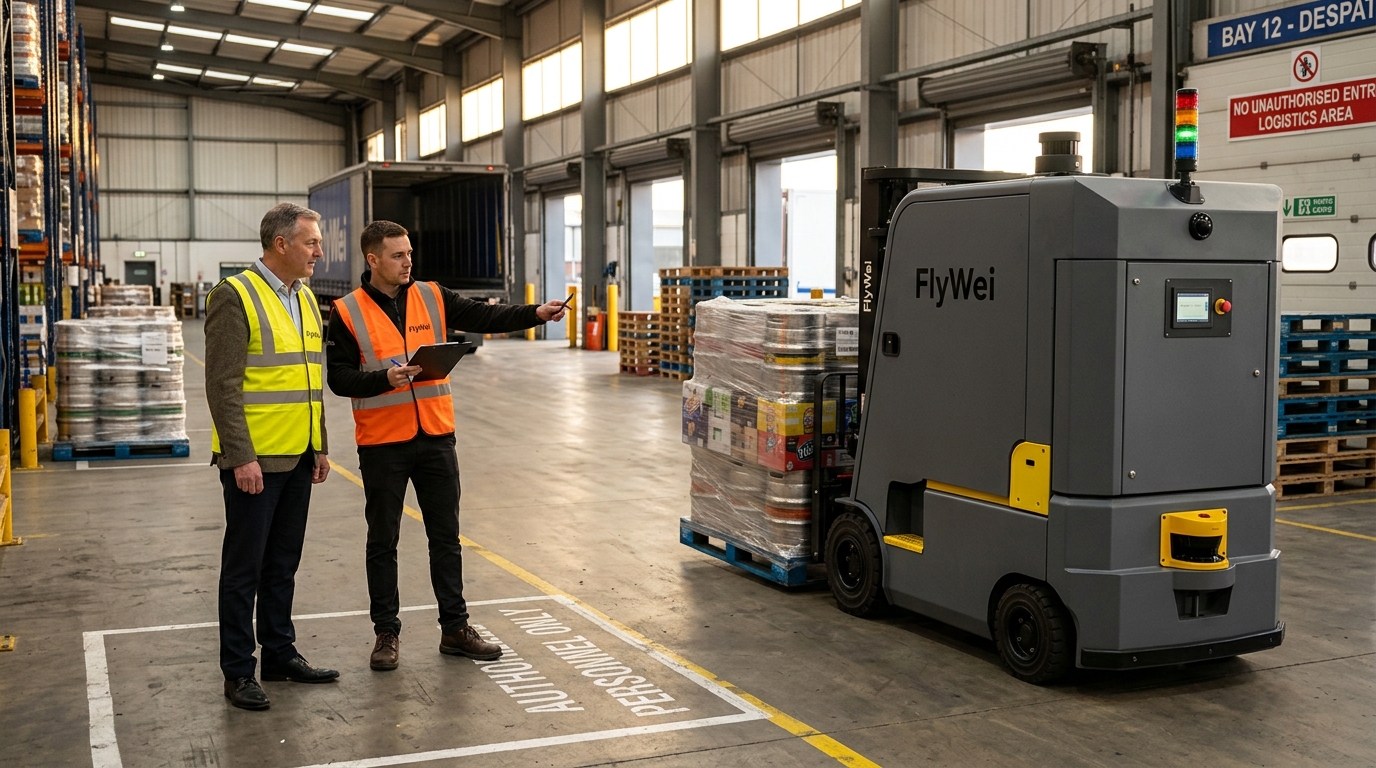
Drinks supply chain automation in the UK is the use of autonomous forklifts, latent-jacking AMRs and centralised fleet orchestration to move palletised beer, soft drinks, spirits and returned kegs between breweries, regional distribution centres and customer delivery loops without depending on a fragile pool of LGV-licensed forklift operators. According to Logistics UK's most recent workforce barometer, the industry still reports a national shortfall of around 39,000 vacancies across LGV and warehouse roles, and the labour-intensive UK drinks sector (anchored on hubs in Burton-on-Trent, Magna Park and DIRFT) feels that shortfall acutely between Easter and Christmas. For a supply chain director running three to nine sites with peak swings of 35 to 60% over baseline, the problem is no longer the cost of a single forklift hour; it is the inability to flex labour fast enough to keep service levels above 98% across every site simultaneously.
Why drinks supply chains break first under peak demand
Three structural pressures collide in the UK drinks sector and they hit harder than in adjacent FMCG categories. The first is volumetric volatility. Easter, Wimbledon fortnight, the August bank holidays, the rugby internationals and the run-up to Christmas all create demand spikes of 35 to 60% over a working baseline, but the underlying production schedule at the brewery cannot flex at the same speed; the result is a swing in pallets despatched per shift that the warehouse layer is expected to absorb on labour alone.
The second is asset complexity. A drinks distribution centre carries far more SKU shapes than a chilled food DC: shrink-wrapped multipacks, cardboard outers, kegs in barrel cages, glass bottles in returnable crates, picked mixed pallets for on-trade routes, and a steady reverse-logistics flow of empties. Each shape needs a different forklift attachment or handling profile, and the safest pairing of attachment to load is encoded in PUWER 1998 risk assessments that have to be kept current.
The third, and the one most SC directors underestimate, is the licence pyramid. Forklift counterbalance and reach-truck operators in the drinks sector are also frequently LGV-licensed because the same site needs flexible labour between yard tractor, dock and racking work. The pool of dual-licensed staff is small and ageing. Health and Safety Executive guidance on workplace transport is unambiguous about the risk profile of fatigued operators, so a "just run another shift" answer is neither legally nor humanely available. Automation is the only structural pressure-release valve left.
The four levers an SC director can pull
Lever 1: Standardise end-of-line pallet flow at every brewery and DC (operational)
The cheapest yard of automation in a drinks supply chain is the move from the production-line discharge conveyor to the despatch racking. It is repetitive, the pallet profile is known, and the route is largely linear. Standardising that single flow at every brewery (same pallet specification, same SKU label, same dock-door logic, same rate-per-hour target) means a counterbalanced autonomous forklift can be dropped in without bespoke commissioning at each site. Crucially, this is also where the regulatory case is easiest to make: clear travel paths, fixed origin and destination, predictable load weight inside the rated capacity. An SC director who insists on this standardisation before any other lever sets the foundation for everything else, including the central fleet manager. Without it, every site becomes its own snowflake and the central rule-set turns into nine site-specific rule-sets in a trench coat.
In drinks supply chain automation, the cheapest yard of robotics is the move from line discharge to despatch racking: standardise that one loop at every brewery before you orchestrate anything else.
Lever 2: Centralise dispatch with an M4-style fleet manager (technical)
One M4 fleet manager pulled across every drinks site is the single biggest unlock available to a multi-site SC director. The job of the fleet manager is to turn the question "do we have capacity right now?" from a phone call into a dashboard. Modern fleet managers speak VDA 5050-compatible interfaces, so the same orchestration loop can talk to autonomous forklifts at one site and latent-jacking AMRs at another, hand off jobs based on capacity, and reroute around blocked aisles in real time. It also gives you something that is impossible to do with humans alone: a per-job audit trail that finance can reconcile against pallets despatched. That audit trail is what turns automation from a capex bet into a board-defensible operating model, because every minute of every robot is tied to a despatched pallet. The site WMS and the central ERP can both consume the M4 telemetry without being rebuilt, which keeps the integration footprint small and avoids the trap of vendor lock-in at the orchestration layer.
Lever 3: Bake PUWER, LOLER and ISO 3691-4 into the design (regulatory)
Regulators do not give drinks supply chains a softer ride than pharma or chemicals. PUWER 1998 governs equipment safety; LOLER 1998 covers lifting operations and thorough examination of any forklift that lifts above floor level; ISO 3691-4 sets the international design standard for driverless industrial trucks. The mistake SC directors make is treating these as a sign-off at the end of the pilot. They should be the design brief at the start: the safety case shapes the layout, the layout shapes the route, and the route shapes the fleet-manager rule-set. Approached this way, the HSE inspector who turns up at month nine of the rollout sees the same risk-assessment trail that was used to commission the very first machine. Approached the other way, the inspector finds nine machines and one risk assessment, and the rollout stalls until the documentation is rebuilt from scratch.
Lever 4: Solve keg and returnable-asset visibility with latent-jacking AMRs (technical)
The dark corner of every drinks supply chain is the returnable asset pool: kegs, plastic crates, dollies, roll cages. They drift, they get miscounted, and they cost real money. Latent-jacking AMRs that slip underneath a wheeled cage, lift, and move it on a defined route give the SC director something they have not had before: a real-time count of returnable assets by location, by SKU and by age, fed straight into the same fleet manager that orchestrates the autonomous forklifts. Pair that with a simple cycle-count discipline on the inbound dock and the returnable-asset shrinkage figure that has been a line item on every drinks finance review for the last decade starts to come down. This is not a glamorous lever, but in a category where a missing keg pool costs more per year than a small fleet of robots, it is one of the easiest to justify on payback.
Where FlyWei fits in a drinks SC director's plan
FlyWei supplies and integrates an autonomous fleet that is purpose-built for the realities of UK drinks supply chains. The FlyWei autonomous forklift range covers the counterbalanced, reach-truck and stacker classes that move palletised drinks and kegs at the volumes a multi-site SC director needs, and FlyWei lifting robots add the latent-jacking AMR family for the returnable-asset and goods-to-person flows in the same building. All of those machines report into a single M4 fleet manager and are dispatched through FlyWei fleet dispatch software, so the operating model is one rule-set across every brewery and DC rather than nine versions in nine sites. FlyWei delivers the safety case, the PUWER and ISO 3691-4 documentation, the floor survey work and the operator training as part of the integration, and we publish our reference material in plain English so the procurement and capex committees can read it without a translation layer. To see how the same approach has been applied to other parts of UK drinks logistics, our reference work on peak-season throughput, warehouse-manager-level deployment, and the wider solutions library are the easiest entry points.
Frequently asked questions
What is drinks supply chain automation in the UK in 2026?
It is the use of autonomous forklifts, latent-jacking AMRs and a centralised fleet manager to move palletised beer, soft drinks, spirits and returnable kegs between UK breweries and regional distribution centres without depending on a shrinking pool of dual-licensed forklift and LGV operators.
How much peak swing does a typical UK drinks SC director need to absorb?
Most multi-site UK drinks operators see swings of 35 to 60% above baseline through Easter, summer sport, August bank holidays and Christmas. Automation gives the throughput floor that lets the human labour layer focus on judgement work (exception handling, mixed-pallet picking and customer-facing on-trade routes) rather than firefighting at the dock.
Does PUWER apply to autonomous forklifts?
Yes. PUWER 1998 applies to all work equipment, autonomous or not. The Health and Safety Executive expects a documented risk assessment, planned maintenance and competent supervision. Driverless trucks must additionally meet ISO 3691-4 design requirements, and any forklift lifting above floor level is also captured by LOLER 1998 with statutory thorough examinations.
Can a fleet manager run different robot brands and classes on one site?
Yes, where the machines speak a common interface such as VDA 5050. M4 can orchestrate counterbalanced forklifts, reach trucks, stackers and latent-jacking AMRs in a single rule-set, which is essential for a drinks site that has linear pallet flow from the line as well as cage and keg movements on the dock side.
Where is the best place to start a drinks automation programme?
End-of-line pallet flow at one brewery. It is repetitive, the load profile is fixed, the route is short, and the regulatory case is simple to document. Once that loop is closed and audited, the same rule-set can be cloned to the next brewery and the next DC with a fraction of the commissioning effort.
How does FlyWei integrate with existing site systems?
FlyWei sits underneath the existing WMS and ERP. The site WMS keeps issuing tasks, M4 turns each task into a routed robot job, and fleet dispatch software publishes the telemetry back to both the WMS and the central ERP. There is no rip-and-replace and no platform lock-in. The operator's existing ERP and WMS continue to be the system of record for stock, orders and finance.
What is the typical payback for a multi-site drinks automation programme?
In our integrations to date, payback periods cluster between 18 and 30 months at the level of a single brewery, faster when returnable-asset shrinkage is included in the business case. The central TCO calculation improves with every additional site that joins the same M4 rule-set.
Ready to map the autonomous-forklift and fleet-orchestration plan for your drinks supply chain across the UK? Talk to FlyWei: we will share our drinks-sector reference architecture, PUWER and ISO 3691-4 documentation, and a no-commitment phasing plan for your three to nine sites.