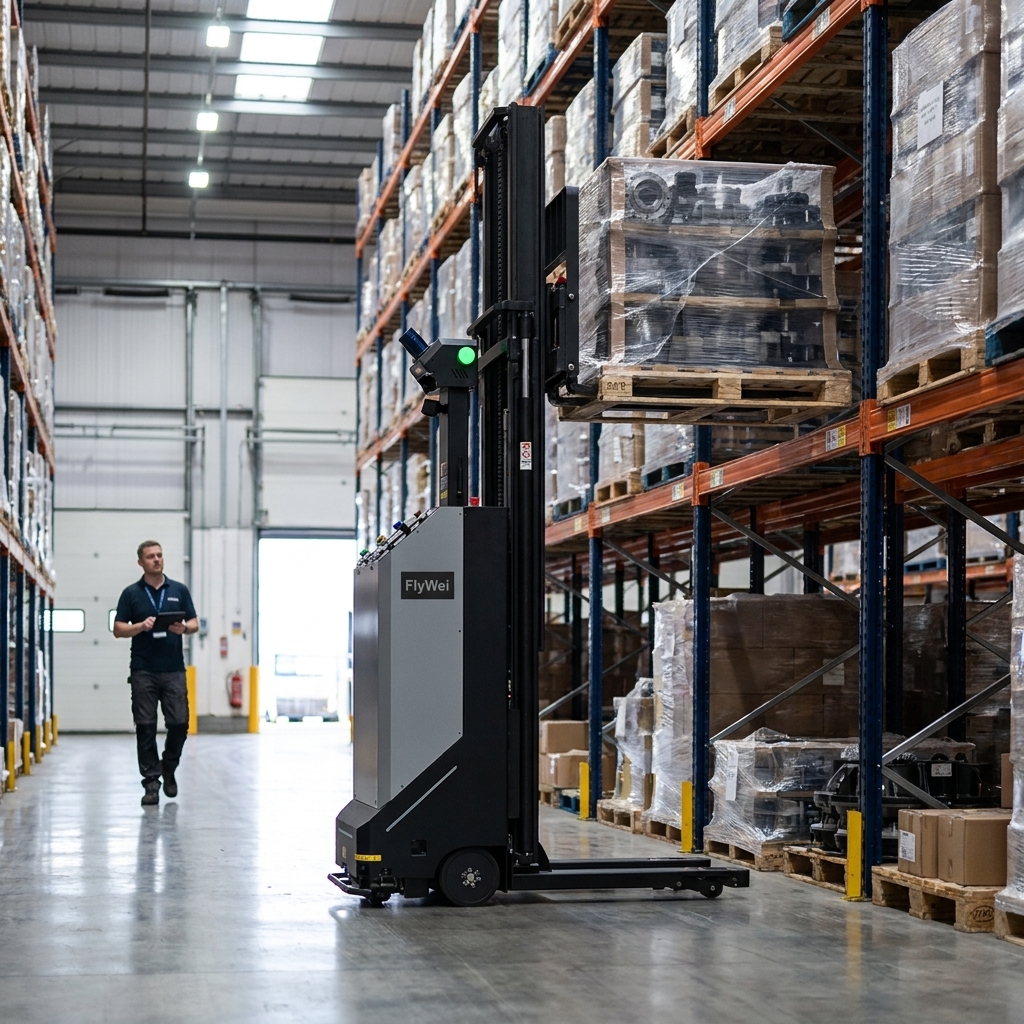
A driverless forklift is an industrial truck that lifts, carries and stacks loads under its own navigation and safety systems, with no operator riding on it and no fixed track to follow. Across Great Britain, employers reported 59,219 non-fatal injuries to employees in 2024/25 under RIDDOR; HSE statistics attribute 17% of them to handling, lifting or carrying and another 10% to being struck by a moving object. In an engineering or heavy-parts plant, those two categories describe internal transport almost exactly: castings, machined housings and gearbox sub-assemblies shuttling between machining cells, the paint line and the finished-goods store on manned counterbalance trucks. The pain this quarter is not the accident that has not happened. It is that one driver absence starves a machining cell of work-in-progress within the hour — and that the constraint on driverless forklift payback is rarely the vehicle. It is whether the plant's existing production and stock systems can hand the fleet a trustworthy queue of work.
Why work-in-progress starvation happens in heavy-parts plants
Engineering plants automate the machining before the movement between it. A five-axis cell may be instrumented to the second, while the pallet of semi-finished housings feeding it arrives when a truck driver becomes free. Excellent cycle times, poor flow times.
Three UK-specific factors make this worse than the theory suggests. The first is labour depth. Two or three shifts need cover at every handover, and counterbalance work in heavy parts requires a trained, certificated operator — HSE's Approved Code of Practice L117 sets out the operator training and safe use duties for rider-operated lift trucks. That depth is expensive to hold in reserve, so most plants hold too little. Agency cover rarely closes the gap, because heavy-parts counterbalance work needs site-specific familiarity as much as a licence.
The second is building stock. Much of the UK's engineering capacity sits in buildings designed for different products, with gangways narrowed by later racking and pedestrian routes crossing truck routes. HSE's workplace transport guidance is clear that segregation and route design come before behavioural controls, but retrofitting segregation costs production time nobody wants to book.
The third is measurement. Few plants can say what proportion of internal moves are the same move repeated. Without that figure, automation gets scoped as "replace the trucks" — slow and capital-heavy — instead of "absorb the repeat moves", which is small, fast and provable. The repeat-move share is the most useful number a plant director can commission this quarter, and counting it needs a clipboard and four weeks rather than a consultancy engagement.
The constraint on driverless forklift payback is rarely the vehicle — it is whether the plant's existing production and stock systems can hand the fleet a trustworthy queue of work.
Lever 1 — Automate the repeat move, not the truck fleet
Rank every internal move by frequency, not by distance or by how loudly the shop floor complains. In heavy parts the top three are usually a machining-cell output to a WIP buffer, a buffer to an assembly feed point, and a finished pallet to the despatch lane. These are fixed-origin, fixed-destination, high-repeat flows — precisely the profile an automated forklift handles without complex exception logic.
Automating one flow does two things a fleet replacement cannot. It releases manned capacity onto the judgement-heavy work that genuinely needs an operator — awkward one-off lifts, trailer loading, breakdown recovery. And it produces a clean before-and-after on one KPI, cell starvation minutes per shift, inside one quarter. That is a number a capex committee can test; a whole-site model is a spreadsheet nobody trusts.
Practically: instrument the flow for four weeks. Count moves per shift, measure the wait between a pallet becoming ready and being collected, and log every reason a move did not happen — that last list decides whether the flow is ready.
Lever 2 — Give the fleet a work queue your systems can feed
This is the technical lever, and where most heavy-industry projects stall. A driverless forklift does not connect to a production or stock system directly. A fleet management layer sits between them, taking work over a documented interface, translating it into robot missions, then writing completions back so the existing system stays the record of stock.
FlyWei's M4 fleet manager performs that translation and arbitrates traffic across mixed machine classes, while RDS robot dispatch decides which vehicle takes which move under what priority. Command and control to the vehicles runs over VDA 5050, the open standard for fleet-to-vehicle messaging, which lets one fleet manager command machines from more than one manufacturer without a bespoke interface per supplier.
Three questions decide whether this lever is cheap or expensive. Can the existing system expose open work through an interface or a scheduled export? Are locations uniquely and reliably identified? Is there a test environment, or does every test consume live production? Where the first answer is no, file-based exchange still works: a scheduled export of ready moves and an import of confirmations, without modifying the core system. Where the second is no, fix the master data first — automation multiplies bad location data rather than absorbing it.
Lever 3 — Rework the safety case, do not inherit it
The regulatory lever is non-negotiable and frequently underestimated. Removing the operator does not remove the employer's duties. PUWER — set out in full at legislation.gov.uk — still requires equipment to be suitable, inspected and used by trained people, and LOLER duties still apply to the lifting function. ISO 3691-4 is the reference standard for driverless industrial trucks, and UKCA obligations sit with whoever places the machine on the market.
What changes is the traffic case. An autonomous fleet follows the route you give it every time, which makes segregation achievable in a way a manned fleet never quite is — but a badly drawn route becomes a permanent hazard rather than an occasional one. Expect to redraw pedestrian crossings, agree stop conditions at blind corners, and set speed profiles per zone. Floor flatness matters more than most expect: high-bay work to TR34 tolerances is the difference between reliable placement and repeated exception handling.
Run this as a workstream with its own owner, not a sign-off at the end: the plants that deploy fastest ran the safety case in parallel with the flow study.
Lever 4 — Fund the fleet against the bottleneck it clears
Heavy-parts plants have lumpy capital cycles, and internal transport competes against machine tools that carry an obvious output number. Win that argument by costing the fleet against the constraint it clears — starvation minutes, overtime absorbed, WIP held — not the trucks it displaces. Displacement invites a headcount conversation; constraint invites a throughput one.
Structure matters as much as the total. Spreading the fleet across a term aligns cost with the throughput it releases and keeps the project inside operating budget rather than the capex round; FlyWei offers 3, 5 and 7-year leasing terms for that reason. Whichever route you take, insist integration scope, interface ownership and post-go-live support appear as visible line items. Integration varies most between plants, and a bundled price hides it. Present the case as one flow with a measured before-and-after, a named integration scope and a funding term, rather than a plant-wide automation programme — committees approve the first and defer the second.
| Lever | Effort to start | Capital exposure | First measurable signal | Check before committing |
|---|---|---|---|---|
| Automate the top repeat move | Low — four weeks of counting | None at study stage | Starvation minutes per shift | Truly fixed origin and destination? |
| Fleet work queue and integration | Medium — depends on data access | Costed separately | Confirmations posting as stock movements | Does the host system expose open work? |
| Safety case and traffic redesign | Medium — needs an owner | Route and floor works | Routes signed off under PUWER | Floor flatness against TR34 |
| Funding structure | Low — commercial | Spread across the lease term | Sits in opex, not capex | Integration and support priced visibly? |
What FlyWei does here
FlyWei is an independent, vendor-neutral UK systems integrator of autonomous forklifts and AMRs. In a heavy-parts plant that matters more than almost anywhere else, because the three flows worth automating first usually need three different machine classes. FlyWei designs the flow, selects machines from across multiple manufacturers, integrates them with the systems the plant already runs, and supports them.
For machining-cell output and despatch lanes, FlyWei supplies counterbalanced driverless forklifts in the 2-tonne class for pallet and heavy-casting work. For gangways narrowed by later racking, the 1.4-tonne narrow-aisle reach-truck class places to high-bay levels without widening the aisle. For sub-assembly trolleys and gearbox carriers moving between cells, FlyWei's heavy-lift and latent-jacking AMRs take the cart-shuttling duty a forklift does badly. The M4 fleet manager runs it as one traffic system, not three fleets.
On integration, FlyWei takes work from the plant's existing ERP, WMS or production system over a documented interface and writes completions back, so that system remains the record of stock; where no interface exists, scheduled exchange is used. FlyWei's engineers are UK-based, and the safety case — route design, zone speed profiles, PUWER and LOLER evidence — is part of the project. See also our note on lifting automated robots in UK engineering warehouses, our guide to what an autonomous forklift is, and wider patterns across FlyWei's solutions.
Driverless forklifts in heavy engineering: common questions
What is a driverless forklift?
An industrial truck that lifts, carries and stacks under its own navigation and safety systems, with no rider and no fixed track. Automated forklift and AGV forklift mean the same class.
Do we have to replace our production or stock system?
Usually not. A fleet management layer sits above the existing system and takes work from it, so that system stays the source of truth. Replacement only matters where it cannot expose work at all.
Can a driverless forklift handle heavy castings and sub-assemblies?
Yes, within the rated capacity of the class chosen. Counterbalanced classes in the 2 to 3-tonne range cover most palletised castings. Awkward non-palletised sub-assemblies often suit a heavy-lift AMR better.
How does this change our PUWER and LOLER position?
The duties stay with the employer, and LOLER still applies to the lifting function. What changes is that the traffic and segregation case must be redrawn for a fleet that follows its route precisely.
What happens if the network goes down mid-shift?
A well-designed integration degrades rather than stops. Vehicles finish the task already issued then hold safely, while the fleet layer queues completions and replays them once the link returns.
Can we run machines from more than one manufacturer?
Yes, where they support a common interface. VDA 5050 lets one fleet manager order vehicles from different suppliers in the same message format, with traffic rules still set centrally.
If work-in-progress starvation between machining cells is on your Q3 risk register, the fastest way to test whether a driverless forklift fixes it is to measure one flow rather than model the whole plant.
Get a 48-hour feasibility read on your highest-volume flow — send the move profile for your busiest route and FlyWei will tell you what an autonomous fleet would absorb and what it would not. For the machine side, start with FlyWei's driverless forklift range.
UK-based engineers. No obligation. A reply within one business day.