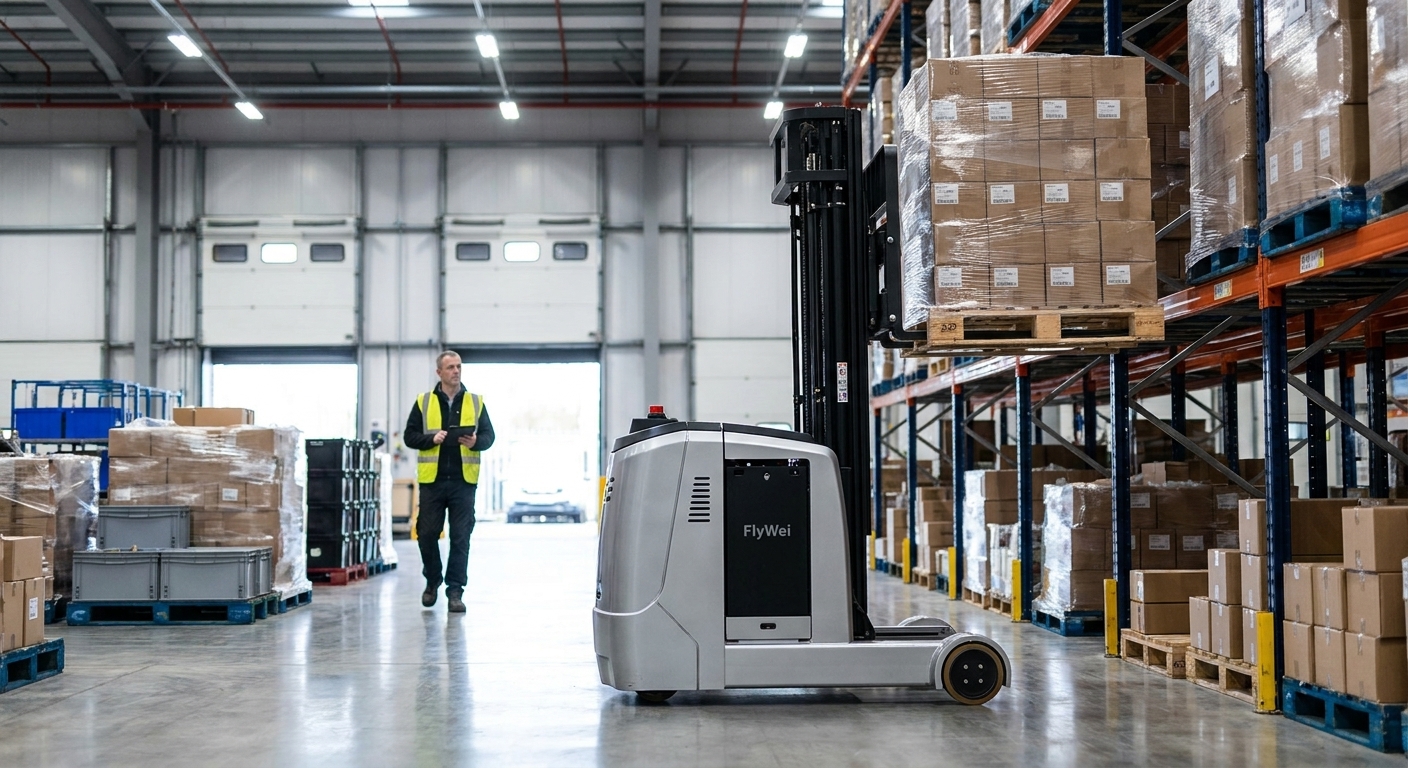
Industrial robot servicing is the planned inspection, calibration, cleaning and repair regime that keeps an autonomous forklift and AMR fleet safely in production. In UK e-commerce fulfilment it is a legal duty rather than a discretionary cost: PUWER 1998 requires work equipment to be maintained in efficient working order and in good repair, and LOLER 1998 requires lifting equipment to receive a thorough examination at least every 12 months. For a warehouse manager running more than 100,000 sq ft into the autumn build-up, that duty collides with reality. Service visits get booked reactively, around whichever machine has already stopped. Mast checks, scanner cleaning and battery inspections are pushed into the one window nobody can spare. And a single stalled reach truck parked in a high-bay aisle blocks the replenishment lane feeding the pick face for the rest of the shift.
Why servicing quietly becomes the constraint
Most UK fulfilment operations inherited their maintenance habits from manned material handling equipment. A driver reports a fault, an engineer attends, the truck returns to the fleet. That model works when twenty interchangeable counterbalance trucks can cover the gap. It stops working the moment a small number of autonomous machines each carry a named, sequenced flow.
Three root causes show up again and again on sites around Magna Park, Daventry and the wider DIRFT corridor.
The first is the peak freeze. From late September, change control tightens and engineering works are deferred until January. Deferred maintenance does not disappear; it lands as unplanned downtime in week 47.
The second is contamination, which is specific to autonomous equipment and largely invisible in a manned fleet. Safety laser scanners, reflector targets and floor-facing sensors accumulate carton dust, shrink-wrap fragments and condensation from chilled goods staging. The machine does not fail; it degrades. It slows at a doorway, hesitates at a junction, and throughput quietly falls until somebody investigates.
The third is the split compliance calendar. Lifting duties fall under LOLER, general work equipment duties under PUWER, and the traffic-management interface sits with HSE workplace transport guidance. Three separate schedules, often held by three different people, means the same machine is taken out of production three times and nobody sees the pattern in its faults. The fault that finally stops the truck in November was usually visible in September, recorded on a form that the person holding the other two schedules never read.
Lever one: build the service calendar from the duty cycle, not the year
Start by ranking every machine by hours worked and lifts performed rather than by acquisition date. In a typical e-commerce operation two or three robots on the pick-face replenishment loop will accumulate double the duty of the goods-in machines, and they should be serviced at roughly double the frequency.
Then move the heavy interventions forward. Anything requiring more than two hours off the floor — mast and chain inspection, drive wheel replacement, battery capacity testing — belongs in August and early September. Reserve the peak window for short, predictable tasks only.
Finally, make the aisle part of the plan. A robot that will be stationary for an hour must not be stationary in a working aisle. Designate a marked maintenance bay off the main runs, sized so an engineer can work safely without an exclusion zone eating a picking module. This removes most of the hidden cost of a service visit, which is rarely the engineer's time and almost always the blocked lane.
Lever two: let the fleet manager schedule its own servicing
The technical unlock is that an autonomous fleet already knows more about its condition than any inspection sheet does. Every mission produces battery discharge curves, drive current, obstacle-stop counts, localisation confidence and time lost to re-planning. Aggregated across a fleet through the M4 fleet manager, that telemetry turns servicing from a calendar activity into a condition-based one.
Two signals matter above all others. A rising count of protective stops on a fixed route usually means a scanner needs cleaning or a reflector has been knocked, not that the route is wrong. A widening gap between commanded and achieved travel speed usually means worn drive wheels or castors. Both are cheap at week 34 and expensive at week 47.
Because command and control runs over the open VDA 5050 standard, this works across a mixed fleet from more than one manufacturer — the diagnostic layer does not care whose badge is on the chassis. The RDS dispatch layer then simply stops routing work to a machine during its booked service slot, so the shift plan absorbs the intervention instead of tripping over it.
Lever three: fold PUWER, LOLER and ISO 3691-4 into one evidence trail
The regulatory lever is about consolidation, not extra paperwork. Under PUWER, work equipment must be maintained in efficient working order and in good repair, and inspection records kept. Under LOLER, lifting equipment requires thorough examination by a competent person at least every 12 months, with lifting accessories on a six-month cycle. Autonomous industrial trucks additionally sit within the scope of ISO 3691-4, which governs safety requirements and verification for driverless trucks and their systems.
Run these as one record per machine, not three. Each service event should capture the PUWER inspection, the LOLER examination status, and the ISO 3691-4 verification items — protective device function, emergency stop performance, speed and braking — against a single asset identifier and date. Standards texts are available through BSI, and sector guidance through Logistics UK.
The payoff is real. When an insurer, a customer audit or an HSE inspector asks how you assure a driverless truck, one asset record answers in minutes. Three disconnected spreadsheets take a week and usually reveal a gap.
Lever four: contract for uptime and spares, not for visits
A service agreement priced per attendance rewards attendance. What a warehouse manager needs is availability, so write the contract in those terms: a defined uptime commitment per machine, a response time that separates a fleet-blocking fault from a cosmetic one, and — most overlooked — a named list of wear parts held in the UK.
Parts availability is usually the difference between a four-hour fix and a two-week outage. Drive wheels, castors, safety scanners, battery modules and charging contacts should be stocked domestically and listed in the agreement. Ask where they sit, not whether they exist.
Ask also who holds competence for the LOLER thorough examination, and what happens to the uptime commitment when your own team modifies a route. Where servicing is bundled into a full-service robot leasing agreement over a three, five or seven-year term, the maintenance obligation and the availability risk sit with the supplier for the life of the asset.
| Model | What triggers a visit | Exposure during peak | Compliance evidence produced | Best fit |
|---|---|---|---|---|
| Reactive (break-fix) | The machine has already stopped | Highest — faults cluster when slack is gone | Fault logs only; records assembled after the event | A single non-critical machine with a manual fallback |
| Scheduled calendar | Fixed interval, quarterly or annual | Moderate — the interval rarely matches real duty | Consistent dated records; fault history not linked to interval | Small fleets with an even workload |
| Condition-based (telemetry-led) | Fleet-manager thresholds on protective stops, drive current, battery health | Lowest — degradation is caught weeks early | One asset record covering PUWER, LOLER and ISO 3691-4 | Any fleet where one machine owns a named flow |
Industrial robot servicing for autonomous forklifts is a legal duty rather than a discretionary cost: PUWER 1998 requires work equipment to be maintained in efficient working order, and LOLER 1998 requires lifting equipment to receive a thorough examination at least every 12 months.
What FlyWei does here
FlyWei is an independent, vendor-neutral UK systems integrator. We select and integrate the best autonomous forklifts and AMRs across multiple manufacturers, which means the servicing regime we design is built around your flows rather than around one supplier's standard visit schedule.
For an e-commerce fulfilment site, FlyWei starts by mapping which machine owns which flow, then sets the duty-cycle thresholds that trigger a service booking. Our autonomous forklifts — reach trucks for high-bay replenishment, stackers for mid-height pick-face work, counterbalance machines at goods-in — are commissioned with their maintenance bay, exclusion zone and access route agreed at design stage, not retrofitted after the first incident. Where cart and tote movement dominates, our lifting robots and AMRs follow the same pattern.
M4 holds the fleet telemetry and the service calendar together, so a booked slot removes a machine from RDS dispatch automatically and the shift plan is built without it. FlyWei engineers are UK-based, the wear-parts list is agreed and stocked before go-live, and every service event writes one record covering PUWER, LOLER and ISO 3691-4. Further worked examples sit in the FlyWei industrial robot servicing newsroom, including pick-face replenishment with autonomous pallet stackers and the wider solutions portfolio.
Industrial robot servicing: frequently asked questions
How often should an autonomous forklift be serviced?
Base the interval on duty rather than the calendar. Machines on high-frequency replenishment loops often need attention at roughly twice the rate of goods-in machines. Statutory minimums apply on top: a LOLER thorough examination at least every 12 months, and PUWER inspection at intervals justified by risk.
Does LOLER apply to autonomous forklifts?
Yes. LOLER 1998 applies to lifting equipment regardless of whether a person drives it. The thorough examination must be carried out by a competent person at least every 12 months, and every six months for lifting accessories or equipment used to lift people.
What is different about servicing a driverless truck?
Safety scanners, reflectors and localisation sensors need routine cleaning and verification that a manned truck does not require. Software and map versions must be recorded in the asset history. And ISO 3691-4 verification items form part of each service event.
Can one maintenance regime cover robots from different manufacturers?
Yes, provided the fleet layer speaks an open standard. Because command and control runs over VDA 5050, one fleet manager can collect condition data from vehicles built by different manufacturers. Wear parts still differ, so the parts list stays per model.
Should we freeze robot servicing during peak?
Freeze the heavy interventions, not the light ones. Move mast inspections, drive wheel changes and battery capacity testing into August and early September. Keep short condition-based tasks such as scanner cleaning running through peak, because those are the ones that prevent a stoppage.
What should a warehouse robot service contract include?
An uptime commitment per machine, a response time that separates fleet-blocking from cosmetic faults, a named UK-held wear-parts list, clarity on who holds LOLER competence, and whether firmware updates are included.
Who is responsible for servicing on a leased robot fleet?
Under a full-service lease the maintenance obligation and availability risk normally sit with the supplier for the term. Confirm in writing that this covers the statutory LOLER examination, the ISO 3691-4 verification items, and consumable wear parts.
If unplanned robot downtime through the autumn build-up is on your Q3 risk register, the fastest way to see where your fleet is exposed is to walk the aisles with someone who does this for a living.
Book a free 30-minute site survey and a FlyWei engineer will map your replenishment flows, identify which machines carry single-point risk, and set out a servicing calendar that survives peak. To start with the equipment instead, see the FlyWei autonomous forklift range.
UK-based engineers. No obligation. We reply within one business day.