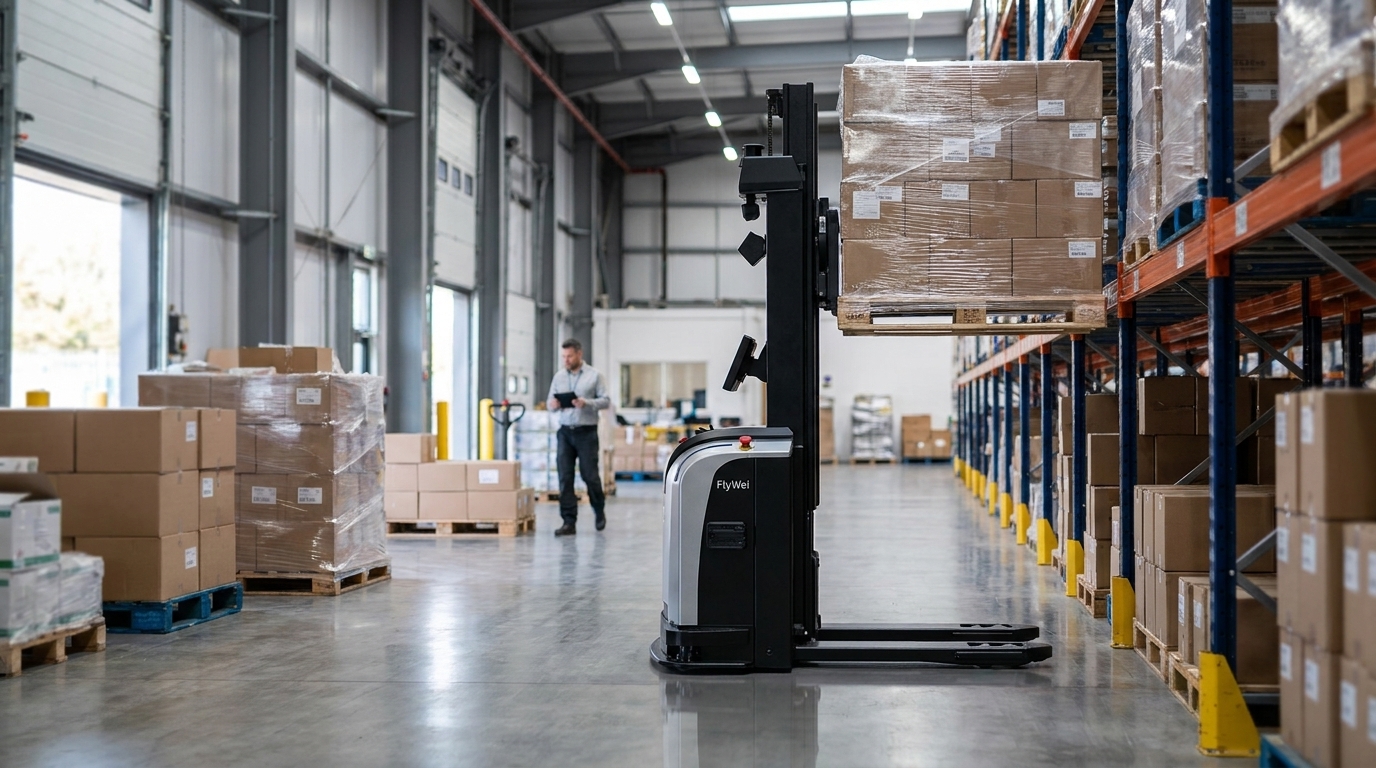
Industrial robot servicing is the planned maintenance, reactive repair, software updating and spare-parts cover that keeps autonomous forklifts and AMRs in a validated working state. Great Britain still records 59,219 RIDDOR-reportable non-fatal injuries to employees a year and 40.1 million working days lost, according to HSE's published workplace injury statistics, and badly maintained equipment sits behind a share of them. For a Plant Director on an MHRA-regulated site the exposure is sharper than a stopped machine. Industrial robot servicing on a regulated pharmaceutical line is a documentation task as much as an engineering one — the maintenance log and the equipment's validated state must both be current before the line restarts. Miss either, and a Q4 batch sits in quarantine waiting on paperwork an engineer finished three weeks earlier. The fix is to design the service regime at the same time as the fleet, not after the first fault.
Why industrial robot servicing breaks down on regulated lines
Most UK pharmaceutical sites did not get this wrong through neglect, but through inheritance. Autonomous forklifts arrive as capital equipment and are handed to an engineering team whose maintenance calendar was written for counterbalance trucks with a driver in the seat. The intervals are hour-based, the checks are mechanical, and nothing in them accounts for a navigation stack, a safety scanner or a firmware release.
The regulatory layer then compounds it. HSE is explicit that under PUWER all work equipment must be maintained in an efficient state, in efficient working order and in good repair, that the work is done by people competent to do it, and that a planned maintenance programme is a useful step towards reducing risk. The underlying duty sits in Regulation 5 of the Provision and Use of Work Equipment Regulations 1998, which also requires that where machinery has a maintenance log, the log is kept up to date.
On a GMP site a second duty runs alongside it. MHRA grades inspection findings as critical, major or other, and a critical deficiency is one that has produced or significantly risks producing a product harmful to humans, as set out in the gov.uk guidance on good manufacturing and distribution practice. A firmware update that changes how a truck decelerates near a filling line is a change. If nobody mapped the visit to the site's change-control procedure, the engineering job is finished and the compliance job has not started. That gap, not the fault, holds the batch.
Industrial robot servicing on a regulated pharmaceutical line is a documentation task as much as an engineering one — the maintenance log and the equipment's validated state must both be current before the line restarts.
Lever 1 — Anchor the maintenance calendar to the production plan
This is the operational lever, and the cheapest available. Take the forward production plan and mark the windows where the packing hall is genuinely idle: changeover, validation downtime, planned shutdown. Schedule preventive work into those windows rather than a fixed month, and have the supplier commit a quarter ahead so engineer availability is not what slips. On a site running two shifts with a weekend clean-down, that means pegging quarterly visits to the shutdown calendar rather than a date.
The second half of this lever is triage. Agree in writing which faults stop the line, which allow degraded running at reduced throughput, and which wait for the next planned visit. Write that list with the shift managers who make the call at 02:00, not in a meeting at head office. A clear degraded-running rule converts a two-hour stoppage into a twenty-minute re-route, and costs nothing. Review it after every line-stopping fault; the first version will be wrong somewhere. Pair it with a named escalation route for industrial robot servicing so the decision never waits on someone finding a phone number.
Lever 2 — Service on condition, using fleet telemetry
This is the technical lever. A fleet manager already knows more about machine health than a fixed interval ever will: battery cycle counts, drive-motor current trends, scanner fault frequency, aborted-mission rates. Surfacing those as thresholds turns servicing from a date into a signal, and gives engineering a defensible reason to spend the window now rather than next quarter.
In practice that means three things. First, instrument the fleet — the M4 fleet manager collects vehicle state over the VDA 5050 open standard, so a mixed fleet reports into one place rather than into one console per manufacturer. Second, set thresholds that trigger a job before a failure: a rising trend in aborted missions on one aisle is a worn guide or a drifting map, both cheap to fix early. Third, let the dispatch layer act on it. When RDS robot dispatch knows a truck is flagged for service, it can stop allocating that truck the highest-priority flows and drain it towards the service bay between missions, so the visit costs you spare capacity rather than a stoppage.
Lever 3 — Build re-verification into the visit itself
This is the regulatory lever, and the one that protects batch release. The visit should not end when the panel is closed, but when the evidence pack is signed: what changed, which firmware version is running, which safety functions were re-tested against which acceptance criteria, and who confirmed the truck is back in its qualified state.
Build that pack from the standards you are already inspected against. ISO 3691-4 covers driverless industrial trucks and their safety requirements and is the natural reference for the functional safety checks. PUWER Regulation 5 and the associated ACOP guidance cover the maintenance record. Your own GMP change-control procedure covers the firmware, and the site's qualification records hold the acceptance criteria the re-test is measured against. The work is not to invent a new document, but to make one visit produce all three signatures on the same day rather than three chases across the following fortnight. Ask any prospective supplier to show you a completed evidence pack from a live UK site before signing.
Lever 4 — Contract UK spares and a response time, in writing
The commercial lever is usually left until after the first fault, which is exactly when you have no leverage. Three questions settle it. Where are the wear parts physically held — UK stock, or a shipment? What is the committed attendance time for a line-stopping fault, in hours, on your shift pattern? And who holds the obligation when the fleet contains machines from more than one manufacturer? Get all three answered in the contract, not the sales deck.
That last question is where a vendor-neutral position matters. A mixed fleet with a single accountable service desk removes the argument about whose fault it is. Where capital approval is the constraint rather than the engineering, service-inclusive autonomous forklift leasing over a 3, 5 or 7-year term folds maintenance, wear parts and UK support into one monthly line, which also removes the annual argument about whether the service budget survived the cut.
| Service model | Typical attendance | Exposure per line-stopping fault | Compliance evidence produced | Best fit |
|---|---|---|---|---|
| Reactive callout only | Next available engineer | Full shift at risk; spares lead time unknown | Repair note only; re-verification ad hoc | Single truck, non-critical flow |
| Fixed-interval preventive | Scheduled by date | Faults still fall between visits | Log current; change control separate | Stable single-shift operation |
| Condition-based with telemetry | Triggered before failure | Lowest; truck drained to bay between missions | Log, safety re-test and firmware record in one pack | 24/7 or GMP-regulated packing halls |
| Service-inclusive lease | Contracted attendance window | Lowest, with cost certainty | As above, supplier-held obligation | Capex-constrained sites |
What FlyWei does here
FlyWei is an independent, vendor-neutral UK systems integrator. FlyWei designs, supplies and integrates FlyWei autonomous forklifts and lifting robots across multiple manufacturers, which is precisely why a single service obligation is possible on a mixed fleet: one desk, one evidence pack, one escalation route, whoever built the chassis. There is no incentive to defend a particular manufacturer's uptime record, because FlyWei does not sell one.
On a pharmaceutical site that works in three layers. The M4 fleet manager holds vehicle health and mission history, so a service decision starts from trend data rather than from a driver's report. RDS robot dispatch arbitrates the work, so a flagged truck is drained to the service bay without a planner intervening. And UK-based engineers carry out the visit and produce the re-verification record against ISO 3691-4 and your own change-control procedure in the same session.
The commercial side is deliberately plain. FlyWei industrial robot servicing is quoted as a visible line with a stated attendance commitment and UK-held wear parts, or folded into a service-inclusive lease. A companion piece covers how servicing lands in a UK pharma capex case, and the sector solutions pages carry the flow-level detail.
Frequently asked questions
What is industrial robot servicing?
Industrial robot servicing is the preventive maintenance, reactive repair, firmware updating, spare-parts supply and engineering support that keeps autonomous forklifts and AMRs safe, available and — on a regulated site — in their qualified state. It produces records as well as repairs.
How often should autonomous forklifts be serviced?
Interval alone is the wrong question. Duty cycle and ambient conditions drive wear far more than elapsed months: a truck running 20 hours a day in a chilled area needs attention sooner than one on two ambient shifts. Set a baseline from the manufacturer's instructions, then adjust using telemetry.
Does PUWER apply to autonomous forklifts and AMRs?
Yes. PUWER applies to work equipment whether or not a person is on board. Regulation 5 requires equipment kept in an efficient state, in efficient working order and in good repair, and any maintenance log kept up to date, by competent people.
Do we need to re-verify a robot after a service visit on a GMP line?
If the visit changed anything affecting the equipment's qualified function — firmware, safety parameters, navigation map, a safety-related component — it falls under change control and the qualified state must be re-confirmed before production resumes. Have the visit produce that evidence.
What should an industrial robot servicing contract include?
A defined preventive scope and interval, a committed attendance time for line-stopping faults, named UK-held wear parts, firmware updating with change-control documentation, remote diagnostic access terms, and one accountable desk for the whole fleet.
How quickly should an engineer attend a robot fault in the UK?
There is no statutory figure, so the number is whatever you contract. Work backwards from the cost of the stopped flow: if an hour of the packing hall is worth more than the premium on a faster commitment, buy it.
Can one service contract cover robots from different manufacturers?
Yes, where the integrator is genuinely independent rather than tied to one product line. A fleet manager speaking the VDA 5050 open standard gives one view of vehicle state across mixed hardware, making a single service obligation practical.
If unplanned robot downtime and post-service re-verification are on your Q4 risk register, the quickest way to size the problem is one flow, not the whole site.
Get a 48-hour feasibility read on your highest-volume flow — send the flow, the shift pattern and the constraint, and our engineers come back with where autonomous handling fits and what evidence the service regime produces. The M4 fleet manager page shows how the fleet layer drives condition-based servicing in practice.
UK-based engineers · no obligation · reply within one business day.