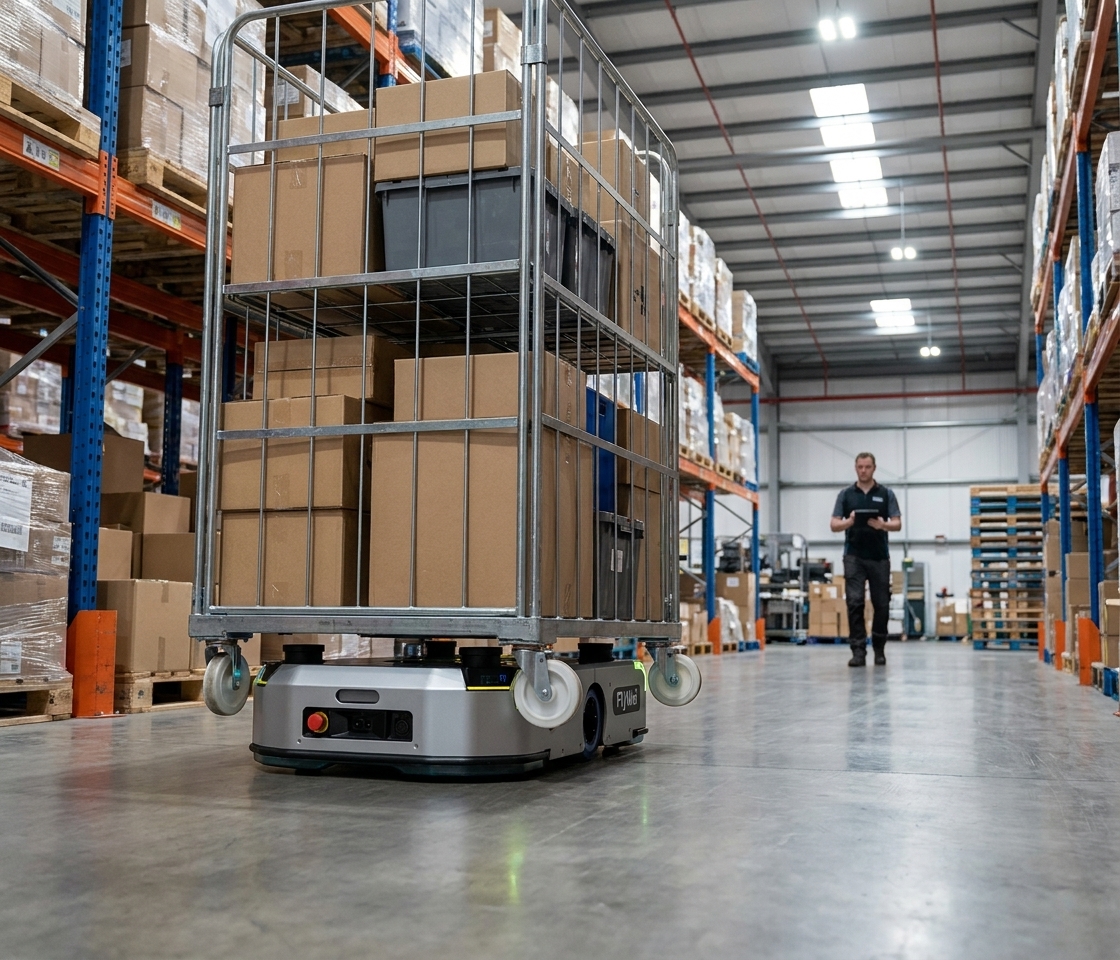
Lifting automated robots are driverless warehouse machines that raise, carry and set down a load — a tote stack, a roll cage, a wheeled trolley or a pallet — and navigate a live building on their own sensing rather than on a fixed track. Both the Provision and Use of Work Equipment Regulations 1998 (PUWER) and the Health and Safety Executive's workplace transport guidance apply to a driverless truck exactly as they do to a manned one. For a supply chain director in contract logistics, the pain this quarter is commercial rather than theoretical: every client onboarded adds cage, tote and trolley movement nobody costed at tender, peak volume lands before agency labour does, and the only lever left is pulling pickers off the face to walk stock across the building — which is precisely when the service levels written into the client contract start to slip.
Lifting automated robots are driverless warehouse machines that raise, carry and set down a load and navigate a live building on their own sensing rather than on a fixed track.
Why contract logistics sites end up walking stock across the building
Contract logistics is the only warehousing model where the layout is a permanently moving target. A grocery client wins a listing and doubles its pallet presentations; a fashion account turns returns-heavy and floods the site with roll cages. In a single-user distribution centre those events are annual. On a shared campus at Magna Park or DIRFT they are monthly, and each one quietly re-cuts the internal transport map the original tender was costed against.
The second reason is structural. Contract tenders are priced on picks, cases and pallets shipped — the units the client recognises. Nobody prices the metres. So horizontal movement between goods-in, the pick face, value-added services and despatch sits in the operation as unfunded work, absorbed by the most flexible resource on site: people. When volume rises the flex comes from the same pool of pickers, which is why a good day on volume can still be a bad day on cost per unit.
Third, the labour market will not rescue it. Recruitment and retention in warehousing have been a standing concern for years, as industry body Logistics UK has consistently reported, and agency cover arrives with the least site knowledge exactly when errors cost most. Around Daventry, Burton-on-Trent and the SEGRO East Midlands Gateway cluster, large employers chase the same shift pool in the same week.
Finally, safety exposure grows with the traffic. Every extra manual trolley move is another pedestrian-vehicle interaction in an aisle, and the HSE is explicit that segregation and traffic management are the controls that matter most. More movement is not neutral; it is more risk, on the same floor, with less experienced staff.
Lever one: re-cut the flow before you automate it
The operational lever comes first: automating a bad flow simply buys a faster bad flow. Spend a fortnight instrumenting what actually moves — origin, destination, unit type, time of day, number of touches. Most multi-client sites discover two or three high-frequency loops — replenishment from bulk to pick face, finished cages from pack to despatch lanes, and empty equipment returning — that between them account for the bulk of the walking. Those loops are the automation candidates, because they are repetitive, predictable and largely independent of which client owns the stock.
Then design the loop to be robot-legible before a machine ever arrives. Fixed pick-up and set-down points, a consistent load carrier, a marked buffer with enough space for a queued unit, and a rule for what happens when the buffer is full. Resist automating the exception-heavy flow first simply because it annoys you most. Prove the concept on the boring loop, capture the labour it releases, then let that fund the harder work. This is the same sequencing that makes an autonomous pallet stacker deployment land cleanly on a shared site.
Lever two: orchestrate the fleet, don't just buy robots
The technical lever is orchestration, and it is where most of the value actually sits. A single robot moving a cage is a demonstration. A fleet that knows which of eleven jobs to take next, which charger to visit at which state of charge, and which aisle is currently congested is an operation. That decision layer is what M4 fleet manager provides, and it is what turns a set of machines into capacity you can commit to a client in a service-level agreement.
Job creation matters as much as job execution. RDS robot dispatch takes the triggers your operation already generates — a replenishment task in the enterprise WMS, a call button at the pick face, a full-pallet signal at end of line — and turns them into robot work without asking supervisors to run a second screen. Insist on standards-based interfaces here. Specifying VDA 5050 for fleet communication means today's robots and next year's additions answer to one master, and that you are not re-buying the integration every time the estate grows. On a multi-client site that is the difference between a fleet that follows the contract and a fleet stranded with the account that bought it.
Lever three: design PUWER, ISO 3691-4 and floor flatness in from day one
The regulatory lever is the one that quietly sets your go-live date. A driverless truck is work equipment, so PUWER applies in full: suitable for purpose, properly maintained, inspected, and used only by people with adequate training and information. The relevant safety design standard is ISO 3691-4, which covers driverless industrial trucks and their systems, and your risk assessment has to cover the whole system — robot, load, route, interfaces and the humans crossing it — not the machine in isolation.
Two practical points decide most UK programmes. First, floor condition: navigation and stable load handling depend on a floor that behaves, so an early flatness and joint survey against the recognised industrial floor standard, TR34, is cheaper than discovering a problem aisle in week nine. Second, traffic management: robots do not remove the need for segregation, they change its geometry. Re-mark the crossings, agree the priority rules, and write them into the site induction that every agency worker receives. Get a BSI-aligned safety file assembled as you build, not afterwards, and the client audit becomes a formality rather than an event.
Lever four: fund the fleet on the shape of the contract
The commercial lever is matching the funding to the risk you actually carry. A capital purchase with a decade of life sits awkwardly against an agreement measured in a few years, particularly when the committee is approving an asset for a client who may re-tender. FlyWei leasing offers three, five and seven-year terms so the term can be set against the contract rather than the depreciation schedule — moving the conversation from capital expenditure to a monthly operating line beside the labour it displaces.
| Measure | How it behaves on a manual multi-client site | What to record once robots run the loop | Where the figure comes from |
|---|---|---|---|
| Horizontal transport hours per shift | Absorbed inside picker hours and invisible on the P&L | Isolated as a discrete, reportable line | Fleet manager job logs |
| Pick-face dwell time | Interrupted every time a picker walks stock away | Continuous; the picker stays at the face | Enterprise WMS transaction timestamps |
| Agency hours at peak | The first and only flex lever available | Reserved for genuinely variable work | Payroll and agency invoices |
| Pedestrian-vehicle interactions per aisle | Rises in direct proportion to volume | Falls as manual trolley moves are removed | Site traffic management review |
| Cost to add a new client flow | Recruit, induct and train | Configure a route and reallocate fleet time | Onboarding project records |
What FlyWei does here
FlyWei is an independent UK systems integrator of autonomous forklifts and mobile robots. Because FlyWei is vendor-neutral, the machine specified for a contract logistics site is chosen on the merits of the flow rather than on a catalogue obligation — and on a shared campus that matters, because one building rarely needs one type of robot.
In practice, FlyWei designs the estate in layers. Lifting automated robots take the cage, trolley and tote loops: a latent-jacking unit slips beneath a wheeled cage, raises it and moves it from pack to despatch without a person walking alongside, while heavier jacking variants handle sub-assembly and equipment moves. FlyWei autonomous forklifts take the pallet work above them — a stacker or narrow-aisle reach truck for replenishment into high-bay racking, a counterbalanced unit for dock-to-stock. M4 runs both classes as one fleet, so the same machines can serve a grocery account in the morning and a returns operation in the afternoon.
FlyWei engineers survey the floor, write the traffic management change, assemble the PUWER and ISO 3691-4 evidence pack the client's auditor will ask for, and phase the deployment so the site keeps shipping throughout. Across the solutions portfolio the pattern is consistent: start with one proven loop, instrument it, then extend the fleet as each new account onboards.
Frequently asked questions
What are lifting automated robots?
Driverless machines that raise, transport and set down a load inside a warehouse, navigating on their own sensing rather than on a fixed track. They include latent-jacking units for carts and cages, heavier jacking robots, and rotary-lift variants that orient a load as well as carry it.
How do lifting automated robots differ from an autonomous forklift?
Lifting automated robots raise a load just far enough to take its weight off the floor and are optimised for horizontal movement. Autonomous forklifts lift to height, into and out of racking. Most contract logistics sites need both.
Do lifting automated robots need a WMS integration?
Not to start. A first loop can run from physical triggers such as call buttons and full-pallet signals. To scale, your enterprise WMS or ERP should create jobs automatically, which is what RDS handles.
What UK regulations apply to lifting automated robots?
PUWER 1998 governs provision and safe use; HSE workplace transport guidance covers segregation and traffic management; ISO 3691-4 is the safety design standard for driverless industrial trucks. Where lifting accessories are used, LOLER 1998 duties may also apply.
Can one fleet work across several client contracts on the same site?
Yes, and that is usually where the strongest return sits. A fleet manager allocates robot time across zones and routes, so a new account can be onboarded by configuring a route rather than by recruiting a shift.
How long does a first deployment take?
Floor survey, traffic management changes, safety documentation and client approval set the timeline more than the engineering does, which is why FlyWei runs them in parallel with the build. One well-chosen loop goes live far faster than a site-wide programme.
Can we lease rather than buy?
Yes. FlyWei offers three, five and seven-year leasing terms, so the funding term can be matched to the client contract term rather than to a depreciation schedule.
If unfunded horizontal movement across your client sites is on your Q3 risk register, the fastest way to size the opportunity is to measure one loop rather than model the whole estate.
Get a 48-hour feasibility read on your highest-volume flow — send the origin, destination and daily unit count for one loop and FlyWei engineers will return an indicative fleet size, a route sketch and the safety work required. The machine classes involved are on the lifting robots page.
UK-based engineers, no obligation, and a reply within one business day.