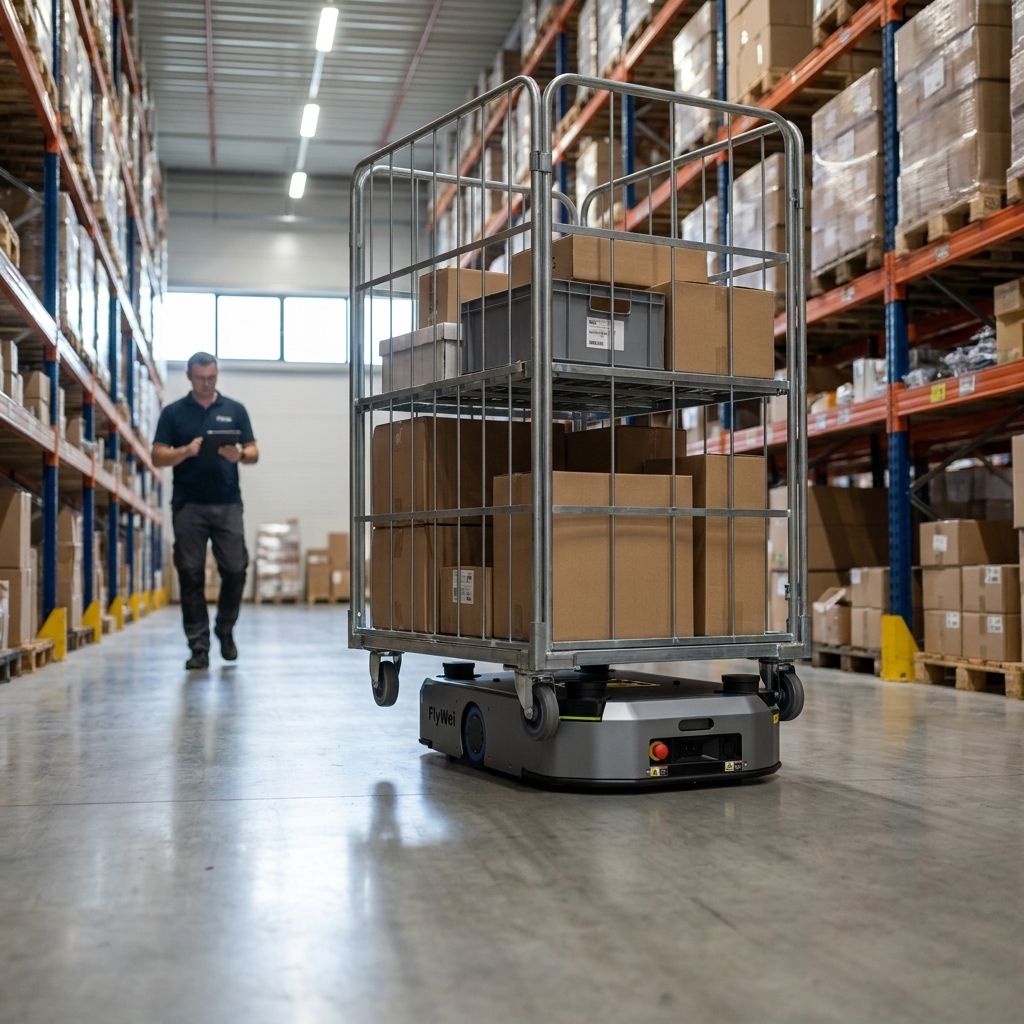
Lifting automated robots are self-driving warehouse machines that raise a load clear of the floor — a pallet, a wheeled cage, a roll cage or a tote trolley — carry it under their own navigation and set it down again, with no operator on board and no manual lift at either end. The case for them in UK food and drink warehousing is a health case before it is a productivity case: the Health and Safety Executive recorded 511,000 workers suffering a work-related musculoskeletal disorder in Great Britain in 2024/25, alongside 40.1 million working days lost to work-related ill health and injury. For a warehouse manager running more than 100,000 sq ft of FMCG finished goods, that national number arrives as a very local problem. The repetitive moves between palletiser, shrink-wrapper and goods-out marshalling are the ones your team does hundreds of times a shift, and they are the ones that quietly generate both your absence record and your despatch variability.
Why line-end handling eats an FMCG warehouse
FMCG manufacturing warehousing has a structural problem general contract storage does not. Production dictates the rhythm, and it does not pause when the warehouse is short-handed. A bottling or snack line at steady output produces a finished pallet or a filled cage on a fixed cadence, and that cadence continues whether you have five MHE operators on shift or three.
The result is a buffer that grows at the line end. Operators who should be putting away are instead clearing congestion in front of the palletiser — the lowest-value move in the building, and the most repetitive. The HSE's guidance on musculoskeletal disorders is clear that the risk factors are task repetition, bending and prolonged handling rather than single heavy loads, a description that fits line-end cage shuttling almost exactly.
Three UK-specific factors sharpen this. The labour market for counterbalance and reach-truck licences in the East Midlands corridor — Magna Park, DIRFT, SEGRO East Midlands Gateway, Daventry — is tight enough that back-shift and weekend cover is routinely filled by agency staff with no site familiarity. FMCG seasonality means your peak coincides with the worst availability. And the vehicle-pedestrian interaction created by that congestion is itself a reportable risk; HSE workplace transport guidance places separation of people and moving vehicles at the centre of a compliant traffic plan, and a congested line end is where that separation breaks down first.
The honest diagnosis is that this is not a speed problem. Your operators are not slow. A fixed-cadence line has been paired with a variable-cadence handling resource, and the variance is absorbed by people doing repetitive lifts.
Lever one — map the fixed-cadence moves before you specify anything
The operational lever is scoping discipline, and it is most often skipped. Spend two weeks logging every move between the line end and the first put-away location: origin, destination, load type, frequency per shift, and whether the move has exceptions. You are looking for the moves that are genuinely fixed — same origin, same destination, same load, every time.
In a typical FMCG finished-goods operation, the large majority of line-end moves meet that test, and those are the only ones worth automating in phase one. The remainder — damaged pallets, QA holds, rework, short-dated diversions — stay manual, deliberately. Attempting to automate exception handling in a first deployment is what turns a twelve-week project into a nine-month one. Write the exception list into the specification as out of scope, and the commissioning window shortens. The measure of a good phase-one scope is that an operator can describe every automated move in one sentence.
Lever two — put the fleet under one orchestration layer
The technical lever is dispatch. A lifting robot that waits for a human to tell it a cage is ready has moved the bottleneck, not removed it. The value appears when the fleet layer takes work directly from the systems that already know what the line is producing.
This is what M4, FlyWei's fleet manager, exists to do. It accepts tasks from the operator's existing ERP and WMS over documented interfaces, converts each into a mission, and dispatches it to whichever machine is free — commanding vehicles from different manufacturers through the VDA 5050 open standard rather than a bespoke interface per supplier. Completions and load confirmations are written back, so the warehouse system stays the record of stock. Where the flow is more complex than transport alone — line-side sequencing, or interaction with a shrink-wrapper or PLC-controlled conveyor — FlyWei's RDS robot dispatch layer handles orchestration above the fleet.
Two design points matter for FMCG specifically. Traffic rules must be set centrally, not per vehicle, because the congestion you are solving is a shared-space problem. And the fleet layer must degrade gracefully: if the link to the warehouse system drops, robots should finish the task already issued and hold safely while completions queue for replay, rather than stopping mid-aisle.
Lever three — build the PUWER and ISO 3691-4 case into the specification
The regulatory lever is documentation, and in the UK it is unforgiving if left late. An autonomous lifting machine is work equipment, so the Provision and Use of Work Equipment Regulations 1998 apply in full: suitability for purpose, inspection, maintenance, and the training and competence of everyone who interacts with it. HSE's PUWER guidance sets out the mobile work equipment duties that bear directly on driverless machines.
Alongside PUWER, ISO 3691-4 is the governing standard for driverless industrial trucks and their systems, and the BS EN version is what a UK insurer and a UKCA conformity file will expect to see referenced. LOLER 1998 applies to the lifting function itself. Floor flatness to TR34 matters more than expected: navigation tolerance and lift stability both degrade on a slab that passed for manual trucks. Specify three things at tender: the safety case and conformity file as a priced deliverable; the thorough-examination regime for the lifting elements; and the training package for the supervisors and fleet controllers who interact with these machines.
Lever four — size the business case on availability, not headcount
The commercial lever is how you frame the number for your capex committee. Building the case on removed heads is the weakest argument, because in a tight market those operators are redeployed to put-away rather than removed. The defensible case is availability: the proportion of shifts where the line end runs at target cadence regardless of who turned up.
A lifting automated robot does not move a cage faster than a fit operator on a good day. It moves it at the same rate on the back shift and in week 48 — and that consistency, not peak speed, is what a fixed-cadence production line needs.
| Option | Cost basis | Shift-to-shift consistency | Time to effect | Main residual risk |
|---|---|---|---|---|
| Additional agency MHE cover | Hourly, rises at peak | Low — worst exactly when demand peaks | Days | Site familiarity; manual handling exposure unchanged |
| Fixed conveyor from line end | Capital, civils-heavy | High, but only on the one route built | 6–12 months | Layout locked; no use if the line moves |
| Lifting automated robots, unorchestrated | Capital or lease per unit | Medium — limited by manual task release | 8–14 weeks | Bottleneck moves to the person calling the robot |
| Lifting automated robots under one fleet layer | Capital or lease, integration priced separately | High across all shifts and routes | 8–14 weeks plus integration | Depends on warehouse-system data quality |
Fund it the way the risk sits. Where the committee weighs monthly cost against a capital request, FlyWei's 3, 5 and 7-year leasing terms put robots, software, maintenance and UK support into one monthly line — usually an easier conversation than a capital bid competing with line investment.
What FlyWei does here
FlyWei is an independent, vendor-neutral UK systems integrator. We are not a manufacturer and not a reseller, which means we specify the machine class that fits your flow rather than the one we happen to make. For an FMCG line end that is usually a mix: lifting automated robots in the latent-jacking class to slip under wheeled cages and tote trolleys, heavier jacking or rotary-lift units where awkward loads need orienting, and FlyWei autonomous forklifts in the pallet-truck or stacker class for the palletiser-to-racking leg.
Our engineers survey the site, log the fixed-cadence moves with your supervisors, and return a scoped phase one with the exception list written out. We integrate the fleet to your existing ERP and WMS through M4, set the traffic rules centrally, and hand over the PUWER and conformity documentation as a deliverable rather than an afterthought. Deployment typically runs 8–14 weeks from survey to live operation, and we audit against the agreed KPIs afterwards. Support is UK-based throughout. You can see how this maps onto FMCG and consumables operations, and a related read covers lifting automated robots in UK parts stores.
Frequently asked questions
What are lifting automated robots?
Lifting automated robots are self-navigating machines that raise a load clear of the floor, transport it and set it down without an operator on board. They differ from base-platform robots, which carry a load on a fixed deck but cannot pick it up and put it down.
How are lifting robots different from autonomous forklifts?
A lifting robot works at low height, raising a cage, trolley or tote frame a short distance off the floor for transport. An autonomous forklift lifts a pallet on forks and can stack it into racking. Most FMCG line-end flows need both.
Do we have to replace our WMS to use lifting automated robots?
Usually not. An orchestration layer sits above your warehouse system and takes work from it, so that system remains the source of truth for stock. Replacement is only worth considering where it cannot expose work through an interface or a scheduled export.
What regulations apply to lifting automated robots in a UK warehouse?
PUWER 1998 applies to them as work equipment, covering suitability, inspection, maintenance and training. LOLER 1998 applies to the lifting function. ISO 3691-4 is the governing safety standard for driverless industrial trucks, and a UKCA conformity file should be part of the handover pack.
How long does a deployment take in an operating FMCG warehouse?
For a scoped phase one covering fixed-cadence line-end moves, 8 to 14 weeks from survey to live running is typical. Integration to the warehouse system is costed separately and is usually the longer pole, because mapping fields and testing against live data takes longer than commissioning vehicles.
What happens on the back shift if the warehouse system goes down?
A well-designed fleet layer degrades rather than stops. Robots finish the task already issued and then hold in a safe position, while the fleet manager queues completions and replays them once the link returns. Ask any supplier how long the fleet manager runs detached.
If line-end congestion and back-shift cover are on your Q4 risk register, the fastest way to find out whether lifting automated robots fit your flow is to count the moves.
Book a free 30-minute site survey and our engineers will log those moves with your supervisors and tell you honestly which are worth automating first. The machine classes we integrate are on our lifting robots page.
UK-based engineers. No obligation. We reply within one business day.