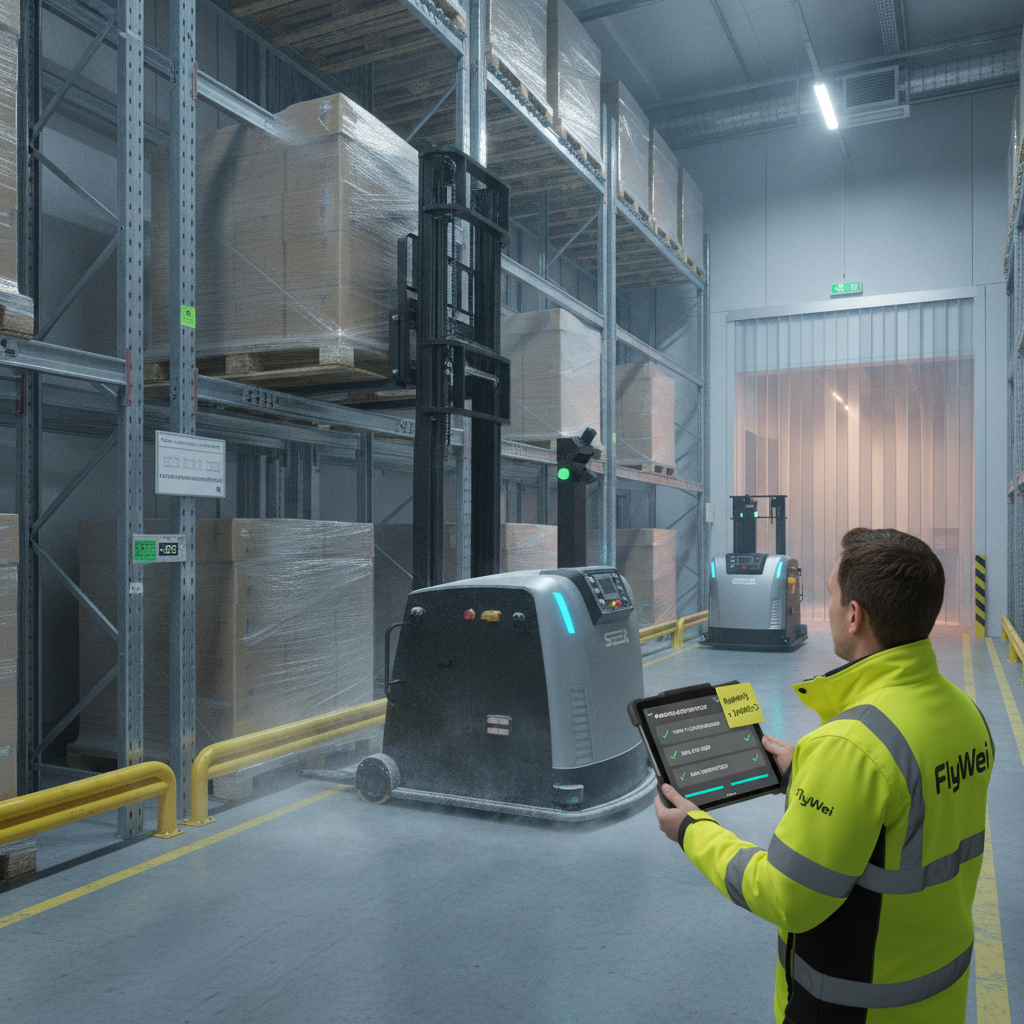
Cold aisle, servicing desk, pharma audit, brownfield goods-in — where driverless didn't automatically buy the throughput hours it promised.
It's the third week of the new fleet. The driverless trucks are on the slab, the operator cab is empty, the driver-shortage line item is closed. And your throughput report is still short. The pick face isn't running the hours you costed for. Somewhere between the procurement decision and the shift end, three or four hours a day are missing — and nobody on the ops floor can tell you which envelope ate them. Was it the cold-aisle rotation you didn't know about? The spare part sitting on a five-day lead? The MHRA pallet-siting rule that pauses the truck at the batch line? The brownfield aisle width that quietly rewrites the wave plan? On most UK estates this quarter, the answer is more than one — often all four.
Driverless is procurement; running is operations — and this quarter's throughput leak has moved from the seat to the envelope the truck runs inside.
1. The Temperature Envelope Is a Duty Cycle, Not a Spec-Sheet Line
Somewhere in the manned-DC world, cold storage got treated as a colder version of ambient. Heavier packaging, more layers on the driver, same rack, same lane. That's the version that shows up on a spec sheet.
The version that shows up on the shift board is different. A UK chilled DC running its manned fleet between +5°C and –30°C loses roughly 30-45% of nominal shift throughput to a rotation constraint most procurement conversations skip — 45 minutes in the sub-zero, 15 minutes out. Rotate the driver, warm up, get on the next truck. Multiply that across a five-shift week and the fleet is capped at somewhere around 60% of shift length before it moves a single pallet.
A driverless truck rated for continuous operation across that same envelope doesn't need the rotation. That's the number that matters — not the LiDAR range, not the payload class, not the top speed on the datasheet. The lever is duty cycle inside a temperature envelope, measured in usable hours per shift, not degrees on a datasheet.
Ask your vendor a simple question in the next meeting: what is the continuous-operation temperature envelope of this specific machine, and how many hours per shift will it actually run at –22°C? If the answer is "up to –30°C" with no duty-cycle figure attached, you don't have a spec — you have a marketing line. And that's where your missing four hours sit.
2. Your PUWER Duty Doesn't Pause For a Spares Lead Time
PUWER 1998 regulation 5 is short. It says the operator keeps work equipment in efficient working order and good repair throughout its working life. That is a legal duty on you, not a service offer from your vendor.
The way that duty gets tested in practice is at the spares desk. When a wheel encoder fails on a driverless counterbalance, the truck stops. If the spare sits in a European parts warehouse on a five-to-ten-day lead time, the truck stays stopped. In a manned operation you still had the option to redeploy the driver onto a manual truck; on a driverless fleet the operator has been sized out of the plan and the shift board doesn't carry that redundancy anymore.
That's why the servicing SLA is not a footnote to the contract — it is the contract. A vendor who cannot commit to a UK parts hub, a next-business-day SLA on the top twenty consumables, and an on-site engineer within four hours for a critical failure is asking you to carry their inventory risk on your OEE plan. Every day the spare is in transit, you are exposed on PUWER regulation 5 as well as short on throughput.
The other half is cadence. ISO 3691-4 sets the safety-integrity bar; PUWER makes the maintenance regime the operator's problem. A sensible pattern is a documented pre-use check at every shift change, a supervised 250-hour service on the drive and lifting mechanism, and a full LOLER thorough examination on the lifting envelope every 12 months, with a shorter interval where the truck is doing man-rider or heavy repeatable lifting work. Each of those has to sit inside a signed servicing plan with the vendor's engineer named and the substitution rules for a missing check spelled out. If the vendor can't put that on paper before you sign — cadence, engineer, substitution rule — the audit trail is missing before the first shift starts, and the LOLER paperwork is the piece an insurer asks for after an incident.
3. In a Regulated Aisle, Every Movement Is Evidence
For a Midlands pharma DC operating to MHRA and GDP, the throughput question isn't "did the pallet arrive at the rack?" It's "did the pallet arrive at the rack, sited correctly, temperature-logged, batch-integrity intact, with an auditable movement record?" A misplaced pallet is a qualified batch at risk. That single fact is why the HSE headline — roughly a quarter of all UK workplace transport injuries come from lift trucks, and the largest concentration sits inside temperature-controlled distribution centres — matters more in a pharma DC than anywhere else on the estate.
A CPCS-carded operator carries the audit on their radio and their memory. A driverless truck can carry it on its onboard task log — but only if that log is exposed to the WMS event stream you actually reconcile against. If the fleet controller is a closed bundled stack that speaks its own dialect, the audit trail still has a manual seam in it, and the supervisor is still in the loop for GDP.
The lever here is neutrality. An open-fleet controller that speaks the standard VDA 5050 dialect and hands its task log to your enterprise WMS the way any UK warehouse-management system expects it, closes that seam. That's how you drop the supervisor hours on PUWER/LOLER admin without losing the audit trail. It's also how you avoid the UK retailer-warehouse-automation lesson from a couple of years back: a closed bundled stack looks like a saving until the day you want to swap a component, and by then the switching cost is a rewrite.
4. The Real Aisle Is Yours, Not the Vendor's
The single most under-priced number in a UK autonomous-forklift business case is the aisle width your building already has. A fleet that needs its own aisle geometry — a widened lane, a re-poured slab, a stripped rack — has already blown its own payback on brownfield ground before the first pallet moves.
The other version is a driverless truck that runs the aisle a UK warehouse already runs. Same rack pitch, same floor, same charging bay footprint. That is the difference between a six-week install and a six-month project. And it's the number that decides whether you can standardise a mixed fleet across five, seven, nine brownfield DCs before peak lands, or whether you get one flagship site and a spreadsheet of excuses for the rest of the estate.
A goods-in aisle with heavy repeatable pallet loops — the reverse-load, breakdown, put-away sequence at every trailer arrival — is where a portable, open-fleet AGV design pays back fastest. No new civils, no new lane markings, no rewritten wave plan. The same aisle, driverless, running the same loop the agency driver was running last Tuesday, at agency day-rate zero.
The trap is the vendor whose "portable" answer means "portable to any building that looks like our demo warehouse." Ask for a brownfield reference in your sector, with the aisle width and the rack pitch on the record. If they can't produce one, they don't have a portable fleet — they have a greenfield product.
The Arithmetic
- ~60% — the shift-length ceiling a manned chilled fleet hits before the driver rotation eats the rest of the sub-zero hours.
- 5-10 days — typical spares lead time on a bundled stack with no UK parts hub; every day of it is a PUWER regulation 5 exposure.
- ~25% — HSE's attribution of UK workplace transport injuries to lift trucks, concentrated in temperature-controlled DCs.
- 6 weeks vs 6 months — the install-window gap between a driverless fleet designed for your existing aisle and one that needs new civils.
- £0 — the extra agency-driver day-rate needed to cover the goods-in reverse-load loop once an open-fleet AGV is running the same loop.
What To Do On Monday Morning
- Pull your coldest aisle's throughput data and back out the rotation minutes. If the sub-zero side is running below 65% of nominal shift length, the rotation is your bottleneck, not the fleet size.
- Ask your incumbent servicing vendor for the top-twenty spares SLA in writing, with the UK parts hub named. If they can't put both on the page, book a PUWER regulation 5 review with your HSE lead this week.
- Walk your goods-in aisle with a tape measure. Log the aisle width, the rack pitch and the charging-bay footprint. Any driverless fleet quoted against those three numbers is a real quote; anything quoted against a demo-warehouse spec is not.
If your throughput report is still short and none of the four envelopes above tell you where the hours went, reply or drop a comment — happy to walk through a quiet, open-fleet design tailored to the aisle and the regulator you actually run against.