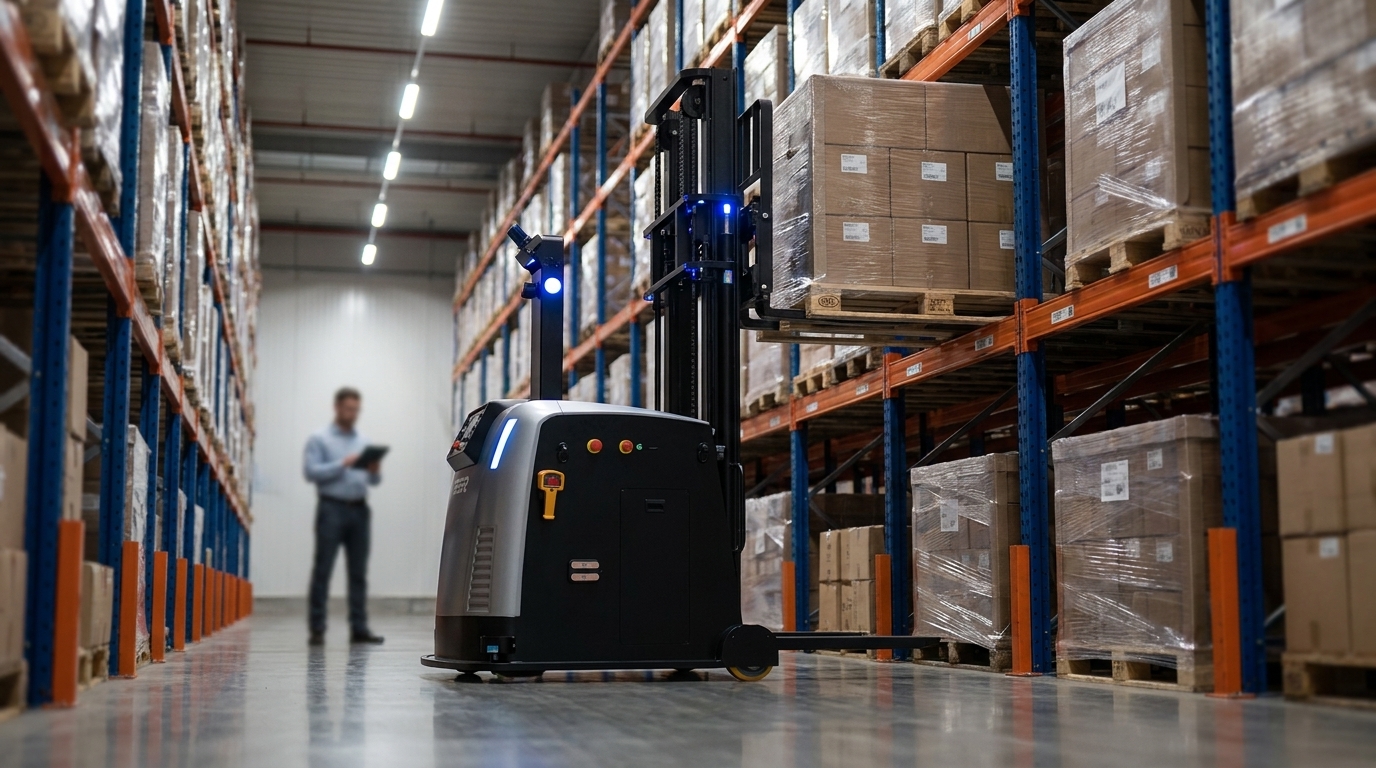
Night replenishment lag, dock-to-stock queues and empty-pallet drift are three symptoms of one unautomated layer — and Q4 is when it bills you.
At 03:40 on a Tuesday in a UK distribution centre, the night shift is not short of people. It is short of pallets in the right places. The mid-height pick faces on three aisles have run dry, the replenishment queue on the handheld is longer than it was at midnight, and the two most experienced truck operators on site are doing what they did last night — chasing the backlog instead of working the plan. By 06:00 the day pickers walk up to faces that are still empty. Short-picks land on the retailer's portal. Someone writes an email about service levels. Nothing broke. The feed simply never caught up.
The through-line across everything we published this week: most UK warehouses have automated the pick and left the pallet layer manual — and the pallet layer is where the throughput ceiling actually sits.
1. The replenishment window, treated as a scheduled leg
Replenishment is usually managed as an exception. It gets a queue, a priority flag and whoever is free. That works when demand is flat. It stops working the moment your pick rate rises, because replenishment is the only task on site whose workload is a direct function of how fast everything else is going. Speed up picking and you have, by definition, created more replenishment — you have simply moved the constraint one layer down and made it someone else's problem at 03:00.
The mid-height faces are where this bites first. They are too high to hand-stack and too low to be worth a dedicated VNA cycle, so they sit in the awkward middle where a counterbalance or stacker truck has to be summoned each time. On a night shift that is fully staffed, the work still queues, because the constraint is not headcount — it is the number of trucks that can be in the aisle, and the number of hours a person can sensibly spend doing repeat vertical moves in the dark.
This is the most automatable leg in the building, and it is automatable precisely because it is boring. The route is fixed. The source is a reserve location. The destination is a face with a known address. The trigger is a stock level crossing a threshold. There is no judgement in it, which is exactly why a driverless stacker fleet handles it well and exactly why it is a waste of your best operators.
Reframe it as a scheduled leg with its own capacity plan rather than a queue that gets drained when there is slack. Ask your automation supplier: what replenishment throughput does this fleet sustain in the fourth hour of a night shift, not the first — and can you show me the fleet's own logs proving it?
2. Dock-to-stock latency before the ramp
The second pattern shows up in operations that have already spent real money on automation — and specifically in e-commerce fulfilment, where a modern goods-to-person or automated pick face sits behind an entirely manual pallet layer. The pick face is a solved problem. Feeding it is not.
Four legs still move by hand: trailer unloading, dock-to-stock putaway, pick-face replenishment and empty-pallet clearance. Each is straightforward on a quiet Wednesday in June. Together they form a serial chain with no slack in it, and in a Q4 ramp they fail in a specific and predictable order. Inbound volume climbs first, so the dock fills. Because the dock is full, putaway is deferred. Because putaway is deferred, stock sits on the floor rather than in a location the pick face can call. Then the pick face — the expensive part, the part with the business case attached — starts idling while pallets it needs are twelve metres away on a marshalling lane, technically on site and functionally invisible.
The unpleasant part is the ratio. The manual pallet layer usually represents a small share of what you spent on automation, but it sets the ceiling for what the whole investment can deliver. A pick face rated well above what the feed can support is not a pick face rated well above what the feed can support — it is a pick face rated at whatever the feed does.
Dock-to-stock latency is the number to watch, and most sites do not measure it as a single figure. They measure unload time, and they measure putaway completion, and nobody owns the gap in between.
Ask: what is my median dock-to-stock latency in hours, and what does it look like on my three busiest days of last year rather than on an average day?
3. The empty-pallet loop nobody owns
Empty-pallet clearance is the leg that never makes the business case and always makes the shift report. Empties accumulate at the pick face, at the palletiser, at the despatch lanes. Someone clears them when they become an obstruction, which means they are cleared late, in bulk, by a truck that was doing something more valuable, usually through an aisle that pedestrians are also using.
It is worth being honest about why this leg stays manual. It has no customer. No SLA depends on it directly, so it never gets its own resource — and then it consumes resource anyway, unpredictably, at the worst moments. Every hour a counterbalance spends on empties during a peak inbound window is an hour it is not spending on putaway, which is the leg that is already late.
This is exactly the shape of work driverless trucks absorb well: low value per move, high frequency, entirely rule-based, and a nuisance to schedule around humans. Handing empties to the fleet does not sound like a transformation programme. It is, however, one of the few changes that gives time back to the leg you actually care about without adding a single person.
Say, illustratively, a 40,000 sqm site running two shifts decides that clearing empties is worth one truck-hour per shift. That is a small number on a spreadsheet and a large number at 15:00 on a Monday in November, because it is precisely the hour you needed for the inbound backlog. The value is not the hour. It is which hour.
Ask: who owns empty-pallet clearance on my site today, and what does that person stop doing when they do it?
4. The pedestrian–vehicle interface
There is a reason every one of these legs eventually becomes a safety conversation. All of them put a truck and a person in the same aisle at the same time, and all of them get worse under time pressure — which is the condition under which people take the shorter route past the racking rather than the marked one.
HSE's workplace transport guidance has long put the toll at roughly 50 deaths and around 5,000 injuries every year across UK workplaces, with struck-by-vehicle among the leading causes. That is the national picture, not a forecast for your site. It is still the right number to have in your head when you are deciding whether the night replenishment run should share an aisle with pickers.
The operational argument for automating these legs is not that machines are inherently safer than your operators — your operators are trained and careful. It is that a driverless truck's behaviour is identical on the fourth hour of a night shift and the first, in the week before Christmas and the week after. It does not take the shorter route because the queue is long. Consistency, not superiority, is the safety case, and it happens to be the same property that makes the throughput case.
There is a second-order benefit worth naming: once the routine vertical moves are handled by the fleet, your experienced operators spend their time on the moves that genuinely need judgement — awkward loads, damaged pallets, trailer work — which is both better use of them and a lower-exposure day.
Ask: how many pedestrian–vehicle interactions per shift does this design remove, and can you show me the traffic map before and after?
5. The fleet standard you set before you buy anything
Here is where the two patterns converge into a procurement decision. Night replenishment wants a stacker. Dock-to-stock putaway wants a counterbalance. Empty-pallet clearance wants a tugger or a low-level truck. Trailer unloading wants something different again. Those are four different machines, and the honest answer is that no single manufacturer is the best in the world at all four.
If you buy from a closed bundled stack, you get one manufacturer's answer to all four questions, and you get it for the next decade — because the fleet management layer, the traffic control and the integration into your WMS all arrive welded to the hardware. The second robot you buy is then not a decision. It is a renewal.
The alternative is to set the standard first and buy the robots second. Decide what your fleet layer must expose — task allocation across mixed vehicle types, a common traffic model, one integration surface into your enterprise WMS, telemetry you own — and treat any machine that cannot meet it as ineligible, regardless of who makes it. This is precisely why FlyWei exists as an independent, vendor-neutral UK systems integrator of autonomous forklifts and AMRs: we integrate the best robots across multiple manufacturers. We are not an OEM, a reseller or a distributor, which means we have no reason to tell you that the truck we happen to sell is the right truck for your night replenishment run.
Ask, in your next vendor meeting: if I add a different manufacturer's truck to this fleet in year three, what breaks — and is the answer in the contract or just in the room?
The arithmetic
- HSE's workplace transport guidance has long put the toll at roughly 50 deaths and around 5,000 injuries every year across UK workplaces, with struck-by-vehicle among the leading causes — the exposure sits in exactly the shared-aisle legs described above.
- An automated forklift AGV is a driverless industrial truck that lifts, carries and stacks palletised loads under software control, without an onboard operator. It is not a conveyor and not a picking robot — it replaces the truck, not the task around it.
- Night-shift replenishment to mid-height pick faces is the most automatable leg in a UK retail DC: fixed route, known source, known destination, threshold trigger, no judgement required.
- Four legs still move by hand in most automated e-commerce sites — trailer unloading, dock-to-stock putaway, pick-face replenishment and empty-pallet clearance — and they form a serial chain, so the slowest one sets the rate for all four.
- Illustrative worked example: on a 40,000 sqm two-shift site, redirecting one truck-hour per shift away from empty-pallet clearance is trivial as an annual figure and decisive as a peak-hour one — the value is which hour you get back, not how many.
What to do on Monday morning
- Measure dock-to-stock latency as one number. Not unload time, not putaway completion — the gap from wheels-stopped to stock callable by the pick face. Pull it for your three busiest days last year, not an average week.
- Count the vertical moves on your night shift. How many replenishment moves to mid-height faces happened between 22:00 and 06:00, and how many of them were done by your two most experienced operators? That ratio is your automation case, written by your own operation.
- Find out who owns empty-pallet clearance. Ask three supervisors; if you get three different answers, that leg is being funded out of someone else's budget in hours nobody is counting.
If any of this looks like your operation, reply to this edition or leave a comment. Happy to give you a quiet read of what an open-fleet design would look like on your site — no pitch, no deck, just the arithmetic on your own numbers.