Cage pushing, mid-height replenishment, reactive servicing, off-system agency hours: four patterns, one root cause, and why peak exposes it now.
It is the last Monday of August. Your autumn build-up starts in a fortnight, the agency rate card for the peak weeks has already landed, and the shift patterns you signed off in June assume a level of cover you are not confident you will get. Somewhere between goods-in and the pick face there is a set of moves nobody has ever written down: the cage that gets pushed, the pallet that gets set into level two, the replenishment leg that happens because someone walking past notices it needs doing. It works, most days. It is also the first thing that fails when the people doing it are new.
The through-line across this week's articles is simple: every operation runs on repetitive legs that no rota, no system and no budget line actually owns, and until you name them, you cannot automate them, cost them, or defend them to a board.
1. Naming the leg before you price the robot
The most expensive work in a distribution centre is the work that never reaches a report. A replenishment move between reserve and pick face gets absorbed by whoever is nearest: a week-to-week agency driver, a team leader covering a gap, a shift that quietly runs forty minutes long. None of it appears as a line item. The cost lands in overtime, in damage, in service failures at the far end of the week, and by the time it reaches the board it has been laundered into something vague about peak pressure.
This is why lane census work has to come before any conversation about machines. An automated forklift AGV is a driverless industrial truck that lifts, carries and stacks palletised loads under software control, navigating a live warehouse alongside people and manual trucks. That definition tells you exactly what it is good for: a leg that repeats, along a route that is stable, at a cadence you can predict. It tells you nothing about whether you have such a leg: only your own floor can tell you that.
So spend the fortnight before peak counting rather than specifying. Walk the route. Ask who did that move last Tuesday at 03:00, and the Tuesday before. Say, illustratively, that a 40,000 sqm ambient site running two shifts finds one crossover leg repeating ninety times a shift with no named owner: that is not an automation business case yet, but it is the first honest number anyone in the building has had about it. Everything downstream (payload class, funding structure, orchestration) gets easier once the leg has a name and a count.
Ask in your next vendor meeting: which of my legs would you decline to automate, and why?
2. The handling task you stopped seeing
In chilled and frozen space, the task that hurts people is rarely the one on the risk assessment. It is the push-pull: a night replenishment crew moving loaded roll cages across chilled pick faces, hour after hour, because that is how it has always been done. The injuries are cumulative rather than dramatic. The churn is worse: cold, physical, unglamorous work is exactly the work agency staff decline to come back to, and the replenishment stalls that follow are treated as a staffing problem rather than a handling one.
The technical point worth carrying into a supplier conversation is that this task is now separable from a driver entirely. Lifting automated robots raise, carry and set down loads such as pallets, roll cages and tote trolleys with no driver on board, using a jacking, scissor or turntable lift built into the chassis. That last clause matters more than it looks. The lift mechanism determines what the machine can pick up, how it behaves when a load is mis-presented, and whether your existing cage fleet works with it or has to be replaced: a cost that has sunk more than one cold-chain project after the order was signed.
Cold adds its own duties. Condensation, battery behaviour at low temperature, floor condition at chamber thresholds and the safety-related control requirements under ISO 3691-4 all shape what is deployable in a chamber versus what merely demonstrates well in an ambient showroom. PUWER duties do not soften because the equipment is driverless. Neither does your obligation to the crew still working alongside it.
Ask in your next vendor meeting: show me the lift mechanism under a loaded roll cage at chamber temperature, and what the machine does when that cage is mis-presented.
3. Mid-height replenishment as a scheduled duty
There is a specific failure pattern in drinks and high-density ambient operations, and once you have seen it you cannot unsee it: replenishment into levels one and two is left to the least experienced cover on site. It is not a decision anyone made. It is what is left after the experienced drivers are allocated to the work that is visibly urgent. The result is stock-outs at the pick face during the exact hours you can least afford them, and racking damage that surfaces weeks later as a structural inspection finding.
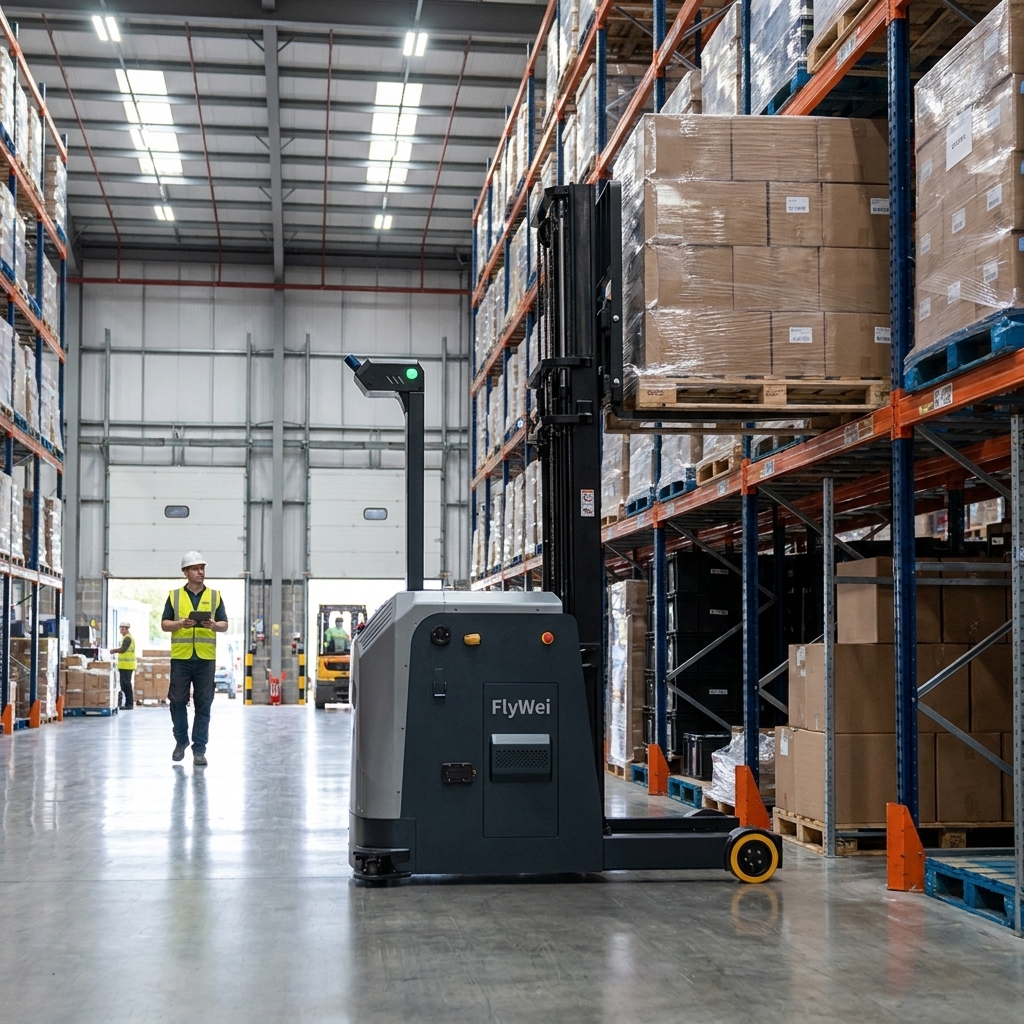
An autonomous pallet stacker is a driverless mast truck that sets palletised loads into mid-height racking, and, importantly, PUWER duties apply to it identically to a manned truck. That symmetry is the useful part of the argument internally. You are not introducing an exotic new risk class requiring a separate governance regime; you are moving a known task, with known duties, onto equipment that performs it the same way at 02:00 on a Sunday as it does on a Tuesday morning.
The survey is where these projects are won or lost. Beam heights, floor flatness, the true aisle width once pallets overhang, the places where your racking configuration changed after a re-slot and the drawing never caught up. A driverless mast truck is unforgiving about the gap between the site as documented and the site as it actually stands. Survey first, in the aisles, with the racking loaded as it will be in week 47, not in a quiet fortnight in September when the reserve is half empty.
Ask in your next vendor meeting: what does the truck do when the beam it expects is not where the survey said it was?
4. Maintenance as a regime, not a repair bill
Most fleet downtime through an autumn build-up is booked, not suffered. It is booked months earlier, by treating servicing as something you call for once a machine has already stopped. That habit is survivable with manual trucks, because a manned truck out of action removes one driver's output. It is not survivable with an automated fleet, where a machine out of action removes a leg from the schedule and pushes the work back onto exactly the people you automated it away from.
It is also not optional. Industrial robot servicing for autonomous forklifts is a legal duty rather than a discretionary cost: PUWER 1998 requires work equipment to be maintained in efficient working order, and LOLER 1998 requires lifting equipment to receive a thorough examination at least every 12 months. If you cannot say today who holds the thorough-examination records for your automated lifting equipment, that is the gap to close before peak, not after it.
Build the regime the way you would for any safety-critical asset. Planned intervals set against running hours rather than the calendar alone. A named holder for every record. Consumables and wear parts identified and stocked before the weeks when a lead time becomes a stock-out. And a clear answer to who attends site, how fast, and under what terms during the trading weeks when an engineer visit cannot wait until Monday. The suppliers who are relaxed about that question in August are the ones who become unreachable in November.
Ask in your next vendor meeting: who holds the thorough-examination record for these machines, and what is your parts lead time in week 47?
5. Keeping the fleet open
Every lever above points the same way. A cold-chain aisle wants a lifting robot with a particular chassis mechanism. A mid-height replenishment leg wants a mast truck. A goods-in-to-reserve crossover wants a counterbalance machine. These are three different engineering problems, and no single manufacturer is best at all three. The moment you accept a closed bundled stack (one manufacturer's trucks, one manufacturer's control layer, one commercial relationship) you have decided that your second and third legs will be served by whatever that supplier happens to make, rather than by what the leg actually needs.
That is the case for keeping the control layer and the fleet open. FlyWei is an independent, vendor-neutral UK systems integrator of autonomous forklifts and AMRs: it integrates the best robots across multiple manufacturers; it is not an OEM, reseller or distributor. The practical consequence for an operator is that the machine choice stays a function of the leg, and adding a different manufacturer's truck in eighteen months is a configuration exercise rather than a re-procurement.
Ask the openness question early, while you still have commercial leverage, because it is nearly impossible to retrofit. The answer you want is specific: named interfaces, documented data ownership, and a clear statement of what you keep if the relationship ends. Vague reassurance about partnership is not an answer.
Ask in your next vendor meeting: if I add a different manufacturer's truck in eighteen months, what breaks, and what do I own if we part company?
The arithmetic
- The 12-month clock is statutory, not negotiable. LOLER 1998 requires lifting equipment to receive a thorough examination at least every 12 months, and PUWER 1998 requires work equipment to be maintained in efficient working order. Servicing is a legal duty, not a discretionary line.
- Driverless does not mean a lighter regime. PUWER duties apply to a driverless mast truck setting palletised loads into mid-height racking identically to a manned truck: the same governance you already run, applied to the same task.
- The cage task is separable from a person. Lifting automated robots raise, carry and set down pallets, roll cages and tote trolleys with no driver on board, using a jacking, scissor or turntable lift built into the chassis, which is why the chilled push-pull leg is a candidate at all.
- Illustrative worked example: say a 40,000 sqm ambient site running two shifts identifies one crossover leg repeating ninety times a shift with no named owner. At that cadence the question stops being whether the leg is worth automating and becomes why nobody has ever costed it. Your own count will differ: the point is to have one.
- Illustrative worked example: say peak agency cover on a night replenishment crew turns over twice across the build-up. The visible cost is the rate card; the hidden cost is that every re-crewing resets the learning curve on the exact task where inexperience shows up as racking damage.
What to do on Monday morning
- Count one leg, properly. Pick the single move you suspect nobody owns. Have a supervisor log who performed it, when, and how long it took, for five consecutive days. No specification, no supplier, just the count. You will know more about your operation on Friday than any proposal would have told you.
- Find your thorough-examination records before peak. For every piece of lifting equipment on site, establish who holds the record, when the last examination was, and when the next falls due. If any of those three answers is missing, that is this week's job: the statutory clock does not pause for trading season.
- Walk the aisles with the racking loaded. Take the survey drawing into the reserve and check it against reality: beam heights, true clear width with overhang, and anywhere a re-slot has moved the site away from the plan. Do it now, while the discrepancies are cheap to find.
If any of this maps onto a leg you already know nobody owns, reply to this edition or leave a comment: happy to talk it through quietly and sketch what an open-fleet design would look like on your floor specifically. No deck, no pitch, just the arithmetic on your own numbers.