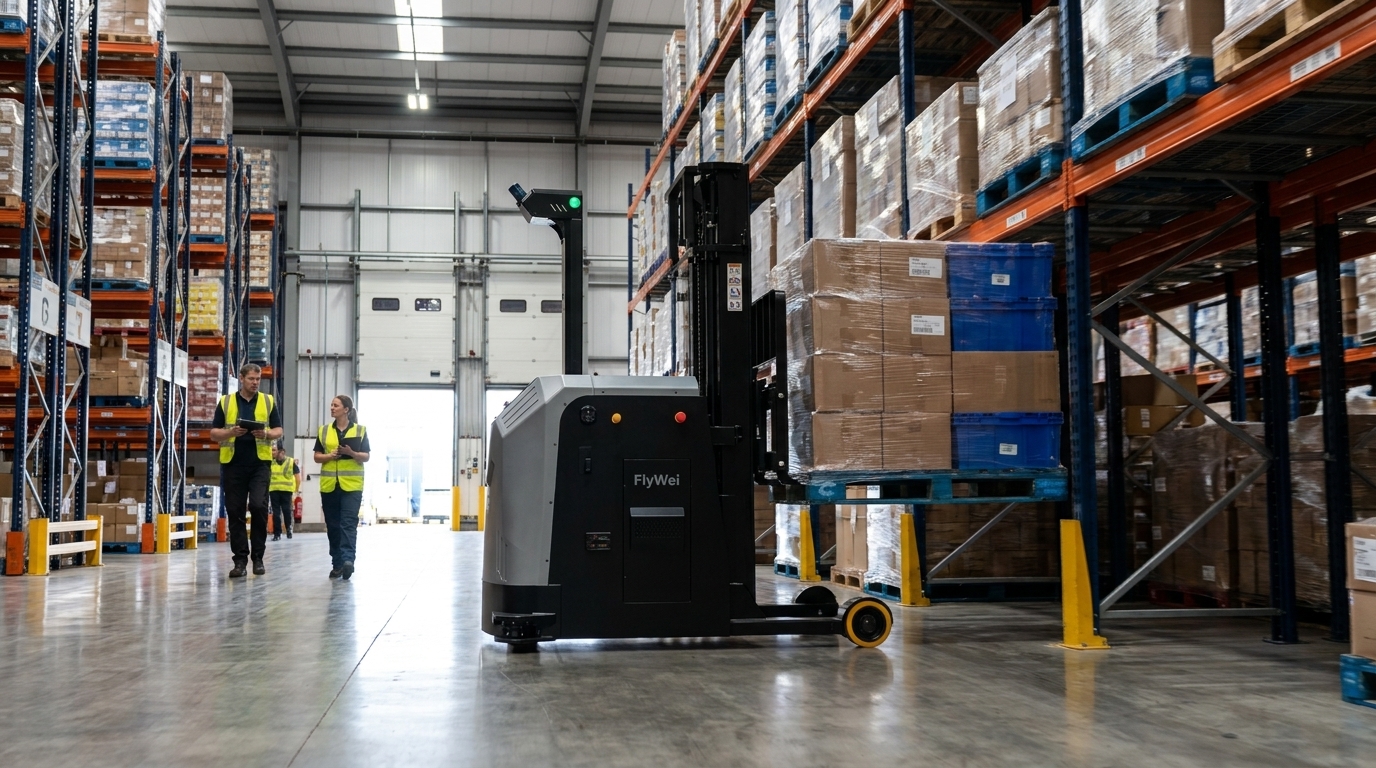
AGV forklift trucks are autonomous, driverless material-handling vehicles that move pallets on fixed logistics loops without a human operator on board, guided by on-board LiDAR, safety-rated PLCs and a warehouse-wide fleet manager. They matter now because Great Britain's workplace-transport injury profile still records around a quarter of all fatal workplace injuries each year linked to vehicles at work, and every unfilled forklift-driver shift on a UK engineering warehouse floor either delays a production line or hides a near-miss. If you run a 100,000-square-foot engineering DC in the West Midlands, the Sheffield / Rotherham corridor or the Rugby triangle, three problems tend to arrive together this quarter: the reach-truck queue at goods-in, the LOLER thorough-examination backlog on ageing counterbalance trucks, and agency driver day-rates that have moved faster than your throughput targets. A properly specified AGV forklift fleet answers all three on the aisles you already own.
Why goods-in throughput stalls in UK engineering warehouses
A 100,000-square-foot engineering DC feeding a UK machining or engine-assembly plant runs a small number of very heavy, very repeatable pallet flows: inbound castings from a foundry, sub-assemblies from a tier-2 supplier, MRO consumables for the plant floor, and finished-goods pallets outbound to the OEM. On paper, four counterbalance and reach trucks with three shifts of drivers cover it. In practice, three forces stall it.
First, the labour market. Logistics UK continues to report persistent driver-vacancy pressure across regional distribution work, and the pool of forklift-licensed operators is smaller and older than the pool of HGV drivers. Second, PUWER 1998 and LOLER 1998 create a real, non-negotiable maintenance overhead: every powered truck needs thorough examination on a strict interval, and older trucks accumulate downtime that nobody planned for. Third, mixed pedestrian-and-vehicle traffic in narrow aisles remains the single largest source of major forklift injuries recorded by HSE, and it forces slower speeds, spotters, one-way flow and shift-marshalling that further choke throughput.
The knock-on effect on your P&L is quiet but expensive: production-line stops for missing sub-assemblies, expedited freight to cover missed OEM windows, and a rising insurance premium on a forklift fleet that has more near-misses per 1,000 hours than the sector median. Adding a fifth truck and a fifth driver does not fix any of the three root causes; it just spreads them across a bigger fleet and a longer LOLER queue.
The four levers that fix it
1. Operational: hand the repeatable loops to AGV forklift trucks first
Not every task in an engineering warehouse belongs on an autonomous truck. The rule that works is simple: automate the loops that are boring, repeatable and dangerous, and keep the human on the loops that need judgement. Start with three flows: inbound-dock to bulk-storage, bulk-storage to line-side buffer, and finished-goods to outbound-dock. Those three are typically 60-70% of a UK engineering DC's total pallet moves and close to 100% of the workforce's fatigue and injury risk. Two counterbalance AGV forklifts running 24-hour cycles absorb that work and free your remaining human operators for exceptions: damaged pallets, tail-lift trailers, over-height loads, and the awkward one-off VOR pull from a supplier van. Track your first quarter by "hours saved per day" and "line-stops avoided", not by "trucks replaced".
2. Technical: the fleet manager is where the money is made
A single AGV forklift is a science project; a coordinated fleet is a business. The economic step-change happens when a fleet manager, an orchestration layer such as FlyWei's M4, decides which truck goes to which pallet, when each truck charges, when it hands off to a human, and how it sequences around a shift changeover. The standard for how that orchestrator talks to individual robots is ISO 3691-4 plus the VDA 5050 fleet-to-truck protocol, and it matters because it lets you scale from two to eight trucks without eight times the software integration. Insist on VDA 5050 support in every quote; without it you are locked into a single vendor's proprietary controller for the next decade.
3. Regulatory: replace paper thorough-examinations with live telemetry
PUWER 1998 requires powered work equipment to be maintained "in an efficient state, in efficient working order and in good repair", and LOLER 1998 requires a thorough examination at set intervals for anything that lifts loads. On a driven fleet, that evidence is a paper certificate in a filing cabinet. On an AGV forklift fleet, every hydraulic cycle, every safety-scanner event and every drive-motor temperature is logged and time-stamped, so your HSE inspector, your insurer and your internal HSSE lead can pull an audit trail per truck per shift. That single change reduces compliance overhead and eliminates the "unknown-history" premium your insurer currently charges on a mixed-age driven fleet.
4. Commercial: lease as OpEx, not buy as CapEx
An outright-purchased AGV forklift lands on the balance sheet at £110,000-£180,000 per truck depending on lift height, payload and safety class. A 3-, 5- or 7-year Robotics-as-a-Service lease converts that number into a monthly OpEx line that includes the truck, the M4 fleet-manager licence, remote monitoring, planned maintenance, LOLER thorough examinations and end-of-life removal. For a UK engineering procurement committee this is usually the shorter path to internal approval, because it aligns the spend with the labour cost it is replacing and the throughput it is unlocking, quarter by quarter, on the same P&L line rather than a five-year CapEx amortisation schedule.
Decision-grade comparison: driven fleet vs AGV forklift fleet vs RaaS lease
| Metric | Driven counterbalance fleet | Owned AGV forklift fleet | AGV forklifts on 5-year RaaS lease |
|---|---|---|---|
| Year-1 CapEx | £85k × 5 = £425k plus driver recruitment | £140k × 5 = £700k | £0 (OpEx only) |
| Annual driver cost (three shifts) | £720k (5 × 3 × £48k fully loaded) | £0 (one supervisor kept for exceptions) | £0 (one supervisor kept for exceptions) |
| PUWER / LOLER admin | Manual paper trail, 4-8 hours per truck per quarter | Automated telemetry log per shift | Automated log plus inspections in the lease |
| Uptime target | ~78% (shift gaps, sickness, breaks) | 96%+ (charged and orchestrated) | 96%+ with SLA-backed remote support |
| Three-year TCO (indicative) | £2.6m+ | £1.4m | £1.1m |
AGV forklift trucks are autonomous, driverless material-handling vehicles that move pallets on the same aisles a UK warehouse already runs, without adding drivers and with a workplace-transport injury profile lower than the sector's fatal-accident norm.
What FlyWei does here
FlyWei supplies and integrates autonomous forklift fleets for UK engineering warehouses from a Coventry-based support team, and we operate the M4 fleet manager as the vendor-agnostic orchestration layer above them. For a heavy-parts engineering DC in the West Midlands, the Sheffield / Rotherham corridor or the Birmingham / Solihull triangle, a typical FlyWei deployment starts with two counterbalance FlyWei autonomous forklifts in the 2-tonne class plus one stacker AGV for narrow-aisle racking, running the inbound-dock-to-bulk and bulk-to-line-side loops on the aisles the current driven fleet already uses.
M4 handles the pallet-level task allocation, VDA 5050 handshakes with each truck, live charging strategy, and the shift-changeover reallocation that keeps throughput flat when your human operators rotate. Fleet dispatch software, our robot dispatch service, provides the 24/7 remote-supervision layer that catches the exceptions (a rogue pallet position, a temporarily blocked aisle, an unusual load profile) before they become a line stop. All maintenance, LOLER thorough examinations and PUWER-mandated inspections are covered under the RaaS lease, so your engineering warehouse team never runs a separate compliance thread for the autonomous fleet.
Real deployments matter more than brochures. Every FlyWei autonomous forklift installation in the UK is documented as a live before-and-after in our case-studies library, with pallets-per-hour, injury-rate and PUWER-compliance evidence you can screenshot straight into an internal CapEx committee. If a fleet is already running elsewhere on your estate, UK-based support engineers can pull the last 90 days of telemetry inside an hour.
Frequently asked questions
Are AGV forklift trucks safe to run alongside human operators in a UK warehouse?
Yes, when specified against ISO 3691-4 and operated under a PUWER-compliant risk assessment. The vehicles carry Cat-3 safety-rated LiDAR scanners, dual redundant e-stops and force-limited hydraulics; on shared aisles they run at a slower, standardised speed with defined exclusion zones, and every incident is logged automatically for HSE review.
How many AGV forklift trucks do I need for a 100,000 sq ft engineering DC?
Typically two to four, depending on aisle length, pallet weight and shift pattern. A 2-tonne counterbalance AGV forklift covers around 12-15 pallet moves per hour on a 60-metre dock-to-storage loop; sizing is best done from the last four weeks of WMS move data rather than from trailer count.
Do I have to rip out my racking and change my WMS?
No. FlyWei autonomous forklifts navigate by natural-feature LiDAR SLAM rather than floor markings or reflectors, so they run on your existing racking. M4 integrates with the WMS you already run through a documented API, so pallet tasks appear as new task types rather than a WMS replacement.
What happens if a pallet is stacked wrong or an aisle is blocked?
The truck holds, fleet dispatch software is alerted in real time, and a remote supervisor either releases the exception or pushes it to your on-site team. The truck never proceeds through an unresolved obstacle, and the exception is logged as a PUWER-relevant event for later review.
Can I lease AGV forklift trucks rather than buy them outright?
Yes. FlyWei offers 3-, 5- and 7-year Robotics-as-a-Service leases that bundle the truck, M4 licence, remote monitoring, planned maintenance and LOLER thorough examinations into a single monthly OpEx charge, which converts a £700k CapEx into a predictable per-truck monthly figure aligned with the labour cost it is replacing.
What UK regulations apply to AGV forklift trucks?
PUWER 1998 (safe use of work equipment), LOLER 1998 (lifting operations), ISO 3691-4 (autonomous industrial trucks), the Health and Safety at Work Act 1974, and UKCA marking post-Brexit. Every FlyWei autonomous forklift ships with the full compliance file and a documented risk-assessment template your HSSE lead can adapt.
How do I get support on-site if something breaks?
Every lease and purchase contract includes remote-first support with M4 diagnostics; on-site engineering visits are dispatched from a UK-based team with SLA-defined response times. Full detail is on the support page.
If PUWER compliance, LOLER backlog and driver-shortage day-rates are on your Q3 risk register for the engineering warehouse floor, the fastest way to see whether an AGV forklift fleet actually fits your aisles is a walk-through with the engineers who would build it.
Book a free 30-minute site survey and a UK-based FlyWei engineer will walk your goods-in, storage and dispatch loops and return a costed fleet-sizing recommendation for your DC. If leasing is the cleaner commercial route, we will also model it against your current driven-fleet TCO: see 3-, 5- and 7-year RaaS options.
UK-based engineers · no obligation · reply within one business day.