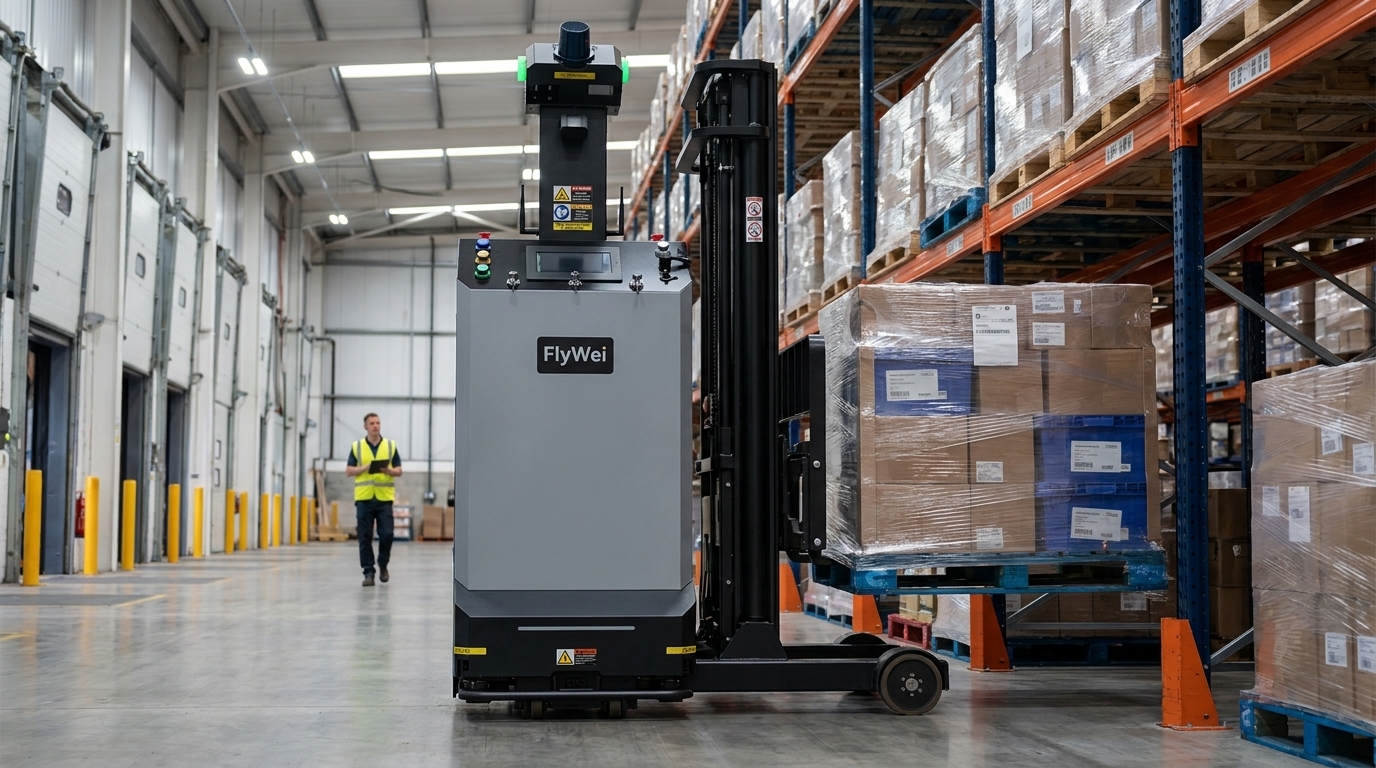
An AGV forklift is a driverless industrial truck that moves pallets under software control, navigating by on-board sensors rather than a seated operator. Across Great Britain, being struck by a moving vehicle killed 24 workers in 2025/26 — second only to falls from height — according to HSE's annual fatal injury statistics. For an Operations Director running an MHRA-regulated distribution centre, the sharper quarterly problem is evidential rather than physical. Every pallet moving from goods-in to quarantine, from quarantine to released stock, and from released stock to despatch must be accounted for. On a manual fleet that account depends on a driver remembering to scan at the right moment, and in Q3 that discipline is stretched thinnest by agency cover and holiday rotas. An AGV forklift removes the manual scan from the internal move: location history is generated by the machine that performed the move rather than reconstructed from a handheld afterwards.
Why the evidence gap opens in a regulated DC
Pharmaceutical distribution in the UK operates under wholesale dealer licensing overseen by the Medicines and Healthcare products Regulatory Agency. The expectation is simple to state and hard to sustain: at any moment you should be able to say where a batch is, what status it holds, and who moved it there. Manual handling meets that through human discipline. A driver collects a pallet, drives it, sets it down, and scans — so the record comes from a second action, separate from the move itself.
That separation is where the gap opens. Scans drift late when a queue builds at the despatch bay, and early when a driver scans on approach to save a walk back to the terminal. Neither is malicious and both are common, particularly on sites around Magna Park and DIRFT where seasonal volume is absorbed through agency labour. The result is a location record that is approximately right and occasionally wrong — and in a regulated environment, approximately right generates deviations and held stock.
There is a quieter cost alongside it. Rack-leg strikes are rarely logged as compliance events, yet still consume quality time and trigger re-inspection. The HSE's workplace transport guidance treats pedestrian–vehicle interaction as the core control problem in warehousing; in a licensed DC it also threatens the product being carried.
Lever one: automate the three fixed lanes first
The operational lever is to resist automating everything and take the three lanes that are fixed, repetitive and evidentially expensive: goods-in to quarantine, quarantine to released stock, and released stock to despatch staging. These moves have stable origins and destinations and need no operator judgement. They are also the moves quality assurance cares about most, because each is a status change as well as a transfer.
Begin by measuring how many of those moves happen per shift and how long each takes door to door. Most sites find the lane count smaller than expected and the elapsed time far longer, because manual moves are interleaved with replenishment. Automating fixed lanes converts a variable-priority task into a guaranteed-throughput one: the vehicles work the lane continuously whether or not the shift is short-handed. Keep exception handling and judgement calls with your experienced operators. The objective is not a dark warehouse; it is removing the moves whose value lies in being done identically every time.
Lever two: make the fleet manager your evidence layer
The technical lever is to treat fleet software as a compliance system, not a traffic controller. A driverless forklift that moves pallets reliably but reports nothing useful has solved half the problem. A regulated operation needs a per-move record: which vehicle, which load, which origin and destination, at what time, completed or exception-raised.
That is the job of the M4 fleet manager, which assigns missions, arbitrates traffic and writes completion events back to the systems holding stock. Vehicle-level command runs over VDA 5050, the open interface between fleet control and mobile robots, which lets trucks of different classes and different manufacture be commanded from one place. Above it, RDS robot dispatch decides sequencing, so a release event pulls stock forward rather than waiting for the next scheduled sweep. Insist on two behaviours at specification stage: every completed move posts a stock movement to your warehouse system, and every failed move raises a visible exception rather than failing silently.
Lever three: build the PUWER and ISO 3691-4 case at design stage
The regulatory lever is to write the safety case while the layout is still on paper. Autonomous trucks are work equipment, so the Provision and Use of Work Equipment Regulations 1998 apply in full — equipment suitable for the task, protection against specific hazards, and recorded inspection and maintenance. The HSE's PUWER guidance is the practical reference for what an inspector expects to see.
Alongside it sits ISO 3691-4, the safety standard for driverless industrial trucks, governing protective devices, stopping performance and behaviour around people. The design-stage questions are concrete. Where do pedestrian routes cross vehicle routes, and can they be separated rather than marked? Does the floor meet the flatness the trucks require, per TR34 industrial floor guidance? Do charging positions sit clear of escape routes? Deciding these early costs drawing-office time; deciding them after commissioning costs racking moves, and in a licensed facility a change notification too.
Lever four: size the fleet against the release queue
The commercial lever is to size against the constraint that actually delays despatch. Many fleets are specified against the busiest hour of the busiest day, producing a vehicle count nobody can defend at capex committee. In regulated distribution the binding constraint is usually not the peak — it is the queue of released stock waiting to be brought forward after a quality release, which arrives in bursts and stalls loading.
Size for that queue and the fleet gets smaller and the payback shorter. Model it: releases per day, pallets per release, the window between release and the loading slot, and the elapsed time per lane. Then decide how to hold the asset. Where the case is framed around a quarterly cost line rather than capital, fleet leasing over three, five or seven years moves spend into operating budget. Where capital is available and the flow is permanent, outright purchase remains cheaper across the asset life.
| Lever | Relative cost | Time to effect | Measure it moves |
|---|---|---|---|
| Automate the three fixed lanes | Medium capital, low disruption | One to two quarters | Scan-to-move variance; lane throughput |
| Fleet manager as evidence layer | Low, if specified at the outset | Concurrent with deployment | Deviations raised per thousand moves |
| PUWER and ISO 3691-4 at design | Lowest — drawing-office time only | Before any vehicle arrives | Pedestrian–vehicle crossings removed |
| Size against the release queue | Reduces capital rather than adds | Immediate, at specification | Vehicles required; release-to-load time |
In UK pharmaceutical distribution, an AGV forklift removes the manual scan step from every internal pallet move, so location history is generated by the machine that performed the move rather than reconstructed from an operator's handheld afterwards.
What FlyWei does here
FlyWei is an independent UK systems integrator of AGV forklifts and autonomous forklift trucks. Because FlyWei is vendor-neutral, the truck specified for a quarantine-to-released-stock lane is chosen on aisle width, lift height, floor condition and duty cycle rather than on what one manufacturer happens to build. A narrow-aisle reach-truck class vehicle suits high-bay released stock; a counterbalanced class suits trailer-adjacent staging; a low-profile pallet-truck class suits dock-to-stock runs. Most regulated sites end up with a mixed fleet.
FlyWei designs the integration around the systems the site already runs. M4 holds the missions and the per-move record, RDS sequences work so a quality release pulls stock forward against the loading slot, and completions are written back so your existing warehouse system stays the record of stock. Where cart and tote movement sits alongside pallet work — sampling, returns, secondary packing — FlyWei lifting robots and AMRs handle it under the same fleet layer. Deployment is incremental: one lane proven against your own deviation and throughput data, then the next. Vehicle classes are covered in what an autonomous forklift is, and the distinction between types in autonomous forklift versus AGV.
Frequently asked questions
What is an AGV forklift?
An AGV forklift is a driverless industrial truck that lifts and transports palletised loads under software control. It navigates using on-board sensors and a map of the building, receives work from a fleet manager rather than a driver, and reports each completed move back to the systems holding stock.
Can an AGV forklift work in an MHRA-licensed warehouse?
Yes. The requirement is not that a person performs the move, but that it is controlled, recorded and traceable. An automated move generates its record from the vehicle that performed it, removing the dependence on a separate manual scan. Handle the change through your existing change-control process.
Do we have to replace our warehouse management system?
Usually not. The fleet layer sits above the warehouse system and takes work from it, so that system stays the source of truth for stock and orders. Replacement is only worth considering where it cannot expose work through an interface or scheduled export — and even then middleware is cheaper.
How long does a first deployment take?
Commissioning vehicles is rarely the long pole. Mapping the building, agreeing exception handling with quality assurance and testing against live data take longer. Sites with unique location identifiers and a documented interface move fastest. Where master data is unreliable, fix it first — automating on top multiplies errors.
What happens if the network or host system goes down?
A well-designed integration degrades rather than stops. Vehicles complete the mission already issued and then hold safely, while the fleet manager queues completions and replays them when the link returns. Ask any supplier how long their fleet manager runs detached, and how duplicates are prevented on reconnection.
How does an AGV forklift affect pedestrian safety?
Autonomous trucks are governed by ISO 3691-4, covering protective devices, stopping performance and behaviour around people. The larger gain comes from layout: automated lanes have fixed routes, so pedestrian and vehicle traffic can be separated by design rather than by signage and habit — what HSE workplace transport guidance asks operators to achieve.
Is leasing or buying better for a first fleet?
It depends how the case is framed. Leasing over three, five or seven years moves spend from capital to operating budget and matches payment to the contract term, suiting a first deployment where the flow may change. Outright purchase is cheaper across the asset life where the flow is permanent.
Where can we see requirements for our sector?
Aisle geometry, temperature and evidence expectations differ between regulated distribution, chilled storage and contract logistics. Configurations sit across FlyWei's solutions pages; UK warehousing context is published by Logistics UK.
If a manual audit trail across quarantine, released stock and despatch is on your Q3 risk register, the fastest way to size the opportunity is to measure your own three lanes.
Book a free 30-minute site survey and a FlyWei engineer will walk your goods-in, quarantine and despatch routes, count the fixed lanes and give you a realistic vehicle count. Specifications are set out on the AGV forklift and autonomous forklift range.
UK-based engineers. No obligation. Reply within one business day.