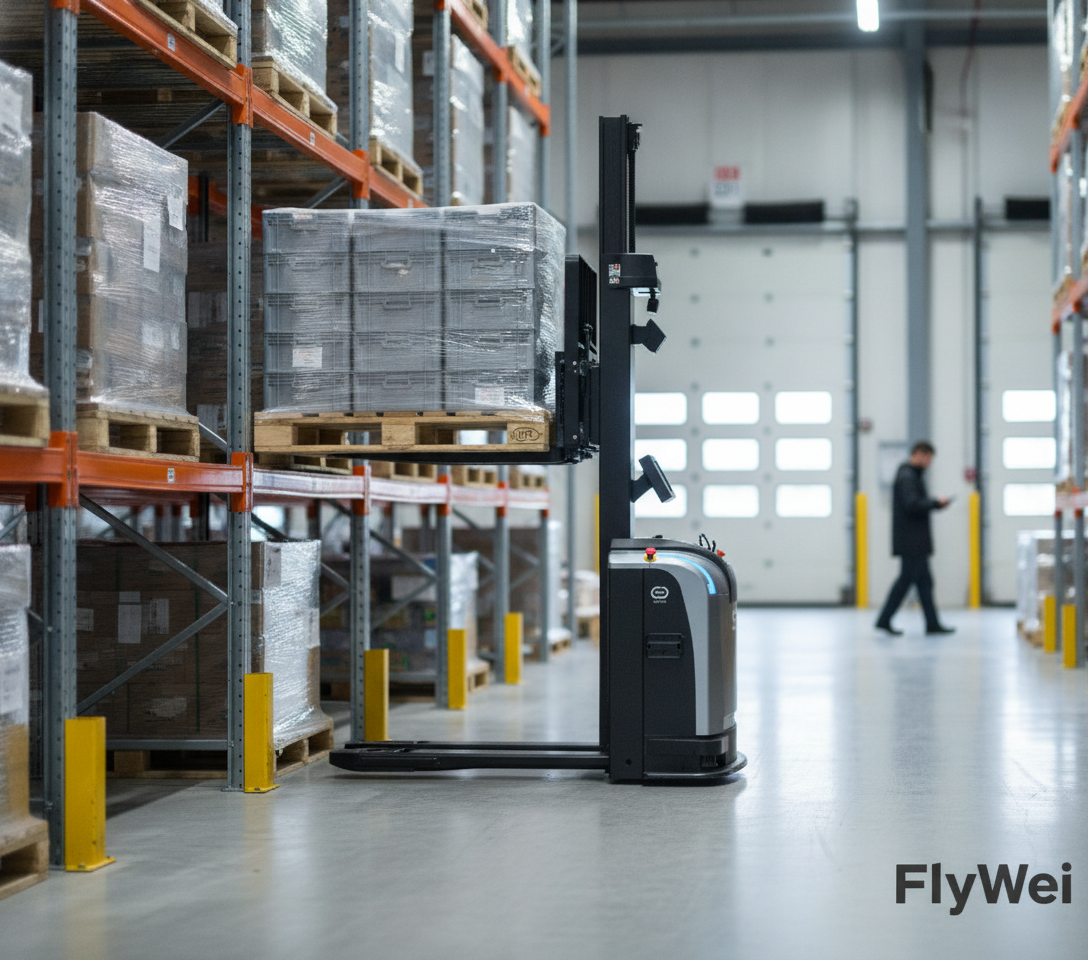
An autonomous forklift for cold storage is a driverless, LiDAR-guided industrial truck rated for continuous operation between +5°C and –30°C, moving pallets, roll cages and paper-wrapped stock without a seated operator. UK workplace transport guidance published by the Health and Safety Executive records that around 25% of reportable workplace transport injuries involve lift trucks each year, and chilled distribution centres carry an above-average share because of ice, fogged optics and bulky PPE. For a multi-site supply chain director running three or more chilled DCs, the pain this quarter is concrete: sub-zero pick throughput is 30-45% below ambient because operators can only endure 45-minute cold spells, aisle widths tolerated for manned trucks squander 25-30% of high-bay cube, and cold-store driver retention is the worst in the network, with turnover routinely double the warm-warehouse baseline across UK 3PL and grocery DCs.
Why chilled DC throughput collapses at –25°C
The physics is unforgiving. Below zero, hydraulic response slows, lead-acid battery capacity drops 15-25%, and every optic fogs. The labour angle is what breaks the P&L. UK cold-store operators have long fought recruitment: candidates who complete their manual-handling induction routinely walk out mid-shift after their first freezer rotation, and Logistics UK workforce data records chilled-site vacancy rates well above the ambient warehouse average across 2024-25. Fixed shift rotations — the 45-in, 15-out cycle mandated by chilled DC risk assessments under the PUWER 1998 code — mean a manned reach truck is idle a quarter of every shift by design.
Add higher PPE costs (insulated boots, freezer suits, thermal gloves), sickness absence spikes during winter peak, and the operational cost per pallet moved in a freezer typically runs 1.7-2.2x the ambient rate. For a supply chain director consolidating volumes across Magna Park, DIRFT and a Burton-on-Trent chilled hub, the compound labour drag is what dominates network TCO — not the machines. The upside: because the driver is the constraint, removing them delivers a step-change no capacity plan alone can match.
A second, quieter drag is real estate. Freezer construction cost is £2,500-£4,000 per pallet position built in 2025, and every metre of unused vertical or horizontal cube is amortising against nothing. Manned reach trucks in a –25°C environment need extra aisle for the operator's field of view through a fogged cage, and health-and-safety planners commonly build in 300-500mm of extra clearance to protect against operator glove-and-boot slips. Multiplied across a 25,000-pallet chilled network, that is a wasted footprint the size of a small ambient DC.
The three levers that unlock chilled DC productivity
Lever 1 — Operational: split the fleet by temperature zone, not by shift
The reflexive answer to cold-store labour cost is to rotate operators faster. The better answer is to redesign the fleet by thermal zone. Palletised inbound receipt and dispatch — the ambient dock and the +5°C chilled staging area — is often still best served by a mix of manned and semi-autonomous pallet trucks: the cycle is short, the exception rate is high, and a human handles anomaly resolution faster. The blast-freezer rooms, low-temperature racking and cross-dock at –25°C are where an autonomous forklift for cold storage earns its capex, because the vehicle does not need a break, does not fog, and does not misjudge distance behind bulky PPE. Splitting the fleet map this way typically converts 40-60% of chilled forklift hours to driverless, keeps the remainder as skilled human roles, and lifts throughput per shift materially without changing rack layout.
Cross-docking through the chilled interface benefits most. A driverless forklift can hold a stable interleave cadence with inbound trailers on a two-minute door beat — difficult to sustain manually across a full shift when operators cycle in and out of the freezer.
Lever 2 — Technical: fleet orchestration with a temperature-aware dispatcher
A single autonomous truck delivers point-solution wins. A network-wide dispatch layer delivers compounding wins. The M4 fleet manager and RDS robot dispatch are the FlyWei layers that make an autonomous forklift for cold storage part of a coordinated flow rather than a lonely trolley: task priorities are re-scored every second against SKU velocity, dock timing, and battery state-of-charge, and cold-tolerant vehicles are automatically prioritised for the coldest lanes so ambient-only trucks never stray into a battery-crippling freezer. A VDA 5050 interface allows the operator's existing WMS to publish tasks in a standard schema, so the dispatch layer is portable across future robot generations. On multi-site rollouts, one dispatch backbone can synchronise five, ten or twenty DCs, allowing supply chain directors to load-balance work across sites during regional peaks. See the M4 fleet manager and RDS robot dispatch for the underlying orchestration.
Lever 3 — Regulatory: PUWER, LOLER and ISO 3691-4 engineered in from day one
UK cold-chain operators live under a well-known regulatory stack: PUWER 1998 (safe use of work equipment), LOLER 1998 (lifting operations and lifting equipment), and — for automated industrial trucks — the ISO 3691-4 autonomous industrial truck standard. The PUWER 1998 statutory instrument requires that machinery is suitable, inspected and maintained for the environment it operates in; ISO 3691-4 defines the safety-related control system, protective devices and hazard zones for a driverless truck. A properly specified autonomous forklift for cold storage arrives with SIL 2 safety controllers, redundant safety scanners rated for condensation, and an inspection routine the site's competent person can lift directly into a pre-approved maintenance plan. The paperwork does not go away, but the audit trail is generated automatically and the risk of operator misuse — the single largest PUWER violation category in chilled operations — is materially reduced.
Manned vs autonomous forklift — chilled DC (indicative per-unit 5-year TCO)
| Metric | Manned cold-store reach truck | Autonomous forklift for cold storage |
|---|---|---|
| Effective productive hours per shift | 4.5 hrs (45/15 rotation, PPE change) | 7.5 hrs (charge only) |
| Pallets moved per shift | 90-120 | 170-210 |
| Aisle width required | 3.5m VNA | 1.9m VNA |
| Direct labour cost per pallet | Baseline | 0.30-0.45x baseline |
| PUWER audit prep effort | Manual logs, weekly | Auto-generated, continuous |
| Typical payback in a UK chilled DC | — | 28-42 months (or zero upfront via leasing) |
An autonomous forklift for cold storage rated for –30°C removes the in/out shift rotation constraint that limits how much of each shift a manned truck can actually work, unlocking materially more moved pallets per bay without adding headcount.
What FlyWei delivers for UK multi-site cold-chain supply chain directors
FlyWei designs, supplies and integrates purpose-built autonomous forklifts, including counterbalance, reach and stacker variants engineered to run continuously at freezer temperatures. Sealed enclosures replace the operator cab, condensation-resistant LiDAR is fitted at the mast and rear, and battery chemistry is selected for stable performance at –30°C. Every truck ships with SIL 2 functional-safety controllers meeting the requirements of ISO 3691-4, and every fleet is coordinated by FlyWei's own M4 fleet manager and RDS robot dispatch — so multi-site supply chain directors have one orchestration backbone across the whole chilled network, not a fragmented per-site tool.
The FlyWei autonomous forklift for cold storage range covers 1.4-tonne narrow-aisle reach trucks, 2-tonne stackers for mid-height chilled racking, and 2-3 tonne counterbalance variants for blast-freezer to trailer flow — the same automated forklift and autonomous pallet stacker families that already ship into UK cold-chain sites at Magna Park, DIRFT and Burton-on-Trent. For finance teams reluctant to lock capex against a five-year cold-chain forecast, FlyWei's 3, 5 and 7-year leasing converts the fleet to a single monthly operating charge with maintenance, remote monitoring and firmware upgrades bundled. UK-based engineers cover deployment, uptime SLA and PUWER inspection support, so the SC director's operations team keeps direct-line ownership without hiring a robotics specialist. See industry solutions for cold-chain reference architectures.
Frequently asked questions
What temperature can an autonomous forklift for cold storage operate at?
Purpose-built cold-store autonomous forklifts operate continuously between +5°C and –30°C. Sealed electronics, condensation-resistant LiDAR and battery chemistry tuned for sub-zero performance are the minimum specification. Ambient trucks moved into a freezer without cold-store certification will experience premature failure, so the fleet must be zone-rated at procurement, not retrofitted later.
How does an autonomous forklift for cold storage handle condensation and icing?
Optical windows on safety LiDAR use heated glass and hydrophobic coatings; mast sensors carry redundancy so a single sensor icing does not stop the truck; and dwell time in temperature-transition zones is scheduled by the RDS dispatcher to prevent thermal cycling that shortens electronics life.
Does an autonomous forklift for cold storage comply with PUWER 1998 and LOLER 1998?
Yes. PUWER 1998 requires suitable, inspected and maintained equipment; the truck's automated maintenance schedule and SIL 2 controllers meet that bar. LOLER 1998 applies to lifting operations and requires thorough examination — the driverless truck is treated exactly as a manned truck under LOLER, with fixed inspection intervals and defect logging generated automatically through the M4 fleet manager.
How does an autonomous forklift for cold storage integrate with an existing WMS?
Via a VDA 5050-compliant interface. The operator's existing WMS publishes tasks in a standard schema and the RDS dispatcher consumes them, so no custom integration is required against each robot model. This future-proofs the multi-site rollout across successive robot generations.
What is the typical payback on an autonomous forklift for cold storage in a UK chilled DC?
28-42 months on unit economics alone, driven by a material throughput uplift and labour cost reduction at the chilled face. With FlyWei's 3, 5 and 7-year leasing, upfront capex is zero and the monthly charge is designed to be lower than the manned labour it replaces from month one.
Can an autonomous forklift for cold storage cross the chilled/ambient interface repeatedly without damage?
Yes when the vehicle is zone-rated and the dispatch layer manages dwell time between temperature zones. Uncontrolled transitions are the main cause of premature electronics failure in cold-store trucks; the M4 fleet manager schedules moves to keep transitions within thermally safe intervals.
How many autonomous forklifts does a typical UK multi-site chilled network need?
A three-site chilled network handling 10,000 pallet moves per day typically maps to 18-24 driverless trucks split across counterbalance, reach and stacker variants, with roughly 40-60% of chilled forklift hours converted from manned to autonomous. FlyWei's fleet-sizing assessment produces the exact answer against your live volume, aisle geometry and shift pattern.
If sub-zero throughput and cold-store driver churn sit on your Q3 risk register, the fastest way to get grounded numbers is a walkthrough of your highest-volume chilled flow.
Get a 48-hour feasibility read on your highest-volume chilled flow — or explore the full autonomous forklift for cold storage range and the 3, 5 and 7-year leasing options for zero-capex deployment.
UK-based engineers · no obligation · reply within one business day.