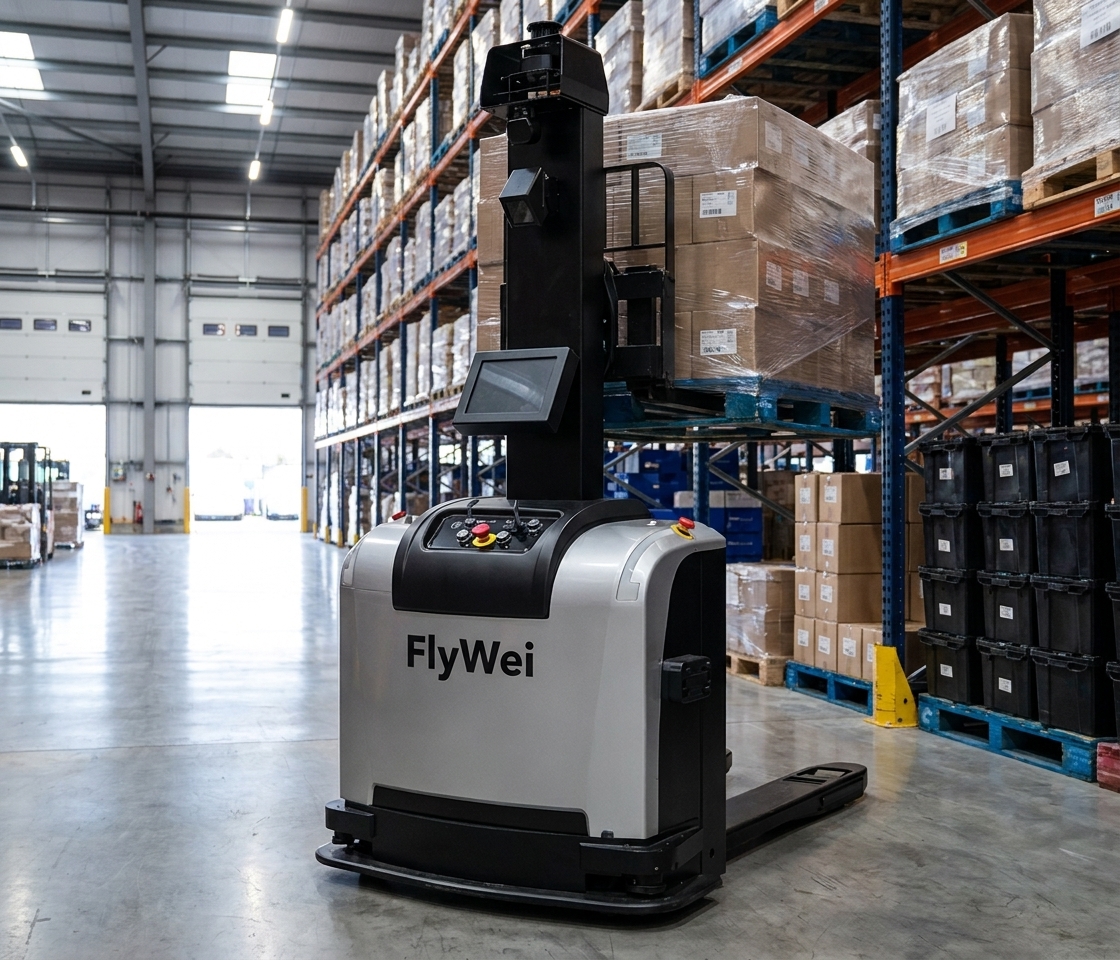
Autonomous forklifts are driverless counterbalance, reach and stacker trucks that lift and move palletised or stillaged loads under fleet-controller instruction, with no operator on board. Two rulebooks govern them in Great Britain at once: the Provision and Use of Work Equipment Regulations 1998 (PUWER, legislation.gov.uk) and, for driverless trucks specifically, ISO 3691-4 (the international safety standard for that machine class). For an operations director running a machining and fabrication site, the pressure this quarter is not the lift. It is the distance. Castings leave the foundry bay, queue, move to machining, queue again, then travel to sub-assembly, paint and despatch, and every one of those hops takes a licensed counterbalance driver away from a bay that is already short-handed. The strongest case for autonomous forklifts here is rarely the lift itself: it is the long, repetitive inter-cell move that ties a skilled driver to a job that adds nothing to the part.
Why the move, not the lift, is the bottleneck
A machining and fabrication plant is laid out around metal-cutting capacity, not material flow. Cells sit where the foundations, extraction and power allow, so parts travel further between operations than anyone would design from scratch. The result is a fleet that spends much of its shift driving and little of it lifting.
Three UK-specific pressures have sharpened that this year. The first is the licence pool. Counterbalance and reach-truck licences are portable, and the big-box distribution estate around Magna Park, DIRFT, Daventry and SEGRO East Midlands Gateway competes for the same operators as a West Midlands or South Yorkshire engineering site, usually with simpler shifts. Manufacturing loses that contest more often than it wins it.
The second is the shape of the work. Engineering loads are heavy, awkward and rarely uniform: cast-iron billets on timber, weldments in steel stillages, transmission cases in returnable containers. That variety is why plants conclude automation is not for them, when the honest answer is that only some flows are ready, and those are usually the longest ones.
The third is legal exposure in a mixed traffic plant. Health and Safety Executive guidance on workplace transport puts separation of pedestrians and vehicles ahead of behavioural controls such as signage and training. Where fitters and maintenance crews cross truck routes all shift, separation is hard with manual trucks and much easier with a machine that only ever drives a defined route at a defined speed.
In heavy engineering plants, the strongest case for autonomous forklifts is rarely the lift itself: it is the long, repetitive inter-cell move that ties a licensed driver to a job that adds nothing to the part.
Lever one: automate the longest flow, not the busiest bay
The instinct is to point automation at the area that generates the most complaints. That is usually goods-in at shift change, which is congested, exception-heavy and full of ad-hoc decisions, and it is the worst possible first deployment. A driverless truck earns its keep on work that is long, repetitive and predictable.
Run the arithmetic on one flow rather than the whole plant. Count the moves on a single route over a full production cycle, including night shift. Measure the true cycle time, gate to gate, including queuing at the cell, waiting for a crane, and the walk back. Multiply that by the number of moves and you have the hours spent on transport rather than production. In most engineering plants one or two inter-cell routes, typically saw shop to machining and machining to sub-assembly, account for a surprising share of total truck hours.
Those routes are also the easiest to defend at a capital review, because the saving is not hypothetical headcount. It is the redeployment of licensed drivers onto work that needs judgement: loading awkward one-offs, servicing the crane bays, covering despatch at cut-off.
Lever two: one fleet layer over mixed trucks
Heavy engineering rarely needs one type of machine. A single plant may want a counterbalance truck for stillages in the yard and machining hall, a narrow-aisle reach truck for consumables and tooling stores, and a heavy-lift mobile robot for sub-assemblies that never touch a pallet at all. Bought separately, each arrives with its own controller, its own map of your site and its own screen in the office.
The alternative is to put a single fleet layer above the trucks. M4 issues work, arbitrates traffic between machines, sets charging strategy and holds one map of the plant, while fleet dispatch software handles dispatch as jobs arrive. Because the interface to the vehicles follows the VDA 5050 open standard, trucks from different manufacturers can take orders in the same message format, which is what makes a mixed fleet practical rather than theoretical.
This matters commercially as much as technically. If the fleet layer belongs to one truck manufacturer, your next purchase is effectively decided for you. If it does not, you can add a different machine class, or a different maker, without rebuilding the integration.
Lever three: put PUWER and ISO 3691-4 evidence in the acceptance test
Compliance is cheap at specification and expensive at handover. Under PUWER the duty sits with you as the user of the work equipment, not with the supplier, so the evidence you will need at an inspection is evidence you should be signing off during commissioning.
Make the acceptance test explicit. Require the supplier to demonstrate detection and stopping behaviour at the speeds and load states you will actually run, not at a showroom setting. Require the traffic rules at every pedestrian crossing point to be shown working with a person in the aisle. Require the route survey to record floor condition, because joint damage and settlement produce navigation faults that get blamed on the robot; where high-bay put-away is involved, floor flatness to TR34 belongs in the same conversation. Where lifting accessories such as cradles or beams are used, the Lifting Operations and Lifting Equipment Regulations 1998 (LOLER, legislation.gov.uk) apply to them as they always did. None of this is exotic. It is written down before money changes hands rather than after.
Lever four: match the funding term to the asset life
The last lever is financial, and in engineering it is often the one that unblocks the project. A robot fleet has a working life measured in years, but a capital budget is agreed one year at a time, so a good operational case can die because it lands in the wrong quarter.
Spreading the cost changes the conversation from capital to operating expenditure. FlyWei leasing runs on three, five and seven-year terms, letting the payments follow the working life of the machines and the production programme they support rather than one year's capital allocation. For an operations director the practical benefit is that the comparison stops being robot versus nothing, and becomes monthly cost of the fleet versus the current cost of covering those transport hours with agency labour and overtime.
| Lever | Cost profile | Where payback shows up | Evidence to demand at acceptance |
|---|---|---|---|
| Automate the longest inter-cell flow | Lowest entry cost; one or two trucks | Driver hours returned to bay-side work; night cover without overtime | Measured cycle time on the live route, including queuing |
| Single fleet layer over mixed trucks | Software and integration, costed separately | Further machine classes added without a new integration | Orders issued to two vehicle types from one controller |
| Compliance designed in at specification | Engineering time, not capital | Avoided rework at handover; inspection-ready | PUWER and ISO 3691-4 tests at your speeds and crossing points |
| Leasing rather than outright purchase | Monthly cost over three, five or seven years | Project proceeds in-year; profile matches asset life | Written comparison against agency and overtime spend |
What FlyWei does here
FlyWei is an independent UK systems integrator of autonomous forklifts and mobile robots. We are not a manufacturer and not a reseller for one, so the specification starts with your flow rather than with a catalogue we are obliged to sell from. In a heavy engineering plant that usually produces a mixed answer.
For the long inter-cell moves described above, FlyWei typically supplies a counterbalance-class autonomous forklift for stillages and palletised castings, and adds a narrow-aisle reach or stacker class where consumables and tooling stores sit in high-bay racking. Where a sub-assembly never sits on a pallet at all, such as a transmission case on a bespoke cradle, a heavy-lift lifting robot is often the better machine, and it runs under the same controller as the trucks.
Above the vehicles, FlyWei deploys M4 as the fleet manager and fleet dispatch software. Your existing production and stock systems stay the record of truth; the fleet layer takes work from them and writes completions back. FlyWei's engineers are UK-based, and the survey work, the safety case and the acceptance testing are done on your floor, in your traffic conditions, on the routes you actually run. You can see how that is applied elsewhere on our solutions pages.
Frequently asked questions
What is an autonomous forklift?
An autonomous forklift is a driverless industrial truck that lifts, carries and places loads without an operator on board. It navigates using on-board sensing and takes its instructions from a fleet controller. The common classes are counterbalance, pallet truck, stacker and narrow-aisle reach truck.
Do autonomous forklifts work with non-standard engineering loads?
Yes, provided the load presents a consistent pick face. Stillages, cradles and returnable containers automate well because their footprint is repeatable. One-off items and anything slung from a crane are better left with a manned truck. The question is whether the load appears the same way every time.
What does PUWER require for a driverless forklift?
PUWER places the duty on the user of the work equipment to ensure it is suitable, properly maintained and used only by trained people. For a driverless truck that means a documented safety case for its routes and speeds, a maintenance regime, and trained supervision. ISO 3691-4 sets the detection and stopping behaviour expected of the machine class.
Can autonomous forklifts run alongside manned trucks and pedestrians?
Yes, and in engineering plants they almost always have to. Health and Safety Executive guidance puts physical separation first, so route design does most of the work: dedicated lanes where possible, defined crossing points where not. Sensing and speed limits handle the rest.
Do we have to replace our production or stock system?
Usually not. A fleet layer sits above the systems you already run and takes work from them, so those systems stay the source of truth for stock and orders. Where no interface exists, a scheduled export of open moves and an import of confirmations is enough to begin.
Can autonomous forklifts be leased in the UK?
Yes. FlyWei offers three, five and seven-year leasing terms, so the cost profile follows the working life of the fleet rather than a single year's capital budget.
If driver hours disappearing into inter-cell transport is on your Q3 risk register, the fastest way to size the opportunity is to measure one route rather than model the whole plant.
Book a free 30-minute site survey and we will walk your highest-volume flow with you, or read the specifications and machine classes on our autonomous forklifts page first.
UK-based engineers. No obligation. We reply within one business day.