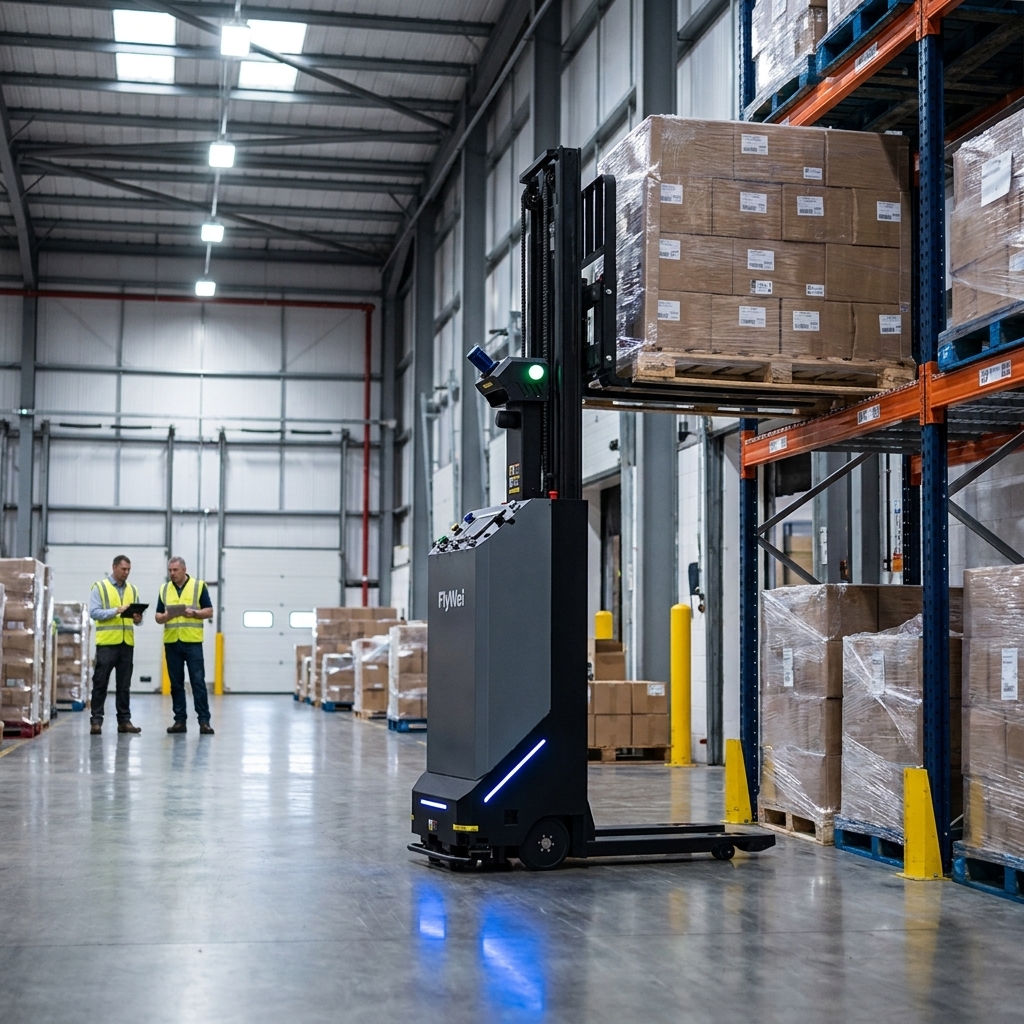
Autonomous forklifts are driverless industrial trucks (automated guided forklifts, or AGFs) that lift, transport and stack palletised loads under software control instead of a human operator, using onboard LiDAR, safety-rated scanners and a fleet manager to move within existing UK racking without floor magnets or reflectors. The UK Health and Safety Executive attributes roughly a quarter of all workplace transport injuries to lift trucks, and the largest concentration sits inside temperature-controlled distribution centres: the same MHRA-regulated pharmaceutical sites where a mis-sited pallet can cost a qualified batch. For UK pharma operations directors this quarter, the pain is concrete: shift-to-shift driver churn is stalling qualified batch releases, PUWER re-inspections are consuming supervisor time, and every manual truck movement inside a Good Distribution Practice zone is a validation event that has to be evidenced.
Why qualified pallet flow is breaking in UK pharma DCs this year
The pharmaceutical distribution centre sits at the intersection of three forces that no other UK warehouse category faces simultaneously. First, every pallet touch is a Medicines and Healthcare products Regulatory Agency Good Distribution Practice event that must be traceable, temperature-logged and operator-attributable: a manual forklift driver's shift change is, in regulatory terms, a change in equipment operator competence that has to be evidenced. Second, the driver labour market for CPCS/RTITB-qualified counterbalance operators has tightened sharply through 2025 and into 2026, with Logistics UK flagging the persistent operator gap as a structural, not cyclical, constraint on distribution capacity. Third, the fixed cost of validating each qualified operator against a site's IQ/OQ/PQ dossier keeps rising even as agency-driver turnover accelerates.
The knock-on effect is that qualified batch release throughput, the metric operations directors are actually judged on, is bottlenecked not by pick face density, not by dock door count, but by how many hours per shift the site can staff a competent pallet-truck operator inside the temperature-controlled zone. Every unqualified movement is a deviation. Every deviation is a QA record. Every record eats supervisor hours that were meant for continuous-improvement work.
The regulatory backdrop compounds this. PUWER 1998 requires the DC to prove that every truck is inspected, maintained and operated by trained persons; LOLER 1998 adds a six-monthly thorough examination requirement for the mast; and the HSE ACOP L117 code sets the operator competence bar. A driverless forklift removes the operator-variance dimension from all three duties.
The three-plus-one levers that fix it
Lever 1, Operational: shift-agnostic staffing on qualified pallet flow
The first fix is not technology, it is org design. An autonomous forklift does not care whether it is 03:00 or 15:00, whether the shift is short of a driver, or whether the agency booking fell through at the last minute. That single property, shift-agnostic availability, is what unlocks the qualified-throughput target. A DC that today runs three 8-hour manual shifts with an effective driver-availability of roughly 78% (holidays, sickness, in-shift breaks, agency no-shows) moves to a fleet with 24/7 availability capped only by charging cycles, which on modern lithium truck packs is a 15-minute opportunity charge inserted between put-away sequences. The operations director's staffing plan collapses from six-crew scheduling into two supervisor rota lines. Payback on this lever alone typically funds the truck lease within two years, before any productivity uplift is counted.
Lever 2, Operational: brownfield deployment inside the existing racking envelope
Pharma DCs almost never have the option of a greenfield rebuild: the racking, the temperature zones, the goods-in dock and the picking mezzanine are all in place. Modern autonomous forklifts that use natural-feature SLAM navigation, rather than magnets, reflectors or floor stripes, drop into the existing racking envelope without civil works. A four-truck deployment can be commissioned inside a 5,000 m² MHRA site in six to eight weeks: the majority of that time is not truck installation but WMS integration, safety-zone mapping and operator familiarisation. Compare this to a shuttle-based ASRS retrofit, which typically requires a 12-to-18 month racking demolition and rebuild.
Lever 3, Technical: M4 fleet orchestration on top of the existing WMS and ERP
A DC's existing WMS knows where every SKU lives and where it needs to go; it does not know how many trucks are available, which is closest to the next task or which is due a charge. Bridging those two layers is the job of the fleet manager. FlyWei's M4 platform exposes a VDA 5050-compliant API that the site's WMS can push tasks to and receive completion telemetry from, with the site's existing ERP untouched. Every movement is signed, timestamped and stored in a GDP-defensible movement log. When a batch is picked, the QA export contains not only the pick record but the truck ID, the sensor telemetry from the run and the operator (a fleet controller, not a driver) who supervised the movement window. That single audit-ready export replaces the manual operator log that pharma QA teams currently reconcile by hand.
Lever 4, Regulatory: single-source PUWER, LOLER and ISO 3691-4 compliance pack
The final lever is the one that ops directors most under-price at business-case stage. A driverless truck under ISO 3691-4 is delivered with a full technical construction file: risk assessment, safety-function analysis (SIL 2 on the main safety scanners under BS EN ISO 13849-1), the LOLER inspection schedule for the mast, the PUWER inspection log template and the UKCA declaration of conformity. When the site's BSI-registered auditor arrives, the compliance evidence is a single dossier per truck rather than a bundle of separately-maintained operator training records, medical certificates and daily pre-use checks. Supervisor hours reclaimed from PUWER admin typically exceed 40 per truck per year: enough on their own to justify a compliance pack purchase.
Every manual truck movement inside a Good Distribution Practice zone is a validation event that has to be evidenced. An autonomous forklift converts that event into a signed, timestamped, machine-generated record, and does it for every pallet, every shift, without exception.
A decision-grade comparison for the Q3 business case
| Lever | Capital / opex profile | Time to steady-state | Payback horizon |
|---|---|---|---|
| Retain manual fleet + add agency drivers | Rising opex, unpredictable | Immediate but eroding | No payback: cost line only |
| Buy four autonomous counterbalance trucks (capex) | Large one-off capex | 6 to 8 weeks | 28 to 36 months on labour + PUWER savings |
| Lease four autonomous trucks (5-year opex) | Predictable monthly opex | 6 to 8 weeks | Positive in month one on labour-cost avoidance |
| Full shuttle-based ASRS retrofit | Very large capex + civil works | 12 to 18 months | 60+ months, requires greenfield-scale change |
What FlyWei does for pharma operations directors
FlyWei integrates and supports autonomous forklifts for UK pharmaceutical distribution centres end-to-end. The core fleet options are the counterbalanced FlyWei autonomous forklift range for temperature-controlled pallet flow, the narrow-aisle autonomous pallet stacker for high-bay racking, and, for goods-to-person picking of totes and small pharma cartons, the latent-jacking AMR from our lifting robot family. All of these are orchestrated by FlyWei's own M4 fleet manager and dispatched by fleet dispatch software, which speaks VDA 5050 to the operator's existing enterprise WMS and ERP.
Every FlyWei deployment ships with the full ISO 3691-4 / PUWER / LOLER compliance dossier, UK-based commissioning engineers who are on site through go-live and the option to move the entire fleet onto a three-, five- or seven-year full-service leasing agreement: the model most UK pharma ops directors now choose, because it protects the capital line for cold-chain expansion while still delivering the qualified throughput uplift from month one.
Frequently asked questions
Are autonomous forklifts MHRA-compliant for GDP-regulated pharmaceutical distribution?
Yes, provided the fleet manager captures a signed, timestamped movement log per pallet and the trucks themselves are supplied under ISO 3691-4 with the full UKCA technical construction file. FlyWei's M4 platform produces a GDP-defensible export that pharma QA teams can attach directly to the batch record.
How long does an autonomous forklift deployment take inside an existing UK pharma DC?
Six to eight weeks for a four-truck brownfield deployment on natural-feature SLAM navigation. No floor magnets, no reflectors, no racking demolition. The bulk of that time is WMS integration and safety-zone mapping rather than physical installation.
Can autonomous forklifts operate reliably inside 2 to 8°C cold rooms?
Yes. Modern counterbalanced autonomous forklifts are specified for continuous operation down to −25°C with heated LiDAR housings, condensation-managed enclosures and cold-store-rated battery packs. Warm-up cycles between ambient and cold zones are handled automatically by the M4 fleet manager.
What happens to my existing WMS and ERP when we add autonomous forklifts?
Nothing changes at the WMS or ERP layer. FlyWei's M4 fleet manager exposes a VDA 5050-compliant task API. The site's existing enterprise WMS pushes tasks to M4 and receives completion telemetry; the ERP is untouched. That preserves your validated software stack and avoids re-qualification.
How does the PUWER inspection burden change with a driverless fleet?
PUWER duties still apply, the truck is still work equipment, but the operator-competence and daily pre-use check evidence collapses from a manual paper trail into a fleet-manager export. LOLER thorough examinations on the mast are unchanged and scheduled through the M4 maintenance planner.
Is leasing genuinely cheaper than buying for a UK pharma DC?
For most UK pharma sites, yes, because leasing turns a large one-off capex request into a predictable monthly opex line that a DC director can approve inside operational budget, protecting the capital pool for cold-chain expansion. FlyWei offers three-, five- and seven-year full-service leases with commissioning, servicing and software updates included.
What accreditations should I expect from the compliance dossier?
UKCA declaration of conformity, ISO 3691-4 technical file, BS EN ISO 13849-1 safety-function analysis at SIL 2 on the primary safety scanners, LOLER inspection schedule for the mast, PUWER inspection log template and the operator (fleet-controller) training pack.
If closing the qualified-throughput gap inside your MHRA-regulated DC is on your Q3 risk register, FlyWei's UK team can size the fleet, model the lease and walk the site with you.
Book a free 30-minute site survey with a UK-based FlyWei engineer, or size the fleet against your monthly volumes on the autonomous forklift leasing calculator.
UK-based engineers · no obligation · reply within one business day.