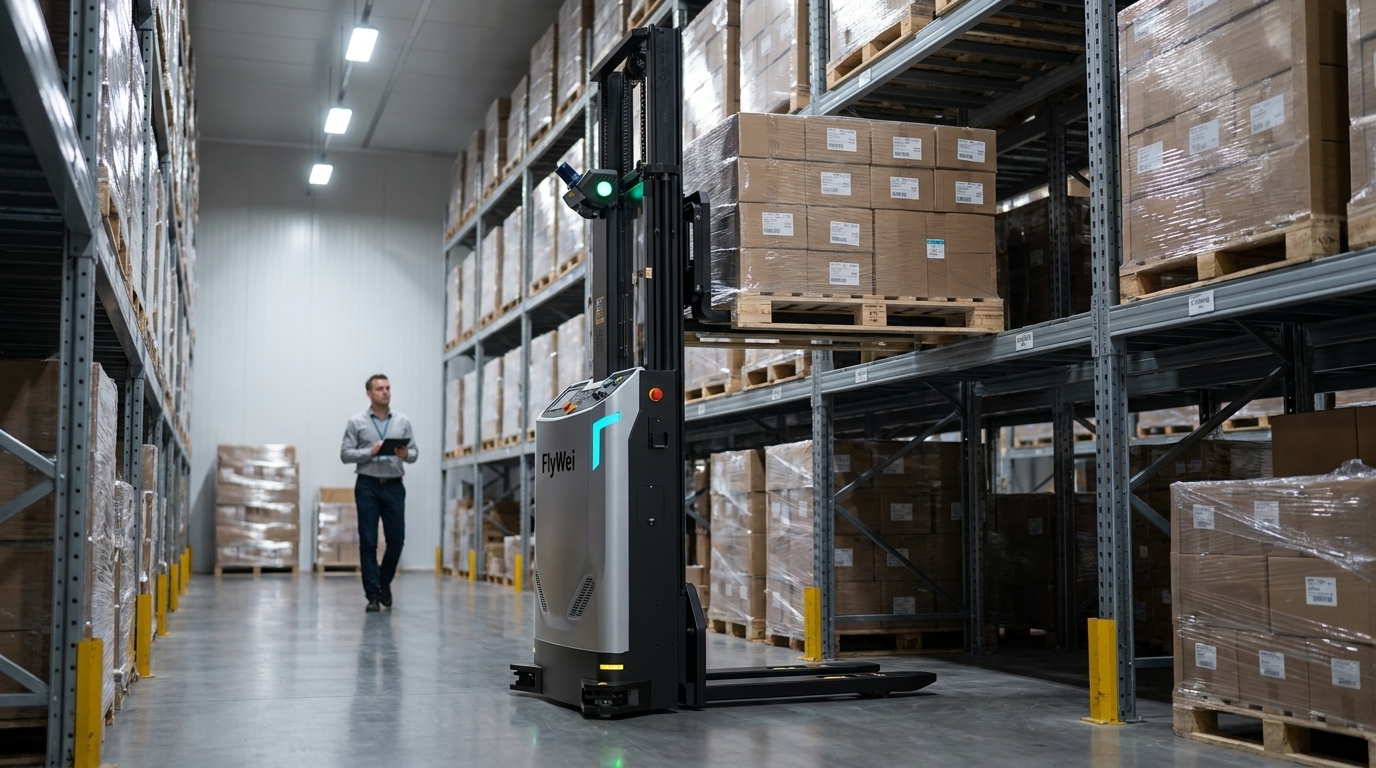
An autonomous pallet stacker is a driverless mast truck that lifts pallets into and out of mid-height racking on its own, navigating a live warehouse without a rider on board. The Health and Safety Executive records around 5,000 workplace transport accidents a year in Great Britain, about 50 of them fatal — a risk repeated across every staging lane and picking face a pharmaceutical network runs. For a supply chain director in an MHRA-regulated business, the pain this quarter is narrower than safety. Mid-height replenishment is the move nobody wants to own: repetitive, licence-restricted, and demanded at exactly the moment despatch needs that same operator on the loading bay. Agency cover papers over the gap, but every uncontrolled pallet move is a line in a Good Distribution Practice audit you cannot fully evidence, and every hour a trained driver spends shuttling cases to a second-level beam is an hour not spent on temperature-sensitive despatch. Across a multi-site network that shortfall becomes a capacity ceiling.
Why mid-height replenishment breaks down in regulated warehouses
The failure is structural rather than cultural. Pharmaceutical distribution sites in the UK have grown by extension rather than design: a chilled module bolted onto an ambient hall, a quarantine cage carved out of a pick face. Racking geometry follows the building rather than the flow, so the second and third beam levels end up holding the fastest-moving lines — precisely the ones needing replenishment every few hours.
Labour supply compounds it. A counterbalance or reach licence takes time and money to obtain and revalidate, and the operator who holds it is worth more on a trailer than on a replenishment run. Sites around Magna Park, DIRFT, Daventry and the SEGRO East Midlands Gateway cluster compete for the same pool, and Logistics UK has consistently flagged operator availability as a structural constraint on UK warehousing rather than a seasonal one. When cover is short, replenishment is the task that slips — it is the one with no customer waiting at the end of it.
Then the regulatory layer lands on top. Under Good Distribution Practice, the medicines regulator expects a traceable account of where a pallet sat, for how long, and who moved it. Manual replenishment produces that record only if somebody scans correctly under pressure, every time. Equipment duties bite in the same place: the Provision and Use of Work Equipment Regulations require lift trucks to be suitable, inspected and operated only by trained people.
An autonomous pallet stacker is a driverless mast truck that lifts pallets into and out of mid-height racking on its own, navigating a live warehouse without a rider on board.
Lever one: split the replenishment loop from the despatch loop
This is the operational lever and it costs nothing but discipline. Map every mid-height put-away and let-down movement for one week and a small number of aisles will usually account for most of the moves, at predictable points in the shift. Those moves are short, repetitive and almost never time-critical to the minute — ideal first candidates to hand to an autonomous pallet stacker rather than to a licensed operator.
The point is not to remove people. It is to stop one person being the constraint on two unrelated queues. Once replenishment runs as a continuous background loop, the despatch team stops losing its best operator every time a pick face runs dry. The first honest benefit is rarely headcount — it is that the replenishment queue no longer carries a variance. It runs at the same rate at 06:00 and at 21:00, which is what makes downstream planning possible.
Lever two: make the stacker a task consumer of the system you already run
This is the technical lever, and where most projects are won or lost. A driverless forklift does not connect to your business system directly. A fleet management layer sits between them, taking work from your enterprise WMS or ERP over a documented interface, translating it into robot missions, then writing completions and load confirmations back so your existing system stays the record of stock. FlyWei's M4 fleet manager performs that translation, and RDS robot dispatch handles the sequencing and priority rules that decide which truck takes which task.
Insist on the open standard. VDA 5050 defines how a central fleet manager issues orders to mobile robots and how those vehicles report position, load and task state back, in a common message format regardless of who built the vehicle. It lets one control layer run a mixed fleet without a bespoke integration per manufacturer — the single most important protection against lock-in when you scale from one aisle to four sites. Ask any supplier how long their fleet layer runs detached if the network drops, and how duplicate confirmations are prevented on reconnection.
Lever three: build the regulatory evidence pack before go-live
This is the regulatory lever, and it is cheaper first than retrofitted. Three documents matter. The first is your PUWER assessment: the Provision and Use of Work Equipment Regulations 1998 apply to a driverless truck exactly as they apply to a manned one, covering suitability, inspection regime, and the competence of anyone who intervenes with it. The second is conformity against ISO 3691-4, the safety standard for driverless industrial trucks and their systems, which governs detection fields, speed limitation and the behaviour of the truck at aisle ends and pedestrian crossings.
The third is floor evidence. Mid-height placement accuracy depends on floor flatness, and a brownfield hall with thirty years of joint movement is rarely to a modern tolerance. A Concrete Society TR34 survey of the working aisles, commissioned before you commit to lift heights, is the cheapest de-risking in the project. Standards are available through BSI. Present all three as a pack, alongside the movement log the fleet layer produces, and the GDP conversation becomes a short one.
Lever four: standardise one duty cycle before you scale across sites
Multi-site networks fail at the second site, not the first. Almost always, site one was allowed a bespoke configuration — different mast height, different pallet spec, different exception handling — so nothing learned there transfers. Fix the duty cycle instead: one pallet footprint, one maximum lift height, one charging strategy, one exception path. The second and third sites then become deployments rather than projects.
It also changes the commercial conversation. A standardised duty cycle is financeable, because residual and service profile are predictable — which is what makes a three, five or seven-year leasing structure work rather than a lumpy capital request per site. Where the same exercise identifies cart or tote movement alongside pallet work, that flow usually belongs to a lifting robot — different machine, same control layer.
| Lever | What it costs to do | What changes on the floor | Where the payback shows up |
|---|---|---|---|
| Split the replenishment loop | One week of movement mapping; no capital | Replenishment stops competing with despatch for operators | Despatch adherence, within weeks |
| Task consumer of existing WMS | Interface scope and a test environment | Stock posts as pallets move, not at a shift-end count | Stock accuracy, first quarter live |
| Regulatory evidence pack | PUWER assessment, ISO 3691-4 review, TR34 floor survey | Inspection questions answered from a log, not from memory | Audit preparation time; no rework at go-live |
| Standardised duty cycle | One spec agreed before site two | Second and third sites deploy rather than redesign | Rollout speed; a financeable service profile |
What FlyWei does here
FlyWei is an independent, vendor-neutral UK systems integrator of autonomous forklifts and AMRs. That matters most to a supply chain director at exactly the point described above — the move from one aisle to a network. Because FlyWei integrates machines from several manufacturers rather than selling one catalogue, the stacker specified for your narrow ambient aisle need not come from the same family as the counterbalanced truck working goods-in, and neither choice locks the control layer.
In a pharmaceutical context, FlyWei starts with a survey of one replenishment flow: movement counts, aisle widths, lift heights, floor condition and the interface your warehouse system can realistically expose. From that comes a fleet-sizing read and a defined scope for the M4 fleet manager to take work from your existing system and return confirmations to it, with RDS handling priority between replenishment and ad-hoc moves. FlyWei engineers commission the trucks, produce the PUWER and ISO 3691-4 documentation alongside your quality team, and hand over a movement log your GDP evidence can be built on.
Where the case is commercial rather than technical, FlyWei sizes the fleet against a leasing structure so cost lands as an operating line matched to the shift pattern it serves. The solutions a network needs are rarely one machine type — they are one control layer over several.
Frequently asked questions
What is an autonomous pallet stacker?
It is a mast-equipped driverless forklift that raises and places pallets into racking without an operator on board. Navigation, obstacle detection and pallet-pocket alignment run on on-board sensors, and tasks arrive from a fleet management layer, not a person in a seat.
Can an autonomous pallet stacker work in an MHRA-regulated warehouse?
Yes, and the documentation is usually stronger than the manual equivalent. Every move is logged with origin, destination, load and timestamp — the account Good Distribution Practice expects. PUWER duties still apply, so the assessment and inspection regime must be in place first.
Do we need to replace our warehouse management system?
Usually not. An orchestration layer sits above your existing system and takes work from it, so that system stays the source of truth for stock and orders. Replacement is only worth considering where it cannot expose work through an interface or scheduled export.
Which standard covers driverless forklifts in the UK?
ISO 3691-4 is the safety standard for driverless industrial trucks and their systems, covering detection fields, speed limitation and behaviour at aisle ends. It sits alongside the PUWER work equipment duties the Health and Safety Executive enforces.
How much floor preparation does an autonomous pallet stacker need?
It depends on lift height. Placement accuracy at the upper beam levels is sensitive to floor flatness, so commission a TR34 survey of the working aisles before committing lift heights. Localised grinding is common in brownfield halls and far cheaper than finding the problem at commissioning.
What happens if a pallet is out of position or the network drops?
A well-designed system degrades rather than stops. An out-of-tolerance pallet raises an exception for a person to resolve instead of being forced. If the link drops, the truck completes the task already issued and holds safely; the fleet layer queues completions and replays them on reconnection.
How long before a pharmaceutical site sees a return?
The first measurable change is usually variance rather than cost: the replenishment queue runs at a consistent rate across all shifts. Payback depends on shift pattern, move volume and how the fleet is financed — which is why a single-flow fleet-sizing read beats a whole-site model.
If mid-height replenishment is sitting on your Q3 risk register while despatch cover is already thin, the fastest way to test the case is on one flow rather than the whole building.
Get a 48-hour feasibility read on your highest-volume flow — or see the machine classes and lift heights on the autonomous pallet stacker and forklift range.
UK-based engineers. No obligation. We reply within one business day.