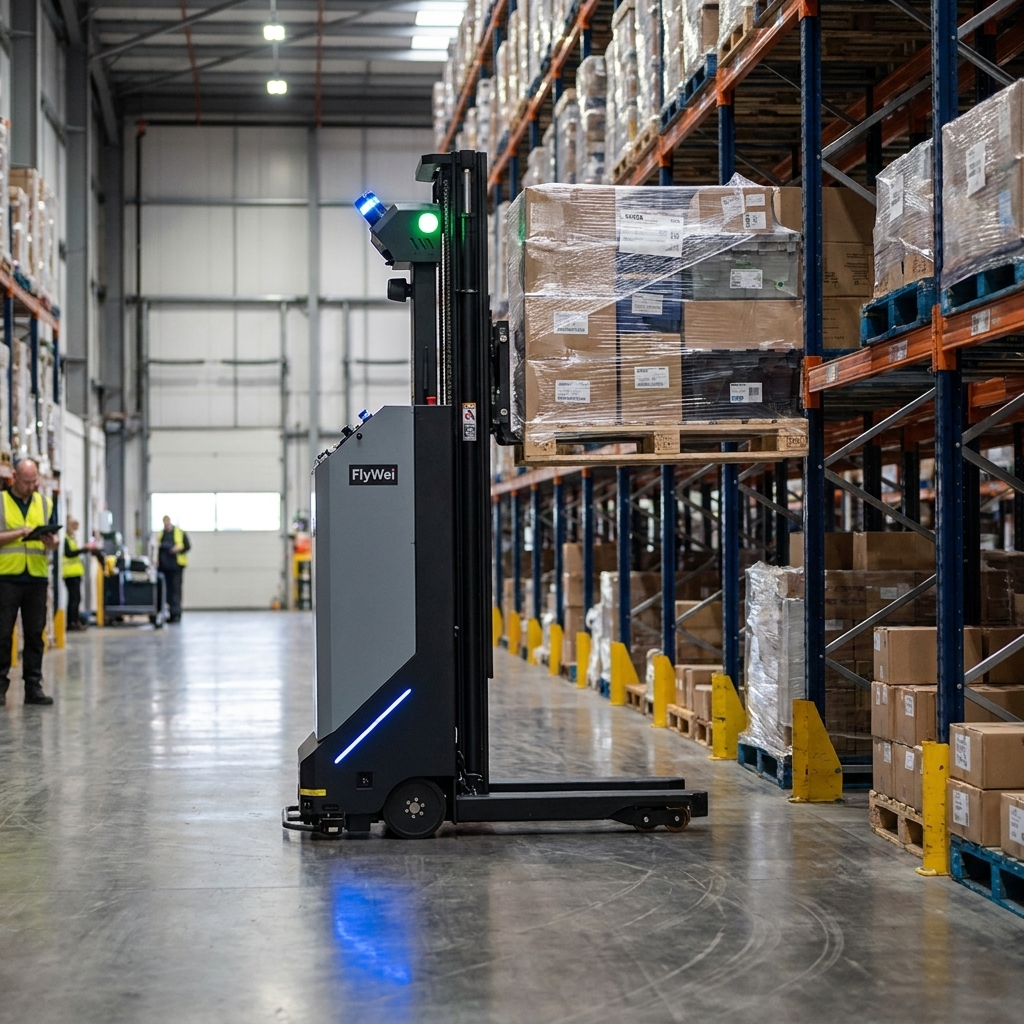
A driverless forklift is an autonomous counterbalance, reach or pallet truck that uses onboard LiDAR SLAM navigation and a central fleet manager to move Tier-1 sub-assemblies from goods-in to line-side without a human operator, and in UK automotive plants where just-in-sequence reliability decides whether a shift ships, it has stopped being a novelty. According to HSE workplace transport data, transport-related incidents remain one of the largest single causes of fatal and major injuries in the UK workplace, and every one of those incidents starts with a person in a cab. For the Plant Director running a mixed-model line in Solihull, Halewood, Ellesmere Port or Sunderland, the pain is not theoretical sensor-fusion: it is that experienced counterbalance drivers cannot be recruited fast enough to protect the JIS window, and the fallback of hand-lifting a 25 kg subframe bracket now sits squarely inside the inspection scope of LOLER 1998.
Why the JIS window is now driven by driver availability, not takt time
Ten years ago, an automotive Plant Director could assume the counterbalance driver pool would flex with production volumes. Post-pandemic labour data from Logistics UK and the wider material-handling channel now says the opposite: counterbalance and reach-truck vacancies in the West Midlands, North-West and North-East automotive corridors routinely run above one in eight, and lead times for a fully certified counterbalance driver (including HSE ACOP L117-aligned basic, specific-job and familiarisation training) sit at around 14 weeks per hire.
For a mixed-model line in Solihull or Halewood, that arithmetic is brutal. A single missed 12-minute JIS window on a door module or a subframe bracket can idle a 60-vehicle-per-hour line before the next hand-over. Managers plug the gap the only way the shift schedule allows: agency drivers on premium rates, and, increasingly, production operators hand-lifting cages, dollies and subframe brackets between the Tier-1 goods-in dock and the line-side supermarket. Both fallbacks fail an audit. Agency-driver spend distorts the annual budget and reduces predictability, while any repetitive lift above roughly 20 kg or performed at awkward posture becomes a manual-handling assessment that a BSI-aligned safety audit will flag. When the same cage is on wheels being lifted onto a stillage, the operation moves under LOLER thorough examination (every six months if it lifts a person, every twelve months otherwise) and the plant carries a liability it did not budget for.
The four levers a Plant Director actually has this quarter
Lever 1: Size the fleet against the JIS window, not the fork count
The most common mistake in a first automotive driverless forklift roll-out is to procure like-for-like: three manual counterbalance trucks retire, three driverless trucks arrive. That maths ignores duty cycle. A driverless counterbalance truck completes a like-for-like pallet move roughly 12 to 18 per cent slower than a skilled human driver in low traffic, but delivers 24/7 availability, no shift-change losses, no smoke break, and, when paired with a robot dispatch layer, no dwell time between tasks. Sized against a JIS window (typically 8, 12 or 15 minutes to the line-side supermarket) rather than a headcount, the correct answer is usually two driverless trucks for every three retiring manual assets, plus one heavy-lift AMR for the higher-mass sub-assembly cages a counterbalance truck should never have been used for in the first place. Model the flow before you buy anything.
Lever 2: Orchestrate the mixed fleet on VDA 5050 through M4
An automotive plant floor is not a single-vendor greenfield. It carries legacy manual trucks, tuggers, existing conveyor sortation and, in most Tier-1 plants, one or two robotic cells the operator has already committed to. A FlyWei M4 fleet manager speaks the open VDA 5050 interface, which means the driverless forklifts, the heavy-lift AMRs and any third-party AMR on the floor take tasks from the same queue, negotiate the same intersections, and hand off through the same traffic manager. The Plant Director gains one operational view (JIS window compliance, mission failures, battery state, geofenced no-go zones) instead of three vendor consoles. Crucially, M4 also exposes fleet events to the plant's existing ERP and MES via a documented event bus, so the go-live does not force a rip-and-replace of the shop-floor systems the operator already trusts.
Lever 3: Treat the driverless forklift as PUWER and LOLER work equipment on day one
UK regulators do not exempt driverless equipment from the two duties that already govern your manual fleet. Under PUWER 1998, a driverless forklift is work equipment: you owe suitability assessment, maintenance regime, and adequate information for supervisors and pedestrians who share its space. Under LOLER 1998, when it lifts a load it is lifting equipment: it needs a thorough examination at least every 12 months by a competent person, with the report retained. A driverless roll-out that treats these as day-one requirements, not launch-week fixes, clears its site safety audit and avoids the re-work that stalls phase two. Compliance to ISO 3691-4 (safety of industrial trucks: driverless trucks and their systems) is the technical spine of that day-one posture; it is also what your indemnity insurer will ask for.
Lever 4: Fund via leasing, not a 12-month capex committee cycle
The counterbalance driver shortage will not wait for a February capex sign-off. A 3, 5 or 7-year operating lease converts the roll-out into a monthly operating cost that lines up against the agency-driver spend it displaces, typically a payback range of 26 to 38 months on a mixed six-truck line-side fleet, without a large first-year balance-sheet hit. It also matches how the automotive parent group already funds robotic cells and press-tool refurbishment, which shortens the internal governance loop.
| Dimension | Manual counterbalance driver | Driverless forklift + M4 |
|---|---|---|
| Time to full productive uptime (per unit) | ~14 weeks recruit + certify | 4 to 6 weeks site survey to go-live |
| Shift coverage | 3 drivers per 24 h + agency cover | 24/7 available; battery swap at end of shift |
| Repeatable JIS window (12 min) | Driver-dependent | Sub-minute variance under M4 and fleet dispatch software |
| PUWER / LOLER duty | Applies | Applies (same duty, different evidence) |
| Fully-loaded hourly cost (agency-blended) | Rising quarter-on-quarter | Fixed via 3/5/7-year lease |
| Sub-assembly hand-lifting risk | Displaces to line operators | Removed: heavy-lift AMR takes the cage |
A driverless forklift is a self-driving counterbalance, reach or pallet truck that uses onboard LiDAR SLAM navigation and a central fleet manager to move automotive sub-assemblies from Tier-1 goods-in to line-side without a human operator, unblocking JIS flow in plants where counterbalance driver vacancies routinely sit above one in eight.
What FlyWei does here
FlyWei supplies and integrates the driverless forklift fleets that UK automotive Plant Directors deploy against JIS reliability. On a typical Tier-1 site (think body-in-white feeding paint, or sub-assembly moving to trim and final) FlyWei site-surveys the line-side flow, models it against the current JIS window, and specifies the mixed fleet: driverless counterbalance trucks for palletised inbound, reach trucks for narrow-aisle put-away, and a heavy-lift AMR (1T scissor-lift class) to carry engine sub-assemblies, motor blocks and transmission cases that no manual truck should be handling. The whole fleet runs on M4, orchestrated on VDA 5050, with fleet dispatch software dispatching to a single queue the operator already sees. UK-based FlyWei engineers own the LOLER thorough-examination programme, the PUWER-aligned inspection schedule and the ISO 3691-4 compliance file: the Plant Director does not carry that duty alone. Roll-out phases are typically: (1) two-truck line-side pilot, four to six weeks; (2) mixed-fleet mainstream, eight to twelve weeks; (3) integration into the plant's ERP and MES via M4's event bus. Full-service leasing on 3, 5 or 7-year terms is available via FlyWei leasing.
Frequently asked questions
Is a driverless forklift legal to run in a mixed-traffic UK automotive plant?
Yes. A driverless forklift certified to ISO 3691-4, with a PUWER-aligned suitability assessment and a LOLER thorough-examination programme, is legal to run alongside pedestrians and manual trucks in the UK, subject to the site risk assessment. Speed, geofencing and clearance rules are set at commissioning by the competent installer.
How does a driverless forklift compare to sending an operator with a manual counterbalance truck for a JIS run?
On raw single-move speed, a skilled human is roughly 12 to 18 per cent faster in low traffic. On JIS window reliability across a 24-hour production day, the driverless fleet wins because it does not lose shift-change time, does not queue for a break, and reports mission failure back to M4 in real time, so the supervisor sees a slip before the line does.
Does a driverless forklift need LOLER inspection?
When it lifts a load it is lifting equipment under LOLER 1998, so yes: thorough examination at least every 12 months by a competent person, with the report retained. FlyWei's UK engineers run the programme on the customer's behalf as part of the leasing contract.
What sub-assemblies should never sit on a driverless counterbalance forklift and should go to a heavy-lift AMR instead?
Engine blocks, transmission cases, battery packs on EV lines, and any cage or stillage where the load's centre of gravity moves during transit. These belong on a scissor-lift heavy-lift AMR (1T scissor-lift class) rather than a counterbalance truck: the lifting robots range covers that class.
Will a driverless forklift talk to our existing ERP and MES?
Yes. M4 exposes fleet events (mission created, mission accepted, mission failed, battery low, geofence breach) via a documented event bus, and the FlyWei integration team writes the adapter to the operator's existing ERP and MES rather than asking the plant to change its systems of record.
What is the realistic payback for a UK Tier-1 automotive driverless forklift roll-out?
On a six-truck mixed line-side fleet leased over 5 years, the observed payback range is 26 to 38 months against a base case of agency-driver premium spend plus the productivity cost of missed JIS windows. Payback shortens materially when the plant is already carrying an active LOLER liability for hand-lifted sub-assemblies.
Can we start with a two-truck pilot before committing to a full fleet?
Yes: a two-truck line-side pilot over four to six weeks is the recommended entry point for a UK automotive plant, and it is the way most FlyWei Tier-1 roll-outs begin. Pilot data becomes the phase-two business case.
If a JIS window slipping under a counterbalance driver shortage is on your Q3 risk register, the fastest way to bound the exposure is a two-truck line-side pilot with real data from your own dock-to-line flow, not a supplier deck.
Get a 48-hour feasibility read on your highest-volume flow, or explore the underlying autonomous forklift range that sits behind a UK automotive Tier-1 roll-out.
UK-based FlyWei engineers · no obligation · reply within one business day.