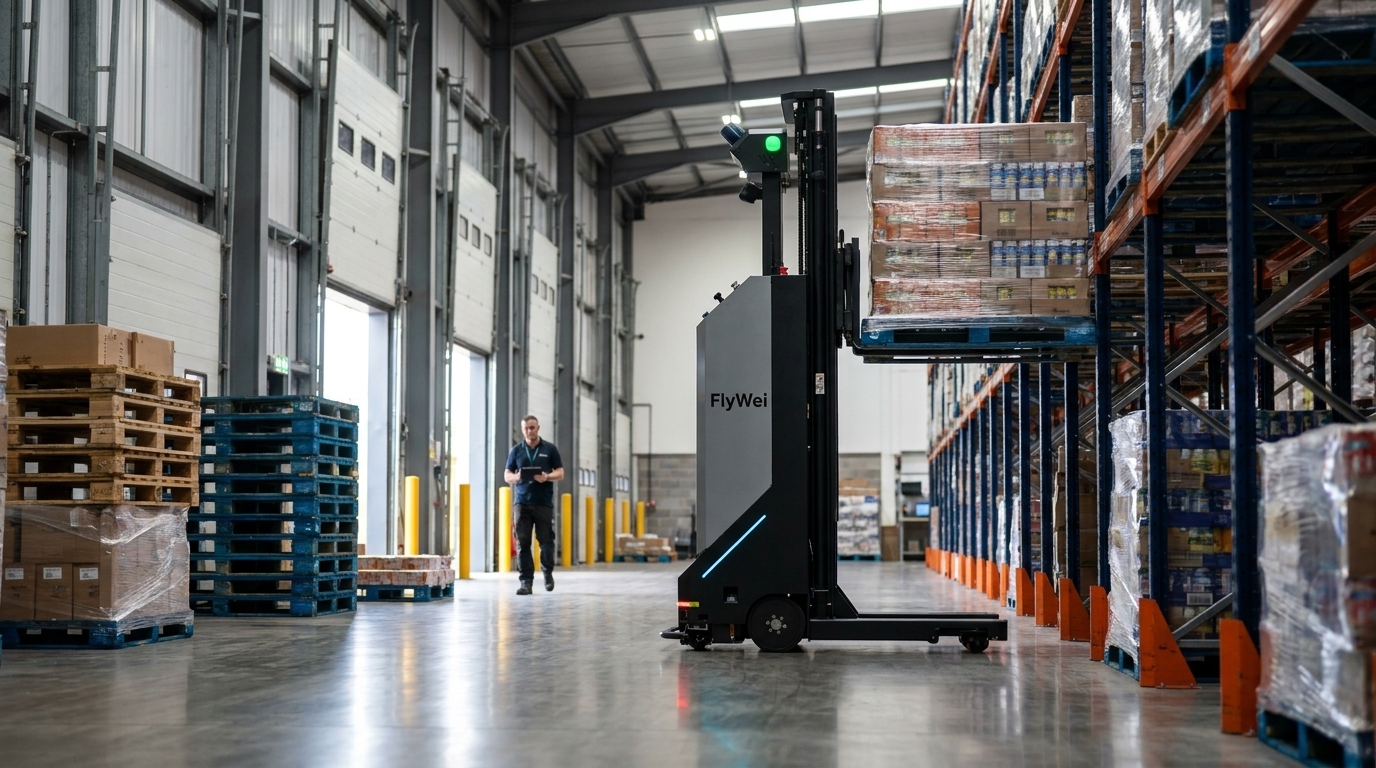
An FMCG robot is a driverless forklift, pallet truck or stacker that moves finished goods and packaging through a food or drink plant unmanned. Manufacturing carries a fatal-injury rate around 1.5 to 2.5 times the all-industry average, and 126 workers were killed in work-related accidents across Great Britain in 2025/26, HSE's 2026 annual statistics report. For an Operations Director running a UK packing hall in the final quarter, though, the pressure is narrower and more immediate. Finished pallets accumulate at line end faster than manned counterbalance trucks can clear them. One truck is pulled away for a changeover, the accumulation conveyor backs up, and a filling line that should be running stops for want of a single pallet move. Night shifts and agency cover sharpen the problem, because the trucks that matter most are the hardest to staff reliably — and every unplanned stop lands on the same OEE report the board reads on Monday morning.
Why line-end pallet flow breaks in FMCG plants
FMCG warehouse automation gets discussed as a labour story, but the operational root cause is variability. A packing hall runs to a production plan with changeovers, clean-downs and promotional runs; the trucks serving it are scheduled to a shift pattern. The two clocks never match. During a steady run one counterbalance truck comfortably clears the accumulation lane. During a changeover that same truck is pulled to feed packaging to the line, and pallet build-up at line end goes unattended for twenty minutes.
Three UK-specific factors make this worse than the arithmetic suggests. Older plants around Burton-on-Trent, and sites in the East Midlands corridor between Magna Park and DIRFT, were laid out for smaller pallet volumes and shorter racking, so travel from line end to bulk store is long and aisles are tight. Seasonal peaks then concentrate demand into the weeks when agency cover is least experienced. And the duty of care does not flex with headcount: PUWER requires work equipment to be suitable, inspected and operated by trained people, while HSE workplace transport guidance expects pedestrian and vehicle routes to be separated by design rather than by signage alone.
Measure it and the pattern is obvious: short, repeated, entirely predictable moves performed by the least available resource on site, in the window where getting it wrong costs most. Logistics UK members report the same shape across palletised sectors, which is why a driverless forklift aimed at one flow outperforms a fleet aimed at everything.
An FMCG robot is a driverless forklift, pallet truck or stacker that moves finished goods and packaging through a food or drink plant unmanned, and UK manufacturing carries a fatal-injury rate around 1.5 to 2.5 times the all-industry average.
Lever one: measure the pallet clock before you specify anything
The operational lever costs nothing and changes every later decision. For two production weeks, log every pallet leaving line end with four fields: time stamp, origin, destination and the reason for any delay over five minutes. Most teams discover their real figure is not average moves per hour but peak moves in the worst fifteen minutes of a changeover — and that is the number an FMCG robot has to meet. Pair it with an honest travel-time measurement, walked at operational speed with the fire doors and pedestrian crossings in place, not measured off a CAD drawing. Two outputs matter. The first is cycle time per move, which sets how many vehicles you need. The second is the delay histogram, which tells you whether you have a throughput problem or a congestion problem; the second one is cheaper to fix, and sometimes a layout change at the accumulation lane removes half the gap before a single vehicle is ordered. Bring this data to any supplier conversation and the specification argument largely resolves itself.
Lever two: orchestrate from the systems you already run
The technical lever is the one that decides whether the programme survives contact with production. Autonomous vehicles do not connect to a business system directly; a fleet management layer sits between them. FlyWei's M4 fleet manager takes work from your enterprise WMS or ERP over a documented interface, converts each task into routes, traffic rules and vehicle assignments, and writes completions and load confirmations back so your existing system remains the record of stock. Robot-side communication uses the VDA 5050 open standard, which means one fleet manager can command vehicles of different types without a bespoke interface for each. Two design questions are worth settling in writing before contract. How long does the fleet layer keep running if the network or the host system drops, and how are duplicate messages prevented when the link returns? A well-designed integration degrades rather than stops: vehicles finish the task already issued, hold safely, and completions replay on reconnection. Where a legacy system exposes no interface at all, a scheduled export of open work with an import of confirmations is usually enough to begin.
Lever three: rewrite the traffic-route assessment, not just the risk register
The regulatory lever is routinely underestimated because teams assume removing the driver removes the duty. It does not. Under PUWER the equipment must still be suitable for its place of use, maintained and inspected, and the people who share space with it must be instructed. ISO 3691-4, the international standard for driverless industrial trucks and their systems, sets the safety expectations for the vehicles and their operating zones; BSI publishes it in the UK and it is the reference your insurer and your safety committee will ask about. The practical work is the traffic-route assessment. Automated routes should be defined, segregated where pedestrian flow is heavy, and governed by right-of-way rules written down rather than assumed. Changeover is the moment to scrutinise, because that is when engineers, hygiene teams and pallet trucks occupy the same floor at once. Expect to move a crossing, add a defined holding zone at the accumulation lane, and set a documented speed reduction near the line. Doing this first also shortens commissioning, because the vehicle is mapped onto a layout that already works.
Lever four: phase the capital, not just the deployment
The commercial lever is sequencing. A single-flow deployment at line end can be commissioned, measured and defended on its own numbers, which gives you a verified baseline before extending to goods-in or inter-bay moves. It also changes how the capital is treated: an operating cost against a named production line is a far easier conversation with a capex committee than a site-wide automation programme. FlyWei leasing over three, five and seven-year terms exists for precisely this reason, and it lets the first flow prove itself before the second is funded. Set the review gate honestly — moves completed in the worst fifteen minutes of a changeover, unplanned line stops attributable to pallet evacuation, and near-miss reports on the automated route — and agree in writing, before go-live, what result justifies funding phase two.
| Lever | What it actually changes | Capital exposure | Time to first measurable effect | KPI it moves first |
|---|---|---|---|---|
| Measure the pallet clock | Replaces assumed demand with peak-window demand; may remove congestion outright | None — internal time only | Two production weeks | Delay minutes per changeover |
| Orchestrate from existing ERP and WMS | Keeps stock records authoritative; removes manual task issuing | Integration scope, costed separately | Pilot flow at go-live | Stock-record accuracy at line end |
| Rewrite the traffic-route assessment | Defines segregated automated routes and right-of-way at changeover | Low — layout changes and signage | Before vehicles arrive | Near-miss reports on route |
| Phase the capital on one flow | Proves the case on a verified baseline first | Spread via leasing terms; no site-wide commitment | First review gate after go-live | Unplanned line stops from pallet evacuation |
What FlyWei does here
FlyWei is an independent, vendor-neutral UK systems integrator of autonomous forklifts and AMRs. That matters because the right machine for a line-end flow is rarely right for the whole site: FlyWei integrates the best vehicles across multiple manufacturers rather than fitting one catalogue to every problem. For the flow described here FlyWei typically specifies a FlyWei autonomous counterbalance forklift in the 2-tonne class between line end and bulk store, with a FlyWei autonomous reach truck where the bulk store runs to narrow aisles and high-bay racking. Where cartons move on wheeled cages instead of pallets, FlyWei lifting robots and AMRs cover that case.
The orchestration layer is where FlyWei does most of the engineering. M4 holds the fleet, the traffic rules and the charging strategy; FlyWei's RDS robot dispatch decides which vehicle takes which task as the plan shifts through a changeover, so priority follows the line rather than a fixed route list. FlyWei engineers design the integration to your existing systems, write degraded-mode behaviour into the specification, and commission against the pallet clock you measured — supported afterwards by UK-based engineers. The same approach runs across FMCG robot and warehouse robotics solutions by industry, with the vehicle range under FlyWei autonomous forklifts and related reading on lifting automated robots in UK FMCG warehousing.
Frequently asked questions
What is an FMCG robot?
An FMCG robot is an autonomous materials-handling machine used in fast-moving consumer goods production and warehousing — usually a driverless forklift, pallet truck, stacker or AMR. It moves finished goods and packaging between lines, buffers and bulk storage with no operator on board, taking its work from existing business systems.
Can an FMCG robot work in a chilled or wash-down packing hall?
Yes, with the environment specified up front. Chilled and high-humidity areas affect sensor performance, battery behaviour and enclosure ratings, so the vehicle specification and the charging strategy both change. Specify the worst environment the vehicle will routinely enter, not the average.
Do we need to replace our WMS to run FMCG robots?
Usually not. An orchestration layer sits above your warehouse system and takes work from it, so that system stays the source of truth for stock. Replacement is only worth considering where it cannot expose work through an interface or a scheduled export.
How many autonomous forklifts replace one manned truck at line end?
There is no fixed ratio, and any supplier quoting one has not seen your data. The answer comes from the pallet clock: cycle time per move against peak moves in the worst fifteen minutes of a changeover.
What does PUWER require once a forklift runs without a driver?
The same duties, applied differently. Work equipment must be suitable for its place of use, maintained, inspected and used by instructed people, and routes separated by design. In practice the traffic-route assessment is rewritten and automated routes segregated.
How long does a line-end FMCG robot deployment take?
It depends far more on data access than on the vehicles. Commissioning is rarely the long pole; mapping order and stock fields, agreeing exception handling and testing against live data are. Projects move fastest where a documented interface already exists.
If pallet evacuation at line end is on your Q4 risk register, the fastest way to size the problem is to have someone walk the flow with you.
Book a free 30-minute site survey and we will measure the line-end flow, the travel distance to bulk store and the changeover window against your own production plan. You can also compare vehicle classes for palletised FMCG flows across the FlyWei autonomous forklifts range.
UK-based engineers, no obligation, and a reply within one business day.