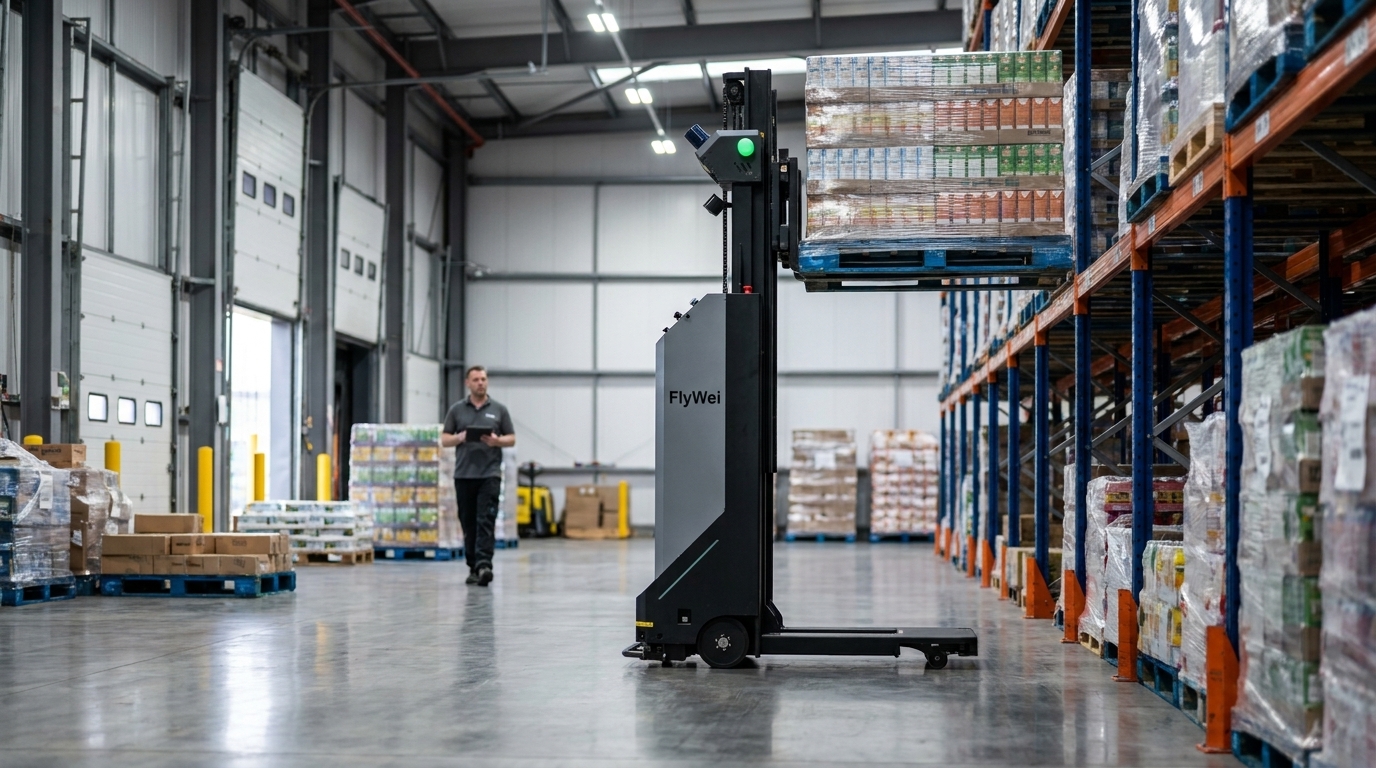
An FMCG robot is a self-driving material-handling machine — an autonomous forklift, an autonomous pallet stacker or a lifting AMR — that moves finished goods, raw materials and empty pallets around a fast-moving food, drink or household-goods plant with no driver on board. The safety case is blunt: around 5,000 workplace transport accidents happen in Great Britain each year and roughly 50 are fatal, according to HSE workplace transport guidance, and end-of-line traffic is where FMCG sites concentrate that risk. For a warehouse manager running more than 100,000 sq ft behind a bank of production lines, the pain this quarter is rarely picking. It is evacuation. Lines finish pallets faster than manned counterbalance trucks can clear them, the end-of-line buffer fills, and the line stops — usually twenty minutes before shift changeover, when half the drivers are already walking towards the gate. Every stoppage is scrap, overtime and a missed retailer delivery slot.
Why line-side pallet flow breaks in UK FMCG plants
Almost every UK FMCG plant was laid out around a manned material-handling model: a fixed number of drivers, a fixed number of trucks, and a pallet-evacuation rate that comfortably exceeded what the lines could produce. Two things then changed. Output per line rose as SKU counts multiplied and retailer promotional peaks sharpened, while the labour pool servicing those lines got thinner and more expensive — a structural constraint Logistics UK has tracked for several years. Evacuation capacity is now the binding constraint, and it is a headcount problem dressed up as a layout problem.
The failure mode is predictable. Finished pallets accumulate at the palletiser and wrapper discharge, into a buffer sized for a few pallets rather than a shift's worth. When a driver goes on break, gets pulled onto a trailer load-out, or cannot cross the main aisle because inbound is running, the buffer backs up and the line stops. At Burton-on-Trent, Daventry and the big Magna Park and SEGRO East Midlands Gateway estates the pattern repeats: the investment went into the line, and what halts the line is a pallet nobody moved.
There is a safety dimension the board sees too. FMCG end-of-line areas are where pedestrians, cleaners, engineers and lift trucks share ground under time pressure. The Provision and Use of Work Equipment Regulations require work equipment to be suitable, maintained and used only by adequately trained people — harder to evidence when agency drivers rotate weekly through a congested cross-traffic zone.
HSE records around 5,000 workplace transport accidents a year in Great Britain, roughly 50 of them fatal — which is why UK FMCG plants now automate line-side pallet moves rather than rely on signage and segregation alone.
Lever 1 — Buffer the line, not the aisle
The operational lever comes first because it is cheapest and it survives whatever technology you choose later. Stop treating the end-of-line discharge as a queue and start treating it as a decoupling point. Measure, over four full weeks, how many pallets each line discharges per hour and how long the longest observed evacuation gap actually is — not the average, the tail. That number sizes everything downstream. Then extend the physical buffer to absorb the tail, and assign the robot a fixed, repeatable route between that buffer and one defined drop location.
Do this and the robot's job becomes boring, which is exactly what you want. A driverless forklift on a fixed evacuation loop is a far easier commissioning problem, safety case and business case than one asked to roam the whole floor. Manned trucks keep the exception work: damaged pallets, trailer loading, anything needing judgement.
Lever 2 — Give the fleet one brain, not five islands
The technical lever is orchestration. A single autonomous forklift is a novelty; a fleet sharing one traffic model is an asset. Without a supervisory layer each machine solves for itself, robots deadlock at aisle intersections, and the site ends up staffing someone to babysit the automation, which is the precise cost the project was meant to remove.
FlyWei's M4 fleet manager holds the site traffic model: zones, priorities, charging windows and the live position of every machine. RDS robot dispatch sits above it and converts demand into work — a pallet-present signal from the palletiser PLC, a task from the operator's existing ERP and WMS, or a scheduled sweep of the line-side buffer. Insist on VDA 5050 as the interface between fleet manager and machine. It keeps the site free to add a different class of robot in three years without rebuilding the integration, and it is the most important line in the specification for any warehouse manager who does not want to be locked to one machine type.
Lever 3 — Build the regulatory case before the robot lands
The regulatory lever is where FMCG projects most often stall at month five. Driverless does not mean out of scope. PUWER 1998 still applies in full: the equipment must be suitable for the work, maintained in efficient working order, and subject to inspection where deterioration would create a risk. Where the machine lifts, LOLER 1998 brings thorough examination duties on the lifting components.
The controlling product standard is ISO 3691-4, covering driverless industrial trucks and their systems — protective-field behaviour, speed in shared zones, emergency stop, and the operating area itself. Read the operating-area clauses early: they drive floor markings, door interlocks and pedestrian route changes that need a shutdown to install. Add a TR34 floor-flatness survey before you commit; a high-bay reach-truck application on a 1980s slab is a different project from the same robot on a new-build floor. Bring safety representatives into the traffic-model review, and keep the risk assessment live through commissioning.
Lever 4 — Size to the shift curve, and fund it as an operating cost
The last lever is commercial. Fleets get over-sized because they are specified against the worst hour of the worst week, and the payback model then collapses. Size on the shift curve instead: cover the sustained evacuation rate across the full shift and retain manned trucks as the surge and exception resource. That is a smaller fleet, faster commissioning and a defensible number for the capex committee.
Funding matters just as much, because a capital request competes against line replacement and refrigeration and usually loses. Structuring the fleet through FlyWei leasing over three, five or seven-year terms moves it into operating expenditure, aligns the cost with the production contract it protects, and lets the site start with two machines on one line and scale once the evacuation data proves out.
The table below is the one-page version for a board pack. Model payback on your own recorded line-stoppage minutes, never on a vendor's generic figure.
| Lever | Where the cost sits | KPI it moves | Gating standard or duty | Planning horizon |
|---|---|---|---|---|
| Buffer the line, not the aisle | Floor space and line-side steelwork | Unplanned line-stop minutes per shift | PUWER workplace transport risk assessment | Measure four weeks, change in one shutdown |
| One fleet brain (M4 + RDS) | Integration and PLC/WMS interfacing | Pallets per robot hour; deadlock events | VDA 5050 interface conformance | Integrate before machines arrive |
| Regulatory case first | Engineering time, marking, interlocks, survey | Time to sign-off; reportable incidents | PUWER 1998, LOLER 1998, ISO 3691-4, TR34 | Concept stage to commissioning |
| Size to the shift curve | Fleet count and funding structure | Cost per pallet moved; capital exposure | Internal capex or leasing policy | Two machines on one line, then scale |
What FlyWei does here
FlyWei is an independent, vendor-neutral UK systems integrator of autonomous forklifts and AMRs. That independence matters most in FMCG, because a single plant rarely needs a single machine class. An end-of-line evacuation loop wants a counterbalanced FlyWei autonomous forklift that takes a wrapped pallet straight off the discharge; narrow-aisle putaway wants a FlyWei autonomous reach truck; the tote flows behind the lines want a FlyWei lifting AMR. FlyWei selects across multiple manufacturers to match the machine to the flow, not the flow to one catalogue.
Practically, FlyWei starts with the evacuation data. Our engineers survey the line discharge, the aisle crossings and the floor, then model the shift curve before recommending a fleet count. FlyWei integrates M4 as the fleet manager and RDS as the dispatch layer, taking the pallet-present trigger from the palletiser and the putaway instruction from the operator's existing ERP and WMS, so the robot follows real production demand rather than a timetable. FlyWei delivers the safety case alongside the hardware — ISO 3691-4 operating-area design, PUWER inspection regime, marking and interlock schedule — and supports the fleet from the UK afterwards. For the supply-chain view see our note on FMCG robot deployment in ambient distribution centres, and for the plant-director angle our guide to automated forklift AGV projects in FMCG manufacturing. Wider context sits on our FMCG robot solutions for UK manufacturing pages.
Frequently asked questions
What is an FMCG robot?
An FMCG robot is a driverless material-handling machine — typically an autonomous forklift, autonomous pallet stacker or lifting AMR — that moves pallets and materials around a fast-moving consumer goods plant with no operator on board. In UK plants the usual first application is end-of-line pallet evacuation.
Can an FMCG robot share aisles with manned forklifts?
Yes, and most UK brownfield deployments are mixed from day one. Shared operation is governed by the operating-area requirements of ISO 3691-4 and your workplace transport risk assessment: speed limits, protective fields, marked pedestrian routes and crossing rules. It must be designed, not assumed.
Does PUWER apply to driverless forklifts?
It does. PUWER 1998 applies whether or not a person is on board, covering suitability, maintenance in efficient working order, inspection and training. Where the machine lifts, LOLER 1998 adds thorough examination duties on the lifting parts.
Which standard covers autonomous industrial trucks in the UK?
ISO 3691-4 is the controlling product standard for driverless industrial trucks and their systems. It sets requirements for the truck and, critically, for the operating area — markings, access control and the interaction between automated and pedestrian traffic.
How many robots does one FMCG production line need?
Size on the sustained evacuation rate across the whole shift, not the peak hour. Record pallets discharged per hour for four weeks, take the tail of the evacuation-gap distribution rather than the mean, and let manned trucks absorb surge work.
Will an autonomous forklift work on an older plant floor?
Often, but survey first. TR34 floor flatness and joint condition drive achievable lift height and travel speed, especially for narrow-aisle reach-truck work above roughly six metres. A low-level evacuation loop tolerates an ageing slab far better than high-bay putaway.
Can we lease an FMCG robot fleet instead of buying it?
Yes. FlyWei offers three, five and seven-year leasing terms, moving the fleet from capital expenditure into operating cost and aligning the spend with the production contract it protects.
If line-side pallet evacuation is on your Q3 risk register, the fastest way to find out what a robot would clear is to measure your own discharge rate against your own floor.
Book a free 30-minute site survey and our engineers will walk your end-of-line areas, aisle crossings and floor, then tell you which lines are worth automating first. Sector context sits on our FMCG robot solutions pages.
UK-based engineers. No obligation. We reply within one business day.