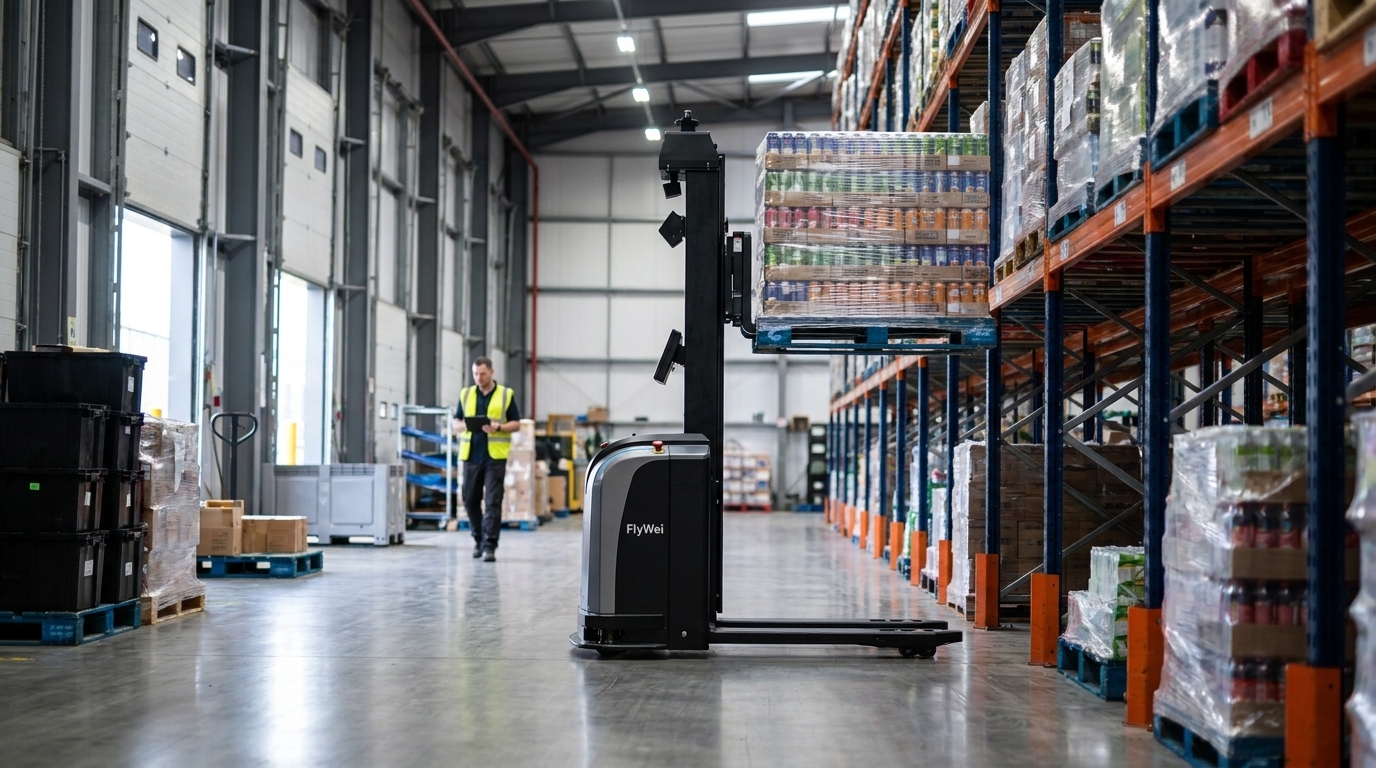
A forklift AGV is a driverless industrial truck that lifts, carries and stacks palletised loads under software control rather than a seated operator. In Great Britain these machines sit inside a settled legal frame: the international standard for driverless industrial trucks is ISO 3691-4, and every such truck must also satisfy the Provision and Use of Work Equipment Regulations 1998. For a plant director in UK drinks logistics, none of that is the pressing problem this quarter. The pressing problem is line-end. A bottling or canning line runs at a fixed rate; pallet evacuation does not. When counterbalance cover is short at changeover, on nights, or in the fortnight either side of a promotion, finished pallets back up behind the palletiser, the buffer fills, and a line that cost seven figures stops because nobody was free to move a pallet forty metres.
Why line-end pallet evacuation stalls in drinks plants
Drinks production is unusually unforgiving of pallet-handling variability. Filling and canning lines are sized to run continuously and are expensive to restart, so the economics of the plant assume the line never waits. Everything downstream of the palletiser, though, is staffed rather than engineered. Pallet evacuation depends on how many counterbalance operators are on shift, how far they are from the line when the buffer fills, and whether they have been pulled onto a trailer that is already late.
Three UK-specific factors sharpen this. First, seasonality: drinks volumes swing hard around summer, Christmas and promotional windows, and sites at Burton-on-Trent and along the M1 corridor near DIRFT and Magna Park compete for the same pool of experienced counterbalance drivers in the same weeks. Second, floor condition: bottling halls are wet, thermally cycled and heavily trafficked, so surface regularity degrades faster than in a dry ambient warehouse. Third, the regulatory load. Workplace transport is a long-standing enforcement priority for the Health and Safety Executive, and a plant mixing pedestrians, manual trucks and reversing trailers at line-end carries a risk profile a plant director must be able to defend.
The result is a plant engineered upstream and improvised downstream. Every hour of unplanned stoppage is cases made later, at overtime rates, against a service level agreed months ago. Adding drivers works until the week they are not available, which is the week it matters.
Lever one: size the line-end buffer before you specify a single truck
The operational lever comes first because it is free. Before any automation decision, measure pallet dwell at the palletiser discharge for four full weeks, including a changeover weekend and a night shift. You are looking for two numbers: the maximum pallets per hour the line produces at rated speed, and the actual evacuation rate achieved in the worst decile of hours. The gap between them, multiplied by the buffer positions available, tells you how many minutes of protection the line really has.
Most drinks plants find the buffer is smaller than the shift pattern assumes. That changes the specification: it tells you whether you need continuous evacuation at line rate, or burst capability to clear an accumulated queue. Those are different fleets. Continuous evacuation favours a few counterbalanced autonomous forklifts cycling a short fixed route; burst clearance favours a larger fleet with dynamic task allocation. Specifying the wrong one is the most expensive error in a drinks automation project, and no supplier can correct it afterwards. Our primer on autonomous forklifts sets out the machine classes.
Lever two: run one traffic plan across the whole fleet
The technical lever is orchestration. A driverless forklift is a vehicle; a fleet is a traffic system. On a live bottling site the constraint is almost never the individual truck's ability to lift a pallet: it is what happens when four trucks, two manned counterbalance units and a pedestrian route converge at the same aisle mouth during a changeover.
This is the job of a fleet manager. FlyWei's M4 fleet manager holds the site map, the traffic rules, the charging strategy and the vehicle assignments in one place, so priority is arbitrated centrally rather than negotiated by trucks in an aisle. Because M4 speaks the VDA 5050 open standard, the same traffic plan governs machines from more than one manufacturer, which matters on a brownfield drinks site where the fleet will grow in stages over several years and the best machine for keg handling may not come from the same source as the best machine for high-bay finished goods.
Above that sits task dispatch. FlyWei fleet dispatch software takes work from the systems the plant already runs (the enterprise WMS, the line control system, or a scheduled export where no live interface exists) and turns it into robot missions, writing completions back so the existing system stays the record of stock.
Lever three: build the PUWER and ISO 3691-4 evidence into the design
The regulatory lever is where plant directors get caught, because compliance evidence assembled after commissioning is always more expensive than evidence designed in. Three documents should exist before an order is placed.
A PUWER suitability assessment, referencing HSE guidance on work equipment, covering your site's actual hazards rather than a generic template: wet floors, dock levellers, shared pedestrian routes, and the interface between driverless and manned trucks. A safety design file demonstrating conformity with ISO 3691-4, including scanner configuration, protective field sizes at each speed, and behaviour on loss of communication. And a floor survey against Concrete Society TR34 free-movement tolerances, because stacking accuracy is a function of the slab as much as the truck. Where lifting accessories are involved, LOLER 1998 applies alongside, and BSI holds the British Standards a specification should reference.
A forklift AGV is a driverless industrial truck that lifts, carries and stacks palletised loads under software control rather than a seated operator, and in Great Britain it must meet ISO 3691-4 and PUWER 1998.
Lever four: match the funding term to the shift pattern
The commercial lever is often decided badly because it is decided last. A plant running three shifts through peak and one through the trough has a utilisation curve that a rigid capital purchase handles poorly. FlyWei leasing over three, five or seven-year terms lets the term follow the contract that justified the automation. Ask for vehicles, fleet software, servicing and spares as separate visible lines rather than one bundled figure.
| Lever | What it changes on the plant floor | Typical lead time | Evidence to demand before you commit |
|---|---|---|---|
| Buffer sizing study | Reveals true minutes of line protection; sets fleet size and type | Four weeks of measurement | Pallet-dwell data covering a night shift and a changeover weekend |
| Fleet orchestration (M4) | Central traffic and priority rules; mixed-manufacturer fleets under one plan | Weeks, in parallel with vehicle build | VDA 5050 conformance statement and a live mixed-fleet reference |
| Task dispatch and integration | Existing WMS or ERP stays the record of stock; robots take work from it | Driven by data access, not vehicle count | Interface specification, exception handling, behaviour on link loss |
| Regulatory design file | Moves PUWER and ISO 3691-4 evidence out of the snag list | Before order placement | Suitability assessment, safety design file, TR34 floor survey |
| Funding term | Aligns cost profile to seasonal utilisation and contract length | Days, once scope is fixed | Vehicles, software, servicing and spares priced as separate lines |
What FlyWei does here
FlyWei is an independent UK systems integrator of autonomous forklifts and AMRs. We are not tied to a single manufacturer, so the fleet specified for a bottling hall is chosen on fit rather than on what one range happens to include. In a drinks plant that usually means a mix: counterbalanced autonomous forklifts cycling finished pallets from palletiser discharge to the marshalling lanes, stacker or reach-truck variants feeding high-bay finished goods, and a tugger or heavy-lift AMR where kegs and returnable containers move on wheeled stillages.
FlyWei designs the traffic plan and the safety case alongside the fleet, not after it, and stages deployments so a first cell, typically one line-end flow, proves the cadence and the safety evidence before the fleet grows. We support the result with UK-based engineers rather than a remote helpdesk. Wider sector context sits under FlyWei industry solutions. The measure of success is one the plant director already tracks: unplanned line stoppages attributable to pallet evacuation, counted weekly.
Frequently asked questions
What is a forklift AGV?
A forklift AGV is a driverless industrial truck that lifts, carries and stacks palletised loads under software control rather than a seated operator. It navigates using onboard sensors and a site map, takes its work from a fleet manager, and is designed to the ISO 3691-4 standard for driverless industrial trucks. The terms driverless forklift, automated forklift and automated guided forklift describe the same class of machine.
Can a forklift AGV work in a wet bottling hall?
Yes, subject to specification. Ingress protection, tyre compound and scanner selection all change for wet and washdown environments, and the floor survey matters more than in a dry warehouse because surface regularity affects stacking accuracy at height. Specify the environment explicitly at enquiry stage; a truck configured for an ambient dry store is not the same machine.
Do we have to replace our warehouse system to automate pallet evacuation?
Usually not. An orchestration layer sits above the existing system and takes work from it, so that system remains the record of stock and orders. Where no live interface exists, a scheduled export of open work and an import of confirmations is normally enough to begin. Replacement is a last resort and rarely the cheapest route.
How do driverless and manned forklifts share the same aisles safely?
Through segregation where possible and arbitration where not. Driverless trucks run to a central traffic plan with defined priority and speed limits by zone; manned trucks and pedestrians are given routes that cross that plan at controlled points. The PUWER suitability assessment should address the mixed-traffic case specifically, because that is where the residual risk sits.
What happens if the network or the host system goes down mid-shift?
A well-designed fleet degrades rather than stops. Trucks complete the task already issued and then hold in a safe state, while the fleet manager queues completions and replays them when the link returns. Ask any supplier how long the fleet runs detached, and how duplicate messages are prevented on reconnection.
Is leasing or purchase better for a seasonal drinks plant?
It depends on the utilisation curve and the contract that justifies the investment. Where volumes swing hard between peak and trough, a lease term matched to the customer contract usually reads better to a capital committee than an outright purchase. Ask for vehicles, software, servicing and spares as separate lines either way.
If unplanned line-end stoppages are on your Q3 risk register, the fastest way to know whether a forklift AGV fleet changes the number is to have someone read the flow.
Get a 48-hour feasibility read on your highest-volume flow, or see the fleet options first on FlyWei autonomous forklifts.
UK-based engineers. No obligation. We reply within one business day.