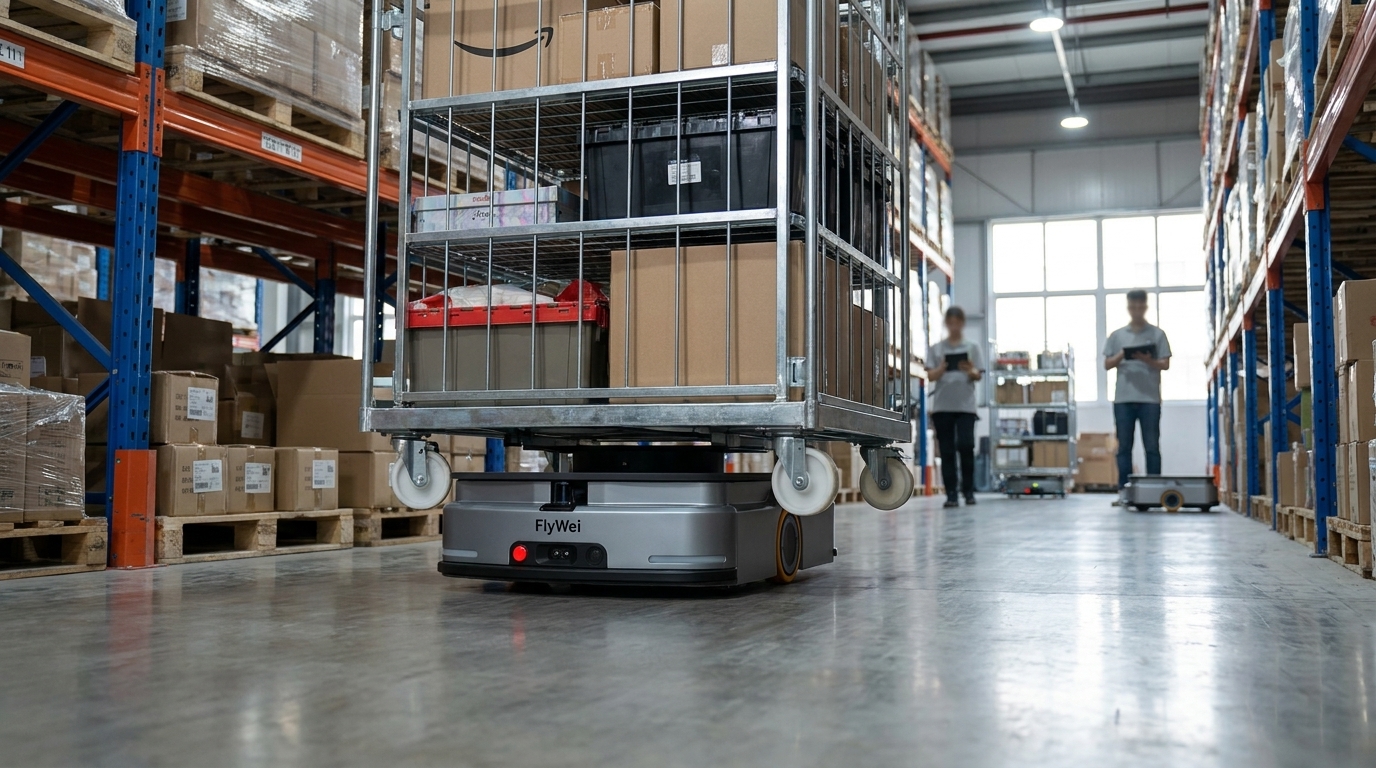
Lifting automated robots are driverless mobile robots that raise, carry and set down loaded totes, crates and pallets between fixed points inside a plant or distribution centre, with no person on board and no fixed conveyor to pay for. In the United Kingdom their safe use is governed by the Provision and Use of Work Equipment Regulations 1998 (PUWER) and by ISO 3691-4 (the international safety standard for driverless industrial trucks), rather than by any single manufacturer's specification. For a plant director running an own-label production hall bolted onto a grocery retail distribution centre, that distinction decides whether a scheme clears the safety committee at all. The pain this quarter is narrower than the technology debate. Between pack-off and the DC marshalling lanes, crates still move on hand trolleys and tow tractors, in surges that peak exactly when despatch windows close and the production plan is already running behind.
Why it happens
Own-label production halls and retail distribution centres were rarely designed as one building. They were joined later, often through a shutter and a short link corridor, and the handover was never given an owner. Production is measured on cases packed; the distribution centre on trailers away on time. The crate dollies between the two belong to whichever shift notices them first.
That gap is tolerable until volume rises. Chilled and short-shelf-life lines run to tight despatch cut-offs, so work does not arrive evenly: it comes in a wave at line changeover, at the end of a run, and in the final hour before a trailer is sealed. The site covers the wave with people: a tow tractor driver pulled off another task, two operatives on hand trolleys, sometimes a counterbalance truck moving a single dolly because nothing smaller is free.
Three costs follow. The first is manual handling exposure on repeated pushing and pulling of loaded dollies, which sits squarely inside the duties the Health and Safety Executive sets out for workplace transport and load movement. The second is traffic risk, because the link corridor is the one place where pedestrians, powered trucks and crate dollies all converge under time pressure. The third is data: the move is invisible to your systems, so nobody can say how long a crate actually waited, and when a trailer leaves short the investigation stalls where the crate stopped being scanned. Across the multi-temperature sites represented by Logistics UK, the bottleneck is a handover, not a machine.
Lever 1: Treat pack-off to marshalling as one timed flow, not two departments
Before any robot is specified, measure the handover as a single flow with a clock on it. Pick your highest-volume line and record three numbers for a fortnight: the time a dolly is full at pack-off, the time it is collected, and the time it is scanned into a marshalling lane. The gap between the first two is your real queue, and it is usually far longer than either department believes.
Then give the flow one owner and one trigger. The work should start when the dolly is full, not when a supervisor spots it. That single change is what makes automation worth doing, because a lifting robot's advantage is not speed, a tow tractor is often quicker, but that it never defers the job. It collects at the same interval at 02:00 as at 14:00.
Specify the cell around the load, not the aisle. Crate dollies, roll cages and plastic pallets each need a different lifting interface, and getting that wrong is the commonest cause of a stalled pilot.
Lever 2: Put an orchestration layer above the systems you already run
The handover only becomes measurable if the robot is dispatched by a system event. In practice that means an orchestration layer sitting above the systems you already run, taking work from your existing production system or enterprise WMS over a documented interface and translating it into robot missions, then writing completions back so your current system stays the record of stock.
FlyWei's M4 fleet manager performs that translation, and FlyWei fleet dispatch software decides which robot takes which move, how traffic through the link corridor is arbitrated, and when a vehicle breaks off to charge. Where vehicles support the VDA 5050 open standard, one fleet layer can command machines from different manufacturers with the same message format, which matters a great deal if you already own powered equipment you intend to keep.
Ask two questions of any supplier. How long does the fleet manager keep running if the link to your business system drops, and how are duplicate completions prevented on reconnection? A well-built integration degrades rather than stops: robots finish the task already issued, hold safely, and replay confirmations once the link returns.
Lever 3: Build the safety case on PUWER and ISO 3691-4 before you choose a robot
A driverless truck is work equipment. That places it under PUWER, which requires equipment to be suitable, properly maintained and used only by people adequately trained, including the supervisors who will recover a stopped robot at 03:00. ISO 3691-4 then sets the requirements specific to driverless industrial trucks, covering protective fields, speed in shared areas and behaviour where people and vehicles mix. Conformity is declared through UKCA marking, and the supporting standards are published in the UK by BSI.
Two physical checks decide more schemes than any of this. The first is floor flatness. Link corridors and older production halls frequently fall outside the tolerances described in Concrete Society guidance TR34, and an out-of-tolerance threshold strip at the shutter will upset a loaded lift long before it troubles a tow tractor. The second is traffic separation through that corridor, where your risk assessment will be tested hardest.
Write the safety case first and let it constrain the shortlist. The other way round is how sites buy equipment that cannot be signed off in the one place it is needed.
Lever 4: Phase the cell, and fund it so the capex committee never sees a cliff
Automate one flow, prove it, then extend. A first cell on one high-volume line gives a measured collection interval and a measured queue reduction: a far stronger paper than a modelled saving. It also contains the disruption: if the pilot needs a different lifting interface, you find that out on one line, not across the hall.
Funding matters as much as scope for this persona, because a plant director is usually asking for capital inside a budget already committed to production assets. Autonomous forklift leasing over three, five or seven-year terms converts the cell into an operating line that can be set against the agency and overtime cover it displaces, which is normally the comparison the committee actually wants to see.
Where the site also needs pallet moves between the hall and bulk storage, keep the orchestration layer common and add autonomous forklifts to the same fleet rather than buying a second control system. One fleet layer across both load types is what keeps phase two cheap.
| Lever | What it changes | Cost profile | Signal that it has worked |
|---|---|---|---|
| Time the handover | Makes the pack-off to marshalling queue visible and owned | Supervisor time only | You can state the average dolly wait |
| Orchestration layer | Dispatches the move on a system event, not a supervisor | Software and integration, costed separately | Every move carries a timestamp in your existing system |
| Safety case first | Constrains the shortlist to equipment that can actually be signed off | Assessment and floor survey | Risk assessment approved before procurement closes |
| Phased cell plus leasing | Replaces a modelled payback with a measured one | Operating cost over three, five or seven years | Phase two is approved on phase one's numbers |
Lifting automated robots move loaded totes and crates between a production pack-off point and a retail distribution centre's marshalling lanes without a driver, and their safe use in the UK is governed by PUWER 1998 and ISO 3691-4 rather than by any single manufacturer's specification.
What FlyWei does here
FlyWei is an independent UK systems integrator. We are not an original equipment manufacturer and not a reseller, so the machine we specify for your link corridor is chosen on the load, the floor and the duty cycle rather than on whose catalogue we happen to hold.
A typical FlyWei scheme starts with one flow: pack-off to marshalling on your highest-volume line. We measure the queue, check floor tolerances at the shutter threshold, and walk the corridor with your safety lead before proposing equipment. Where the load is a crate dolly or a wheeled cage, FlyWei lifting automated robots of the latent-jacking class slide underneath and lift, avoiding any rebuild of the dollies you already own. Where the flow also carries pallets, FlyWei autonomous forklifts join the same fleet.
M4 takes the work from the system that already knows a dolly is complete and returns a confirmation when it lands in the lane, so the move finally appears in your data. Fleet dispatch software handles corridor traffic and charging windows around your changeovers. Commissioning is staged around production, not against it: the first cell runs alongside the existing manual method until the numbers justify standing it down. Further FlyWei warehouse automation solutions extend the same fleet layer into bulk storage once phase one is proven.
Frequently asked questions
What are lifting automated robots?
Driverless mobile robots that lift a load (a tote, a crate dolly or a pallet) carry it elsewhere in the building and set it down, with no operator on board. In a retail own-label plant they most often run short, repetitive moves between pack-off and the marshalling lanes.
Do we need to replace our existing system to use them?
Usually not. An orchestration layer sits above your current production or warehouse system and takes work from it, so that system stays the record of stock. Replacement is only worth considering where it cannot expose work at all.
Which regulations apply to a driverless truck in a UK plant?
PUWER 1998 applies because the robot is work equipment, and ISO 3691-4 sets the safety requirements specific to driverless industrial trucks. The HSE's workplace transport guidance covers traffic and pedestrian separation, and conformity is declared through UKCA marking.
Will our floor take them?
The question that decides most schemes. Link corridors and older halls often fall outside the flatness tolerances described in TR34 guidance, especially at shutter thresholds and expansion joints. Survey the floor before procurement, not during commissioning.
How long does a first cell take to commission?
It depends far more on data access and floor condition than on the vehicles. Where the floor is in tolerance and completed work is already visible to your system, a single flow moves quickly.
Does leasing change the business case?
It changes how the committee sees it. A three, five or seven-year term turns the cell into an operating cost, set against the agency and overtime cover it displaces.
If the queue between pack-off and marshalling is on your Q4 risk register, the fastest way to size it is to measure one flow rather than model the whole hall.
Get a 48-hour feasibility read on your highest-volume flow, or see how FlyWei lifting automated robots are specified for crate and cage handling.
UK-based engineers. No obligation. We reply within one business day.