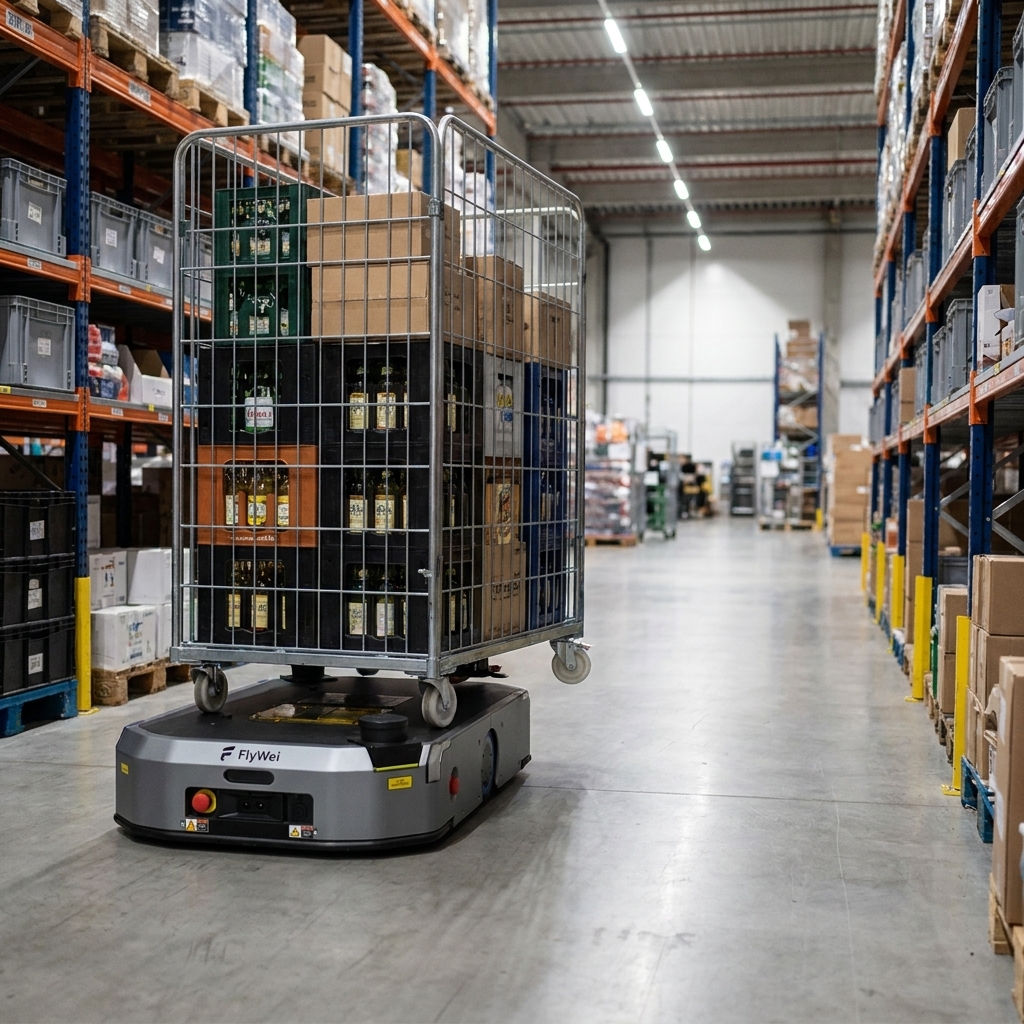
A lifting robot is a driverless machine that raises, carries and sets down a loaded pallet, keg cage or stillage without an operator. Automating that move removes the driver from the task but not the duty holder: lifting equipment used at work must still be thoroughly examined at least every 12 months under LOLER 1998, whoever or whatever is driving it. For a supply chain director running a UK drinks network, that distinction matters this quarter. Kegs, stillages and dolavs are the heaviest, most awkward and most repetitive loads in the building, and they move on the shifts that are hardest to staff, in the small hours between chill store, marshalling lane and loading dock. Every unplanned absence on that flow shows up twice: as a manual handling exposure your safety report has to explain, and as a trailer that leaves Burton-on-Trent late.
Why the keg and stillage loop is the last flow to get automated
Drinks logistics carries a load profile most warehouse automation was never shaped for. A palletised case order behaves predictably. A keg cage does not: heavy, top-loaded, returned dirty from trade, stacked in mixed heights and routed through a chill store where floors sweat and shrink-wrap slips. Add empties travelling the other way and you have a bidirectional loop with no clean start and no clean finish.
That loop then meets the UK labour market. Counterbalance and reach truck work in drinks concentrates on nights and early mornings, when brewery despatch and depot marshalling overlap. Those shifts carry the thinnest cover, so one absence does not degrade the flow gently, it stops a lane of it. The director sees a late trailer at Daventry or Magna Park; the site sees somebody asked to do more repetitive lifts than the risk assessment assumed.
Regulation compounds it. The HSE workplace transport guidance treats the interface between pedestrians and moving trucks as one of the highest-consequence risks in any warehouse, and drinks depots concentrate that interface exactly where the pressure sits: marshalling lanes at the dock edge inside a loading window. PUWER 1998 meanwhile requires work equipment to be suitable, maintained and used only by people adequately trained, a duty that grows heavier every time agency drivers are flexed in for peak.
So the loop sits in a gap: too variable for fixed conveyor, too heavy for light goods-to-person equipment, too safety-critical to hand to an unproven machine. That gap is where a lifting robot belongs.
Lever one: re-cut the flow before you buy a lifting robot
The common mistake is automating the move you already have. That move was designed around a driver who improvises: finds a gap, re-stacks a leaning cage, cuts across the marshalling lane. A lifting robot will not improvise, which is the safety benefit and the planning burden in one.
Start by separating the repeatable core from the exceptions. In most drinks depots the bulk of keg and stillage movement runs between a handful of fixed location pairs: chill store to marshalling, marshalling to dock, dock to empties yard, empties to wash. Those pairs are the automation candidate. Damaged stock, customer returns and ad hoc line calls stay manual, and should be planned to stay manual rather than quietly assumed away.
Then fix presentation. Consistent pallet quality, a defined stillage height and a marked drop footprint do more for reliability than any sensor specification. A lifting robot deployment lives or dies on that groundwork, not on the machine.
Lever two: put every lift under one fleet layer
A drinks depot rarely automates a single machine class. The keg cage wants a heavy-lift base that slides underneath. The palletised despatch leg wants a counterbalanced truck. The narrow-aisle chill store wants a reach truck. Buy those as three islands and you inherit three traffic models, three charging strategies and three sets of exception alarms.
The technical lever is orchestration. A fleet manager sits above the machines, takes work from the system you already run, and converts it into missions, routes and right-of-way decisions. FlyWei's M4 fleet manager does this across mixed vehicle types, while FlyWei fleet dispatch software decides which machine takes which task as priorities shift through a loading window.
VDA 5050 is what makes this practical: an open interface between a fleet manager and vehicles from different manufacturers. That is a commercial protection as much as a technical one. It stops a keg-handling decision this year from binding your dock flow to a single supplier for the next decade.
Lever three: build the LOLER and PUWER evidence pack on day one
Automation changes who operates the equipment. It does not change that the equipment is lifting equipment. The thorough examination regime under LOLER 1998 still applies, and PUWER 1998 duties on suitability, maintenance and training still bind, now covering the people who supervise, recover and re-task machines rather than ride them.
Write ISO 3691-4 into the specification. It covers driverless industrial trucks and their systems: protective devices, speed and stopping performance, and expected behaviour where automated and manual traffic share space. Ask any integrator to state in writing how the proposed configuration meets it, and note that BSI publishes the standard in its UK adopted form.
Then assemble the pack while the project is live rather than at handover: a risk assessment per automated route, the pedestrian segregation plan for marshalling lanes, the examination schedule, the training matrix, and a recovery procedure for a stalled machine mid-window. Logistics UK members will recognise this as the evidence an insurer and an auditor ask for first.
Lever four: fund the first cell as an operating cost
The case for a lifting robot in drinks logistics is usually sound and usually stalls, because it reaches a capex committee holding cash for peak. A supply chain director who wants the loop fixed this year has to solve the funding shape, not only the payback.
Leasing changes that shape. FlyWei offers three, five and seven-year terms through warehouse robot leasing, which moves the fleet into operating cost, matches the charge to the shifts it covers, and lets you start with the one loop that hurts most instead of a site-wide programme.
It changes the risk conversation too. A shorter term on a first cell buys the option to extend into autonomous forklifts for the palletised legs once the keg loop is proven, without committing a whole network on the strength of one pilot. Fund the proof, then fund the estate.
Automating a keg or stillage move with a lifting robot removes the driver from the task but not the duty holder: lifting equipment used at work must still be thoroughly examined at least every 12 months under LOLER 1998.
Comparing the four levers
Indicative planning positions for a first keg and stillage cell, confirmed at site survey.
| Lever | Effect on the keg loop | Capital exposure | Evidence it produces |
|---|---|---|---|
| Re-cut the flow | Turns an improvised move into a defined route pair | None beyond survey time | Route map and exception list |
| One fleet layer | Mixed machine classes share traffic and charging rules | Software and integration, not vehicles | Interface specification and task log |
| Compliance pack | Removes the audit surprise at handover | Engineering time | LOLER schedule, PUWER training matrix, ISO 3691-4 statement |
| Operating-cost funding | Starts this year rather than at the next capex round | Monthly charge, no purchase | Lease schedule and cost-per-shift comparison |
What FlyWei does here
FlyWei is an independent UK systems integrator of autonomous forklifts and AMRs. Vendor-neutral by design, FlyWei selects machines across multiple manufacturers and makes them work together on one site, so a depot with a keg loop, a palletised case flow and a chilled narrow aisle is served by one design instead of three procurements.
In a drinks network that normally starts with a single flow. A FlyWei heavy-lift AMR slides beneath keg cages and stillages between chill store and marshalling. A FlyWei autonomous counterbalance truck takes the palletised despatch legs to the dock. Where the chill store runs narrow aisle, a FlyWei autonomous reach truck handles high-bay put-away. All of it runs under M4, with fleet dispatch software setting task priority as the loading window tightens.
Integration is where the effort goes. Your existing warehouse system stays the record of stock; M4 takes work from it and writes completions back, so cages and pallets update as they move rather than at a shift-end count. Where no interface exists, a scheduled export and import is enough to begin.
FlyWei hands over evidence as well as machines: route risk assessments, the examination schedule, the supervisor training matrix and a recovery procedure the night shift can actually run. FlyWei sector solutions shows how this maps across a multi-site network.
Frequently asked questions
What is a lifting robot?
A lifting robot is a driverless mobile machine that raises, carries and sets down a load without an operator on board. In warehousing it covers heavy-lift and jacking AMRs that lift from underneath, and autonomous trucks that lift on forks.
Can a lifting robot handle kegs and stillages?
Yes, provided the load is presented consistently. Steel keg cages, stillages and dolavs suit a heavy-lift AMR that slides underneath and jacks the whole unit. Mixed stack heights and damaged cages should be routed to a manual exception lane.
Does a lifting robot still need LOLER thorough examination?
Yes. Removing the driver does not remove the duty. Lifting equipment used at work remains subject to the thorough examination regime under LOLER 1998, and PUWER duties on suitability, maintenance and training continue to apply.
What does ISO 3691-4 cover?
ISO 3691-4 sets safety requirements for driverless industrial trucks and their systems, including protective devices, speed and stopping performance, and behaviour where automated and manual traffic share the same space. Name it in your specification.
Do we have to replace our warehouse system?
Usually not. A fleet manager sits above your existing system, takes work from it and writes completions back, so it stays the record of stock. Where there is no interface, a scheduled export and import is normally enough to start.
Will a lifting robot work in a chilled drinks store?
Chilled operation is routine, with specification attention on battery chemistry, condensation management on sensors and floor condition at the temperature boundary. Frozen and deep-chill environments need a tighter specification again, confirmed at survey.
If manual keg and stillage handling is on your Q3 risk register, the fastest way to test the case is on one flow rather than a whole network.
Get a 48-hour feasibility read on your highest-volume flow and FlyWei will tell you whether the keg loop or the palletised despatch leg is the better first cell. You can also review the FlyWei lifting robot range first.
UK-based engineers, no obligation, and a reply within one business day.