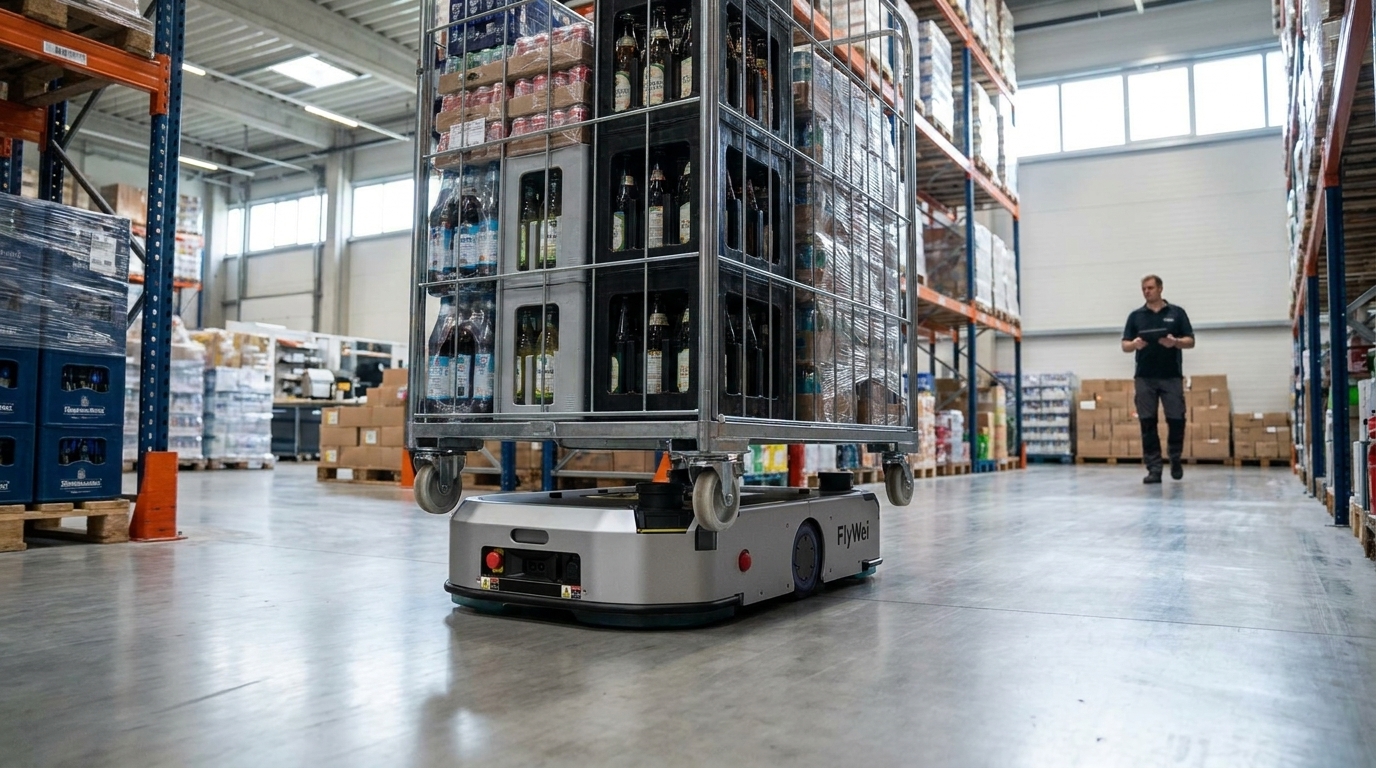
A lifting robot is an autonomous mobile robot that raises and moves loads of up to 1,000 kg without a person under the load: the modern replacement for the manual pump-truck-and-pallet-wrapper handoff that still injures thousands of UK drinks-plant operatives every year, from craft breweries to national bottlers and soft-drinks lines. According to the Health and Safety Executive, handling, lifting and carrying accounts for roughly 17% of all RIDDOR-reportable non-fatal injuries in Great Britain each year, with food-and-drink manufacturing consistently sitting above the national average. For a plant director at a Burton-on-Trent brewery or a Midlands bottling line, that shows up in three familiar ways: a supervisor absent for six weeks with a slipped disc, a stretch-wrapper starved because two operatives phoned in sick, and a case-packer running below rated speed because a keg stack sits misaligned on the infeed conveyor.
Why the drinks-plant handoff still injures people in 2026
Drinks production has three physical problems no other food sector shares in the same combination: heavy unit loads (a stacked keg pallet is 700 to 900 kg; a shrink-wrapped PET pallet 600 to 800 kg), high changeover frequency (SKU proliferation from craft beer, low-sugar reformulation, own-label runs), and cold, wet floors around chill tanks and can-line washers. Add the persistent HGV-driver and warehouse-labour shortage flagged by Logistics UK in successive Skills and Employment reports, and the shift pattern that used to sustain manual palletiser feed simply does not exist any more.
The HSE's PUWER guidance is explicit: where a suitable technical control eliminates the manual-handling task, it must be preferred over training, procedures or personal protective equipment. That is the point at which the lifting robot stops being an innovation project and starts being a compliance obligation, because a bottling line where an operative lifts one 12 kg keg after another through an eight-hour shift is not a defensible working system when a fleet of 500 kg-rated autonomous lifters exists on the market.
The board-level number that finally moves the plant capex committee is not a headcount saving: it is the RIDDOR insurance line. One serious keg-line back injury absorbs the equivalent capex of the first two lifting robots long before the personal-injury claim is settled.
The four levers that fix it (rank them for the board pack)
1) The operational lever: separate the pallet from the person
Map the plant on a single sheet of A3 and colour every point where a human currently touches a load over 25 kg. In a typical UK brewery that is: keg wash outfeed to keg palletiser, keg palletiser to shrink-wrapper, shrink-wrapper to cold-store gate, cold-store gate to loading bay. Each of those four transitions is a candidate for a heavy-lift AMR or an autonomous forklift; the transition with the highest RIDDOR history usually gets the first robot. The operational lift, quietly, is not throughput, plants rarely automate to add lines, it is predictable throughput: a lifting robot does not phone in sick at 05:00 on a Bank Holiday Monday, and it does not need a driver CPC.
2) The technical lever: orchestration beats point solutions
A single lifting robot in a corner is a demonstration. Six lifting robots, four autonomous forklifts and two conveyor merges are a fleet, and a fleet without an orchestrator collides on the wet floor between chill tank and wrap. FlyWei's M4 fleet manager is the traffic-control layer that dispatches lifting robots, autonomous pallet stackers and autonomous forklifts as one mixed fleet, publishes to the BSI-tracked VDA 5050 interface for interoperability with third-party vehicles, and hands the operator's existing ERP and WMS the same task-completed message every plant already knows how to consume. Insist that any lifting robot RFP includes a VDA 5050 conformance statement in the technical annex: it is the difference between a five-year fleet and a five-year lock-in.
3) The regulatory lever: PUWER + LOLER + ISO 3691-4 as one inspection regime
The compliance mistake plant directors keep making is treating the lifting robot as new science. It is not. Under PUWER it is work equipment; under LOLER it is lifting equipment (six-monthly thorough examination if it carries people, twelve-monthly if it only carries loads); under ISO 3691-4 it is a driverless industrial truck with a specified functional-safety envelope, safety-rated LiDAR and defined behaviour when a person enters its aisle. Write a single Approved Code of Practice-aligned inspection plan that stitches the three together and hand it to the site's competent person; the alternative is three parallel logbooks and an HSE workplace-transport visit that finds gaps in all of them.
4) The financial lever: lease before you buy
A fleet of eight heavy-lift AMRs at £115k to £140k per unit is a £1m+ capex conversation that will not survive a mid-year budget freeze. FlyWei's 3-, 5- and 7-year lifting robot leasing converts the same fleet into a per-month opex line that clears the finance-director committee inside a single budget cycle, and the residual is scoped so the plant can refresh to the next-generation robot at year 5 instead of writing down a fully-depreciated block. For the plant director who is signing off a Q4 line-efficiency push, this is the difference between "next year, if the numbers hold" and "on site by shutdown week".
| Metric | Manual pallet truck + operator | Fixed roller conveyor + palletiser | Lifting robot (heavy-lift AMR) |
|---|---|---|---|
| Load range | 150 to 800 kg (operator strain rises above 400 kg) | 200 to 1,200 kg (fixed path) | 300 to 1,000 kg (any path) |
| Injury exposure per 1,000 shifts | High: HSE RIDDOR reports concentrate here | Low, but pinch-point incidents on guarding failure | Very low: no human under the load |
| Capex per line | £8k truck + £45k/yr per operator | £180k to £350k civils + kit | £110k to £140k per robot; leaseable from month one |
| Line changeover | Immediate | Days of re-engineering | Software re-route, minutes |
| Payback (typical UK drinks plant) | Baseline | 3.5 to 5 years | 18 to 30 months on a two-shift line |
A lifting robot in a UK drinks plant handles pallets up to 1,000 kg without a human under the load, cutting the plant's exposure to the RIDDOR-reportable manual-handling injuries that dominate food-and-drink production incident reports each year.
What FlyWei does for a UK drinks plant
FlyWei supplies and integrates a mixed fleet of lifting robots, autonomous forklifts and pallet stackers built for the drinks-plant environment: IP-rated for the wet zone around a bottle-washer, floor-loading verified against a TR34-compliant slab, and dispatched by FlyWei M4 with the existing WMS as the source of truth for finished-goods movement. Our field engineers, all UK-based, walk the plant with your production and safety team before a single robot lands on site: the deliverable of that first survey is a lever-by-lever heat map that names the two highest-payback transitions and specifies the ISO 3691-4 safety envelope for each. From order to first-load-moved on a typical two-shift drinks line is 10 to 14 weeks; from first-load-moved to signed-off ROI is another eight, thanks to the fleet dispatch layer that lets shift supervisors reroute lifting robots the way they already reroute pallet trucks. The Q3 conversation with a UK drinks plant director usually ends the same way: not "can this work?" but "how many can you stage for shutdown week?"
FAQ
What size load can a lifting robot handle in a drinks plant?
Modern heavy-lift AMRs are rated from 300 kg to 1,500 kg. A UK drinks plant typically specifies 500 kg for keg-and-crate work and 1,000 kg for full pallet moves; both sizes clear a standard EUR pallet without operator strain.
Is a lifting robot subject to LOLER as well as PUWER?
Yes. Under LOLER 1998 any equipment that lifts a load is lifting equipment and requires a thorough examination at defined intervals; under PUWER 1998 the same machine is also work equipment and needs an inspection and maintenance regime. A single competent-person plan should cover both duties.
How does a lifting robot navigate a wet-floor bottling hall?
The current generation uses safety-rated 2D LiDAR plus a SLAM map that is re-baselined after any layout change, with wheel-slip compensation calibrated for the friction coefficient of a wet epoxy or resin floor. ISO 3691-4 defines the safety envelope; specify it in the RFP.
Can a lifting robot integrate with our existing WMS?
Yes: via VDA 5050 or a direct API. FlyWei M4 publishes task-completed and pallet-moved events in the format your enterprise WMS already ingests, so no bespoke middleware is required.
What is the payback on a lifting robot for a two-shift UK bottling line?
Typical payback runs 18 to 30 months when you include avoided agency labour, avoided RIDDOR-reportable incidents and reduced changeover time. On a 3-year lease the plant is usually cash-positive from around month 14.
Do we need to change our floor before a lifting robot arrives?
Usually not. TR34-compliant industrial slabs common in UK drinks DCs already meet load rating and flatness; a survey confirms it in one visit. Older sites sometimes need a joint seal or a resin overlay in one aisle.
How does a lifting robot handle a keg-line stoppage upstream?
M4 sees the throughput drop from the palletiser and reassigns lifting robots to the cold-store back-fill task automatically, so the fleet does not sit idle when one line stops.
How does a lifting robot compare with an autonomous forklift?
An autonomous forklift is optimised for tine-carried pallet moves at varied heights; a lifting robot is optimised for lift-and-transport of a load placed directly on its top deck. Most UK drinks plants run a small mixed fleet of both under a single M4 orchestrator.
If keg-line manual handling is on your Q3 risk register, we can put a number on the exposure, and a robot on the floor, inside the same quarter.
Get a 48-hour feasibility read on your highest-volume drinks-plant flow, or see the current FlyWei lifting robot range before you brief the safety committee.
UK-based engineers · no obligation · reply within one business day.