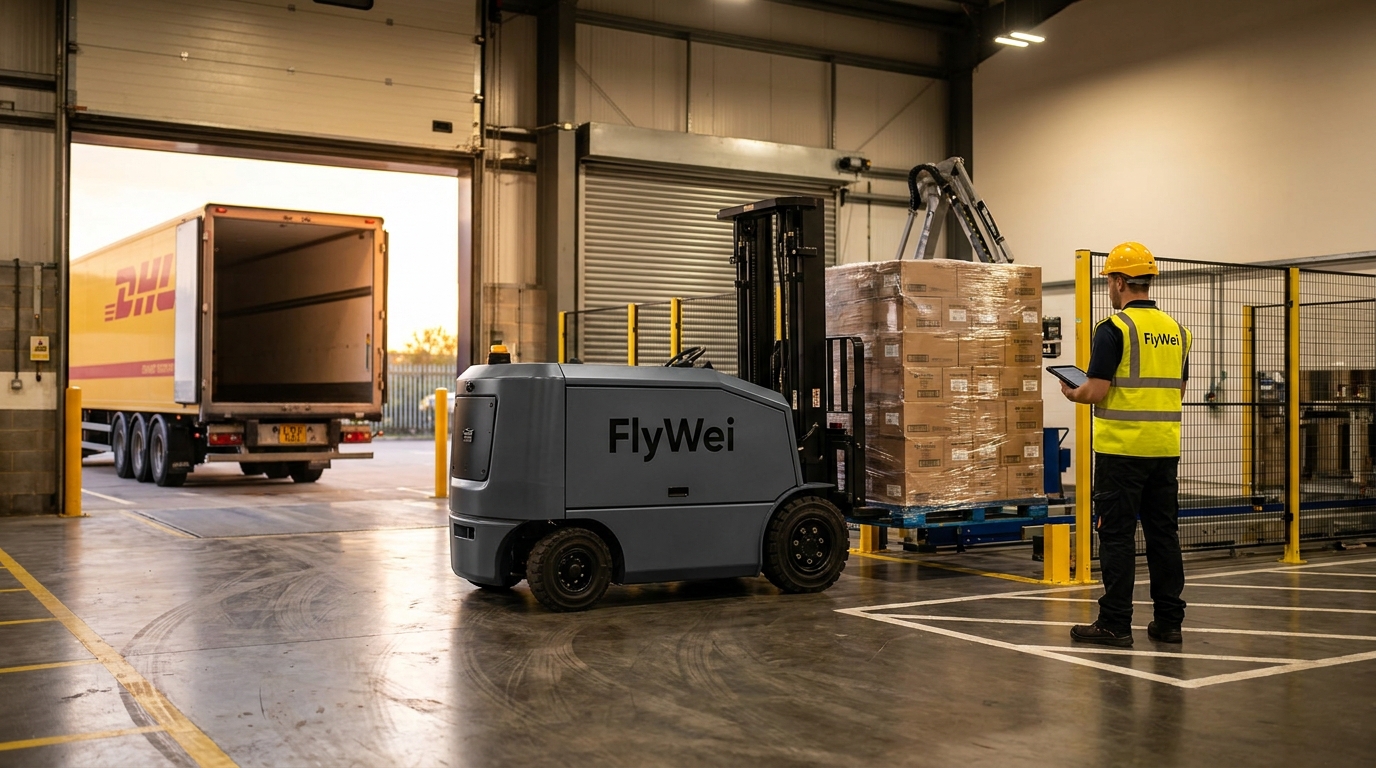
Lifting robots for FMCG warehouses are autonomous mobile machines that shift full pallets from end-of-line case-packers to dispatch lanes without a human operator at the controls, decoupling production throughput from the daily forklift staffing roster. The Health and Safety Executive reports that workplace transport, overwhelmingly forklift trucks, accounts for around a quarter of all workplace fatalities in Great Britain, and that figure barely moves year on year despite training, signage and segregation programmes. For the UK FMCG warehouse manager running a 200,000 sqft site through the 2026 peak, the consequence is familiar: the case-packer keeps producing, but pallets queue behind it because the duty forklift operator is on the other side of the building handling a late inbound, or finishing a put-away in the high bay. Throughput sags, the dock slips, the night shift starts late, and the residual manual-handling risk climbs every time someone steps in to clear the buffer by hand to keep the line moving.
Why end-of-line palletising breaks UK FMCG warehouses in 2026
Three forces converge on the FMCG warehouse manager this year, and each one is sharper than it was twelve months ago. The first is production cadence: modern case-packers, palletisers and shrink-wrappers run at finished-pallet rates that compound quickly across a multi-line UK site, and the line PLC does not care whether the dispatch dock has cleared the previous lot. The second is dispatch pressure: HGV slot booking is now near-religious for the major grocers and convenience symbols, so a late or under-loaded trailer triggers a tariff that swallows the day's margin on that order, and on the big midlands hubs around Magna Park and DIRFT those slots are policed by the minute. The third is labour. Logistics UK has been flagging counter-balance forklift operator scarcity in its annual skills work for several years, and on a typical FMCG site the duty operator is rarely doing only end-of-line work: they cover put-aways, replenishment, ad-hoc rework, and the occasional dock recovery, which is why pallets queue at the packer in the middle of every busy shift.
Then there is the regulatory backdrop. The Provision and Use of Work Equipment Regulations 1998 (PUWER) requires equipment to be suitable, maintained and safely used; ACOP L117 is the practical guide for rider-operated lift trucks; BS EN 1175 covers the electrical safety of industrial trucks; and RIDDOR catches the reportable end of the manual-handling tail. None of those rules are new, but the cost of a single near-miss or a successful manual-handling claim has risen sharply with the wider UK employer-liability premium environment. The math on the line manager's desk has shifted: every hour of manual end-of-line palletising is now both a throughput cost and a balance-sheet exposure, and the case for moving that work onto a documented, sensored, route-bounded autonomous platform has tightened. Lifting robots are now the cheapest hour of that shift, not the most expensive.
Lever 1, Buffer the line: decouple case-packer output from dispatch (operational)
The first lever is operational and it costs nothing in capex to begin with. Map a 4 to 6 pallet buffer immediately downstream of each case-packer, sized so the packer can run for around ten minutes without a removal cycle. Walk the lane and chalk in a one-way autonomous corridor from the buffer to the dispatch staging zone, with a passing bay every 30 metres for any manual counter-balance traffic. The buffer is not the goal; the buffer is what lets a lifting robot do its job. The duty cycle of a lifting AMR is "wait for full pallet, lift, drive, deposit, return", and that cycle is only as efficient as the slack the manager has built around it. Pair the buffer with a five-minute morning briefing on the lane rules, and the shape of the shift changes before a single robot arrives on site.
Lever 2: Orchestrate fixed and autonomous trucks under one fleet manager (technical)
The technical lever is fleet orchestration. FMCG warehouses rarely go fully autonomous in year one: the manager keeps three or four manual counter-balance trucks for unpredictable work, and adds two or three lifting robots for the predictable packer-to-dock loop. The risk is that those two fleets collide, literally or in the schedule. The fix is a fleet manager that speaks the open VDA 5050 protocol to the autonomous units and exchanges live status with the warehouse's existing telematics for the manual trucks. FlyWei's M4 fleet manager issues route reservations, monitors battery and duty-cycle health, and yields the lane when a manual truck calls priority. Pair M4 with the FlyWei fleet dispatch software layer and the case-packer's PLC can request a pallet move directly, with no manual ticketing in between. That is the technical step that turns the buffer in Lever 1 into a self-emptying queue, and it is the same orchestration backbone our 3PL readers will recognise from the AMR fleet-intelligence comparison we ran earlier this month.
Lever 3: Bring autonomous lifting under PUWER and ISO 3691-4 (regulatory)
Regulatory compliance is where FMCG sites trip themselves up, usually by treating the new robots as if they sit outside the PUWER world. They do not. PUWER 1998 applies to every piece of work equipment used at work, autonomous or not, and the duty holder is the employer. ISO 3691-4 is the international safety standard specifically for driverless industrial trucks, and it sets out the safety-related control system requirements, the protective field configurations and the operator-presence checks that a lifting robot must satisfy in a mixed-traffic warehouse. The practical compliance pack the manager needs is short: an updated risk assessment for the packer-to-dock corridor, an ISO 3691-4 conformity statement from the equipment supplier, a documented hand-back procedure for any manual override, and a near-miss log fed back into the same RIDDOR triage as the rest of the site. With that pack on file, the site is legally and operationally ready for autonomous lifting on day one, and the SHEQ team has a paper trail it can defend to an HSE inspector without rebuilding the safety case from scratch.
Lever 4, Phase the capex: prove ROI on one line, then scale (commercial)
The fourth lever is commercial discipline. The FMCG capex committee will fund a 90-day proof on one packer line far more readily than a site-wide retrofit. Pick the line with the most predictable pallet output and the longest packer-to-dock route; that combination gives the lifting robot the easiest schedule and the most hours of useful work. Track three numbers only: pallets-per-hour off that packer line, end-of-shift dispatch on-time rate, and reportable manual-handling incidents. If those three move in the right direction over 90 days, and on a well-mapped FMCG line they typically do, the case for scaling to the next packer line writes itself. For a more detailed payback model see our AMR ROI calculator for UK warehouses, which uses the same three-number framework adapted for 3PL operators and reads across cleanly to multi-line FMCG sites.
What FlyWei does on the FMCG end-of-line
FlyWei supplies and integrates the autonomous lifting fleet that solves the end-of-line problem. For the high-volume packer-to-dock loop FlyWei deploys heavy-lift autonomous AMRs: knee-height scissor-jacking platforms that slip under a full pallet, lift it cleanly and travel it down a chalked corridor to the dispatch lane at walking pace. For the slightly higher-bay moves into staging racks FlyWei supplies autonomous forklifts in the stacker and counter-balance class, sized to the rack-height profile of the specific FMCG site. The lifting-robot range covers the latent-jacking puck for the cart-based sub-assembly flows that some food and personal-care plants still run between packer and palletiser. All of those machines report into the M4 fleet manager and accept route tasks from fleet dispatch software, which is what allows FlyWei to deliver a fleet rather than a set of devices. FlyWei's UK service desk owns the on-site maintenance schedule, the over-the-air firmware updates and the quarterly safety-case review with the customer's SHEQ team, so the FMCG warehouse manager has one phone number to ring, not three. For a working example of how this lands on an adjacent vertical see our food and beverage distribution playbook, which uses the same fleet pattern on a multi-line UK dispatch operation.
Frequently asked questions
What is a lifting robot for an FMCG warehouse?
A lifting robot for an FMCG warehouse is an autonomous mobile machine (typically a heavy-lift AMR, an autonomous stacker or an autonomous counter-balance forklift) that performs full-pallet moves between the end-of-line case-packer and the dispatch dock without a seated operator.
Are lifting robots legal in UK warehouses under PUWER?
Yes. PUWER 1998 applies to all work equipment regardless of whether it is operator-controlled or autonomous. The duty holder must show suitability, maintenance and safe use, and for driverless trucks the conformity reference is ISO 3691-4.
How long does a UK FMCG site take to prove ROI on lifting robots?
A well-scoped 90-day pilot on a single packer line is the standard FlyWei proof window. The three measurements that matter are pallets-per-hour off the line, dispatch on-time rate and manual-handling incident count.
Can lifting robots work alongside manual forklifts in the same aisle?
Yes, with a documented mixed-traffic safety case. ISO 3691-4 sets the protective-field and operator-presence requirements, and a passing-bay layout every 30 metres is the practical UK pattern. The M4 fleet manager yields the lane when a manual truck requests priority.
What pallet weights can FlyWei lifting robots handle?
FlyWei's heavy-lift autonomous AMR class handles up to one tonne; the autonomous counter-balance forklift class handles up to two tonnes; and the autonomous stacker class is sized to mid-height FMCG dispatch racking. Selection is per-site, based on the actual packer output and the dispatch racking profile.
How does FlyWei integrate lifting robots with our existing WMS?
FlyWei's fleet dispatch software integrates with the operator's existing enterprise WMS and ERP through a documented REST and message-queue interface; the case-packer PLC can also call directly. M4 carries the fleet-level orchestration and the VDA 5050 traffic management.
Talk to FlyWei about a 90-day end-of-line lifting-robot proof. Book a site walk with the FlyWei UK team and we will scope the buffer, the corridor and the ROI numbers against your packer output.