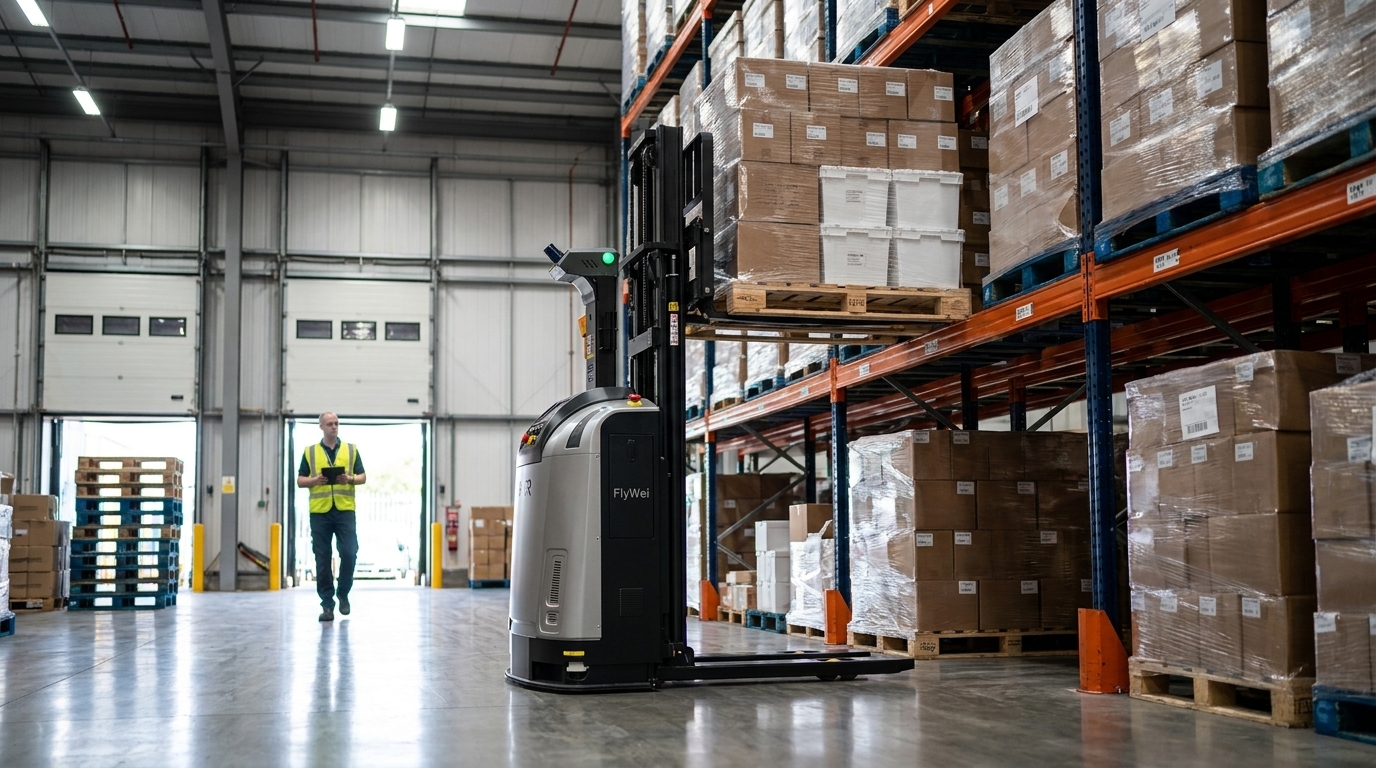
AGV forklift trucks are driverless industrial trucks that lift, carry and place palletised loads inside a warehouse without an operator on board, taking their instructions from a fleet controller rather than a driver. In Great Britain they sit under two legal regimes at once: as work equipment under the Provision and Use of Work Equipment Regulations 1998 (PUWER, legislation.gov.uk), and as driverless trucks under ISO 3691-4 (the international safety standard for that class of machine). For the manager of a 100,000 sq ft MHRA-regulated distribution centre, that dual status is the whole problem this quarter. Agency drivers turn over faster than the induction programme can absorb them, every pallet movement has to be reconstructable at audit, and the racking damage report keeps landing on your desk in the same three aisles. Automation is not the hard part. Proving what moved, when, and under whose authority is.
Why traceability, not lifting, is the bottleneck
A pharmaceutical distribution centre does not fail an inspection because a pallet moved slowly. It fails because nobody can show, three months later, which truck took which pallet from quarantine to released stock, at what time, and on whose instruction. Manual handling generates that record indirectly: a scan at pick-up, a scan at put-away, and a gap in between that everyone agrees to treat as continuous.
Three UK-specific pressures have widened that gap. The first is labour churn. Big-box sheds around Magna Park, DIRFT and Daventry compete for the same counterbalance and reach-truck licences, so a validated site can be re-inducting a meaningful share of its truck operators every quarter. Each new starter is a fresh training record, a fresh competence assessment and a fresh source of variability in how carefully a load is set down.
The second is building geometry. Racking installed for a slower, lower-throughput operation is now being worked harder, with narrower effective clearances than the original design assumed. The Health and Safety Executive is explicit that workplace transport risk is managed by separating people from vehicles and by controlling the route, not by asking drivers to concentrate harder. Damage clusters in the same aisles because the geometry, not the individual, is the cause.
The third is evidential. Regulators and customers increasingly expect movement data to be queryable rather than reconstructable. A paper-and-scan trail answers the question eventually; it does not answer it in the room. That is why so many warehouse managers now describe their automation business case in terms of evidence quality, and why the finance conversation has shifted from headcount to risk. Logistics UK and BSI both frame this as a governance question first and a technology question second.
AGV forklift trucks are driverless industrial trucks that move palletised loads without an operator on board, and in Great Britain they are regulated simultaneously as work equipment under PUWER 1998 and as driverless industrial trucks under ISO 3691-4.
Lever one: fix the location data before a single truck arrives
This is the operational lever, and it is the one most often skipped. A driverless truck cannot infer that bay 14-03-B "usually means" the overflow block by the goods-out door. Before any deployment, every location the fleet will touch needs a unique identifier, a physical marker that matches the record, and a stock balance the team actually trusts. Run a blind count on the flow you intend to automate first. If the variance is material, that is your project for this quarter, not the robots.
The practical test is simple: can you export a list of open moves from your existing warehouse system, and can that system accept a confirmation back? If yes, you have an integration path. If no, a scheduled file exchange still works to begin with, and it avoids modifying a validated system. Either way, resolve it before capital is committed, because remediation after go-live is far more expensive than remediation before it.
Lever two: one fleet layer above mixed-manufacturer trucks
This is the technical lever. The trucks are not where lock-in happens; the controller is. A fleet management layer sits between your warehouse system and the vehicles, converting each task into routes, traffic rules, charging decisions and vehicle assignments, then writing completions back so your existing system stays the record of stock. Where that layer speaks the VDA 5050 open standard, one controller can command trucks from different manufacturers using the same message format.
For a regulated site the practical benefit is continuity. You can add a narrow-aisle machine in year two without a second control room, a second integration and a second training package. M4 fleet management handles the traffic and task assignment; FlyWei fleet dispatch software handles the rules that decide which move matters most when the packing hall and goods-in both want the same truck. Ask any supplier how long that layer keeps running if the link to your warehouse system drops, and how duplicate confirmations are prevented on reconnection.
Lever three: write PUWER and ISO 3691-4 into the acceptance test
This is the regulatory lever, and it is where warehouse managers have the most leverage and use it least. PUWER makes you responsible for equipment that is suitable, maintained and used by trained people, whether or not a person sits on it. ISO 3691-4 sets out what a driverless truck must do about detection, speed and stopping in a shared space. Neither is satisfied by a certificate in a folder.
Turn both into observable tests at handover: a pedestrian entering the route at the worst realistic point; a mixed manual and automated aisle at shift change; a load presented out of tolerance; a deliberate loss of network. Record what the truck did, not what the datasheet says it does. Add the maintenance regime, the competence requirements for your own supervisors and the escalation path for exceptions. Sign against evidence you generated on your own floor.
Keep the same discipline after handover. PUWER duties are continuing, not a one-off, so the inspection regime, the record of who is competent to supervise the fleet, and the review that follows any near miss all need an owner and a date. Written that way, the compliance pack doubles as the evidence your customers and inspectors ask for.
Lever four: prove it on one flow, then extend
The fourth lever is commercial discipline. Pick the single highest-volume, lowest-variability flow in the building, usually palletised finished goods from the packing hall to the bulk store, and automate only that. It gives you a clean before-and-after on damage, on move times and on evidence quality, and it gives finance a payback figure drawn from your own site rather than a generic model. Where capital is the constraint rather than confidence, a leasing structure spreads the cost across the term the trucks are actually working.
| Lever | Where the cost sits | Typical time to evidence | What the board sees |
|---|---|---|---|
| Location and stock data clean-up | Internal team time, no capital | Weeks, before any deployment | Count variance closed; a defensible baseline |
| Independent fleet layer over mixed trucks | Software and integration, costed separately from vehicles | At second-phase expansion | No second control room, no repeat integration |
| PUWER and ISO 3691-4 acceptance testing | Specification effort, priced into handover | At handover, then each service interval | Site-generated evidence, not supplier assertion |
| Single-flow proving run | Smallest viable fleet, leasable | One full peak cycle | Payback drawn from this building, not a model |
What FlyWei does here
FlyWei is an independent, vendor-neutral UK systems integrator of autonomous forklifts and AMRs. We are not tied to one manufacturer's range, which matters in a regulated warehouse because the right machine for the packing-hall flow is rarely the right machine for the high-bay aisle. FlyWei specifies, integrates and supports the fleet as one system.
In a pharmaceutical distribution centre that usually means a small mixed fleet: FlyWei autonomous forklift trucks in counterbalance form for dock-to-stock pallet moves, a narrow-aisle reach-truck variant for the high-bay locations, and FlyWei lifting robots where totes and trolleys move between the packing hall and dispatch. Above them, FlyWei M4 handles traffic, task assignment and charging strategy, while FlyWei fleet dispatch software applies the priority rules that keep quarantine releases ahead of routine replenishment.
FlyWei engineers survey the building first, map the aisles and clearances as they are rather than as drawn, and design the acceptance tests alongside your quality team so the evidence pack is a deliverable rather than an afterthought. Where capital timing is the constraint, FlyWei leasing over three, five or seven years matches the cost to the working life of the fleet. Sector-specific configurations sit under FlyWei solutions, and our earlier notes on safety controllers for mobile robots in pharma and on industrial robot servicing for regulated sites cover the maintenance and functional-safety detail in full.
Frequently asked questions
What are AGV forklift trucks?
AGV forklift trucks are driverless industrial trucks that lift, transport and place palletised loads without an operator on board. They navigate using onboard sensing and a site map, and take their tasks from a fleet controller rather than a driver.
Can AGV forklift trucks be used in an MHRA-regulated warehouse?
Yes, provided the movement record satisfies your quality system. Every move must be uniquely attributable, timestamped and retrievable, and the equipment must meet PUWER and ISO 3691-4. Build those checks into your acceptance test rather than accepting a supplier certificate alone.
Do we need to replace our warehouse management system?
Usually not. A fleet layer sits above your existing system and takes work from it, so that system remains the source of truth for stock. Where no interface exists, a scheduled export of open moves and an import of confirmations is normally enough to start.
How do driverless forklifts work safely alongside pedestrians?
Through route design first and sensing second. Health and Safety Executive guidance on workplace transport puts separation of people and vehicles ahead of behavioural controls. ISO 3691-4 then sets the detection, speed and stopping behaviour required where separation is not absolute.
Can we run trucks from different manufacturers in one fleet?
Yes, where they support a common interface. The VDA 5050 open standard lets one fleet manager issue orders to vehicles from different suppliers using the same message format, so a separate integration for every manufacturer is no longer required.
How many AGV forklift trucks does a 100,000 sq ft site need?
It depends on move volume, distance and shift pattern rather than floor area. Count the moves on one flow over a full peak cycle, measure the average cycle time including queuing and charging, and size from that. A site survey produces those figures in a day.
Is leasing available for autonomous forklift fleets in the UK?
Yes. FlyWei offers three, five and seven-year terms so the cost profile matches the working life of the fleet rather than the capital budget of a single year.
If unreconstructable pallet moves and repeat racking strikes are on your Q3 risk register, the fastest way to size the problem is to walk the aisles with someone who does this for a living.
Book a free 30-minute site survey with a FlyWei engineer, or see the range and specifications on our AGV forklift trucks page.
UK-based engineers. No obligation. We reply within one business day.