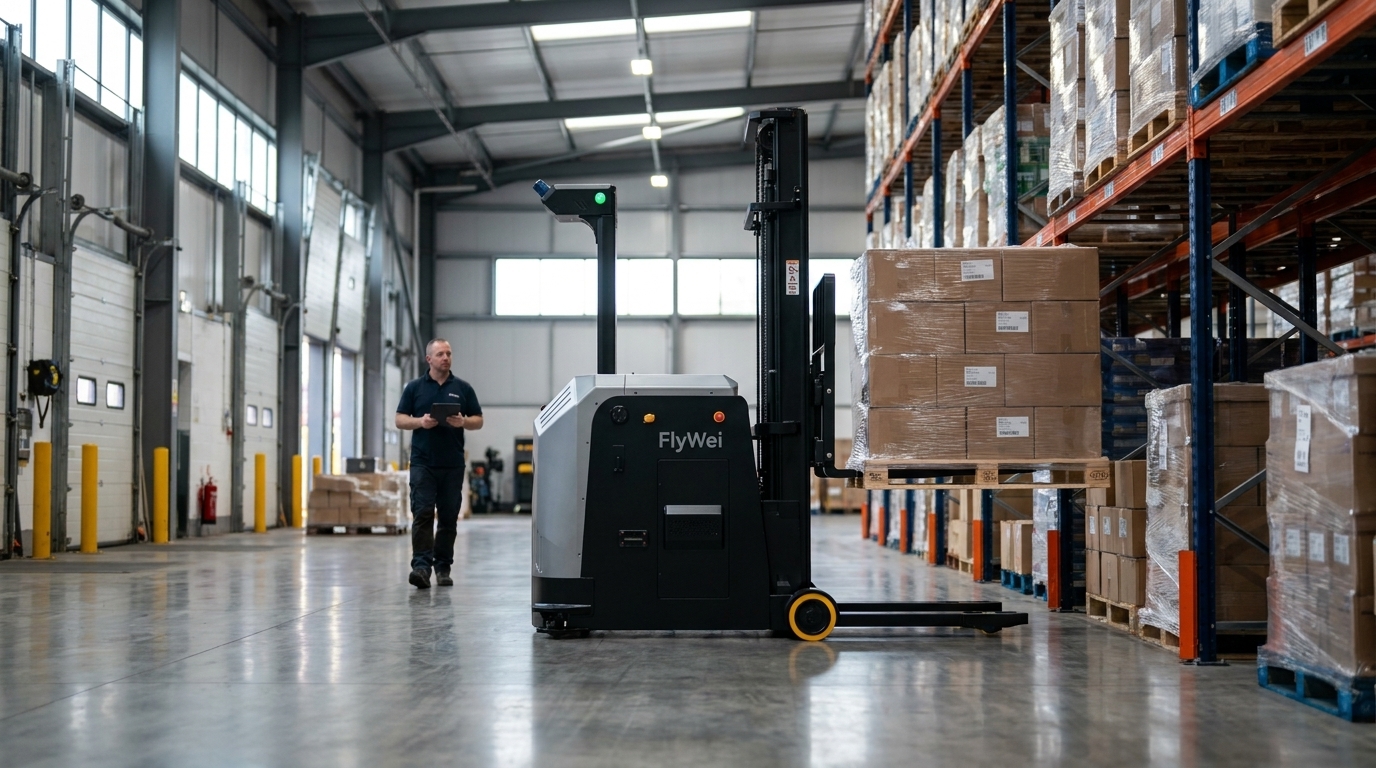
An AGV forklift is a driverless industrial truck that moves palletised loads along a defined route under software control, without an operator on board. The safety case is not marginal: the Health and Safety Executive records more than 5,000 workplace transport incidents a year in Great Britain, around 50 of them fatal. For a supply chain director in e-commerce fulfilment, though, the pressure this quarter is arithmetic rather than moral. Q4 volume plans are signed off in Q3, and the pallet-move layer beneath the pick face (decant to reserve, reserve to pick, pick to despatch lanes) is the part of the operation that scales worst. Counterbalance and reach truck drivers are the hardest agency line to fill at peak, they take the longest to induct on a site they will leave in January, and every unfilled shift shows up as a replenishment queue at the pick face before it shows up in the despatch cut-off.
Why the pallet-move layer breaks first
E-commerce fulfilment has spent a decade optimising the pick. Goods-to-person cells, put walls and route-optimised pick paths have pushed units-per-hour up at the face. What has not changed at the same rate is how a full pallet gets from a trailer to reserve, and from reserve down to a pick location, in a building whose aisles are full of people.
That work is done by counterbalance trucks, reach trucks and pallet stackers, and is bounded by three things that do not flex with demand. The first is licensed, site-inducted labour. A reach truck operator working an 8-metre high-bay above a live pick face is not an agency slot you fill on the Friday before a promotion, and Logistics UK has tracked that shortage for years. It bites hardest when volume peaks, because every operator in the region is being bid for at once.
The second is the safety envelope. As pedestrian traffic rises (more temps, more agency pickers, more unfamiliar faces) the sensible response is to slow the trucks, widen segregation and add marshals. That is correct practice, and it directly reduces the pallet throughput you were relying on. The Provision and Use of Work Equipment Regulations put that duty on the operator of the equipment, not the supplier.
The third is that peak is not a spike but a plateau with a hard end date. Anything you buy to cover it (labour, hired trucks, a shift pattern) you unwind at cost in January. The result is familiar: over-resourced in October, under-resourced in the third week of November, expensive in both directions.
An AGV forklift is a driverless industrial truck that moves palletised loads along a defined route under software control, without an operator on board.
Lever one: automate one flow, not one building
The operational mistake that kills automation business cases is scope. A director under peak pressure asks what proportion of MHE hours can be automated across the site, and discovers the programme now touches every aisle, shift and exception path in the building.
The productive question is narrower. Find the single flow with the highest move count and lowest variability: in most fulfilment centres that is decant-to-reserve or reserve-to-pick-face replenishment on the fastest-moving SKU band. It runs the same route, load type and heights all day. Instrument it for a fortnight and you have a defensible move-per-hour baseline rather than an estimate.
That one loop is what a driverless forklift is genuinely good at, and where the return is easiest to prove. It protects the peak plan in the right place: every automated replenishment move is an operator hour released back to the flows that still need judgement; damages, returns, awkward loads, trailer work. You are not removing people from the building, but moving them off the leg that scales worst.
Lever two: orchestrate mixed traffic, do not just add robots
The technical lever that decides whether a deployment survives peak is traffic management. One automated truck in a quiet aisle is a demonstration. Six sharing aisles with manual trucks, pedestrians and a trailer being tipped is an operation, and the difference is the orchestration layer.
That layer does three jobs. It takes work from the systems you already run, so your existing warehouse system stays the record of stock rather than being replaced. It converts each task into a route, a priority and a vehicle assignment, arbitrating between vehicles wanting the same aisle. And it writes completions back, so a pallet move posts as a stock movement when it happens.
FlyWei's M4 fleet manager performs that arbitration, and FlyWei fleet dispatch software handles the task queue that sits above it. Because the vehicle interface follows the VDA 5050 open standard, trucks from different manufacturers can be commanded through one fleet manager, so the fleet you size for this peak is not the fleet you are locked into for the next. The same layer runs the lifting robots and AMRs handling cage and tote movements, rather than a second disconnected control system.
Lever three: close the regulatory case before October, not during it
Driverless trucks in a live UK building are a settled regulatory question, and the paperwork is what most often delays a pre-peak go-live. Treat it as a critical path item, not an afterthought.
Four documents carry the weight. PUWER 1998 puts the duty on you to ensure work equipment is suitable, maintained and used by trained people: for an automated truck, a documented safe system of work covering how it behaves near pedestrians and how it is recovered when it faults. ISO 3691-4 covers driverless industrial trucks and their systems, and is what a supplier's conformity claim should point at alongside UKCA marking. LOLER duties apply to the lifting function. And the concrete matters more than buyers expect: an automated truck holds a tighter navigational tolerance than a human driver, so floor flatness to the relevant TR34 classification is a survey item, not a formality.
None of this is exotic, and BSI-published standards give you the reference points to write against. What it is, reliably, is work that cannot be compressed into the last fortnight before a peak ramp.
Lever four: match the funding shape to the demand shape
The commercial lever is left to the end most often, and it is where peak-driven cases stall at the capex committee. A fleet sized for November running through a February trough looks poor on a purchase case, reasonable on a term one.
FlyWei offers autonomous forklift leasing over 3, 5 and 7-year terms, letting the cost sit alongside the flow it protects rather than landing as a capital event in a quarter when nothing is yet proven. You approve an operating line against a measured move count instead of defending a capital number against a forecast. Our AGV forklift buyer's guide sets out which cost lines should be priced separately.
| Option | What it flexes | Time to be productive | Where it fails at peak | Value after January |
|---|---|---|---|---|
| Agency MHE operators | Headcount, week by week | Days, plus induction and licence checks | Fill rates fall when regional demand peaks; knowledge leaves with the shift | None |
| Overtime on existing operators | Hours, not people | Immediate | Fatigue and absence risk rise across a long plateau | None |
| Short-term truck hire | Equipment only | Days for trucks, weeks for operators | Adds machines to a constraint that is actually people | None |
| AGV forklift on one instrumented flow | Move capacity on a defined route, 24/7 | Weeks: survey, integration and sign-off are the path | Only if scoped site-wide instead of one flow | Full: the flow stays automated |
What FlyWei does here
FlyWei is an independent UK systems integrator of autonomous forklifts and AMRs. We are vendor-neutral by design: we integrate the machines that suit the flow, drawn from multiple manufacturers, rather than selling one catalogue into every building. That distinction is practical: the truck suiting an 8-metre narrow-aisle reserve is rarely from the same family as the one suiting a dock-to-stock shuttle, and specifying both keeps a phased rollout honest.
On a site like this we start with a flow survey: instrument the replenishment loop, measure real move counts and dwell, and check aisle geometry and floor flatness before anything is specified. From there we design and supply the automated forklift configuration that fits: reach truck class for high-bay reserve, counterbalance or autonomous pallet stacker class for lower-level and dock work.
M4 then runs the fleet against your existing systems, arbitrating traffic between automated trucks, manual trucks and pedestrians, while fleet dispatch software holds the task queue. We handle the PUWER and ISO 3691-4 documentation as part of delivery rather than leaving it with your SHE team, and support the fleet in service through UK-based engineers. Across our sector solutions the pattern that works is the same: prove one flow, then extend.
AGV forklift FAQs
What is an AGV forklift?
An AGV forklift is a driverless industrial truck that moves palletised loads along a defined route under software control, without an operator on board. It navigates using onboard sensing, takes tasks from a fleet management layer, and reports completion back. Our guide covers the classes.
What is the difference between an AGV forklift and an autonomous forklift?
In everyday use the terms overlap; buyers search driverless forklift, automated forklift and automated guided forklift interchangeably. The technical distinction is navigation: traditional AGVs follow a fixed path set by wire, tape or magnets, while autonomous trucks map the building and plan routes dynamically, coping with a changed floor plan.
Can an AGV forklift be deployed in a fulfilment centre that is already running?
Yes, and that is the normal case. Brownfield deployment is phased: one instrumented flow is automated first, running alongside manual trucks and pedestrians under a documented traffic plan, then extended. What sets the timeline is aisle geometry, floor flatness and data access.
What UK regulations apply to an AGV forklift?
PUWER 1998 places the duty on the operator of the equipment to ensure it is suitable, maintained and safely used, supported by a documented safe system of work. LOLER 1998 covers the lifting function, ISO 3691-4 is the standard for driverless industrial trucks, and UKCA marking should be present.
How long before peak should we start if we want an AGV forklift running?
Plan on a full quarter, not a few weeks. The vehicles are rarely the long pole: flow instrumentation, aisle and floor checks, integration and the safe system of work all sit on the critical path.
Do we need to replace our warehouse system to run an AGV forklift?
Usually not. A fleet management layer sits above your existing system and takes work from it, so that system stays the record of stock and orders. Where no interface exists, a scheduled export of open work and import of confirmations is enough to begin.
If the pallet-move layer beneath your pick face is on your Q3 risk register, the fastest way to size the problem is to measure one flow rather than model the whole building.
Get a 48-hour feasibility read on your highest-volume flow: send the move counts and aisle dimensions for one replenishment loop and we will tell you what an AGV forklift deployment on it involves.
UK-based engineers, no obligation, reply within one business day.