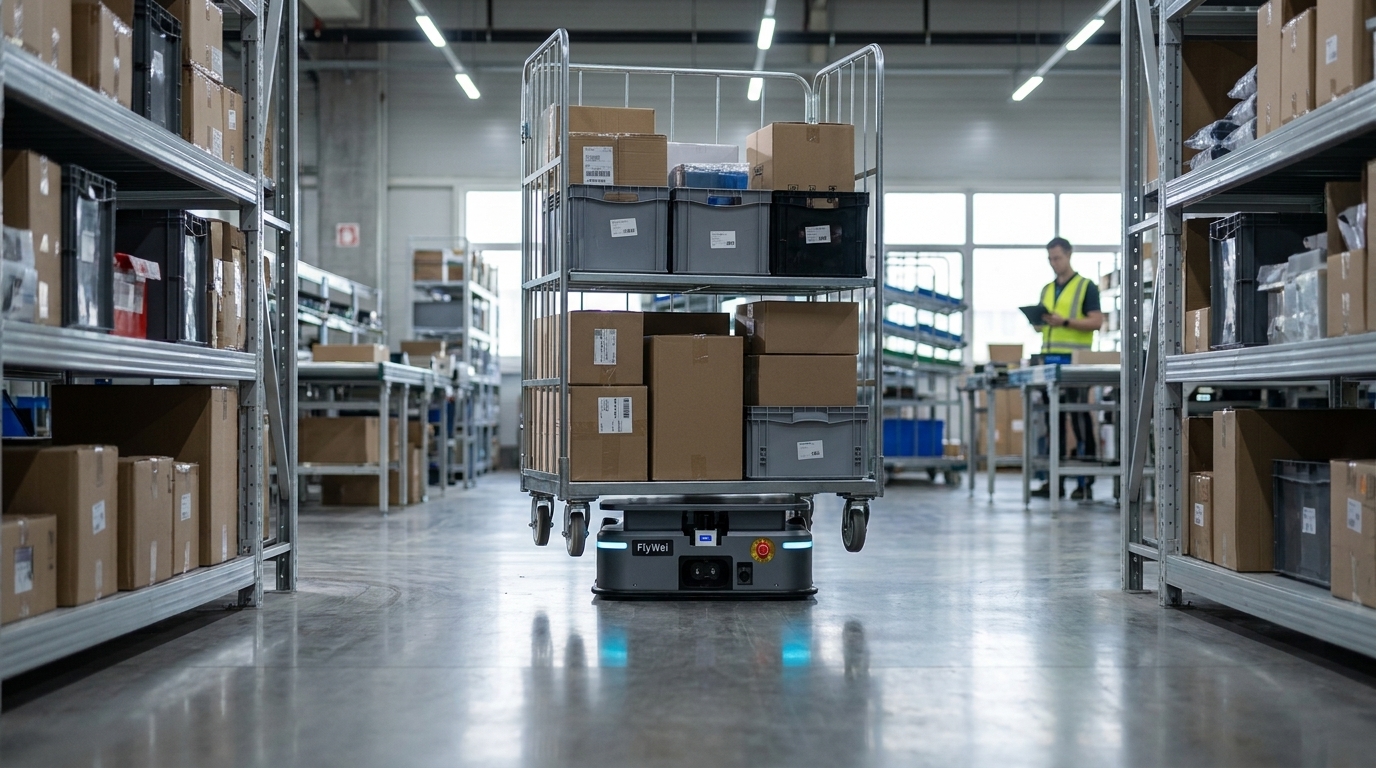
AMR controllers are the onboard control units that turn a mobile robot's sensor feed into motion, safety decisions and fleet-level instructions — the layer that sits beneath every autonomous forklift and AMR on a plant floor. The stakes are physical: of the 126 workers killed in work-related accidents in Great Britain during 2025/26, 24 were struck by a moving vehicle and 21 by a moving object, according to HSE's provisional figures. If you run operations for a UK engineering or heavy-parts site, you already feel the gap. You have a brownfield plant, irregular loads — castings, engine sub-assemblies, transmission cases — vehicles of four different ages sharing one aisle, and a successful robot pilot in one bay that will not scale into the next. The reason is rarely the robot. An AMR controller is the single component that sets a mobile robot's safety rating, its navigation method, and whether a fleet manager can command it alongside vehicles from other manufacturers.
Why engineering sites stall after the first successful robot
Heavy-parts plants, from the West Midlands to the industrial estates around Burton-on-Trent, are the hardest brownfield automation case in UK industry, for structural rather than technical reasons. Aisles laid out for people narrow unpredictably around press lines and work-in-progress buffers. Loads are machined castings, transmission cases and part-built sub-assemblies with shifting centres of gravity, not uniform pallets. And the fleet was bought over fifteen years, in separate capex rounds, from whichever channel was cheapest that year.
That history defeats the second phase of automation. The first robot works because it is commissioned as an island: one route, one load type, one set of hand-drawn safety boundaries. Add a second vehicle from a different source and you discover that neither unit will accept instructions from the other's control software, that their obstacle-detection behaviour differs at the same closing speed, and that no single screen shows you where both machines are.
Regulation sharpens the problem. Workplace transport remains one of the most persistent causes of serious harm in UK industry — HSE recorded 59,219 non-fatal employee injuries under RIDDOR in 2024/25, with being struck by a moving object accounting for around a tenth of them. HSE's workplace transport guidance expects segregation, visibility and controlled interaction between vehicles and people. A fleet you cannot see as one system is a fleet you cannot evidence as safe — and that is what stops an operations director signing off bay two.
An AMR controller is the single component that sets a mobile robot's safety rating, its navigation method, and whether a fleet manager can command it alongside vehicles from other manufacturers.
Lever one — specify the control layer before you specify the fleet
Reverse the usual procurement order. Most sites choose vehicles and inherit whatever control units arrive inside them, which is how a plant ends up with four incompatible stacks. Decide the control standard first and make vehicle selection answer to it.
Three requirements go into the specification before any machine is quoted: the controller must expose an open fleet interface, carry a stated safety performance level, and support the navigation method your building actually allows. A press shop with reflective surfaces and constantly moving work-in-progress needs natural-feature navigation, not a fixed guidance path someone will block within a week.
This collapses a surprising amount of lifetime cost. One controller family means one spares holding, one engineering competency, one set of commissioning tools and one integration to your business systems rather than a fresh project each time. It also preserves your freedom to buy the best vehicle for each task later. Our AMR controllers range is built on that principle: a common control standard that different vehicle classes can be built or retrofitted onto.
Lever two — make one fleet manager the arbiter of every movement
This is the technical lever, and it turns a pilot into an operation. Vehicle-level control decides how a single machine moves; it cannot decide which of six machines takes the next job, who yields at the junction outside the paint line, or how charging is sequenced. Those are fleet decisions, and they need a layer above the vehicles.
What makes that possible across a mixed-age, mixed-source fleet is VDA 5050, the open standard for communication between mobile robot fleets and a central fleet control. It uses MQTT transport and JSON messages, so one fleet manager can issue orders to vehicles from different manufacturers in a common format instead of needing a bespoke interface per supplier. Where a controller speaks it natively, integration becomes configuration rather than development.
Work should also come from the systems you already run, not a parallel schedule maintained by hand. M4 fleet manager converts tasks into routes, traffic rules and vehicle assignments; RDS robot dispatch handles allocation and priority. Both take work from your existing production and warehouse systems through a documented interface, as set out in our approach to ERP and WMS integration, and write completions back so those systems stay the record of stock.
Lever three — build the PUWER case into the controller choice
The regulatory lever, and the one most often deferred until it is expensive. Under the Provision and Use of Work Equipment Regulations 1998, duties for safe work equipment sit with the employer operating it. HSE's PUWER guidance requires equipment to be suitable for its use, properly maintained, and fitted with adequate controls and protective devices. An autonomous vehicle transfers none of that to the integrator.
In control terms, what satisfies it is a safety-rated architecture: a controller with a declared functional-safety performance level, safety laser scanners whose protective fields change with speed and load, and emergency stop circuits inside the certified chain rather than bolted on. ISO 3691-4, the international standard for driverless industrial trucks and their systems, is the reference assessors expect you to have worked to, alongside the ACOP guidance in HSE's L117 for rider-operated lift trucks where manual and autonomous vehicles share space. UKCA marking and the site's own risk assessment complete the file.
The practical consequence is that safety-rated control cannot be retrofitted cheaply. A functional-safety forklift controller specified at the outset costs a fraction of re-engineering a fleet commissioned without one, and it is what lets autonomous and manned trucks share an aisle instead of a fenced cell.
Lever four — retrofit the assets you already own
The commercial lever. Engineering sites typically hold serviceable trucks with years of life left, and replacing them wholesale to automate is rarely the best use of capital. Brownfield retrofit — fitting an autonomous forklift controller, navigation sensors and safety scanners to a suitable existing vehicle — converts an asset you have already paid for.
Retrofit is not universal. The base vehicle needs electric drive, an accessible control interface and sound mechanical order; a truck near end of life should be replaced, not converted. Where it applies it shortens lead time, because the machine is already on site and known to your maintenance team.
For the mixed case — some retrofits, some new FlyWei autonomous forklifts, some lifting robots for sub-assembly moves — phasing the cost matters more than the headline price. FlyWei leasing over 3, 5 and 7-year terms lets a plant roll out bay by bay against operating budget instead of waiting for one large capex round — usually what keeps a stalled pilot stalled.
| Lever | Cost profile | Payback signal to watch | Who owns it |
|---|---|---|---|
| Standardise the control layer first | Specification effort only; no hardware cost yet | Second vehicle commissions in days, not months | Operations with engineering |
| One fleet manager over all vehicles | Software and integration; scales per vehicle, not per project | Moves completed per shift without added supervision | Operations with IT |
| Safety-rated control from the outset | Higher cost per controller; avoids re-engineering later | Autonomous and manned trucks sharing aisles safely | Operations as PUWER duty holder |
| Retrofit serviceable existing trucks | Fraction of a new vehicle; limited by base truck condition | Capital released against the same throughput gain | Procurement with maintenance |
What FlyWei does here
FlyWei is an independent, vendor-neutral UK systems integrator of autonomous forklifts and AMRs. We integrate the best machines across multiple manufacturers rather than selling one range, which matters in a brownfield plant because the right answer is almost always a mixture: a retrofitted counterbalanced truck on the heavy-casting move, a stacker on mid-height racking, a heavy-lift AMR shuttling engine sub-assemblies to the line, and manual trucks where they earn their keep.
The control layer is where we start. FlyWei engineers survey the site, confirm which existing vehicles are credible retrofit candidates and which movements justify a new machine, then set one control standard across the fleet — safety-rated where vehicles and people share space, VDA 5050-capable so M4 can command every unit regardless of origin.
From there M4 handles traffic, routing and charging strategy across the fleet, and RDS allocates jobs from your existing production systems. Commissioning is phased bay by bay, keeping production moving. Support comes from UK-based engineers, with the control architecture documented well enough to stand up in a PUWER review. Our earlier piece on AGV controllers in co-packing operations covers the same architecture in a contract-packing setting, and Logistics UK publishes sector guidance on fleet operations.
Frequently asked questions
What is an AMR controller?
An AMR controller is the onboard unit that runs an autonomous mobile robot: it fuses sensor data into a position estimate, plans motion, enforces the vehicle's safety functions and talks to a central fleet manager.
What is the difference between AMR controllers and AGV controllers?
Navigation method, not hardware category. AGV controllers follow fixed infrastructure such as magnetic tape, so routes are physical. AMR controllers localise against the building, so routes are software and change without touching the floor.
Can we automate forklifts we already own?
Often yes. A retrofit needs electric drive, an accessible control interface and sound mechanical condition. Trucks near end of life are better replaced, and a site survey separates the two cases.
Do safety controllers for mobile robots satisfy PUWER?
Partly. A declared functional-safety performance level evidences adequate protective devices, but PUWER duties rest with the employer, so risk assessment, training, maintenance and pedestrian rules remain yours.
Can robots from different manufacturers run in one fleet?
Yes, where they share a common interface. VDA 5050 lets one fleet manager order vehicles from different suppliers in the same message format. Traffic rules still have to be set centrally.
How long does a controller-led automation project take on a live site?
Commissioning vehicles is rarely the long pole. Site survey, agreed traffic rules and testing the interface to your production systems take most of the time.
What does a SLAM navigation controller need from our building?
Stable geometry to localise against: racking, walls and columns that do not move daily. Open spans, reflective surfaces and shifting work-in-progress need attention at survey stage.
If a stalled automation pilot and an unevidenced mixed fleet are both on your Q4 risk register, the control layer is the thing to settle first.
Book a free 30-minute site survey and a FlyWei engineer will walk your aisles, identify which trucks are credible retrofit candidates, and set out the control standard that would let you scale past bay one. Our AMR controllers range sets out the safety and navigation options.
UK-based engineers · no obligation · we reply within one business day.