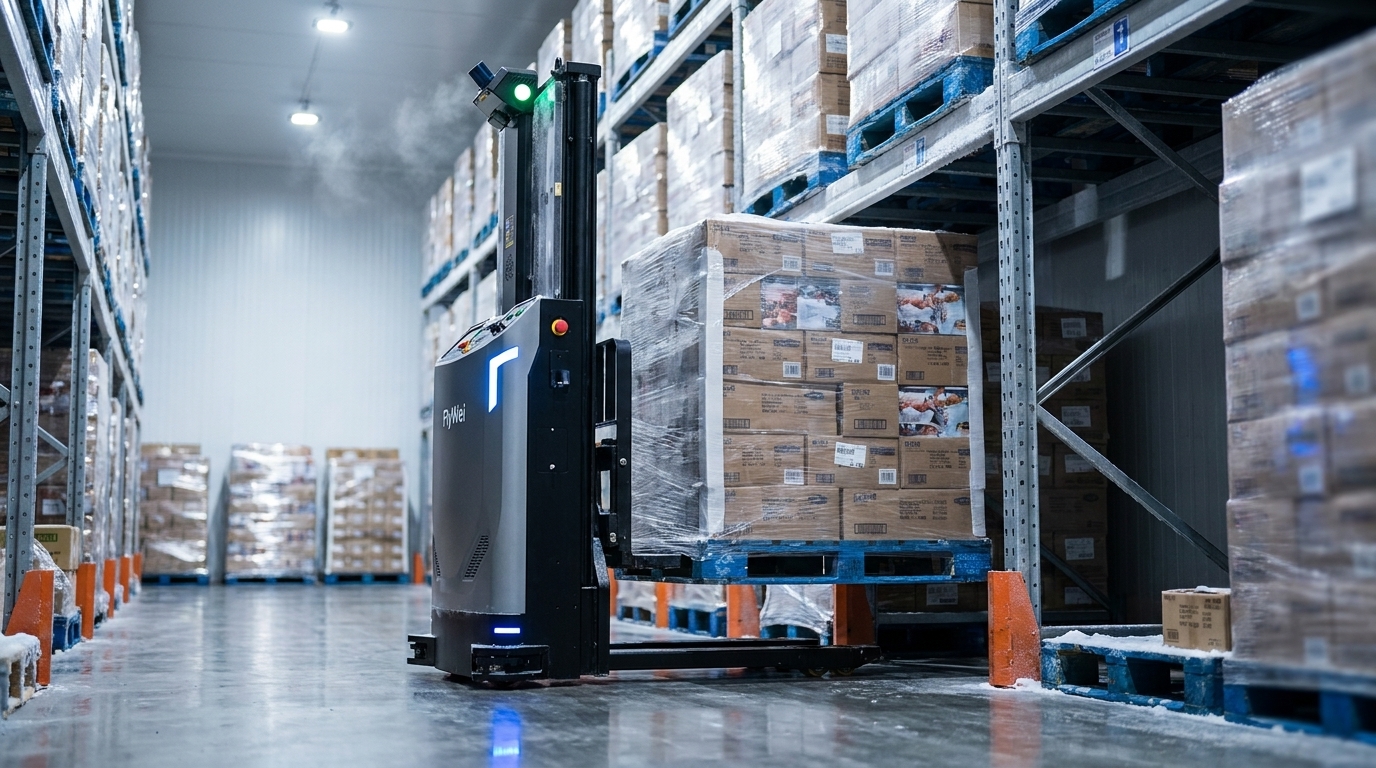
An autonomous pallet stacker is a driverless mast truck that lifts palletised loads into racking under software control, with no operator on board. In UK cold stores the machines, and the people working alongside them, sit under the Provision and Use of Work Equipment Regulations 1998, enforced by the Health and Safety Executive, while driverless truck behaviour is set by ISO 3691-4. For a warehouse manager running a chilled or frozen site above 100,000 sq ft, the practical case is narrower than the headlines suggest. Put-away stops every time a manual stacker operator comes out of the cold for a mandated warming break. Inbound pallets then queue on the dock, chilled stock sits outside its specified temperature band, and the aisle meant to absorb Q4 volume becomes the constraint. An autonomous pallet stacker is used chiefly to keep narrow-aisle put-away running through the warming breaks that cold-exposure rules force on manual operators.
Why cold-store put-away stalls
A chilled chamber held between 0°C and 4°C, or a frozen chamber at −18°C to −25°C, imposes a working pattern no amount of shift planning removes. Operators rotate out of the cold on a schedule, and they rotate out as a group when the chamber is coldest. That is a safety requirement, not slack in the roster, and the Health and Safety Executive treats workplace transport inside those chambers as a controlled activity in its own right.
The result is a put-away flow with structural holes in it. A narrow-aisle stacker nominally resourced for a full shift is available for a fraction of it, and the gaps land unevenly across the day. Goods-in does not pause to match. Pallets accumulate in the marshalling bay, usually the warmest part of a cold facility because it adjoins the dock doors, so the stock most at risk of drifting out of specification is exactly the stock waiting longest.
Three UK factors sharpen this. Labour for cold-store work is thin, and a site competing with the clusters at Magna Park, DIRFT, Daventry or Burton-on-Trent is chasing the same people as every ambient operator nearby. Narrow-aisle racking built to maximise cubic capacity leaves almost no room to work around a stalled truck, so one gap propagates down the aisle. And PUWER 1998 and LOLER 1998 duties apply in full at temperature, where routine inspections take longer.
An autonomous pallet stacker is used chiefly to keep narrow-aisle put-away running through the warming breaks that cold-exposure rules force on manual operators.
Lever one: move put-away off the break clock
The operational lever is to take the flow with the longest cold exposure and the least decision-making, dock-to-rack put-away, and run it driverless, keeping your team on work that needs judgement: goods-in checking, exception handling and despatch marshalling.
Scope it narrowly: one inbound lane, one block of racking, one shift pattern. Baseline the honest numbers first: time from trailer unload to pallet in location, marshalling queue depth at three fixed points in the day, and put-away moves completed per staffed hour rather than per rostered hour. Those three figures are what your capex committee will test, and they are the only defensible measure of whether an autonomous pallet stacker earned its place. Run the baseline before anyone quotes a payback period, because a payback built on rostered hours will not survive a live peak.
Lever two: orchestrate the aisle, do not just automate the truck
The technical lever is the layer above the machine. A driverless truck taking one task at a time is a slower manual truck. The gain comes from a fleet manager that knows which aisle is occupied, which pallet is due and what charge state each vehicle holds before a task is released.
In practice your warehouse system keeps holding stock and deciding what work exists, while a fleet layer converts each task into a route, a traffic rule and a vehicle assignment. M4 fleet manager handles allocation and traffic arbitration; FlyWei fleet dispatch software runs the task queue and the write-back, so completions post as stock movements rather than at a shift-end count. Where vehicles come from more than one manufacturer, the open VDA 5050 standard carries command and control in a common message format, which is what keeps a mixed fleet maintainable instead of a set of bespoke interfaces. Insist on seeing the interface specification, not just a demonstration.
Lever three: evidence the compliance case before go-live
The regulatory lever is the one most often left until the week before commissioning, and the one that delays sign-off. Driverless industrial trucks are work equipment, so duties under the Provision and Use of Work Equipment Regulations 1998 cover selection, suitability, inspection and operator information exactly as for a manned truck.
Build the evidence pack alongside the engineering. It needs the vehicle safety case against ISO 3691-4, including protective field behaviour at the speeds you will actually run; a pedestrian segregation drawing for every aisle the fleet enters, with barriered zones marked; the emergency-stop and recovery procedure, naming who may enter an aisle and under what isolation; the thorough-examination schedule under LOLER; and training records for the supervisors marshalling the fleet. Ask your integrator to deliver this as a named deliverable with an owner per item. A supplier who cannot say who writes the segregation drawing is telling you something useful.
Lever four: specify floor, frost and power at survey stage
The fourth lever is physical, and in cold chain it is decisive. Narrow-aisle driverless trucks are sensitive to floor flatness: a floor surveyed against TR34 tolerances behaves predictably at height, and one never surveyed does not. Measure it during the site survey rather than discovering a deflection at the fourth beam level during commissioning.
Condensation is the cold-store specific. Every transition between chamber and dock cycles moisture across sensor windows, scanning surfaces and connectors, so specify heated or purged enclosures, sealed connectors and a dwell pattern that avoids repeated rapid transitions. Then settle power: opportunity charging in a cold chamber behaves differently from ambient charging, and battery chemistry, charger placement and time spent out of the cold all belong in the design rather than improvised later. Floor, frost and power are where cold-store deployments quietly lose the availability the business case assumed.
| Lever | What it actually changes | Evidence to gather on your site | Standard or duty engaged |
|---|---|---|---|
| Driverless put-away on one lane | Removes break-driven holes from the put-away duty cycle | Dock-to-location time; marshalling queue depth at three fixed times; moves per staffed hour | PUWER 1998 selection and suitability |
| Fleet orchestration layer | Turns single-task automation into aisle-level throughput | Aisle occupancy conflicts per shift; task wait time; charge-state downtime | VDA 5050 command and control |
| Compliance evidence pack | Moves sign-off risk from the week before go-live to the design phase | Segregation drawings per aisle; recovery procedure; LOLER examination schedule | ISO 3691-4; LOLER 1998 |
| Floor, frost and power survey | Protects the availability figure the business case rests on | Floor flatness survey; condensation cycles per shift; charge window per vehicle | TR34 floor tolerances; BSI and ISO equipment standards |
What FlyWei does here
FlyWei is an independent UK systems integrator of autonomous forklifts and AMRs. FlyWei is vendor-neutral by design, specifying and integrating machines from multiple manufacturers rather than selling one maker's catalogue, which matters in cold chain, because the right stacker class for a 9-metre chilled narrow aisle rarely comes from the same source as the right counterbalanced truck for your yard.
For a chilled or frozen site FlyWei starts with the survey rather than the robot: floor flatness, aisle geometry, dock transitions, condensation cycles, and where your pedestrians actually walk as opposed to where the drawing says they do. FlyWei then specifies the stacker class against that survey, from the FlyWei autonomous pallet stacker range and the wider autonomous forklift line-up, and sizes the fleet against measured put-away demand rather than a nameplate figure.
Integration decides whether it holds. FlyWei delivers M4 for fleet traffic and allocation and fleet dispatch software for write-back, connecting to the warehouse system you already run so it stays the record of stock. Commissioning includes the compliance evidence pack above, with a named owner per item. Where capital is the constraint rather than the engineering, FlyWei supplies the same specification under 3, 5 and 7-year leasing terms. Our earlier piece on autonomous forklifts for cold storage goes deeper on temperature engineering, and our guide to autonomous forklifts covers the vehicle classes.
Frequently asked questions
What is an autonomous pallet stacker?
A driverless mast truck that lifts and places palletised loads into racking under software control, with no operator on board. A fleet management layer issues each move; the truck navigates, lifts and reports completion. It differs from a pallet truck, which moves loads at floor level, and from a counterbalanced forklift, built for yard and dock work rather than narrow aisles.
Can an autonomous pallet stacker work at −25°C?
Cold-rated configurations exist, but the temperature rating alone is not the test. What matters is how the vehicle handles transitions between chamber and dock, because repeated condensation cycling across sensor windows and connectors is what degrades availability. Specify heated or purged enclosures, sealed connectors and a defined dwell pattern.
Do we have to change our racking?
Usually not, provided aisle widths are consistent and the floor meets TR34 tolerances at the lift heights you need. The common remediation is the floor, not the racking.
Which UK regulations apply to driverless stackers?
Driverless trucks are work equipment, so PUWER 1998 applies to selection, suitability, inspection and information. Lifting duties fall under LOLER 1998. Vehicle behaviour, including protective fields and speed, is governed by ISO 3691-4. The Health and Safety Executive treats workplace transport as a controlled activity, so pedestrian segregation must be documented per aisle.
How does it connect to the warehouse system we already run?
Through a fleet layer rather than directly. Your existing system decides what work is needed and keeps holding stock. The fleet manager converts each task into a route, a traffic rule and a vehicle assignment, then writes completions and load confirmations back so balances update as pallets move. Replacing your warehouse system is rarely necessary.
What happens if a pedestrian walks into the aisle?
Protective fields slow and then stop the vehicle before contact, and the fleet layer holds any task routed into that aisle. That is the designed behaviour, not the plan. The plan is segregation: marked pedestrian zones, defined entry rules, and a recovery procedure naming who may enter an aisle and under what isolation.
Can we lease rather than buy?
Yes. The same specification is available over 3, 5 and 7-year terms, which moves spend from capital to operating budget and often unblocks a project that is engineering-ready but capex-constrained. Ask for integration, commissioning and support to be priced as visible line items rather than bundled into one monthly figure.
If cold-store put-away throughput is on your Q4 risk register, the fastest way to find out whether a driverless stacker fits your aisles is to have someone measure them.
Book a free 30-minute site survey and we will baseline your dock-to-location time, check aisle geometry and floor flatness, and tell you plainly whether put-away is the right first flow on your site. You can also see the vehicle classes and specifications on our autonomous forklifts page.
UK-based engineers. No obligation. We reply within one business day.