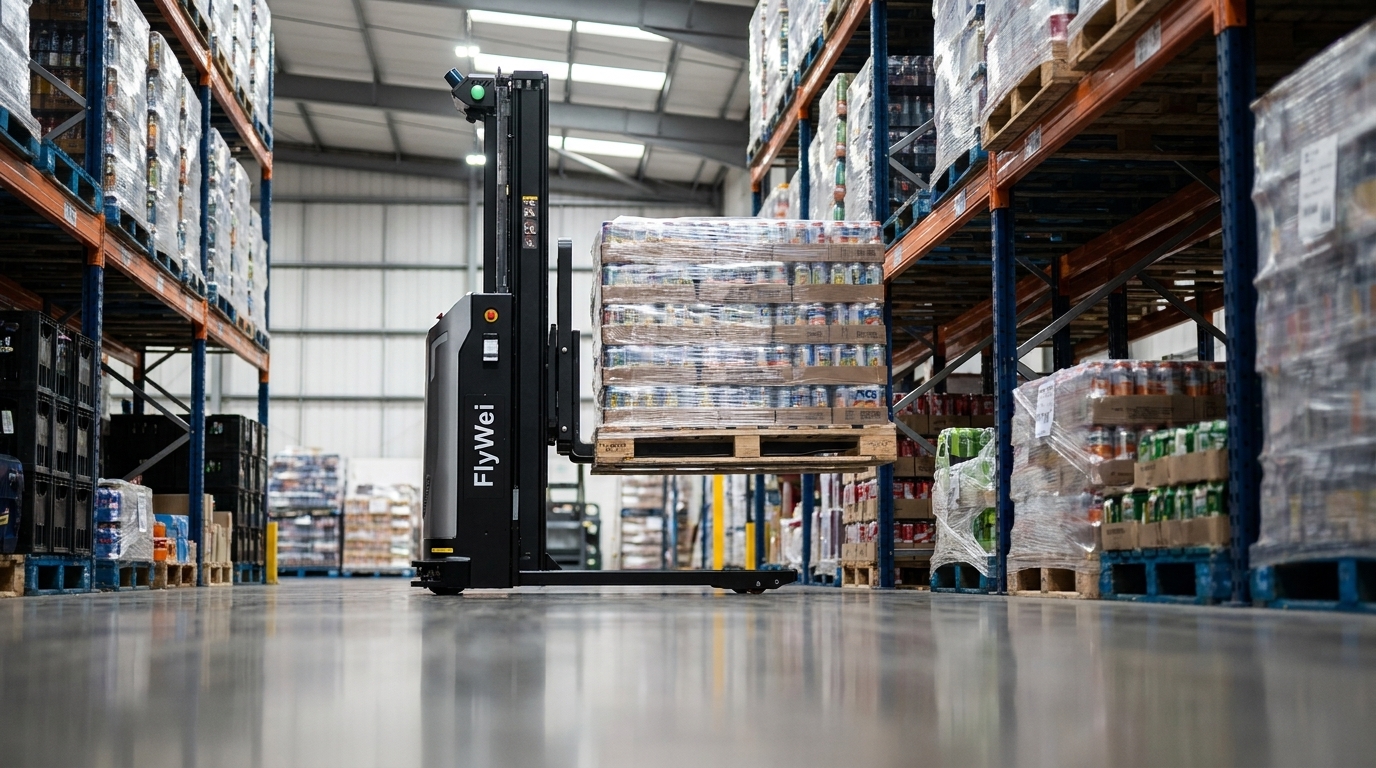
An autonomous pallet stacker is a driverless mast truck that lifts, carries and sets palletised loads into mid-height racking without an operator on board, navigating by on-board sensing rather than by wire or tape. Since 5 December 1998, Regulation 4 of the Provision and Use of Work Equipment Regulations 1998 has obliged every UK employer to make work equipment suitable for the place and conditions in which it is used, and that duty falls identically on manned and unmanned trucks. For a warehouse manager running a 100,000 sq ft drinks distribution centre around Burton-on-Trent or Daventry, the duty meets an awkward reality every peak. Replenishment into levels one and two is the most repeatable move on site and the one most often left to whoever is available: an agency driver on week two, a stacker with a bent fork carriage, and a pick face that runs dry at four in the afternoon.
Why mid-height replenishment breaks first in a drinks DC
Drinks logistics carries a load profile that punishes manual mid-height handling. Palletised glass, cans in shrink-wrapped trays and steel kegs are dense, top-heavy and unforgiving of a rushed set-down. A full pallet of bottled product concentrates a lot of mass over a small footprint, and the beam it lands on has no tolerance for a fork entering two degrees out. Meanwhile the demand curve is brutally seasonal: a summer heatwave, a bank holiday weekend and the December run all arrive with the same warehouse footprint and a larger share of temporary labour.
The second factor is who does the work. Replenishment is nobody's headline KPI. Despatch has a cut-off, goods-in has a booking slot, and the replenishment leg quietly absorbs whatever capacity is left — which during peak is the least experienced capacity on site. The Health and Safety Executive's workplace transport guidance is blunt about the pattern that follows: pressure, unfamiliar equipment and shared pedestrian routes are the conditions in which lift-truck incidents cluster.
The third factor is the building. Many UK drinks DCs are second- or third-generation occupancies at estates such as Magna Park, DIRFT and SEGRO East Midlands Gateway, where the slab was poured for a different racking pitch and a different truck. Localised floor deflection that a seated driver corrects without noticing becomes a measurable mast sway at six metres. None of this is a robot problem. It is a groundwork problem that automation exposes rather than creates, and it is why a survey should precede a specification.
Lever one — separate the repeatable leg before you size a fleet
The operational lever comes first because it is free. Split your internal moves into three buckets over one full week: fixed-route repeatable work, variable work that still follows rules, and genuine exception handling. In most drinks DCs the first bucket is dominated by pallet moves from the reserve block to pick-face levels one and two, on a small number of routes, at predictable trigger points.
Automate that bucket and nothing else in phase one. The temptation is to start with the loudest problem — trailer loading at cut-off — but that flow carries the most variability and the least tolerance for a slow first month. A driverless forklift running the replenishment leg overnight arrives at the morning shift with a full pick face and no overtime attached to it. That is a result you can show a general manager without a caveat, and it buys the credibility phase two needs. Measure the baseline before anything moves: replenishment moves per shift, pick-face stock-outs, and hours of manual stacker time. Without those three numbers from your own system, no later payback claim will survive your finance team.
Lever two — orchestration decides whether it survives peak
The technical lever is fleet orchestration, and it is where most projects are actually won or lost. A single autonomous pallet stacker moving pallets in an empty aisle is a demonstration. Six trucks sharing aisles with manual counterbalance trucks, pedestrians and a trailer-loading surge is an operation, and it needs a layer that arbitrates between them.
That is the job of a fleet manager such as FlyWei M4: it holds the site map, the traffic rules, the charging strategy and the task queue, and it issues orders to vehicles over the open VDA 5050 standard so that trucks of different types answer to one controller rather than to several disconnected consoles. Charging strategy deserves particular attention in drinks. Opportunity charging during the natural gaps between replenishment waves keeps a fleet available through a peak shift; a fleet that charges only when depleted hands you its lowest availability exactly when December needs its highest. Ask any supplier to show how the fleet behaves when the network drops mid-task.
Lever three — connect it to the system you already run
The integration lever keeps your existing record of stock intact. Autonomous trucks do not talk to a business system directly; a dispatch layer such as FlyWei RDS sits between them, takes work from your existing ERP and warehouse system over a documented interface, turns it into robot missions, and writes completions and load confirmations back. Your enterprise WMS stays the source of truth, and a replenishment move posts as a stock movement when the pallet lands rather than at a shift-end count.
The practical constraint is data quality, not connectivity. Locations must be uniquely identified, stock balances must be trusted, and exception paths must be agreed in writing before go-live: what happens when a target location is already occupied, when a pallet is out of profile, when a load is refused. Sites that automate on top of unreliable master data multiply their errors rather than remove them. If your warehouse system cannot expose open work through an interface, a scheduled export and import of confirmations is a legitimate starting point and avoids modifying the core system.
Lever four — the regulatory duties that do not transfer
The regulatory lever is the one procurement forgets and the HSE does not. Taking the driver off the truck does not move a duty holder. Under PUWER, suitability, maintenance and inspection remain with the employer, and the HSE guidance on work equipment sets out what that means in practice. Lifting operations bring LOLER duties alongside. The relevant product standard is ISO 3691-4, the international safety standard for driverless industrial trucks and their systems, published through ISO and adopted in the UK through BSI; ask for the conformity file and the UKCA route, not a verbal assurance.
Then survey the ground. Floor flatness to the Concrete Society TR34 classifications governs how confidently a mast places a load at height, and racking condition governs whether the beam will accept it. Commission a flatness survey and a racking inspection during scoping, not after commissioning, and treat any remediation as a line in the project rather than a surprise. Trade guidance from bodies such as Logistics UK is a reasonable place to start on the operational duties that sit around this.
An autonomous pallet stacker is a driverless mast truck that sets palletised loads into mid-height racking, and PUWER duties apply to it identically to a manned truck.
| Approach | Best-fit flow | Operational trade-off | Duty engaged before sign-off |
|---|---|---|---|
| Manual stacker, permanent operators | Variable work, frequent exceptions | Availability tracks recruitment; quality varies with tenure | PUWER inspection and operator competence records |
| Manual stacker, agency cover at peak | Short seasonal surges only | Fastest to deploy, weakest on consistency | PUWER familiarisation and site induction per worker |
| Autonomous pallet stacker on fixed routes | Reserve block to pick-face levels one and two | Consistent cycle every shift; needs flat floor and clean data | PUWER, ISO 3691-4 conformity, TR34 flatness survey |
| Mixed fleet under one orchestration layer | Replenishment plus dock-to-stock at volume | Highest throughput ceiling; needs central traffic rules | All of the above plus documented pedestrian interaction |
What FlyWei does here
FlyWei is an independent, vendor-neutral UK systems integrator of autonomous forklifts and AMRs. We are not tied to one manufacturer, so the specification for a drinks DC starts with your flow rather than with a catalogue. In practice that means FlyWei surveys the site first — routes, floor, racking, aisle widths, pedestrian interfaces and the seasonal load profile — and then designs a fleet around the replenishment leg you actually run.
For mid-height work in drinks, FlyWei typically integrates a FlyWei autonomous pallet stacker from its range of autonomous forklifts for the reserve-to-pick-face moves, with an automated forklift of counterbalance class where dock-to-stock volume justifies it. FlyWei M4 holds the fleet: one map, one set of traffic rules, one charging strategy, VDA 5050 orders to every vehicle. FlyWei RDS carries the work from your existing ERP and warehouse system and returns confirmations, so stock updates as pallets move.
FlyWei delivers the commissioning, the safety file and the UK-based engineering support behind it, and can structure the fleet through FlyWei leasing over three, five or seven-year terms where capex is the constraint rather than the case. Sector-specific configurations sit under FlyWei solutions, and heavier sub-assembly and cart-shuttling work is handled by FlyWei lifting robots. Related reading: our retail DC replenishment guide and a drinks peak-season fleet piece.
Frequently asked questions
What is an autonomous pallet stacker?
A driverless mast truck that lifts, carries and places palletised loads into mid-height racking without an operator on board. It navigates by on-board sensing rather than by wire or tape, and takes its work from a fleet management layer.
How does it differ from a driverless forklift or an AGV forklift?
The terms overlap. An AGV forklift historically followed a fixed guide path, while a modern driverless forklift maps its environment. The distinction that matters is the mast: a stacker suits mid-height racking, a counterbalance truck suits ground-level and trailer work.
Do PUWER duties still apply if there is no driver?
Yes, and they do not transfer to the supplier. The employer remains responsible for suitability, maintenance and inspection of the work equipment. Add LOLER duties for the lifting operation, and confirm conformity against ISO 3691-4 before the truck enters service.
Does our floor need to be resurfaced?
Often not, but it must be measured. Localised deflection that a seated driver corrects instinctively shows up as mast sway on an unmanned truck. Commission a TR34 flatness survey and a racking inspection during scoping, not after commissioning.
Will we have to replace our warehouse system?
Usually not. A dispatch layer sits above your existing ERP and warehouse system, takes open work from it and writes completions back, so that system stays the record of stock. Replacement is only worth considering where it cannot expose work at all.
What happens during a December peak if the network drops?
A well-designed fleet degrades rather than stops. Trucks finish the task already issued and then hold safely, while the fleet manager queues completions and replays them on reconnection. Ask what prevents a duplicate stock posting when the link returns.
If pick-face stock-outs and agency cover on the replenishment leg are on your Q3 risk register, the fastest way to find out whether automation fits is to have someone walk the routes with you.
Book a free 30-minute site survey and we will assess your replenishment flows, floor flatness and racking condition against what an autonomous pallet stacker can realistically take on.
UK-based engineers. No obligation. We reply within one business day.