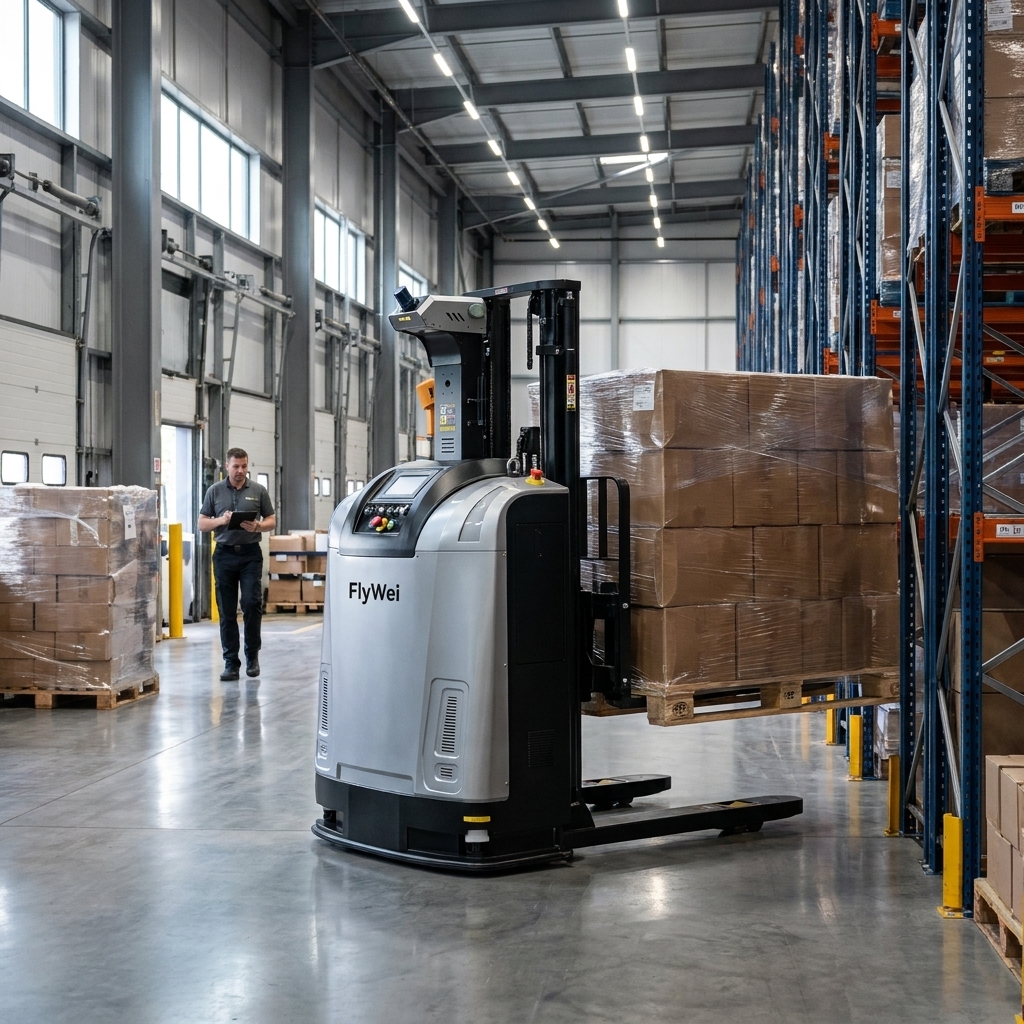
Robotic pallet truck safety near staff in a UK warehouse is achievable, and routinely achieved, provided three conditions hold. Being struck by a moving vehicle killed 24 workers in Great Britain in 2025/26, the largest single category of fatal workplace accident recorded by the Health and Safety Executive, so the question deserves a precise answer. A robotic pallet truck can work safely alongside staff when safety-rated scanners slow or stop it near people, the same PUWER duties that apply to a manually driven truck are met, and the installation is validated against the real site layout before it runs unsupervised. For a plant director running an engineering parts store, the pain this quarter is concrete: shift changeover drops fitters, stores operatives and visiting contractors into the same aisles as pallet movement, and one near miss recorded in a Q4 audit can stall an automation case for a year.
Why mixed traffic is the hard part, not the robot
Most UK engineering parts stores were laid out for people first and trucks second. Aisles follow racking economics, crossing points grew where doors happened to be, and the goods-in apron doubles as a contractor route. Into that, a plant director must introduce a machine running the same route hundreds of times a shift, with no driver making eye contact.
The risk is not that the truck fails to see a person. A safety-rated laser scanner detects a leg at floor height reliably, and is tested to do so. The risk is that the layout makes the truck meet people so often that the scanner does safety work the design should have done. A truck that stops constantly is safe and useless. A truck that rarely meets a pedestrian is safe and productive.
The Health and Safety Executive is explicit that the first control is separation, not detection. Its guidance on separating pedestrians and vehicles asks for separate routes wherever reasonable, marked and signposted crossings with clear sight lines, barriers and raised kerbs, and restrictions on route use at predictable peaks such as shift changeover. The same page carries a specific duty for driverless vehicles: fit safeguards so the vehicle cannot trap a pedestrian, keep adequate clearance, and remove fixtures that could create a trapping hazard.
That last clause is where engineering sites tend to fail an audit. Clearance that suits a driver who can judge a gap does not suit a truck running a fixed path past stillages, cantilever rack ends and pallet overhang, because a trapping point only has to exist once.
Lever one, operational: design the traffic plan before the truck arrives
Walk the flow and mark every point where the robot path crosses a pedestrian desire line, then remove the crossings you can and formalise the ones you cannot. In a parts store that usually means pulling the stores operative walkway off the goods-in apron, putting a marked crossing with a mirror or a sight line at the one remaining intersection, and barriering the rack ends the truck turns around. Then handle time as well as space. If changeover pushes a crowd through one door for a few minutes, the answer is often to hold robot movement on that route for those minutes rather than to engineer the door. Fleet software can enforce that as a schedule, which makes it auditable rather than dependent on a supervisor remembering.
Finish by naming a duty holder for the traffic plan. Layouts drift: a stillage parked in a crossing undoes a month of design work, and the only reliable control is someone whose job it is to notice it.
Lever two, technical: safety-rated sensing and graded speed zones
A robotic pallet truck does not have one stopping behaviour, it has several, mapped to zones. The safety-rated scanner carries a warning field and a protective field. Entering the warning field slows the truck and sounds the audible warning, entering the protective field triggers a safety stop. Those fields switch by speed and location, so the truck runs a long protective field down an open aisle and a short one in a tight turn.
Specify three things. First, the fields are configured per zone against your layout, not left at factory defaults. Second, the stop is a safety function in the control system, not a software convenience, so it behaves correctly if the navigation computer hangs. Third, the human-facing signals are set for your floor: light tower states that your staff can read at distance, and an audible level that carries over compressor and machine-shop noise without becoming the alarm everyone ignores. Our guide to vision guided and laser guided forklifts covers how the navigation choice changes what the sensing stack has to do.
Lever three, technical: one traffic plan across the whole fleet
Safety near staff degrades fastest when two robots meet in the same place as a person. Two trucks negotiating a junction take longer to clear it, and a truck waiting in a crossing is parked in the one place you did not want it. The control is a single traffic manager owning right of way, junction reservations and deadlock resolution for every machine on the map.
That is the job of a fleet manager such as the M4 fleet management software, which dispatches work over the VDA 5050 interface. VDA 5050 is an open standard, so a mixed fleet can share one map and one traffic plan rather than running two uncoordinated systems in the same aisles. The practical safety gain is that pedestrian zones, no-go areas and changeover holds are defined once, centrally, and applied to every robot, including ones added in a later phase.
Lever four, regulatory: build the PUWER and ISO 3691-4 evidence pack
A robotic pallet truck is work equipment. The Provision and Use of Work Equipment Regulations 1998 apply in full, and Part III of the regulations as made deals specifically with mobile work equipment. So your pack needs the same documents as a manual truck fleet, plus the ones autonomy adds: a risk assessment covering mixed traffic, the safety validation records for the scanner fields as configured on your site, the UKCA or CE conformity evidence for the machine, a planned inspection and maintenance regime, and training records for the staff who work near it and the people authorised to recover it.
Two additions catch sites out. Where the truck lifts, LOLER thorough examination applies to the lifting function. And the general duty on workplace transport does not pass to the supplier when the driver is removed, so the operator stays the duty holder. We cover verification in how safety is validated for AI powered warehouse robots.
| Control measure | What it changes on the floor | Duty or standard it supports | Evidence you can audit |
|---|---|---|---|
| Route separation and barriers | Robot path and pedestrian routes stop overlapping | HSE workplace transport site safety | Marked layout drawing, walkway survey |
| Marked crossings with sight lines | Interactions happen at one predictable point | HSE separating pedestrians and vehicles | Crossing register, sight line check |
| Graded warning and protective fields | Truck slows then stops as a person approaches | ISO 3691-4 driverless truck safety | Per-zone field configuration record |
| Clearance and trapping point survey | No fixture can pinch a person against the truck | HSE driverless vehicle safeguards | Signed clearance survey per route |
| Centralised traffic plan and zone holds | Robots never queue inside a crossing | Risk assessment control, PUWER | Fleet manager zone and schedule config |
| Inspection, maintenance and training | Safety functions stay proven across fleet life | PUWER, and LOLER where the truck lifts | Service records, competence matrix |
A robotic pallet truck can work safely alongside staff when safety-rated scanners slow or stop it near people, the same PUWER duties that apply to a manually driven truck are met, and the installation is validated against the real site layout before it runs unsupervised.
What FlyWei does here
FlyWei Robotics, the UK partner of SEER Robotics, supplies, installs, integrates and supports autonomous forklifts, AMRs and lifting robots across the UK, and connects them to the WMS or ERP a site already runs. For an engineering parts store the work starts with a site survey rather than a machine: walking the flow, marking the crossings, measuring clearance at rack ends and stillage lines, and agreeing which movements should be automated first and which should stay manual.
From that survey FlyWei specifies the right class of autonomous forklift or robotic pallet truck for the load, lift height and aisle, configures the warning and protective fields zone by zone against your layout, and sets up the M4 fleet manager so pedestrian zones, no-go areas and shift changeover holds are enforced centrally. Dispatch is wired into your existing systems through the robot dispatch software, so the traffic plan and the work queue stay in step.
After handover, maintenance keeps the safety functions proven. FlyWei diagnoses most faults remotely through the M4 fleet manager and arranges an engineer visit when hardware needs attention, with genuine SEER Robotics parts. Details of what is covered sit on the robot servicing and support page, and maintenance is included in leasing and hire agreements.
Frequently asked questions
Does a robotic pallet truck need a safety fence or a cage?
No. A driverless industrial truck is built to run in shared space using safety-rated scanners, so the control is detection plus separation, not a physical enclosure. Fencing is normally reserved for fixed automation such as a wrapping or palletising cell the truck feeds.
What happens if a person steps out in front of it?
The warning field slows the truck and sounds the audible and visual warning, and the protective field triggers a safety stop before contact. Stopping distance is why the fields are switched by speed and configured against your real aisle widths rather than left at defaults.
Is a banksman or supervisor needed while it runs?
Not once the installation has been validated and signed off. Supervision is normally required during commissioning and the initial supervised running period, which is when the traffic plan is tested against real shift behaviour rather than the drawing.
Who is the duty holder, FlyWei or the operator?
The site operator remains the duty holder under PUWER and the workplace transport duties, exactly as with a manual fleet. FlyWei supplies the conformity evidence, the configuration records and the maintenance regime that let the operator discharge those duties.
Does LOLER apply to a robotic pallet truck?
Where the truck lifts a load, the lifting function falls within LOLER and needs thorough examination at the required interval. A low-lift pallet mover and a stacker are treated differently here, so confirm the classification for the specific machine during the survey.
Can it work during shift changeover?
It can, but on many engineering sites the better answer is a timed hold on the affected routes while foot traffic peaks. A fleet manager enforces that as a schedule, which is auditable and does not rely on anyone remembering.
If mixed foot and truck traffic in the parts store is on your Q4 risk register, the fastest way to size it is to look at one flow, not the whole site.
Get a 48-hour feasibility read on your highest-volume flow and we will come back with the traffic plan questions that decide whether that route can be automated safely. Or browse the autonomous forklift and robotic pallet truck range.
No obligation, and we reply within one business day.