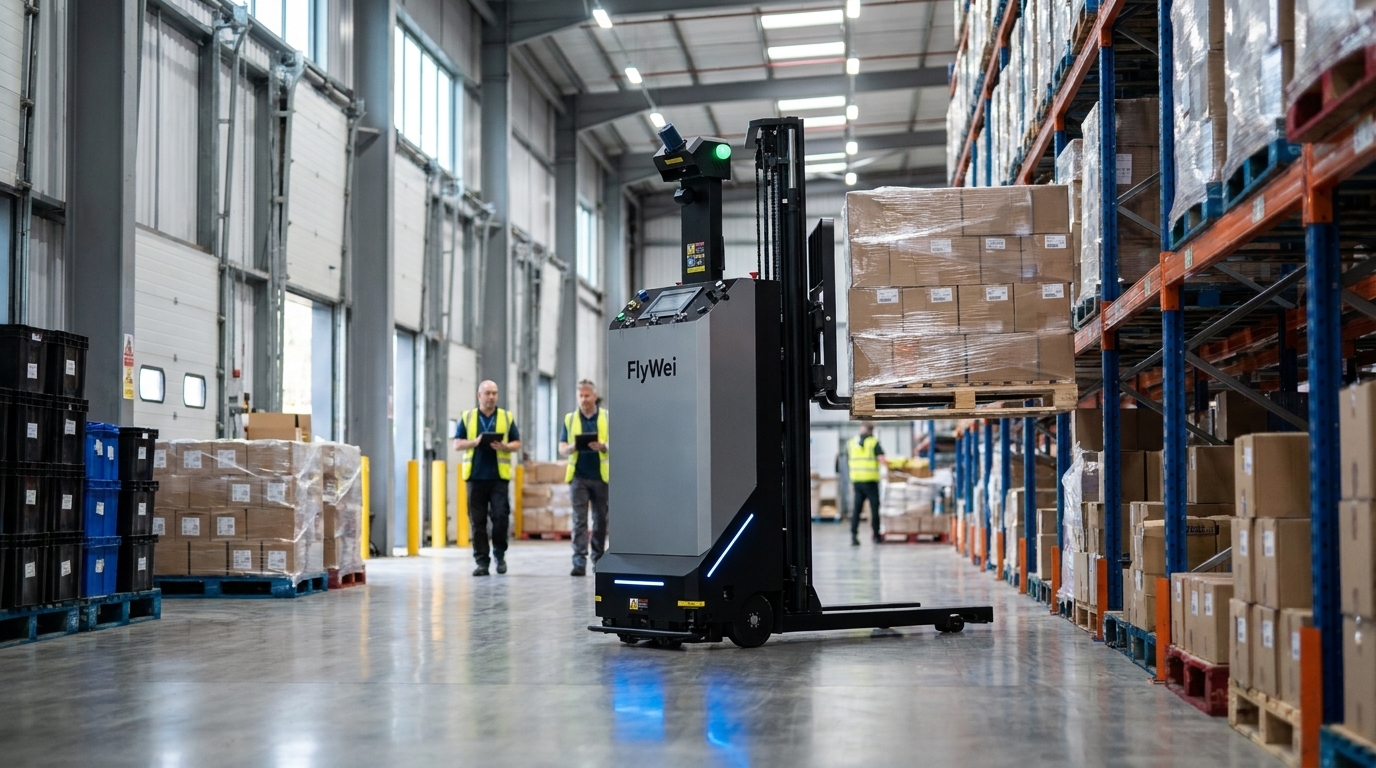
Safety validation for AI-powered warehouse robots is the formal process of proving that a machine's protective functions stop it safely, assessed against published functional-safety standards rather than against claims made for its navigation software. The Health and Safety Executive recorded 126 workers killed in work-related accidents across Great Britain in 2025/26 (HSE statistics), and vehicles striking people remains one of the recurring causes. For a plant director in drinks logistics, that figure is the backdrop to a specific sign-off. Palletised cases and kegs move between a packing hall and a high-bay store on a route shared with forklift drivers, line operators and visiting hauliers. The supplier's deck describes an AI perception stack. What a safety file needs is the standard applied, the certified safety controller, the performance level of each protective function and the residual risks left to the site.
Why safety validation gets confused with AI capability
Two different engineering disciplines have been collapsed into one sales conversation. Autonomy software decides where a truck should go and how it should get there. Functional safety decides what happens when something unexpected enters the aisle, and it is built to carry on working precisely when the clever layer is wrong. Buyers hear a single word, robot, and reasonably assume one supplier answer covers both.
The market has encouraged the confusion. Advances in machine perception are genuinely significant, so vendor material leads with them, and a procurement team finds detection accuracy percentages where it expected certification references. A perception model that is right almost all of the time is a performance claim. A safety function is a guarantee about the worst case, verified by a method a third party can repeat.
Warehouse environments make the gap concrete. HSE guidance on workplace transport is built around separating people from vehicles and controlling where that separation breaks down: dock edges, blind corners, crossings and the yard. In a drinks operation those pinch points are busy and seasonal. A Burton-on-Trent packing hall running extra shifts before a peak has agency staff who have not walked the route, trailer curtains blocking sightlines and condensation changing stopping distances.
Under the Provision and Use of Work Equipment Regulations 1998, the duty sits with the employer operating the equipment, not with the company that built it. That is why validation evidence matters commercially as well as technically: the plant director signs the risk assessment, and the evidence pack makes that signature defensible.
Lever one: split the tender into an autonomy question and a safety question
Write two separate sections into the specification and score them separately. The autonomy section asks how the truck navigates, how it recovers from a blocked route, how it handles a pallet that is out of position and how missions are prioritised. The safety section asks a different set of questions entirely, and none of them mention AI.
For each protective function, ask what standard it is designed to, what its performance level or safety integrity level is, what component implements it, and how it is proved. Obstacle detection, emergency stop, speed limitation in defined zones, load-height interlocks and behaviour on loss of power or communications each deserve their own line. Ask what the truck does when the navigation software stops responding, and expect a controlled stop that does not depend on that software.
Scoring the sections separately prevents a common failure: a strong autonomy demonstration quietly earning marks for safety. Separating them forces the supplier to produce documents rather than a demonstration, and documents are what the file needs.
Lever two: require a rated safety controller independent of the autonomy stack
The technical answer to "how is this validated" is usually a specific piece of hardware. Safety functions on a driverless truck run on a safety-rated controller, with safety-rated laser scanners feeding protective fields that trigger a slowdown or a stop regardless of what the navigation layer intends. This is the layer that should carry the certification, so ask for the controller part number and its rating rather than a general assurance. FlyWei publishes the range it supplies on its AMR and AGV robot controllers page, including functional-safety variants intended for autonomous forklift applications.
Fleet orchestration sits above all of this and should not be confused with it. A fleet manager allocates missions, sequences traffic at intersections, manages charging and holds the map. FlyWei supplies SEER's M4 fleet manager for that role, and M4 communicates with vehicles over the open VDA 5050 standard. Traffic management reduces encounters between a truck and a person, but it is a risk-reduction measure rather than a protective function. If the network drops, the safety scanners still stop the truck. Ask a supplier to state plainly which behaviours survive a loss of the fleet connection, and make that answer part of the written scope.
Lever three: validate against the standards, and keep the evidence
The governing reference for this class of machine is BS EN ISO 3691-4, the standard for driverless industrial trucks and their systems, published internationally as ISO 3691-4 and adopted in the UK through BSI. It sets requirements for the vehicle, the automated area and verification, covering things a datasheet never mentions: how the operating zone is defined, how manual intervention is handled, and what must be re-verified after a layout change.
Around it sit the duties you already know. PUWER requires work equipment to be suitable, maintained and inspected, with inspection by a competent person where safety depends on installation conditions. Where the truck lifts a load that could fail and injure someone, LOLER thorough examination also applies, which we cover in whether an autonomous forklift needs a LOLER examination. UKCA or CE marking and a declaration of conformity should name the standards applied. Logistics UK and BSI material is useful supporting reading for a board paper, but the declaration and the validation report carry the weight.
Keep the pack as a living file. New racking, a changed pedestrian route or a different pallet pattern can invalidate the original assessment, and the standard expects re-verification rather than a one-off sign-off.
Lever four: prove it on your floor, at your duty cycle
Factory validation establishes that the machine type is safe. Site acceptance testing establishes that this fleet is safe in your building. Test the protective fields at the speeds the trucks will actually run, loaded to the profile you actually handle. Kegs and palletised glass behave differently from empty pallets, and stopping distance is a function of load.
Run the conditions you would rather not think about: a pedestrian stepping out from behind a trailer, a pallet overhanging into the aisle, a mixed shift where manual and automated trucks share a route. Record each result against the protective function it exercises, and keep it with the declaration of conformity.
Finally, write the traffic management plan before go-live. It names the automated zones, the crossing points, the manual intervention procedure and who may use it. Inspectors and insurers ask for it, and supervisors need it on day one.
| What a supplier often says | What to ask for instead | What good evidence looks like |
|---|---|---|
| Our AI detects obstacles with high accuracy | Which safety function stops the truck, and to what standard | Named protective function with its performance level, on a rated safety controller |
| The platform is certified | Certified to what, by whom, covering which configuration | Declaration of conformity listing BS EN ISO 3691-4 and the configuration assessed |
| Proven in thousands of installations | Validation evidence for our layout and duty cycle | Site acceptance test record against each protective function, signed and dated |
| Safety is handled in the software | What happens when the fleet connection is lost | Architecture showing scanners and controller acting without the autonomy layer |
Safety validation for AI-powered warehouse robots is assessed against published functional-safety standards rather than against claims made for the navigation software.
What FlyWei does here
FlyWei, the UK partner of SEER Robotics, supplies, installs, leases and supports autonomous forklifts and AMRs, and connects them to the stock system a site already runs. FlyWei is a systems integrator and integrator rather than the manufacturer, which shapes what a plant director receives at handover: the machine classes and rated capacities, the declaration of conformity and the standards applied, the controller specification including its functional-safety rating, and the site layout showing automated routes and pedestrian separation.
For a drinks operation, the practical work starts with the flow rather than the fleet. FlyWei scopes which legs go first, typically the repetitive trunking move between the packing hall and the high-bay store, and which stay manual because they involve variable pallet quality or third-party trailers. Counterbalanced trucks from the autonomous forklift range handle the palletised case and keg moves, reach trucks serve the high bay, and the fleet runs under M4 with traffic rules set for the crossing points your layout actually has.
The validation work is then concrete. Protective fields are configured for the real speeds and loads, site acceptance tests are run against each safety function, and the records are handed over as a pack rather than scattered across emails.
Frequently asked questions
Is an AI-powered warehouse robot safer than a conventional AGV?
Not automatically. Better perception reduces how often a truck meets an unexpected obstacle, but safety is judged on the worst case. A machine with a strong AI stack and a weak protective architecture validates worse than a simpler certified truck.
What standard covers autonomous forklift safety in the UK?
BS EN ISO 3691-4, for driverless industrial trucks and their systems, is the governing reference. It sits alongside PUWER duties on the employer, LOLER where lifting applies, and UKCA or CE marking with a declaration of conformity.
Who is legally responsible for safety once the robots are running?
The employer operating the equipment holds the duty under PUWER, whatever the supplier contributed. The manufacturer is responsible for the machine conforming as supplied. Insist that validation evidence is handed over rather than referenced.
Can a third-party AI safety platform replace functional-safety certification?
No. Such platforms can add monitoring, analytics or simulation value, but none substitutes for a rated protective architecture assessed against the standard. Treat one as an addition to the safety case, never as the safety case.
How often does validation need repeating?
Whenever the assumptions change. New racking, an altered pedestrian route, a different pallet pattern, a change in operating speed or a software release affecting a safety function all trigger re-verification. Agree the trigger list in the contract.
What should we test during site acceptance?
Each protective function at the real duty cycle: stopping distance loaded and unloaded at operating speed, protective field response at crossings and blind corners, emergency stop, behaviour on loss of power and of the fleet connection, and the manual intervention procedure.
Does the fleet manager form part of the safety system?
It reduces risk rather than providing protection. Traffic rules, zone control and mission sequencing lower the number of encounters between trucks and people. The stop itself must come from safety-rated scanners and a controller acting independently.
If proving the safety case for automated trucks is on your Q4 risk register, the fastest way to find the evidence gaps is to look at one flow in detail.
Get a 48-hour feasibility read on your highest-volume flow and we will tell you which protective functions it needs, what validation evidence to require from a supplier, and whether autonomous forklifts suit it at all.
No obligation, and we reply within one business day.