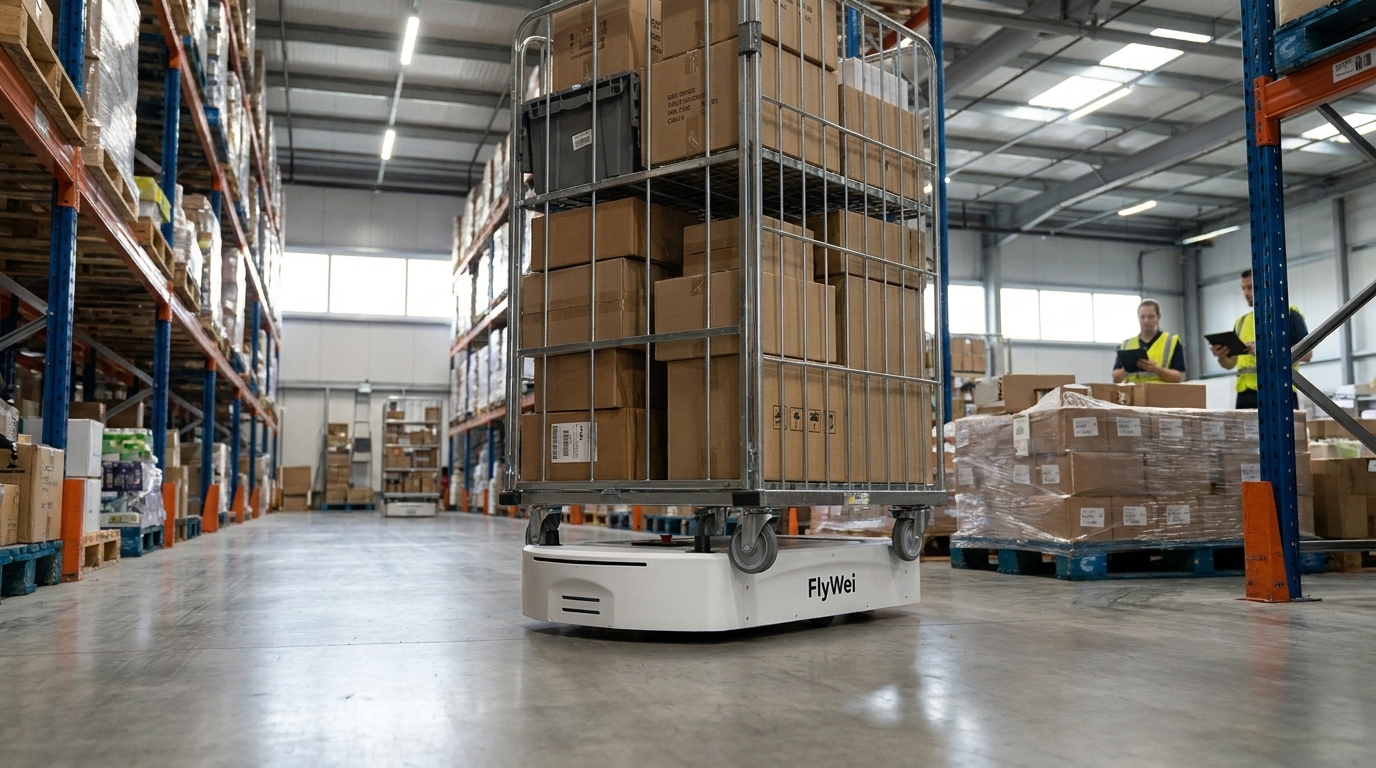
AMRs are mobile robots that navigate an existing pallet racking layout by SLAM mapping, planning routes inside the aisle widths already in place. That matters because warehouse traffic remains dangerous work: of the 126 workers killed in Great Britain in 2025/26, 24 were struck by a moving vehicle, according to provisional HSE figures. For a warehouse manager running an e-commerce fulfilment centre through peak, the worry is rarely the robot. It is the rebuild. The racking was signed off, load-tested and filled years ago, and taking beams down in November is not an option. Most warehouses can add AMRs to an existing pallet racking layout without moving a single beam, because the robot maps the aisles it is given rather than demanding aisles built to suit it. The exceptions are narrow and knowable in advance: very narrow aisle racking, worn floors, and mixed pedestrian traffic at the pick face.
Why racking gets blamed for a problem the floor is causing
Ask a warehouse manager what stands between their site and a working robot fleet and the answer is usually the racking. It is the most visible and least movable thing in the building, so it absorbs the blame. It is seldom the limiting factor. A modern autonomous mobile robot builds its own map of the aisle using laser scanners and odometry, then localises against that map every time it runs. It does not need floor magnets, wire guidance or reflective targets fixed to the uprights, which is what earlier guided vehicles demanded and what most people picture when they imagine a layout change.
What causes trouble is everything around the racking. Clear width at the tightest point in a route governs whether a robot can pass, and that point is rarely the aisle itself. It is the dock approach, the corner into the pick face, the gap left by a pallet overhanging its beam, or the stillage parked in a cross aisle last Tuesday. Floor condition matters for the same reason: a robot lifting a load to height is sensitive to slab flatness and joint condition in a way a driver simply absorbs. UK slabs are specified against the Concrete Society TR34 flatness classes, and knowing which class your floor was built to predicts success far better than the racking type does.
Mixed pedestrian and vehicle movement at the pick face is the hardest condition to automate safely and the one where automation does most good. Employers already owe duties here under the Provision and Use of Work Equipment Regulations 1998 and the wider workplace transport guidance HSE publishes in HSG76, Warehousing and storage. A project that treats those duties as its starting point tends to land. One that treats them as end-stage paperwork tends to slip.
Lever 1: survey the route, not the rack drawing
The first practical move is to stop measuring the racking and start measuring the route. Walk the path a pallet takes from goods-in to the pick face to despatch, recording clear width at every pinch point with a tape rather than from the drawing. Note the corners, dock levellers, ramp gradients and places where pallets habitually overhang, record sprinkler heights where a lifted load will pass beneath, and photograph the floor joints along the route. The exercise takes a morning and answers most of the questions a supplier would otherwise answer with assumptions. It also produces housekeeping fixes that make the manual operation safer before any robot arrives. Sites that survey first rarely find a racking problem. They find a cross-aisle used as overflow storage, which is a far easier conversation.
Lever 2: let the fleet manager hold the map and the traffic rules
The technical lever is to keep the layout logic in one place rather than letting each robot hold a private idea of the building. A fleet manager such as SEER's M4 platform holds the site map, the one-way rules, the priority at junctions, the no-go zones around the pick face and the charging strategy, and issues every mission from that single source. When the layout changes, and in an e-commerce fulfilment centre it changes every peak, you edit the map once instead of reconfiguring each machine. Open standards earn their keep here: the M4 fleet manager speaks VDA 5050, an open standard for messages between a fleet controller and mobile robots, so a site is not locked into one communication scheme. Pair that with a connection into the systems the site already runs, so robots take work from your existing warehouse system rather than asking the team to key tasks twice. The robot dispatch software handles that translation layer.
Lever 3: prove the layout under PUWER and ISO 3691-4 before peak
The regulatory lever is a risk assessment of the layout, not just the machine. Driverless industrial trucks are covered by ISO 3691-4, and the equipment falls under PUWER, which requires work equipment to suit the place it is used. Read together the obligation is clear: the site defines the safe operating envelope, so the site must be assessed. In an existing racking layout that means agreeing where the robot slows, where it stops, where people may walk and where they may not, and how a blocked aisle is cleared. Document the pedestrian segregation at the pick face, the signage, the floor markings and the emergency stop arrangements. Do it well before peak, because the assessment usually produces three or four small physical changes and each needs a slot in a schedule that December will not give you.
Lever 4: treat very narrow aisle as a robot choice, not a rebuild
If the site genuinely runs very narrow aisle racking, the answer is still not a new layout but a different machine. Very narrow aisle work is a recognised automation case with its own guidance, covered in the FlyWei guide to VNA automation in the UK, and the options are a narrower-footprint robot, guided running inside the aisle with free navigation outside it, or restricting the robot to the transfer aisles while people work the VNA face. Each keeps the racking exactly where it is. The same logic applies to high bay racking, where lift height rather than width is the constraint, and to drive-in racking, where entry tolerance is the limit. In every case, ask a supplier which machine in the range fits the aisle you have and what it gives up to fit. A supplier who answers that with a layout change has answered the wrong question.
| Existing layout | What usually limits the robot | Typical change to the racking | KPI to watch after go-live |
|---|---|---|---|
| Wide aisle, adjustable pallet racking | Pallet overhang and cross-aisle clutter | None | Blocked-route exceptions per shift |
| Narrow aisle, 2.5m to 3m clear | Clear width at the corner, not in the aisle | None, corner markings only | Mean time per pallet move |
| Very narrow aisle, under 2m | Robot footprint and in-aisle guidance | None, change the machine class | Aisle throughput versus manned baseline |
| High bay above 8m | Lift height and mast stability | None, check slab flatness class | Deposit accuracy at top beam level |
| Drive-in or push-back | Entry tolerance and lane alignment | Lane entry guides may help | First-pass entry success rate |
| Mezzanine pick face | Lift access and floor loading | None, verify loading with the designer | Pedestrian interactions logged per week |
Most warehouses can add AMRs to an existing pallet racking layout without moving a single beam, because the robot maps the aisles it is given rather than demanding aisles built to suit it.
What FlyWei does here
FlyWei, the UK partner of SEER Robotics, supplies, installs and supports autonomous forklifts, AMRs and lifting robots for an existing pallet racking layout across the UK, and connects them to the warehouse system a site already runs. The starting point on an e-commerce site is the route survey described above, done with your team rather than sent as a questionnaire. From it we say plainly which machine class fits the aisles you have: a latent-jacking AMR running under cage trolleys at the pick face, a pallet-truck class for dock-to-stock moves, or a narrow-aisle autonomous reach truck where height is the constraint.
The fleet runs under the M4 fleet manager, which holds the map, the traffic rules and the charging plan centrally, so a layout change during peak is a map edit rather than a reconfiguration. Integration with your existing warehouse or ERP system is scoped as its own piece of work with named owners on both sides, because that, not the robots, sets most project timelines. Where a site wants to prove the idea first, we size a single flow and widen it once the numbers hold, the approach set out in our note on phased automation without a rebuild. Robots are supplied to buy, to lease over three, five or seven years, or to hire.
Frequently asked questions
Do we need to change our pallet racking to use AMRs?
Almost never. SLAM navigation maps the aisles already in place, so standard adjustable pallet racking in a wide or narrow aisle layout needs no modification. Changes, where they happen, are usually floor markings, corner guards and clearing cross-aisle storage.
What is the minimum aisle width for an AMR?
There is no single figure: it depends on the machine class, the load width and the turn the robot must make. The number that matters is clear width at the tightest point in the route, measured on site, not the nominal width on the racking drawing.
Can AMRs work in a very narrow aisle warehouse?
Yes, with the right machine. Options are a narrower-footprint robot, guided running inside the aisle with free navigation outside it, or keeping the robot in the transfer aisles while people work the VNA face. The racking stays where it is.
Does the floor need to be resurfaced?
Usually not, but it must be assessed. Slab flatness and joint condition affect stability when a load is lifted to height. Knowing which Concrete Society TR34 class the slab was built to, and inspecting joints along the route, answers this before work is committed.
How do AMRs and people share the pick face safely?
Through segregation, speed zoning and documented rules. PUWER requires work equipment to suit the place it is used and ISO 3691-4 covers driverless industrial trucks, so the layout itself is assessed: where the robot slows, where it stops, where people may walk.
Will AMRs talk to the warehouse system we already run?
Yes. The fleet manager sits between your warehouse or ERP system and the robots, taking work over a documented interface and writing completions back, so your existing system stays the record of stock. Replacement is rarely needed.
How long does it take to map an existing layout?
Mapping a single flow is typically measured in days rather than weeks. The longer items are the route survey, the safety assessment and the integration work, which is why those start first.
If adding capacity without touching the racking is on your Q4 risk register, settle it by measuring the route rather than arguing about the drawing.
Book a free 30-minute site survey and we will walk your busiest flow, record clear width at every pinch point and tell you which machine class fits the aisles you have. If a lifting robot is the wrong answer for your layout, we will say so.
No obligation, and we reply within one business day.