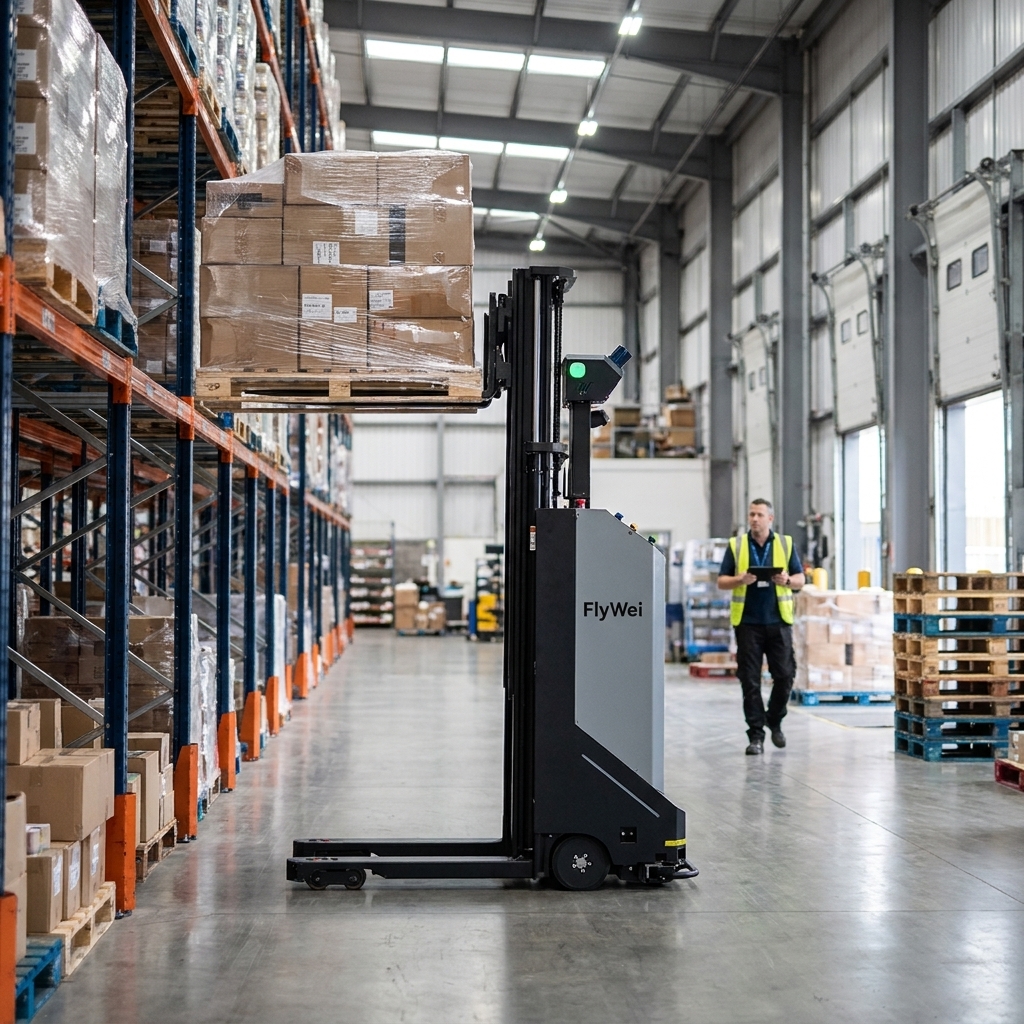
Phased warehouse automation is the practice of adding autonomous forklifts and AMRs to a working warehouse one zone or one shift at a time, using the racking, floor and systems already in place, so a full rebuild is not a prerequisite. The safety argument for moving that traffic away from people is blunt: the Health and Safety Executive recorded 24 workers killed after being struck by a moving vehicle in 2025/26, provisional figures published alongside 126 work-related deaths in total. For a warehouse manager running a 3PL contract site of more than 100,000 sq ft near Magna Park or DIRFT, the rebuild conversation is academic this quarter. The racking is full, the customer's volumes are committed through the January returns peak, and the only quiet window is a Sunday night. The real question is whether robots can be introduced into a building that cannot stop.
Why buyers assume automation means a rebuild
The assumption is manufactured, not irrational. Most published automation stories are greenfield: a new shed, a new floor poured to tolerance, racking specified around the machines from day one. Those are the projects that reach conference stages, so the model a UK warehouse manager inherits is a building designed around robots rather than robots fitted around a building.
Capital approval reinforces it. A committee that meets quarterly prefers one large, defensible number to five small ones, so proposals get bundled upwards until the scheme needs a shutdown, at which point it is too large to approve.
UK conditions sharpen the problem. Much of contract logistics operates from buildings leased on terms shorter than the payback a vendor quotes. A 3PL holding a three-year or five-year client contract cannot sign off a ten-year capital scheme against a building it may not occupy, and the client will not underwrite it either. Logistics UK, which represents operators across road, rail, sea and air, tracks the cost and labour pressure making the business case urgent and the capital case impossible.
Physical legacy matters too. Floors laid before TR34 flatness classifications were routinely specified can be uneven enough to limit high-bay work, and aisle widths set for a counterbalanced truck in 2004 constrain what reaches the top beam today. None of that blocks automation. It means the first phase is chosen around what the building already supports.
Lever 1: automate one flow, not one building
The operational lever is scope discipline. A phase should be a single flow with a fixed origin, a fixed destination and enough repetition to be worth a machine: dock-to-stock put-away, trunking full pallets to marshalling lanes, or the overnight replenishment run that eats a driver's whole shift. Rank candidates by moves per shift and travel distance, then take the dullest one.
Set the baseline before anything arrives: moves per hour, average travel distance, queueing time at the dock and the proportion of pallets rejected for condition. Without those four numbers the phase cannot be judged, and an unjudged phase never gets a successor. Run it for six to eight weeks alongside manual trucks under agreed mixed-traffic rules, rather than fencing the robots into a private corridor.
Keep the exit cheap. Phase one should be reversible within a shift, so that if volumes move the work returns to manual handling with no stranded infrastructure. That is what makes phase two a decision rather than an argument.
Lever 2: let a fleet manager take work from the systems you already run
The technical lever is the layer between your warehouse system and the vehicles. Autonomous forklifts do not connect to an ERP directly. A fleet manager such as M4 sits in between, taking tasks from the system that already decides what needs moving and converting each into routes, traffic rules and vehicle assignments. Completions are written back, so your existing system remains the record of stock.
No API is not a blocker. A scheduled export of open work and an import of confirmations is often enough to begin, with middleware handling translation, retries and duplicate suppression. It avoids modifying a core system mid-contract. Our ERP integration services page sets out how that seam is scoped and who owns each side.
Insist on an open standard underneath. VDA 5050 lets one fleet manager issue orders to vehicles from different manufacturers using the same message format, which keeps a later phase from becoming a fresh integration project. Decide in phase one how long the fleet layer runs detached if the network drops. That answer matters more at peak than any brochure throughput figure.
Lever 3: build the safety case zone by zone under PUWER and ISO 3691-4
The regulatory lever is the one that most rewards phasing. Autonomous industrial trucks are work equipment, so the Provision and Use of Work Equipment Regulations 1998 apply to them exactly as they apply to a manual truck: suitable for the task, properly maintained, used by trained people, inspected on a schedule you can evidence. ISO 3691-4 then sets the safety requirements specific to driverless industrial trucks and their systems, covering protective fields, speed in shared areas and the behaviour expected at blind corners.
A site-wide switch forces one enormous risk assessment covering every aisle, pedestrian route and door. Zone-by-zone produces a small assessment per phase, each testable and signed off by the people who work that zone. HSE guidance on lift truck management, training and thorough examination remains the reference point, because autonomy changes who is driving, not whether the duties exist.
Practical sequence: mark the zone, agree pedestrian crossing points, set scanner fields and speed limits for the actual aisle widths, brief every shift including agency staff, then run a supervised fortnight. Record the assessment against the phase rather than the site, so phase two inherits a template.
Lever 4: stage the funding the way you stage the robots
The commercial lever closes the gap between a building you lease and machines you were asked to buy. Funding a phase on a term matching the contract it serves keeps the approval small and the risk proportionate: a three-year, five-year or seven-year autonomous forklift leasing term sized to one flow survives a quarterly committee that would reject a site-wide capital request outright.
Price each phase as its own line: vehicles, integration scope, safety work, training and support after go-live. Bundled numbers hide which part is actually expensive, and integration is costed separately because it depends on how your system exposes work, not on how many trucks arrive. Ask for phase two to be quoted at the same time, so you know the marginal cost of widening before you start.
| Phase | Typical scope | What must be true before you start | Typical elapsed time | What it proves |
|---|---|---|---|---|
| 1. Single flow | One repetitive route, two to four vehicles, one shift | Locations uniquely identified, pallet quality consistent | 8 to 12 weeks | The building tolerates autonomy without stopping |
| 2. Shift extension | Same flow across nights and weekends | Charging strategy agreed, out-of-hours escalation named | 4 to 6 weeks | Utilisation, not headcount, drives the payback |
| 3. Adjacent flow | Second route on the same fleet manager | Confirmations posting cleanly, exceptions trusted | 6 to 10 weeks | The integration seam scales without rework |
| 4. Mixed fleet | Different vehicle classes on one control layer | Open standard in use, traffic rules set centrally | 8 to 12 weeks | Supplier choice stays open for later phases |
Phased warehouse automation is the practice of adding autonomous forklifts and AMRs to a working warehouse one zone or one shift at a time, using the racking, floor and systems already in place, so a full rebuild is not a prerequisite.
What FlyWei does here
FlyWei is an independent, vendor-neutral UK systems integrator of autonomous forklifts and AMRs, which is the position that makes phasing honest. Not being tied to one manufacturer's range means phase one is specified around the flow and the building rather than around whichever machine a single supplier sells. For a contract logistics site that usually means one pallet-truck or reach-truck class vehicle on the dullest route, not a fleet.
FlyWei starts with a survey of the aisles, floor and traffic patterns you actually have, then specifies the vehicle class, safety scheme and integration scope for phase one only. FlyWei autonomous forklifts run under the M4 fleet manager, with the robot dispatch software turning warehouse tasks into missions and writing completions back to the system you already use. Because the control layer speaks an open standard, a later phase can add a different vehicle class without a fresh integration.
FlyWei also writes the phase so it can be judged: baseline figures agreed before go-live, a review at six weeks, and a quoted marginal cost for the next flow. To compare funding routes first, read how robotics as a service is scoped for a UK forklift fleet, or browse warehouse robotics solutions by industry.
Frequently asked questions
Can a warehouse be automated while it keeps running?
Yes, and that is the normal case in UK contract logistics. Work is introduced one flow and one zone at a time, with manual trucks continuing around the automated route under agreed mixed-traffic rules. The constraint is commissioning access rather than downtime.
Do we have to change our racking to automate?
Usually not for the first phase. Vehicles are selected to suit existing aisle widths and beam heights, which is why a survey comes before a specification. Racking changes arise only when you want to reach heights the current configuration cannot support.
What if our warehouse system has no API?
File-based exchange works. A scheduled export of open work and an import of confirmations is often enough to start, with middleware handling translation, retries and duplicates. It needs clear timing rules, but it avoids modifying the core system during a live contract.
Which flow should be automated first?
The most repetitive one, not the most difficult. Look for a fixed origin, a fixed destination, a high count of moves per shift and consistent pallet quality. Dock-to-stock put-away and pick-face-to-marshalling trunking are the usual candidates.
How long does the first phase take?
Eight to twelve weeks to steady state once vehicles are on site, with integration rather than the vehicles setting the pace. Projects move fastest where locations are uniquely identified, stock balances are trusted and a test environment exists.
Can autonomous forklifts share aisles with manual trucks?
Yes, under a documented traffic scheme. ISO 3691-4 covers protective fields and speed behaviour for driverless trucks, and PUWER duties on training, maintenance and inspection apply to both fleets. Pedestrian routes are agreed per zone and briefed to every shift, including agency staff.
What happens to a phase if we lose the client contract?
This is why phases are funded on terms matched to contract tenure and phase one is kept reversible within a shift. Vehicles are not fixed infrastructure, so a flow can return to manual handling.
If adding capacity to a building that cannot stop is on your Q4 risk register, the next step is deliberately small.
Book a free 30-minute site survey and we will walk one flow with you, measure the aisles and say whether it is a sensible first phase or whether a different route pays back faster. Ranges and specifications are on the FlyWei autonomous forklifts page.
No obligation, and we reply within one business day.