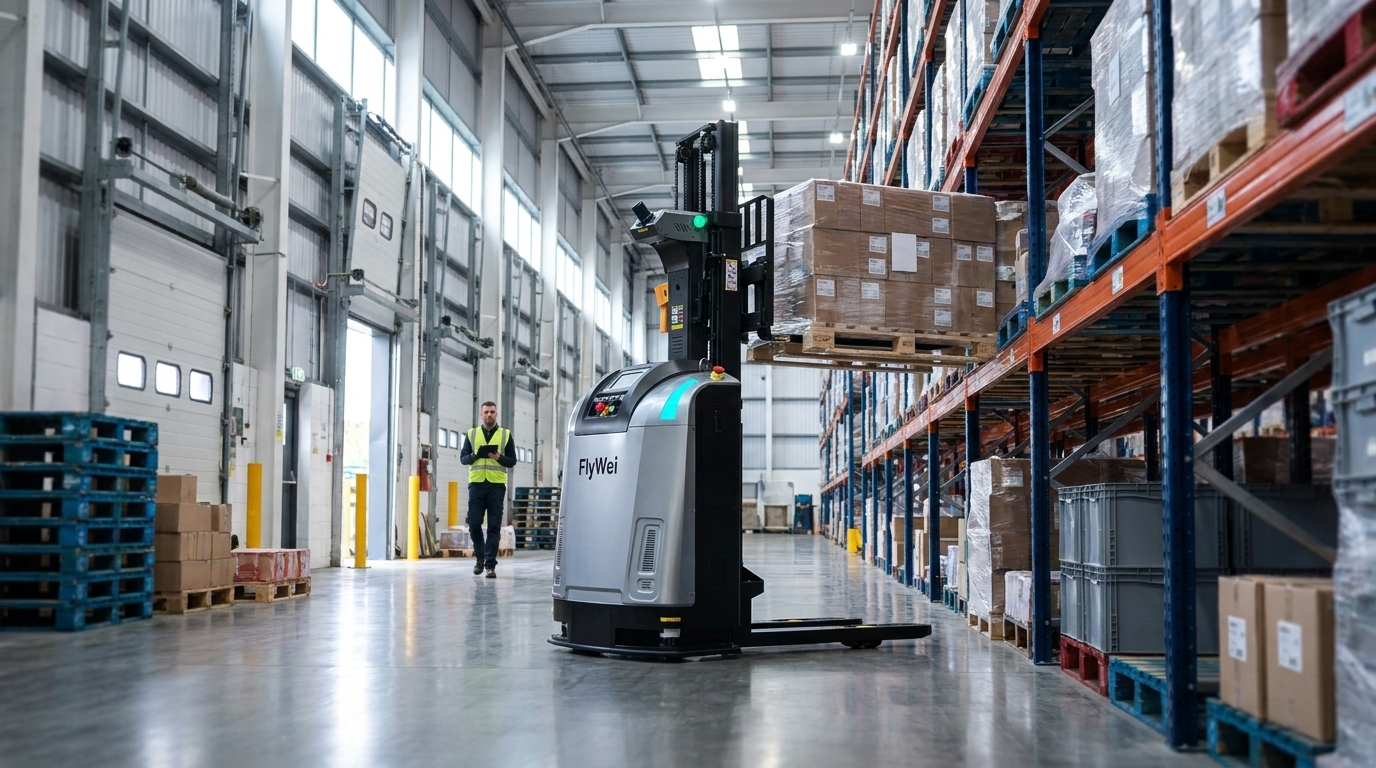
Real time stock accuracy with robots and an ERP is a product of move confirmations rather than of counting, because each completed robot move reports the load, the location it left and the location it reached, and your business system posts that as a stock movement. The operational case is hard to argue with in a sector that still sends people into live aisles to count. Transport and storage records 2,430 non-fatal injuries per 100,000 workers, an annual average for 2022/23 to 2024/25 published in the HSE industry injury statistics. For an operations director moving palletised drinks and kegs through a Burton-on-Trent depot, though, the pain this quarter is narrower than safety. Balances true up at a shift-end count, so the figure a customer service desk quotes at 14:00 was last correct at 06:00, and the gap is absorbed by overtime, by chasing pallets round the yard and by credit notes nobody budgeted for.
Why stock goes stale between counts
Most UK drinks depots did not choose a shift-end count. They inherited it. The pallet moves, a driver notes it on a sheet or scans at a fixed station, and the posting happens when someone gets round to it. In a chilled or duty-bonded area the lag is worse, because the operator wants to be out of the cold before keying anything. The result is a balance accurate at two points in the day and an estimate for the other twenty-two hours.
Kegs make it sharper. A palletised case load keeps one identity for its whole journey, while a keg stillage changes composition at every consolidation point, and the depot is reporting on returnable assets as well as saleable stock. By the time the count runs, the variance has several plausible causes and no evidence to separate them.
The second cause is organisational. Stock accuracy sits with the warehouse team, but the consequences land on customer service and transport planning. Nobody owns the lag itself, so it is managed with buffer stock and a rule that says do not promise anything on today's inbound. In a sector running seasonal peaks, that buffer ties up working capital exactly when it is scarcest. Logistics UK has pushed visibility of this kind up the agenda for operators of every size.
Lever one, make the move the posting event
The operational change is smaller than it sounds. Today a move generates a note that later becomes a posting. Under automation the move generates the posting. When a robot accepts a task it already knows the load it is collecting, the location it is collecting from and the location it is delivering to, because it cannot execute without them. The task completion message therefore carries everything your business system needs to post a movement.
Start by mapping the three fields end to end before any vehicle arrives on site. Agree how a load is identified, whether by pallet licence plate, SSCC label or keg stillage reference. Agree that every location the robots touch has a unique code, including floor-stacked bays and the marshalling lanes most systems treat as one blob. Where a location is really a zone, decide whether the robot reports the zone or a sub-location. Projects stall here far more often than they stall on vehicles.
Lever two, one confirmation contract above the fleet
Technically the pattern is a layered one. Your warehouse system decides what work is needed. A fleet management layer turns each task into routes, traffic rules and vehicle assignments. The vehicles report position, load state and task status upward. The M4 fleet manager sits in that middle layer, and under it the VDA 5050 open standard carries order and state messages between the fleet manager and vehicles from more than one manufacturer.
What matters for stock accuracy is that your business system sees one confirmation contract, not one per vehicle type. Define a single message shape carrying load, source, destination, timestamp, outcome and a unique message reference, and make the fleet layer responsible for producing it however the vehicle below happens to speak. That unique reference prevents a double posting when a link drops and queued confirmations replay, the failure mode covered in what happens if the network fails during robot operation. Insist on idempotent posting from day one.
Lever three, make failure louder than success
A fleet that posts only its successes will make your stock worse, not better, because the successes arrive fast and the failures arrive never. Three outcomes need explicit handling. A move that completes posts a movement. A move that is cancelled before collection posts nothing and clears the reservation. A move that is abandoned mid-journey, with a load on the forks or under the chassis, posts the load to a quarantine location and raises an exception on a named queue with a person attached to it.
That third case is the one operators forget. A pallet physically on a robot in an aisle but still recorded in its origin bay is a phantom, and phantoms destroy confidence in an automated balance. Agree the quarantine location, the alert route and the target response time before go-live, and review the exception log weekly for the first quarter. Exceptions near zero in week one usually means they are being swallowed.
Lever four, the regulatory and audit layer
Automation does not relieve you of the duties you already hold. Under the Provision and Use of Work Equipment Regulations 1998 the equipment must be suitable, inspected and used by trained people, and HSE guidance on PUWER applies to an autonomous truck exactly as it applies to a manned one. ISO 3691-4 is the reference standard for driverless industrial trucks and their safety functions, and BSI publishes the British adoption that UK duty holders are generally assessed against.
There is an audit benefit hiding in this. A move-confirmed record is a timestamped chain of custody for every pallet and stillage, which is more evidence than a shift-end count ever produced. For an operator handling duty-suspended stock that is worth having on its own terms, provided the log is immutable and retained. Decide retention periods with finance and compliance before the first move is posted, not after a query lands.
| Measure | Shift-end count | Move-confirmed | What changes for the operations director |
|---|---|---|---|
| Balance is correct | Twice a day | Continuously | Customer service quotes live stock instead of a morning snapshot |
| Counting labour | Planned hours every shift | Cycle counts on exception only | Hours move from counting to despatch cover at peak |
| Variance investigation | After the fact, no evidence trail | At the failed move, with a timestamp | Root cause in minutes rather than a next-day hunt |
| People in live aisles | Counters among moving equipment | Supervision from marked zones | Fewer interactions to assess under PUWER |
| Buffer stock held | Sized for the lag | Sized for real demand variability | Working capital released ahead of seasonal peak |
Real time stock accuracy with robots and an ERP comes from move confirmations, so balances update as pallets move rather than at a shift-end count.
What FlyWei does here
FlyWei is an independent, vendor-neutral UK systems integrator of autonomous forklifts and AMRs. We are not an OEM and not a reseller, so the machine selection follows the flow rather than a catalogue. In a drinks depot that usually means FlyWei autonomous forklifts in counterbalanced and reach-truck classes for palletised case stock and high-bay put-away, with a stacker class covering mid-height replenishment to the pick face.
Above the vehicles, the M4 fleet manager holds traffic rules, charging strategy and task assignment, and produces the single confirmation contract described above. The robot dispatch software carries the business rules deciding which work is released and in what order, so a late trunker can change priority without anyone touching a vehicle.
The integration work is where stock accuracy is won or lost, and our ERP and WMS integration service starts with the data rather than the robots. We map load identity and location codes, agree the exception and quarantine design, define idempotent posting, and test against your real order and stock data before a vehicle is commissioned. Where a system cannot expose work through a live interface, a scheduled export and import with middleware handling translation and retries is a legitimate first step. The aim is the same either way. Your existing system stays the record of truth, fed by moves instead of by counts.
Frequently asked questions
Does real time stock mean we can stop cycle counting altogether?
No, and you should not want to. Move confirmations remove the routine shift-end count, but a sampling regime still catches events the robots never see, such as damage, mis-labelling at goods-in or a load moved by hand. Cycle counting becomes a targeted audit driven by exceptions rather than a scheduled labour cost.
What if our system can only accept a file, not a live message?
File-based exchange still works. A scheduled export of open work and an import of confirmations is often enough to begin, with middleware handling translation, retries and duplicates. Balances then update on the import cycle rather than instantly, so choose an interval the business can live with. It avoids modifying the core system, which is often the deciding factor.
Who owns the stock balance once robots are posting movements?
Your warehouse or business system does, without exception. The fleet layer reports events and holds no parallel balance. Any design where the fleet keeps its own authoritative stock record will eventually disagree with finance, and reconciling two authoritative records is worse than the problem you set out to solve. See do I need to replace my WMS to use AMRs.
How do we stop duplicate postings when the link drops?
Give every confirmation a unique reference generated by the fleet layer and have the receiving system reject a reference it has already processed. This is idempotent posting, and it is the most valuable single line in the interface document. Without it, a replay after reconnection posts the same keg movement twice.
Can mixed-manufacturer fleets still give one clean stock feed?
Yes, provided the fleet manager normalises their messages. VDA 5050 standardises order and state exchange between a fleet manager and vehicles from different suppliers, and the fleet manager then emits one confirmation shape upward. That is what keeps your integration cost flat as the fleet grows.
What data should we actually exchange, and what should stay in the fleet layer?
Exchange task requests inbound and acceptance, progress, completion, exceptions and load confirmations outbound. Keep battery state, fault codes and detailed telemetry in the fleet layer and summarise it for reporting. Pushing telemetry into a business system creates volume without decisions.
How long before the balance is trustworthy enough to quote from?
Plan on a parallel run. Keep the existing count for the first few weeks while the move-confirmed balance builds alongside it, compare daily, and investigate every divergence. Most teams quote from the live balance once a week of parallel running produces no unexplained variance.
If a stock balance that is only correct twice a day is on your Q4 risk register, the fastest way to size the fix is to look at the flow rather than the fleet.
Book a free 30-minute site survey and we will walk your highest-volume pallet and keg flows, identify which moves can become posting events first, and show you where the M4 fleet manager would sit above your existing systems.
No obligation, and we reply within one business day.