Warehouse readiness for robot to ERP integration is mostly a data question rather than a robot question: it means unique location identifiers, stock balances your team actually trusts, and a business system able to expose open work and accept confirmations back. Everything else is commissioning. The physical risk the project is meant to remove is real, because handling, lifting or carrying still caused 17 per cent of the 59,219 employee injuries employers reported under RIDDOR in 2024/25, according to HSE. The trap is automating on top of weak master data, which multiplies errors rather than removing them. For an operations director in engineering and heavy industrial parts, that trap is familiar: serialised castings and machined components sit in bays created years ago by a shift supervisor, one bay holds several part numbers, and the ERP shows a quantity nobody will stand behind at quarter end. Robots cannot interpret that. They will move exactly what they are told to move.
Why readiness fails in heavy industrial parts warehousing
Engineering and heavy parts operations rarely fail a robot project on the shop floor. They fail it in the master data, which grew to serve people who could compensate for it. A picker who has worked the aisle for nine years knows that bay J14 really means the floor space in front of it, and that the quantity on screen is roughly right until the stock check. None of that knowledge is written down, and none of it transfers.
Three failure patterns recur. The first is location identity: bays are numbered but floor buffers, staging lanes and marshalling areas are not, so many robot moves have no destination they can be given. The second is balance trust, where cycle counting has lapsed and the ERP quantity is treated as advisory. The third is interface silence: the system knows what work exists but has no documented way to publish it.
The regulatory layer compounds it. Once a vehicle moves without a rider, the duty under PUWER to provide suitable work equipment and control risks from mobile plant must be evidenced for a flow with no human making judgement calls in the aisle. Sites that treat that as a go-live task lose weeks, and the same applies to pedestrian segregation, which HSE guidance on rider-operated lift trucks expects to be designed rather than signposted.
Lever 1: Give every location a unique identity and a single owner
The operational lever is dull and decisive. Walk the flow you intend to automate and list every place a load can legitimately rest: racking beams, floor buffers, staging lanes, inspection benches, the quarantine cage, outbound marshalling. Each gets a unique identifier that exists in the ERP and is readable in the aisle. Where a buffer is defined by custom rather than a label, that is new master data, not a mapping exercise. Give the list one named owner, usually a warehouse team leader rather than an IT analyst: the person who can say whether a lane is real is the one who stands in it. Then audit it: pick twenty loads at random across a shift and check that system and physical location agree without anyone explaining the discrepancy. If you cannot reach the high nineties on that sample, remediation is the project for now. A robot will not discover the exception. It drives to the identifier it was given.
Lever 2: Prove your system can hand out work and take confirmations back
This lever tests the interface rather than the vehicle. A task a robot can execute needs five fields filled from existing data without human interpretation: what to move, from where, to where, by when, and at what priority. Sit with an analyst and try to populate those five fields for one real flow, using only what the business system already holds. Most sites find one field missing, and that discovery is worth more than a trial. Then test the return path, because confirmations are where stock accuracy is won or lost. Each completed move must post a stock movement naming the load, origin and destination, and each failed move must raise an exception rather than disappear quietly. Without a live interface, a scheduled export of open work and an import of confirmations is a legitimate start, as covered in our guide to integrating robots when your system has no API. It is slower and needs explicit timing rules, but it avoids modifying a core system.
Lever 3: Put a fleet layer and an open standard between the ERP and the vehicles
The technical lever is architectural. Robots do not connect to an ERP directly, and any supplier offering that should be asked what happens at phase two. A fleet management layer sits between the two: it takes task requests over a documented interface, decides which vehicle takes which mission, holds traffic rules and charging strategy, and returns acceptance, progress, completion and exception messages. The M4 fleet manager plays that role in a FlyWei build, and the robot dispatch software carries the business rules deciding which work is released and in what order. Your ERP never issues a path, a speed or a mast movement, so it is never coupled to a vehicle generation. Below the fleet layer, insist on VDA 5050, the vendor-neutral open standard letting vehicles take missions from one fleet manager without a bespoke interface for each. That is what keeps phase two competitive. Our explainer on whether you need to replace your WMS to use AMRs sets out the same boundary from the warehouse system side.
Lever 4: Close the regulatory gap during scoping, not at go live
The regulatory lever is the one that slips. Under the Provision and Use of Work Equipment Regulations 1998, equipment must be suitable for its purpose and risks from mobile work equipment must be controlled, and that assessment changes materially when the operator leaves the seat. Three documents should exist before any vehicle arrives. A traffic management and segregation plan showing where robots and pedestrians share space and what physically prevents a conflict. A PUWER suitability assessment covering the vehicle, the load and the floor, including joint condition and flatness, usually the real constraint in heavy parts buildings. And a safety case referencing ISO 3691-4, the international standard for driverless industrial trucks, published in the UK through BSI as a BS EN standard alongside BS EN 1175 for electrical requirements. Agree in writing who owns each. Insurers increasingly ask for the segregation plan before confirming cover, as Logistics UK members report at renewal.
| Readiness gate | Ready | Blocks go live | Who owns it |
|---|---|---|---|
| Location identity | Every rack, buffer, lane and bench has a unique ID and an aisle label | Buffers defined by custom, reused bay codes | Warehouse team leader |
| Balance trust | Random load sample matches the system without explanation | Quantities advisory until stock check | Inventory controller |
| Work publication | Open work exposed via a documented interface or scheduled export | Work lives on a printed list | ERP or systems owner |
| Confirmation path | Completions post stock movements, failures raise exceptions | Silent failures, no exception owner | Operations and systems |
| Traffic and segregation | Plan drawn, physical controls specified, routes fixed | Segregation by signage and habit | Health and safety lead |
| Equipment suitability | PUWER assessment covers vehicle, load and floor | Floor flatness unmeasured | Engineering manager |
Warehouse readiness for robot to ERP integration is mostly a data question rather than a robot question: unique location identifiers, trusted stock balances, and a business system able to expose open work and accept confirmations.
What FlyWei does here
FlyWei, the UK partner of SEER Robotics, supplies, installs and supports autonomous forklifts, AMRs and lifting robots, and connects them to the ERP or WMS an engineering site already runs. For an operations director weighing readiness, the first piece of work is not vehicle selection. It is a written assessment of the flow: which locations need identity, which balances need rebuilding, and what the existing system can publish today. That assessment produces a scope with visible line items, so integration is not an afterthought attached to a machine order.
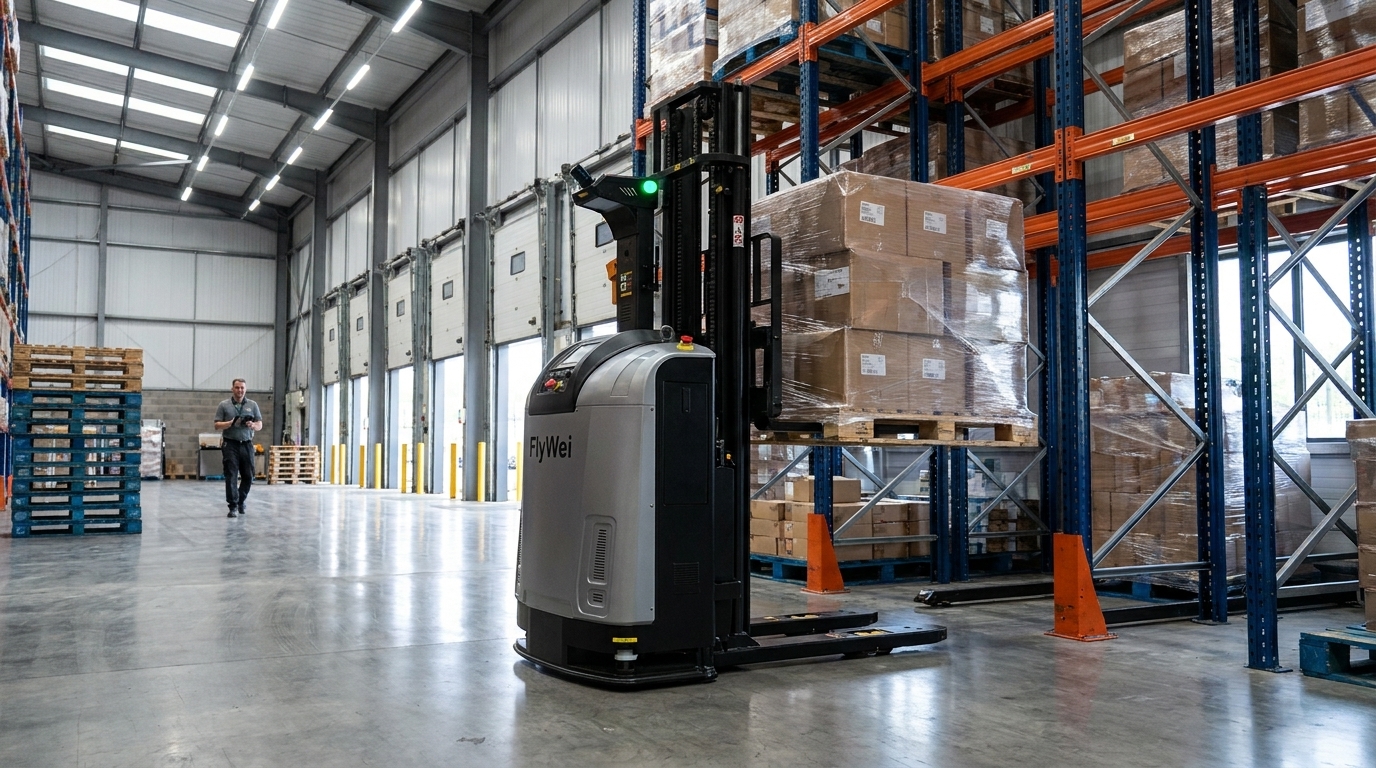
Where the flow is ready, the vehicle follows the move, not a catalogue. Palletised castings moving between goods-in and machining cells usually suit FlyWei autonomous forklifts in counterbalanced or reach truck classes, while sub-assembly trolleys feeding a line suit a heavy-lift or tugger class from the lifting robot range. All take missions from the M4 fleet manager, which holds the traffic rules and the single interface to your business systems.
FlyWei designs that interface, builds the mapping for locations, loads and exceptions, and specifies the warehouse robot ERP integration scope in the open: who builds each side, what the test environment contains, how exceptions reach your team, and what post go-live support covers. Your teams keep one record of stock, and the robots report into it.
Frequently asked questions
Is our warehouse ready to connect robots to our ERP?
Readiness is mostly a data question. Locations must be uniquely identified, stock balances trusted, and the existing system able to expose open work and accept confirmations. Where master data is unreliable, automating on top of it multiplies errors rather than removing them, so fix the data first.
What is the minimum data quality we need before starting?
A practical bar is that a random sample of loads across one shift matches the system location without anyone explaining a discrepancy, and that every resting place for a load has a unique identifier. Below that, remediation is the project.
Do we have to replace our ERP or WMS?
Usually not. An orchestration layer sits above the existing system and takes work from it, so that system stays the source of truth. Replacement is only worth considering where it cannot expose work at all, and middleware is normally the lighter route even then.
What if our ERP has no API at all?
File-based exchange still works. A scheduled export of open work and an import of confirmations is often enough to begin, with middleware handling translation, retries and duplicate suppression. It needs clear timing rules.
Who should own readiness inside our business?
Split it. A warehouse team leader owns location identity, an inventory controller owns balance trust, the systems owner owns what can be published, and the health and safety lead owns traffic and segregation. One named owner per gate makes the self-check resolvable.
How do we test readiness without committing to a full project?
Take one repeatable flow and try to fill five fields from existing data alone: what to move, from where, to where, by when, and at what priority. If a person must interpret any field, you have found the remediation work.
What regulatory work has to happen before go live?
A traffic management and segregation plan, a PUWER suitability assessment covering vehicle, load and floor, and a safety case referencing ISO 3691-4 for driverless industrial trucks. Agree in writing who writes each one during scoping.
If unreliable location and stock data sits on your Q4 risk register as the thing blocking an automation business case, the fastest way to resolve it is to walk the flow with someone.
Book a free 30-minute site survey and we will produce a written readiness view of one flow: the locations needing identity, the balances needing rebuild, and what your system can publish today. If the flow is ready, we will show which autonomous forklift class fits the move.
No obligation. We reply within one business day.