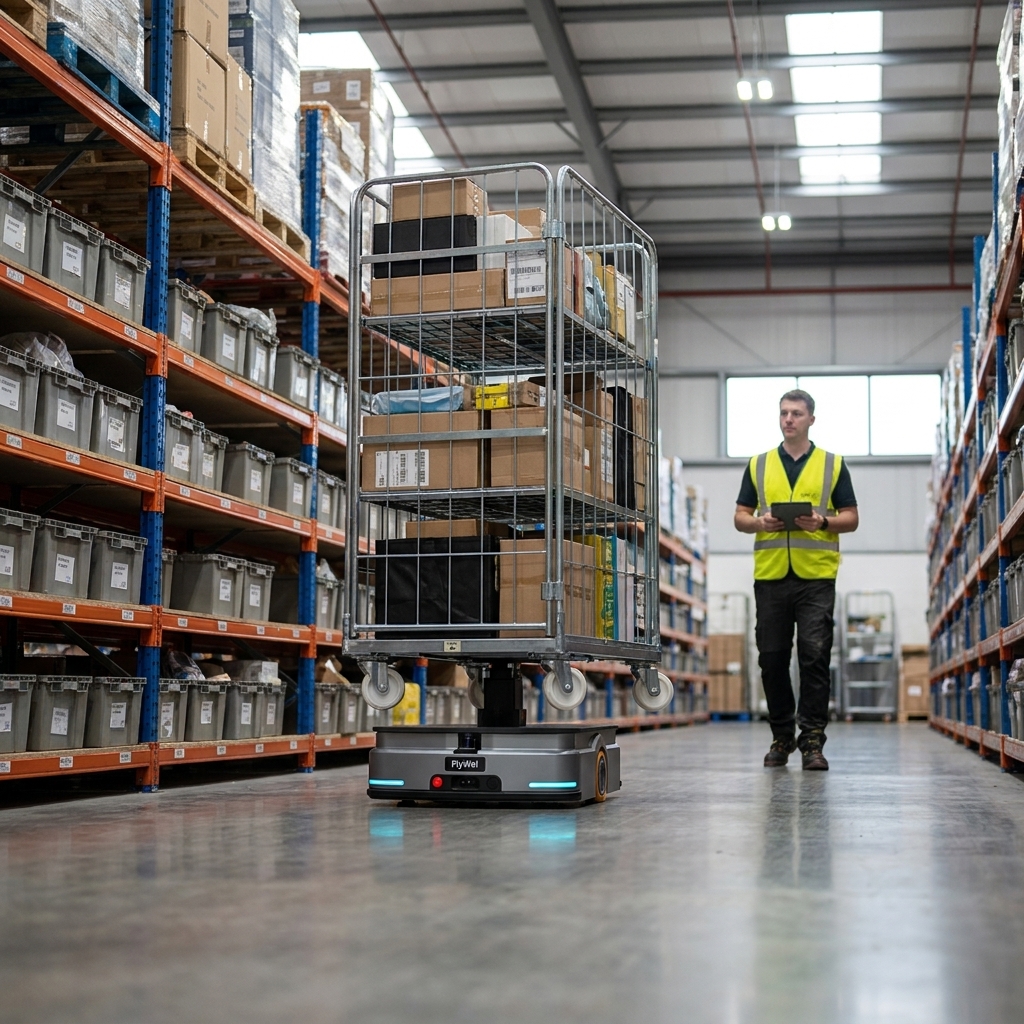
A lifting robot is an autonomous mobile robot that raises a load — a tote stack, a roll cage, a wheeled trolley — a short distance clear of the floor and carries it between two fixed points, with no person pushing, pulling or taking the weight at either end. The scale of what that removes is not marginal: 511,000 workers in Great Britain suffered a work-related musculoskeletal disorder in 2024/25, part of 40.1 million working days lost to work-related ill health and injury, according to headline figures published by the Health and Safety Executive. For an operations director in e-commerce fulfilment, that number arrives with a date attached. Volumes climb from late October, headcount is topped up with agency staff, and the cages shuttling between pick faces, packing benches and despatch get heavier as order profiles shift. The absence booked in week three of peak was usually created in week one, by a manual move nobody costed.
Why the manual move layer breaks first
Most UK fulfilment sites automated the visible thing. Conveyor, sortation and put-to-light all got budget because their benefit was countable. The layer that never got automated sits between those islands: a person walking a roll cage from a pick face to a packing bench, a trolley of returns dragged to a re-work bay, totes lifted from a floor-level stillage to waist height. Each move is individually trivial. Repeated four hundred times a shift across a mezzanine at Magna Park or SEGRO East Midlands Gateway, it becomes the largest consumer of labour hours on site and the largest single source of injury risk.
Three UK-specific factors compound it. First, the labour pool: big-box e-commerce clusters around Daventry, DIRFT and the M1 corridor draw from the same agency supply, so the marginal peak worker is newer, less conditioned and more likely to be handling a loaded cage on their fourth shift. Second, the duty is not discretionary. The Manual Handling Operations Regulations 1992 require employers to avoid hazardous manual handling so far as is reasonably practicable, then assess and reduce what cannot be avoided — and "we hired more people" is not an avoidance measure. Third, order profiles are getting worse: multi-item baskets and bulkier consumables push average cage weight up in exactly the weeks when the workforce is least experienced.
The result is a cost that hides in two places your weekly review does not connect — agency spend, which looks like a volume problem, and absence, which looks like an HR problem. They are the same problem, and it is a materials handling one.
511,000 workers in Great Britain suffered a work-related musculoskeletal disorder in 2024/25, part of 40.1 million working days lost to work-related ill health and injury.
The four levers that fix it
Below is the shape of a realistic programme. The table is blunt about effort, because the lever that fails most peak projects is not the technology — it is the one that needed a decision in July.
| Lever | What it actually changes | Effort before go-live | First measurable effect |
|---|---|---|---|
| 1. Redesign the move | Removes moves entirely; shortens the rest | 2–3 weeks of observation, no capital | Walked distance per operative per shift |
| 2. One fleet layer | Mixed machines take work from one queue | Integration scoping with your WMS owner | Idle time and deadheading across the fleet |
| 3. Compliance file from day one | Turns sign-off from a gate into a formality | Runs in parallel; costs calendar, not cash | Go-live date holding as planned |
| 4. Monthly cost structure | Payment matches an eleven-week demand curve | One capex committee paper avoided | Cash position through Q4 |
Lever 1 — Redesign the move before you specify the robot
Spend three weeks counting before you spend anything else. Stand on the mezzanine and record, for each repeated move, the origin, the destination, the mass, the frequency per shift and who does it. You will nearly always find that two or three flows account for most of the handling exposure, and that at least one of them exists only because a bench was positioned badly in 2019. Fix those by moving furniture; they cost nothing to remove and they distort any business case built on them. What survives that cull is your actual automation scope. Specify against it in plain operational language — mass, cycle time, floor condition, aisle width, hours of coverage — and hold that specification when suppliers want to widen it. An operations director who arrives at procurement with three flows, measured, is in a far stronger position than one who arrives with a vision.
Lever 2 — Put one fleet layer over every machine on the floor
The failure mode in mixed estates is not robots colliding. It is robots idling while another machine type queues, because each has its own scheduler and neither can see the other's work. Insist on a single orchestration layer that takes work from your existing warehouse system and assigns it across every machine on site, whoever built them. That is what the M4 fleet manager is for: one queue, one traffic model, one view of utilisation. Where machines come from different manufacturers, VDA 5050 — the open MQTT-and-JSON command standard for mobile robot fleets — is what makes that credible rather than aspirational, because it removes the need for a bespoke interface per supplier. Below the fleet layer, RDS robot dispatch handles the exception traffic that eats supervisor time: a blocked aisle, a cage presented off-square, a charge window colliding with a wave. Ask any supplier how long their fleet layer keeps running if the link to your warehouse system drops. The answer tells you more than any throughput figure.
Lever 3 — Build the PUWER and ISO 3691-4 file on day one
Automation changes who is exposed; it does not remove the duty holder. A lifting robot is work equipment, so PUWER 1998 applies in full: suitable for the task, maintained, inspected, and used only by people trained and found competent. ISO 3691-4 governs driverless industrial trucks and their systems, and it is the document your insurer and your safety committee will ask for by name. Alongside it you need a revised assessment under the Manual Handling Operations Regulations 1992 showing what the robot has removed, and a traffic plan under HSE workplace transport guidance covering how pedestrians and machines share a mezzanine during a peak shift with double the normal footfall. None of this is difficult. It is only fatal when it starts in week ten of a twelve-week project, which is how a November go-live becomes a February one.
Lever 4 — Size for the peak you actually get, and pay for it monthly
Peak demand is a curve, not a plateau. Sizing a permanent fleet against your worst Tuesday in November buys machines that idle for nine months; sizing against your annual average leaves you hiring agency staff in exactly the weeks the robots were meant to cover. The workable answer is a core fleet sized to steady-state flow, with additional units brought in for the peak window under a term that ends when the curve does. Structuring that as an operating cost rather than capital expenditure also changes who signs. Fixed-term leasing over three, five or seven years — robots, fleet software, maintenance and UK support in one monthly rate — turns a capex committee paper into a line an operations director can defend on their own budget. Model it honestly: monthly rate against agency hours displaced, absence days avoided and overtime you currently treat as unavoidable.
What FlyWei does here
FlyWei is an independent UK systems integrator of autonomous forklifts and mobile robots. Vendor neutrality matters most here, because an e-commerce mezzanine rarely needs one machine type. FlyWei specifies lifting robots for the cage and trolley flows — latent-jacking units that drive beneath a wheeled cage, raise it clear of the floor and take it to the packing bench or despatch lane untouched — and brings in heavier jacking units where bulk loads exceed what a base platform will carry. Where the same site also has pallet moves feeding the pick face, FlyWei integrates autonomous forklifts into the same estate rather than running a separate project; that approach is set out in our guide to planning autonomous forklifts for e-commerce peak. Every machine takes work from M4, so utilisation is measured across the whole fleet rather than per supplier. FlyWei engineers are UK-based, commission on site, and write the PUWER and ISO 3691-4 documentation as part of delivery. The same pattern applied to heavy manual handling elsewhere is covered in our lifting robot guide for UK drinks logistics.
Frequently asked questions
What is a lifting robot?
A lifting robot is an autonomous mobile robot that raises a load clear of the floor and moves it between two points without a person taking the weight. In e-commerce fulfilment most are latent-jacking units that drive beneath a wheeled cage, lift it a few centimetres and carry it.
How is a lifting robot different from an autonomous forklift?
Payload geometry, mainly. A lifting robot handles carts, cages, totes and trolleys at low height. An autonomous forklift handles palletised loads and places them into racking, often to height. Many sites need both, which is why running them under one fleet manager matters more than choosing.
Can a lifting robot work on a mezzanine?
Usually, but it is a structural question before a robotics one. Confirm floor loading for the combined mass of robot and load, a surface flat enough for reliable navigation, and a traffic plan for how machines and pedestrians share the deck at peak footfall — all during survey.
Do we need to replace our warehouse system to deploy lifting robots?
Rarely. A fleet layer sits above your existing system and takes work from it, so that system stays the record of stock. Replacement is only worth discussing where nothing can be exposed through a documented interface or a scheduled export, and even then middleware is usually cheaper.
Does automating a move remove our manual handling duty?
No — it changes what the assessment says. The Manual Handling Operations Regulations 1992 require hazardous handling to be avoided so far as is reasonably practicable, and a robot is how you demonstrate avoidance. PUWER duties then apply to the robot as work equipment.
How long does a lifting robot deployment take before peak?
For a single scoped flow, plan twelve weeks from survey to live running. Commissioning is rarely the long pole; integration scoping, safety documentation and operator training are. If you are reading this in late September with a November peak, scope one flow rather than three.
Is leasing or buying better for peak capacity?
Leasing usually fits better, because peak capacity earns its keep for only a fraction of the year. A fixed-term lease covering robots, fleet software, maintenance and support in one monthly rate keeps the decision inside an operational budget rather than a capital committee.
If manual handling exposure on the mezzanine is on your Q3 risk register and peak starts in six weeks, the cheapest thing you can do this month is measure the three flows that hurt most.
Book a free 30-minute site survey and a FlyWei engineer will walk your mezzanine, record the repeated moves and tell you which of them a robot should take — or see the range of FlyWei lifting robots first.
UK-based engineers. No obligation. We reply within one business day.